Guadalajara Cathedral (Catedral de Guadalajara): The Complete Visitor Guide
The Catedral Basílica de la Asunción de María Santísima anchors Guadalajara's historic center, surrounded by four plazas and centuries of layered history. Its twin neo-Gothic spires are the city's most recognized silhouette, and entry is free. Here is everything you need to know before you go.
Quick Facts
- Location
- Av. Fray Antonio Alcalde 10, Zona Centro, Guadalajara, Jalisco
- Getting There
- Plaza Universidad metro station (SITEUR), approx. 3 blocks away
- Time Needed
- 30–60 minutes for self-guided visit; longer if attending Mass
- Cost
- Free admission (active place of worship)
- Best for
- Architecture enthusiasts, history lovers, first-time visitors to Guadalajara
- Official website
- http://www.arquidiocesisgdl.org/inicio.php
Why This Cathedral Matters
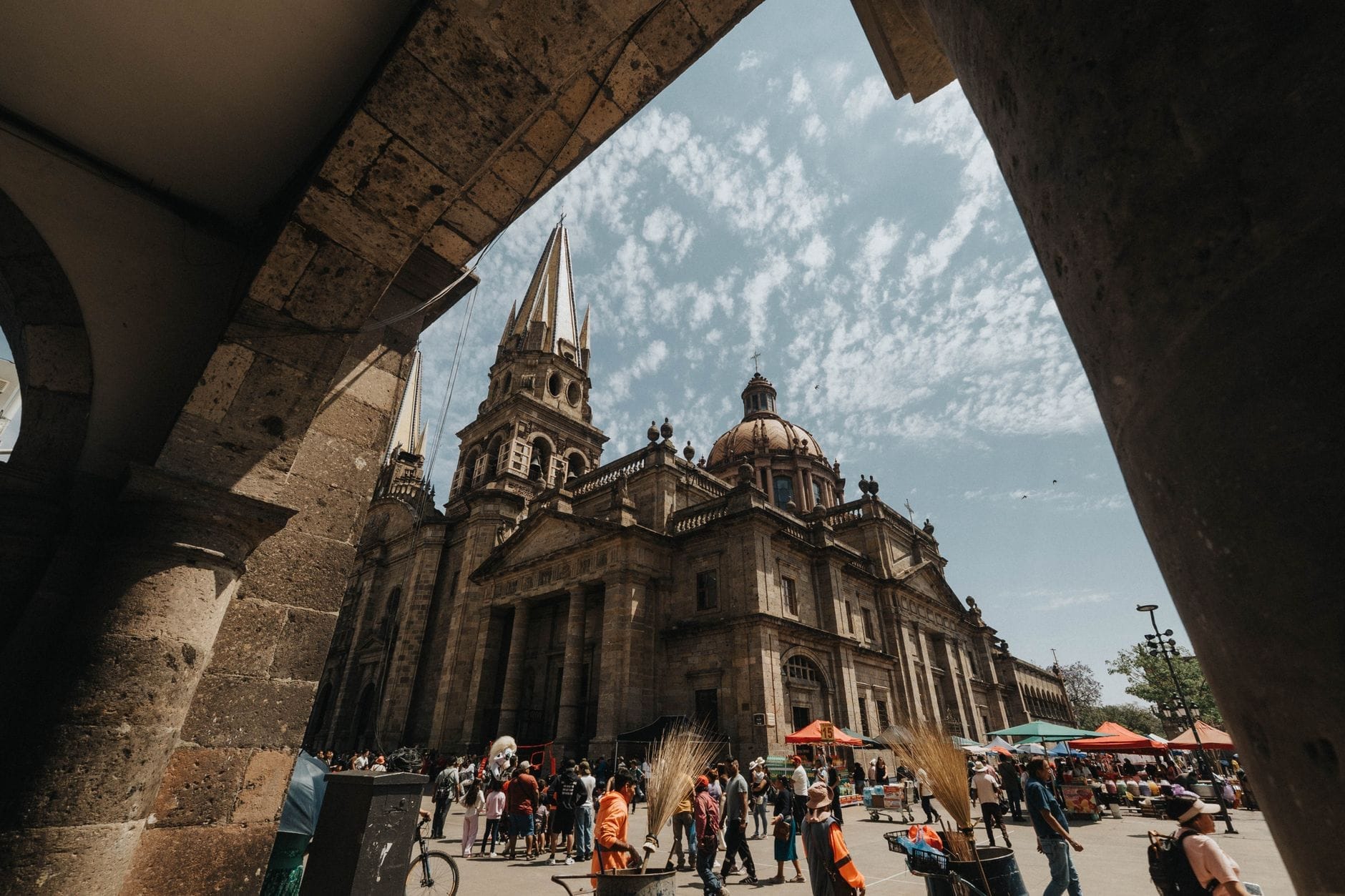
The Catedral Basílica de la Asunción de María Santísima, most commonly known as the Guadalajara Cathedral, is not merely the most photographed structure in Jalisco's capital. It is the physical and symbolic center around which the entire Centro Histórico was organized. Four plazas radiate from its flanks: Plaza de Armas to the south, Plaza de la Liberación to the east, Plaza Guadalajara to the west, and the Rotonda de los Jaliscienses Ilustres to the north. That arrangement is not incidental. It reflects centuries of deliberate urban planning in which the church sat literally at the crossroads of civic, religious, and commercial life.
What makes the cathedral visually distinct from most Mexican churches of comparable age is the mismatch in its architectural story. The main body reflects Spanish Renaissance construction from the late 16th and early 17th centuries, while the twin yellow spires piercing the sky above were not built until 1854, more than two centuries later. That gap in time produces a building that feels like an architectural argument with itself, and the tension is precisely what makes it worth examining closely.
💡 Local tip
Entry is completely free. The cathedral is an active parish church, so if you visit during a scheduled Mass, you are expected to observe silently or wait outside until the service concludes before exploring the interior.
A Brief History of the Building
The original church on this site was erected in 1541, barely a decade after the Spanish founded Guadalajara. That early structure was seriously damaged by fire in 1574. Construction of the current building began in 1561 and proceeded slowly alongside the city's colonial growth, with the main structure completed in 1618 under architect Martín Casillas. The cathedral was elevated to the status of Minor Basilica by Pope Pius XII, a designation that signals its importance within the Catholic hierarchy.
The towers you see today are not original. An 1818 earthquake destroyed the earlier towers and dome. The replacement neo-Gothic spires, designed by Manuel Gómez Ibarra, were completed in 1854. Their yellow-tiled surfaces catch the light differently depending on the hour, which is one of the reasons the building photographs so differently in the morning versus the afternoon. The spires have since become so associated with Guadalajara's identity that their silhouette appears in regional branding and has been reproduced on everything from embroidered textiles to ceramic tiles sold in the nearby craft markets.
Tickets & tours
Hand-picked options from our booking partner. Prices are indicative; availability and final rates are confirmed when you complete your booking.
Lake Chapala and Ajijic guided tour from Guadalajara
From 68 €Instant confirmationFree cancellationGuadalajara and Tlaquepaque guided tour
From 73 €Instant confirmationFree cancellation
What You See From the Outside
The cathedral's exterior rewards a slow circuit. Most visitors arrive from the south side, facing Plaza de Armas, which gives them the main facade with its ornate portal and the spires rising behind. That is the classic image. But walking around to the north side, facing the Rotonda de los Jaliscienses Ilustres, reveals a quieter, less-photographed perspective where the building's mass and scale become more apparent without the crowd.
The yellow ceramic tiles on the spires have a texture that catches the hand's attention if you pass close to the base. The facade stonework shows different erosion patterns depending on sun exposure, with the western face typically more weathered. In the early morning, when the sun rises over Plaza de la Liberación to the east, the front facade is in full shade and the light is softer, better for photography without harsh shadows. By late afternoon, the western side of the building glows. The four surrounding plazas, especially Plaza de Armas to the south, fill with families, street vendors, and calandrias (horse-drawn carriages) as the day cools.
Inside the Cathedral
The interior is long, high-ceilinged, and deliberately austere in its nave compared to the decorative richness of later Mexican Baroque churches. Three naves divide the floor plan, with the central one leading the eye toward the altar. The natural light enters primarily from windows along the side naves and from the area around the main altar, creating a gradual shift from dim entrance to illuminated sanctuary. In the mid-morning, the quality of light inside is particularly calm, and the sounds of the city outside become a low murmur.
Several works of art inside are worth noting. The cathedral contains a painting attributed to the school of Bartolomé Esteban Murillo, the Spanish Baroque master, although specific attribution details should be verified with current signage on-site, as curatorial descriptions can change. The side chapels contain altarpieces from different periods, and the variety in style reflects the cathedral's long construction and modification history across several centuries.
Dress codes apply. The cathedral is an active place of worship, and visitors are expected to have covered shoulders and avoid shorts or beachwear. A light scarf or jacket carried in a bag is a practical solution in warmer months. Photography inside is generally permitted, but using flash near ongoing services or at altarpieces is not appropriate, and common sense applies. Tripods are not practical in the space and are unlikely to be well-received.
⚠️ What to skip
Mass schedules mean the cathedral may be partially or fully inaccessible to casual visitors at certain hours. If you are visiting specifically to explore the interior artwork and architecture, arriving outside of scheduled Mass times (typically early morning on weekdays, or mid-week mid-morning) will give you the most uninterrupted access.
How the Experience Changes by Time of Day
Early morning, around 8:00 to 9:30, is the least crowded window. The surrounding plazas are quiet, the air at Guadalajara's 1,550-meter elevation carries a noticeable cool edge even in summer, and the cathedral feels more reflective than performative. This is when locals attending morning Mass outnumber tourists, and the atmosphere shifts accordingly.
Midday brings organized tour groups, school visits on weekdays, and the full street-vendor economy across the adjacent plazas. The cathedral itself stays cooler than the surrounding streets, which makes it a natural refuge during the warmer months of April through June when Guadalajara sees its highest temperatures, sometimes reaching 30 to 32 degrees Celsius. The noise level inside rises noticeably as visitor numbers increase.
Late afternoon, roughly from 17:00 onward, the plazas surrounding the cathedral become the most socially active. Families take evening walks, vendors set up near Plaza de la Liberación, and the cathedral's spires catch the western light at a golden angle. If you can make two visits, one in the morning for interior exploration and one in the early evening for exterior photography and the surrounding plaza atmosphere, you will see two distinctly different versions of the same place.
Getting There and Practical Logistics
The cathedral is directly accessible on foot from most of the historic center. The nearest SITEUR metro station is Plaza Universidad, approximately three blocks away. Uber, DiDi, and Cabify all operate in Guadalajara and will drop you directly adjacent to the building. Parking in the historic center is limited and congested, so arriving by transit or ride-hailing is significantly more practical than driving. If you are orienting yourself in the Centro Histórico for the first time, the spires serve as a reliable directional landmark from almost any point within the downtown area.
Opening hours are commonly listed as 8:00 to 20:00 daily, though some sources indicate 19:00 as the closing hour. These hours can shift on major religious feast days or during special events tied to the Archdiocese of Guadalajara. Verifying current hours locally before planning an evening visit is advisable.
The cathedral is described as wheelchair and stroller accessible, though the plazas surrounding it have cobblestone and uneven paving in sections that can be challenging for mobility aids. The main entrance and interior floor are smoother. Accessibility within the side chapels may vary.
The Cathedral in Context: What Surrounds It
The cathedral sits at the center of what is arguably the most concentrated square kilometer of civic architecture in western Mexico. To the east, across Plaza de la Liberación, stands the Teatro Degollado, a neoclassical theater that opened in 1866. To the south, Palacio de Gobierno de Jalisco faces Plaza de Armas and contains the famous José Clemente Orozco murals on its staircase, including the celebrated image of Hidalgo. Walking this circuit takes less than 20 minutes and provides a compressed survey of Guadalajara's architectural and political history.
To the north, the Rotonda de los Jaliscienses Ilustres honors notable figures from Jalisco's history with a circular monument and underground crypt. The combination of the cathedral, the Rotonda, and the surrounding government buildings creates a walkable ensemble that forms the core of any serious first visit to Guadalajara. If you are planning your time in the city, a half-day in this immediate area covers the historical foundation before branching out to neighborhoods like Colonia Americana or Tlaquepaque.
Who Might Not Enjoy This Visit
Travelers who have already spent significant time in Mexican colonial cities such as Mexico City, Oaxaca, or Puebla, and feel saturated by cathedral architecture, may find Guadalajara Cathedral covers familiar ground. While its architectural history is genuinely layered, the interior does not match the ornate Baroque excess of, say, the Rosario Chapel in Puebla or the Sagrario Metropolitano in Mexico City. The exterior spires are the structure's most distinctive visual element, and those can be fully appreciated in 15 minutes from the surrounding plazas without entering.
Visitors with limited mobility who find cobblestone plazas difficult should be aware that the immediate surroundings require some navigation over uneven surfaces. The cathedral interior itself is more manageable, but reaching it involves crossing the plaza perimeter.
Insider Tips
- The north facade, facing the Rotonda de los Jaliscienses Ilustres, is far less photographed than the main south entrance and gives a cleaner, less obstructed view of the building's full height. Go there first before the tour groups arrive.
- The spires are tiled in yellow glazed ceramic, and the color shifts noticeably depending on cloud cover. Overcast mornings during the June-to-September rainy season can produce a deeper, more saturated yellow than the washed-out tone you get under strong midday sun.
- If you are in Guadalajara in late October or early November, the cathedral and surrounding plazas take on a particular atmosphere during Day of the Dead preparations and observances, with altars and flowers placed in the adjacent Rotonda area. The combination of the cathedral backdrop and the ceremonial elements makes for a visually striking experience.
- The four plazas surrounding the cathedral each have a different social character at different hours. Plaza de Armas tends to draw family groups in the evening and has a small bandstand used for occasional performances. Plaza de la Liberación, closer to Teatro Degollado, draws a slightly different crowd and is a good spot to observe the architectural ensemble as a whole.
- Attend a Sunday morning Mass if you want to hear the cathedral's full acoustic potential. The combination of the choir, the organ if in use, and the architectural resonance of the vaulted nave is genuinely impressive, regardless of religious affiliation.
Who Is Guadalajara Cathedral (Catedral de Guadalajara) For?
- First-time visitors to Guadalajara establishing their historical and geographic bearings
- Architecture enthusiasts interested in the collision of colonial Spanish Renaissance and 19th-century neo-Gothic design
- Photographers working in the early morning or late afternoon when the light interacts with the yellow-tiled spires
- Travelers building a half-day walking circuit of the Centro Histórico's civic core
- Visitors interested in Mexican religious art and colonial ecclesiastical history
Nearby Attractions
Other things to see while in Centro Histórico:
- Calandrias (Horse-Drawn Carriage Rides)
Calandrias are Guadalajara's traditional horse-drawn carriages, operating through the colonial streets of the Centro Histórico since the early 20th century. A slow, unhurried circuit past cathedral facades, plazas, and pedestrian corridors, they offer a different pace from the city's foot traffic. This guide covers what to expect, when to go, and whether it's worth your time.
- Instituto Cultural Cabañas (Hospicio Cabañas)
A UNESCO World Heritage Site at the heart of Guadalajara's Centro Histórico, Hospicio Cabañas houses José Clemente Orozco's most celebrated murals inside a neoclassical complex of staggering scale. This is the single most significant cultural site in western Mexico, and one of the most important in all of Latin America.
- Lienzo Charro de Jalisco
The Lienzo Charro Charros de Jalisco, on Av. R. Michel near Parque Agua Azul, is one of Mexico's most storied charro arenas. Home to one of Mexico's oldest charro associations, this is where Jalisco's equestrian traditions are kept alive through competitive charreadas, pageantry, and music.
- Mercado Corona
Mercado Corona is a three-floor public market in the heart of Guadalajara's historic center, about one block from the Municipal Palace and a short walk from the Cathedral. Free to enter, open from early morning, and packed with fresh produce, street food, and everyday goods, it offers a ground-level look at how the city actually feeds and sustains itself.