Mercado Corona: Guadalajara's Downtown Market With 130 Years of History
Mercado Corona is a three-floor public market in the heart of Guadalajara's historic center, about one block from the Municipal Palace and a short walk from the Cathedral. Free to enter, open from early morning, and packed with fresh produce, street food, and everyday goods, it offers a ground-level look at how the city actually feeds and sustains itself.
Quick Facts
- Location
- Av. Miguel Hidalgo y Costilla 469, Zona Centro, Guadalajara – bounded by Hidalgo, Santa Mónica, Zaragoza, and Independencia streets
- Getting There
- Walk from the Cathedral and Plaza de Armas (a very short walk, roughly one block from the Municipal Palace); accessible via city buses and taxis serving Centro Histórico
- Time Needed
- 45 minutes to 1.5 hours
- Cost
- Free entry; bring MXN cash for vendors
- Best for
- Food lovers, budget travelers, early risers, photographers interested in everyday city life
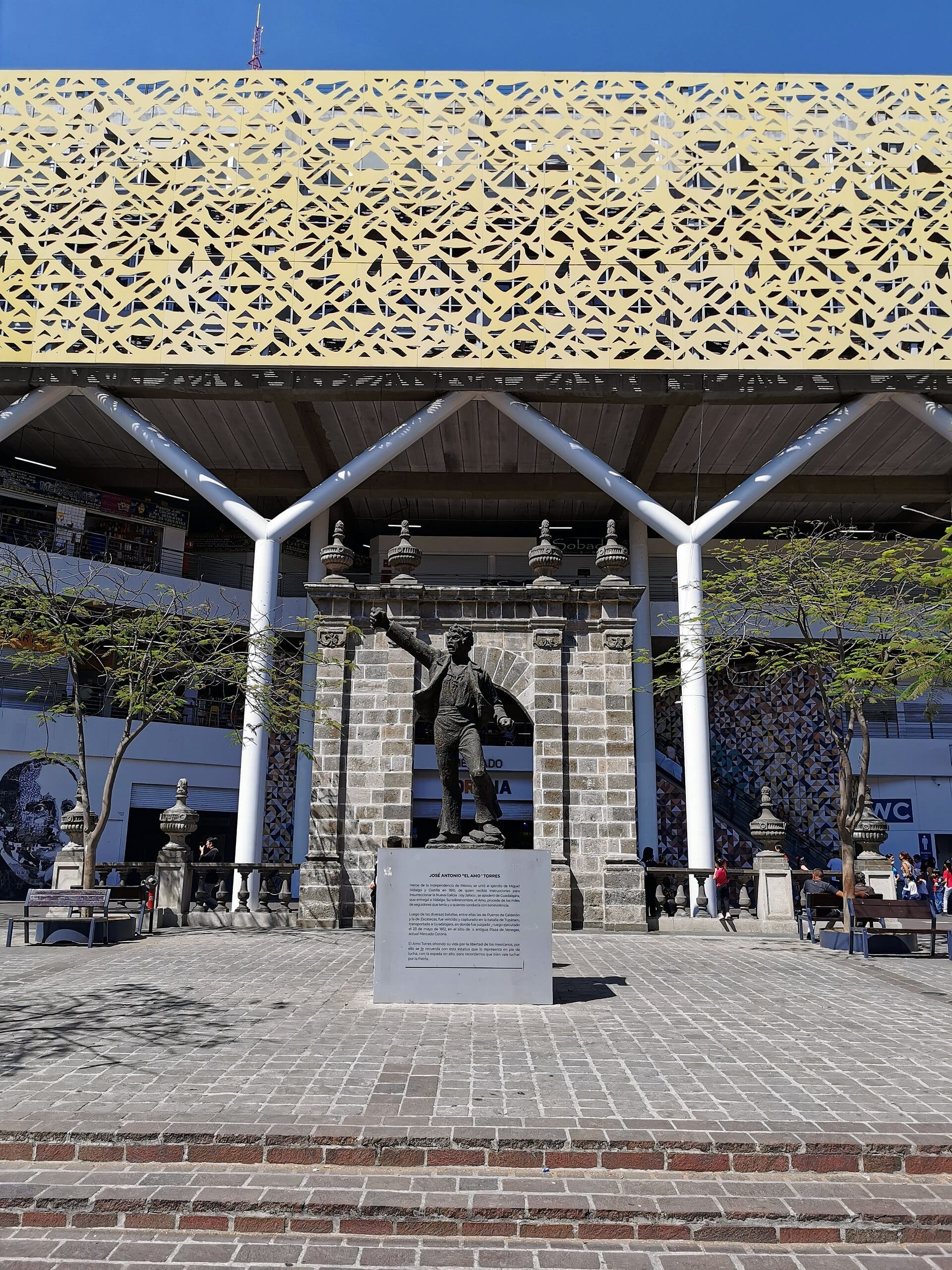
What Mercado Corona Actually Is
Mercado Corona is a full-block, three-floor public market in the Centro Histórico of Guadalajara, one block north of the Palacio Municipal and roughly 60 seconds on foot from the Cathedral. It is not a tourist market. It is not a craft bazaar. It is the kind of place where families from across the city come to buy chiles by the kilo, where office workers grab a bowl of pozole before 9 AM, and where vendors who have occupied the same stall for decades know their regular customers by name.
The building holds 581 commercial spaces across three floors, with elevators, staircases, parking spaces, terraces, and a food court connecting and serving them. The architecture is modern and functional, comparable in layout to an urban shopping center, but the atmosphere is anything but corporate. The air carries the mingled scent of raw meat, fresh herbs, frying oil, and ripe fruit in a combination that defines Mexican market culture.
ℹ️ Good to know
Entry is free. Bring Mexican pesos in cash — most vendors do not accept cards. Small bills (MXN 50 and 100) are especially useful for food stalls.
A History Built on Fire and Persistence
Construction of the original Mercado Corona began in 1888 under the order of Jalisco Governor Ramón Corona. The market was inaugurated on September 15, 1891 — after Governor Corona had been assassinated before the building opened. The market was named in his honor posthumously, a tribute that has outlasted every disaster that followed.
And there were disasters. The building has survived major fires in 1910, 1919, 1929, and again in 2014, which forced its reconstruction. Each reconstruction has shaped the current structure, which no longer resembles a 19th-century market hall. What visitors see today is a product of repeated reinvention: practical, dense, and alive in a way that newer, purpose-built commercial spaces rarely manage.
The history of Mercado Corona is inseparable from the broader story of downtown Guadalajara. The surrounding block sits within the same civic core that contains the Guadalajara Cathedral, the Palacio de Gobierno, and the Plaza de Armas. For over a century, the market has fed the people who live and work in that civic orbit.
Tickets & tours
Hand-picked options from our booking partner. Prices are indicative; availability and final rates are confirmed when you complete your booking.
Lake Chapala and Ajijic guided tour from Guadalajara
From 68 €Instant confirmationFree cancellationGuadalajara and Tlaquepaque guided tour
From 73 €Instant confirmationFree cancellation
What You'll Find Inside: Floor by Floor
The ground floor is where the food action concentrates. Produce vendors line the central corridors with stacks of tomatillos, nopales, dried chiles, and seasonal fruit. Meat and poultry counters operate alongside them, their owners calling out to passing shoppers with practiced ease. The noise level is high, the movement constant, and the passage between stalls narrow enough that you develop an instinct for turning sideways.
Food stalls serving hot meals cluster along the interior perimeters and on upper floors. Dishes commonly found include pozole, birria, tortas ahogadas, and antojitos — the kind of regional staples that make Guadalajara's food culture worth exploring on its own terms. Prices are low, portions are generous, and the experience of eating at a market counter surrounded by locals going about their day is something no restaurant can replicate.
Upper floors carry a mix of goods: household items, clothing, herbal medicine stalls, and services. The diversity is one of the market's defining qualities. This is a place where someone might come to buy fresh epazote, get a blouse altered, and pick up a remedy for an upset stomach, all in a single visit.
💡 Local tip
If you want to eat, head to the upper floor food area or look for stalls with plastic stools and laminated menus. These spots tend to offer full meals at lower prices than the ground-floor counters with more tourist foot traffic.
How the Market Changes Through the Day
Arriving around 7:00 to 8:30 AM puts you in the market at its most alive. This is when the produce is freshest, the breakfast stalls are at peak service, and the vendor community is settling into the day's rhythm. The mood is purposeful rather than leisurely. Regulars move with efficiency, orders are called across counters, and the sound of a busy market at work is at its most textured.
By midday the crowds thicken with workers from the surrounding government buildings, shops, and offices. Tables at food stalls fill quickly from around noon to 2 PM, which is the main meal window in Mexican daily life. If you want a seat without waiting, aim for 11:30 AM or after 2:30 PM.
Late afternoon sees some stalls begin to wind down, particularly produce vendors who sell out of the best stock by mid-afternoon. The building's atmosphere grows quieter and more relaxed after 4 PM, though specific closing times vary by vendor. Hours are not uniformly published, so visiting in the morning is the safest choice for a full experience. Confirm current hours locally if your visit depends on a specific vendor type.
Getting There and Getting Around
The market's location makes it one of the easiest attractions in Guadalajara to reach without planning. If you are already visiting the Cathedral, the Rotonda de los Jaliscienses Ilustres, or the Plaza de Armas, Mercado Corona is about a one-block walk from the Municipal Palace, located between Hidalgo, Santa Mónica, Zaragoza, and Independencia streets in the historic center. It is effectively impossible to visit Guadalajara's historic center and miss it.
City buses and taxis serving the Centro Histórico stop within close walking distance. The market's address is Av. Miguel Hidalgo y Costilla 469, and most navigation apps route accurately to it. Ride-hailing apps including Uber and DiDi operate in central Guadalajara and can drop you directly at the building.
The building includes elevators connecting its three floors, which provides meaningful access for visitors with limited mobility. Street-level entry points on multiple sides of the block offer options for entering without navigating steps. The internal corridors are narrow and often crowded, however, and a wheelchair or stroller will require patience during peak hours.
⚠️ What to skip
The Centro Histórico can be congested, particularly on weekends when pedestrian events and street vendors occupy nearby plazas. Arrive on foot from a nearby drop-off point rather than trying to park directly at the market.
Photography, Practicalities, and Honest Expectations
Mercado Corona photographs well in the morning, when natural light angles through the upper floors and the produce displays are at their most complete. A wide-angle lens or a phone camera with a decent low-light performance handles the interior well. Ask before photographing individual vendors — most will not object, but a quick gesture and a smile go a long way.
This is not a market designed for slow browsing. The corridors are narrow, the vendors are working, and the overall energy is oriented toward transaction rather than experience. Visitors who come expecting a curated, photogenic market with craft goods and artisan stalls will be underwhelmed. Visitors who come to see how a working-class Mexican market actually operates — and to eat inexpensively and well — will find exactly that.
For craft shopping and artisan goods, the markets in Tlaquepaque or the Tonalá crafts market are better suited. Mercado Corona's value is in its authenticity as an everyday urban institution, not in its appeal as a souvenir destination.
If you are building a broader itinerary for Guadalajara's food culture, the Guadalajara food guide covers both market eating and the city's full range of dining options.
Insider Tips
- Order at stalls where the menu is handwritten on a chalkboard or laminated card rather than printed in color — these are almost always cheaper and operated by longer-standing vendors.
- The tortas ahogadas stalls in the market serve Guadalajara's signature sandwich (a birote roll soaked in chile sauce) at prices well below what you'll pay at dedicated restaurants nearby. Ask for 'media ahogada' if you want medium-spicy rather than the full heat.
- Arrive before 8 AM on weekdays if you want the calmest experience. Market vendors and their families are stocking up at this hour and the food stalls are just getting their first customers.
- The ground floor on the Independencia-facing side has the densest cluster of fresh produce. This is the best entry point if you want to photograph ingredients or pick up seasonal fruit to eat while you walk.
- Keep your bag in front of you and your phone in a pocket in the main corridors. The market is not particularly dangerous, but it is crowded and inattentive visitors can attract opportunistic theft, as is common in any dense urban market environment.
Who Is Mercado Corona For?
- Food travelers who want to eat regional Jalisco dishes at local prices
- Budget-conscious visitors building a morning around the historic center
- Photographers interested in documentary-style urban and market scenes
- Travelers who prefer observing daily local life over curated tourist experiences
- Early risers looking for a genuine breakfast stop before the main sights fill with crowds
Nearby Attractions
Other things to see while in Centro Histórico:
- Calandrias (Horse-Drawn Carriage Rides)
Calandrias are Guadalajara's traditional horse-drawn carriages, operating through the colonial streets of the Centro Histórico since the early 20th century. A slow, unhurried circuit past cathedral facades, plazas, and pedestrian corridors, they offer a different pace from the city's foot traffic. This guide covers what to expect, when to go, and whether it's worth your time.
- Guadalajara Cathedral (Catedral de Guadalajara)
The Catedral Basílica de la Asunción de María Santísima anchors Guadalajara's historic center, surrounded by four plazas and centuries of layered history. Its twin neo-Gothic spires are the city's most recognized silhouette, and entry is free. Here is everything you need to know before you go.
- Instituto Cultural Cabañas (Hospicio Cabañas)
A UNESCO World Heritage Site at the heart of Guadalajara's Centro Histórico, Hospicio Cabañas houses José Clemente Orozco's most celebrated murals inside a neoclassical complex of staggering scale. This is the single most significant cultural site in western Mexico, and one of the most important in all of Latin America.
- Lienzo Charro de Jalisco
The Lienzo Charro Charros de Jalisco, on Av. R. Michel near Parque Agua Azul, is one of Mexico's most storied charro arenas. Home to one of Mexico's oldest charro associations, this is where Jalisco's equestrian traditions are kept alive through competitive charreadas, pageantry, and music.