Rotonda de los Jaliscienses Ilustres: Guadalajara's Monument to Its Greatest Figures
Standing between the Cathedral and the Municipal Palace in Guadalajara's historic center, the Rotonda de los Jaliscienses Ilustres is a neoclassical circular monument containing 98 niches intended to hold the remains of distinguished Jaliscienses. Admission is free, the plaza is accessible at all hours, and the 22 bronze statues around the plaza make it one of the most photogenic corners of downtown.
Quick Facts
- Location
- Av. Fray Antonio Alcalde 108, Zona Centro, Guadalajara — between the Cathedral and the Regional Museum, with the Palacio Municipal on the south side of the block
- Getting There
- Light rail (SITEUR): Plaza Universidad stop on Lines 1 or 3, then a short walk north through the historic center
- Time Needed
- 20–40 minutes to walk the plaza and read the statues; allow longer if combining with nearby sites
- Cost
- Free — no ticket or registration required
- Best for
- History enthusiasts, architecture lovers, photography, and anyone doing a walking tour of the historic center
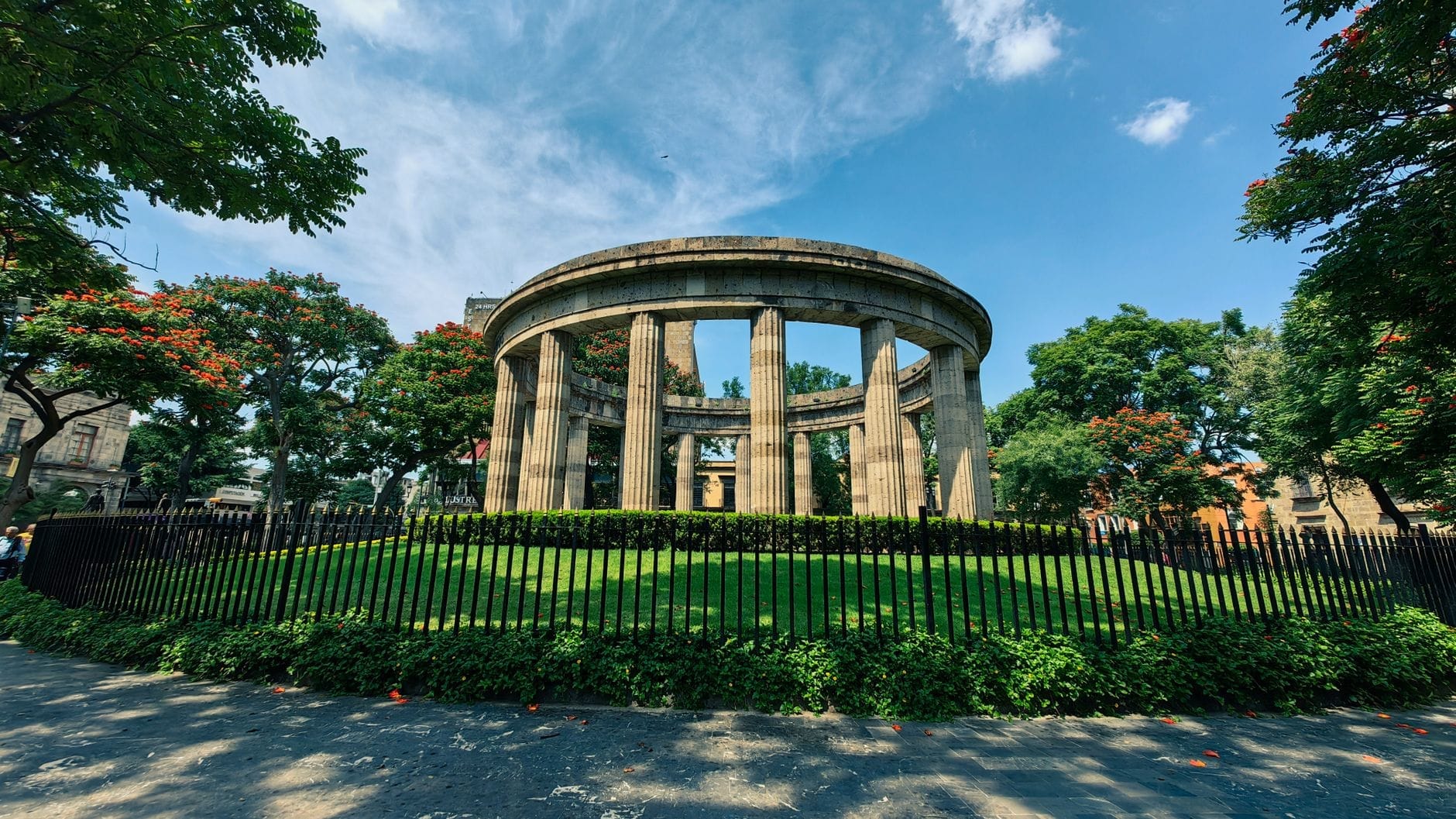
What the Rotonda Actually Is
The Rotonda de los Jaliscienses Ilustres is an open-air neoclassical monument and collective mausoleum in the heart of Guadalajara's historic center. Built and inaugurated in 1952 and designed by architect Vicente Mendiola under the administration of Governor José de Jesús González Gallo, it was built as part of a broader effort to dignify and reorganize the city's colonial core. The structure consists of 17 fluted cantera stone columns, stripped of base and capital in a deliberately austere style, supporting a circular ring inscribed with the words 'Jalisco a sus hijos esclarecidos' — Jalisco to its distinguished sons and daughters.
Inside the structure there are 98 niches designed to receive the remains of notable Jaliscienses. Around the rotonda and its surrounding plaza, 22 bronze statues stand on individual pedestals, each representing a figure recognized by the state of Jalisco as having made an exceptional contribution to Mexican culture, science, politics, or the arts. Originally named Rotonda de los Hombres Ilustres, the monument was officially renamed Rotonda de los Jaliscienses Ilustres in 2000, when women such as Irene Robledo García began to be included among its honorees.
ℹ️ Good to know
The Rotonda is not a museum with guided tours or interpretive panels. It is a civic monument in an open plaza. Bring your own research or download a guide beforehand if you want to identify the statues by name.
The Setting: Where It Sits in the Historic Center
The Rotonda occupies an entire city block in the pedestrianized core of Guadalajara's Centro Histórico, flanked by Paseo Alcalde, Miguel Hidalgo, Liceo, and Independencia streets. To the west sits the Guadalajara Cathedral, and to the south the Palacio Municipal faces the Plaza de Armas. This geographic position places it at the literal and symbolic center of the city's civic identity.
The plaza around the Rotonda is flat, paved, and largely unshaded. Tall laurel trees line sections of the perimeter, offering pockets of shade, but much of the monument itself is exposed to direct sun. On a warm May or June afternoon, the stone absorbs heat and the air smells faintly of cantera dust and nearby street food. The ground-level paving is smooth and even, making the site accessible by wheelchair from the main street approaches, though specific accessible ramps at every entry point should be confirmed locally.
Tickets & tours
Hand-picked options from our booking partner. Prices are indicative; availability and final rates are confirmed when you complete your booking.
Lake Chapala and Ajijic guided tour from Guadalajara
From 68 €Instant confirmationFree cancellationGuadalajara and Tlaquepaque guided tour
From 73 €Instant confirmationFree cancellation
The Monument in Detail: What You'll See Up Close
The 17 columns are the defining architectural feature: tall, unadorned, and cut from light-grey cantera stone quarried in Jalisco. The absence of capitals gives them an unfinished, almost solemn quality that differs from the heavily ornamented colonial buildings nearby. At the top, the horizontal ring connects all columns and frames a view of open sky at the center. From below, looking upward through the ring on a clear day, the contrast between stone and sky is the strongest photograph you can take here.
The 22 bronze statues placed around the plaza vary considerably in size and artistic style, reflecting different eras of production. Some are mounted high on stone pedestals; others stand at a more approachable height. Each has a name plate. Among the figures commemorated are painters, musicians, writers, politicians, and military figures whose work shaped Mexican and Jalisciense identity across several centuries. Reading the names without prior knowledge can feel abstract, but the quality of the bronze casting on several statues rewards close inspection.
If you are specifically interested in the art and murals associated with Jalisco's cultural heritage, the Hospicio Cabañas is a short walk east and houses José Clemente Orozco's most ambitious murals. The two sites together make a coherent half-day itinerary focused on Jalisciense identity and civic history.
How the Experience Changes by Time of Day
Early morning, between roughly 7 and 9 AM, is when the Rotonda reads most clearly. The low-angle light from the east catches the column surfaces and casts long shadows across the paving, making the geometry of the structure legible in a way that flat midday light erases. Local residents cross the plaza on their way to work, a few older visitors sit on nearby benches, and the area around the Cathedral is relatively quiet. The cantera stone looks almost white at this hour.
By late morning, school groups arrive regularly, particularly on weekdays. Guided visits to the monument are common for primary and secondary school students from across Jalisco, which means the plaza can be crowded with children from around 10 AM onward. The noise level rises considerably. If you prefer a quieter experience, arrive before 9:30 AM or revisit after 5 PM, when school groups have left and the late afternoon light returns favorable angles to the columns.
At night, the monument is lit from below, which dramatically changes its character. The columns glow against a dark sky, the inscribed ring stands out clearly, and the plaza takes on a quieter, more contemplative tone. Evening walkers, couples, and small groups of tourists pass through. The surrounding historic center remains active in the evenings, so there is no sense of isolation.
💡 Local tip
For the best photographs of the columns, come in the first two hours after sunrise or in the hour before sunset. Midday light flattens the texture of the cantera stone completely.
Historical and Cultural Context
The Rotonda was inaugurated in 1952, a period when Mexico's post-revolutionary government was actively constructing civic narratives around national and regional identity. Locating a hall of fame for Jalisco's distinguished figures in the historic center, directly adjacent to the Cathedral and government buildings, was a deliberate statement about the relationship between regional pride and institutional power. The choice of neoclassical architecture, rather than the muralist or modernist idioms popular at the time, positioned the monument within a longer tradition of European-influenced civic memorialization.
The name change in 2000, from Rotonda de los Hombres Ilustres to Rotonda de los Jaliscienses Ilustres, reflected a broader shift in how Mexican institutions formally acknowledged gender in public commemoration. The state of Jalisco also adopted the extended form Rotonda de las y los Jaliscienses Ilustres in some official communications, which is a grammatical construction in Spanish that explicitly names both the feminine and masculine forms.
For visitors with a deeper interest in Guadalajara's civic architecture and colonial-era urban planning, the Guadalajara architecture guide provides broader context on how the historic center developed and which buildings define each era.
Practical Walkthrough: Getting There and Around
The most straightforward approach by public transit is the SITEUR light rail: take Line 1 or Line 3 to the Plaza Universidad stop and walk north through the pedestrian corridor toward the Cathedral. The Rotonda will be on your right, visible within a few minutes’ walk depending on pace and foot traffic.
Ride-hailing apps including Uber and DiDi both operate in the historic center. Drop-off directly at the monument can be complicated by the pedestrianized streets; most drivers will stop on Avenida Fray Antonio Alcalde or one of the adjacent streets, a few steps from the plaza. From there, the Rotonda is immediately visible.
The Rotonda works naturally as a stop within a broader walking tour of the historic center. The Guadalajara walking tour guide maps out a route that connects the Rotonda with the Cathedral, Plaza de la Liberación, Degollado Theatre, and Hospicio Cabañas within a two to three hour circuit.
⚠️ What to skip
The plaza is fully exposed. In summer (June to September), afternoon temperatures can reach 30°C (86°F) with high humidity. Bring water and sun protection if you plan to spend time reading the statues during midday hours.
Who Should Temper Their Expectations
The Rotonda de los Jaliscienses Ilustres rewards visitors who bring some prior knowledge of Mexican and Jalisciense history. Without context, the 22 bronze statues are a series of names and faces that carry little immediate weight. There are no audio guides, no explanatory panels inside the monument, and no on-site visitor center. If you are expecting a museum experience with interpretive content, you will find the visit thin.
Travelers with very limited time in Guadalajara who are choosing between major sites should know that the Rotonda is best treated as a complement to other nearby attractions rather than a destination in itself. The Cathedral, the Palacio de Gobierno with its Orozco murals, and Hospicio Cabañas each offer more layered visitor experiences. The Rotonda adds weight to those visits by grounding them in Jalisco's broader tradition of civic commemoration.
Insider Tips
- The stone ring inscription 'Jalisco a sus hijos esclarecidos' is most legible in the late afternoon when the sun is low and angled from the west. This is also when the columns cast their longest shadows across the paving.
- Before arriving, search for a list of the 22 bronze statues and the figures they represent. The municipality and state government publish commemorative information around civic anniversaries that can help you identify who is who without interpretive panels on-site.
- The Rotonda sits on the most photographed block in Guadalajara, shared with the Cathedral's north facade. If you want an image of the monument without crowds or people in the foreground, arrive before 8 AM on a weekday.
- School group visits peak on Tuesday through Thursday mornings during the academic year (roughly September to June). If you visit on a Monday, Friday, or during school holidays, the plaza is noticeably quieter.
- The night lighting is genuinely impressive and rarely mentioned in travel coverage. If you are doing an evening walk through the historic center, the illuminated columns are worth a second visit after dinner.
Who Is Rotonda de los Jaliscienses Ilustres For?
- History and culture travelers who want to understand how Jalisco constructs its regional identity
- Architecture enthusiasts interested in neoclassical civic monuments and cantera stone construction
- Photographers working the historic center who want strong geometric subjects in early morning or late afternoon light
- Anyone completing a full walking tour of the Centro Histórico — the Rotonda anchors the north end of the main civic sequence
- Visitors pairing a visit with the Guadalajara Cathedral or Hospicio Cabañas on the same morning
Nearby Attractions
Other things to see while in Centro Histórico:
- Calandrias (Horse-Drawn Carriage Rides)
Calandrias are Guadalajara's traditional horse-drawn carriages, operating through the colonial streets of the Centro Histórico since the early 20th century. A slow, unhurried circuit past cathedral facades, plazas, and pedestrian corridors, they offer a different pace from the city's foot traffic. This guide covers what to expect, when to go, and whether it's worth your time.
- Guadalajara Cathedral (Catedral de Guadalajara)
The Catedral Basílica de la Asunción de María Santísima anchors Guadalajara's historic center, surrounded by four plazas and centuries of layered history. Its twin neo-Gothic spires are the city's most recognized silhouette, and entry is free. Here is everything you need to know before you go.
- Instituto Cultural Cabañas (Hospicio Cabañas)
A UNESCO World Heritage Site at the heart of Guadalajara's Centro Histórico, Hospicio Cabañas houses José Clemente Orozco's most celebrated murals inside a neoclassical complex of staggering scale. This is the single most significant cultural site in western Mexico, and one of the most important in all of Latin America.
- Lienzo Charro de Jalisco
The Lienzo Charro Charros de Jalisco, on Av. R. Michel near Parque Agua Azul, is one of Mexico's most storied charro arenas. Home to one of Mexico's oldest charro associations, this is where Jalisco's equestrian traditions are kept alive through competitive charreadas, pageantry, and music.