Hospicio Cabañas (Museo Cabañas): Guadalajara's Most Important Building
A UNESCO World Heritage Site at the heart of Guadalajara's Centro Histórico, Hospicio Cabañas houses José Clemente Orozco's most celebrated murals inside a neoclassical complex of staggering scale. This is the single most significant cultural site in western Mexico, and one of the most important in all of Latin America.
Quick Facts
- Location
- Calle Cabañas 8, eastern end of Plaza Tapatía, Centro Histórico, Guadalajara, Jalisco
- Getting There
- Walk from the Cathedral area via Plaza Tapatía (10–15 min); taxis and Uber drop off at Plaza Tapatía / Mercado San Juan de Dios
- Time Needed
- 1.5 to 3 hours
- Cost
- Approx. MXN $80 general; MXN $55 for Mexican nationals with ID; Tuesdays free. Verify on arrival.
- Best for
- History, art, architecture, photography, cultural immersion
- Official website
- museocabanas.jalisco.gob.mx
What Is Hospicio Cabañas?
The Hospicio Cabañas, now officially known as Museo Cabañas, is a neoclassical building complex in the Centro Histórico of Guadalajara that has its origins in 1805 and opened its doors in 1810. It was commissioned by Bishop Juan Cruz Ruiz de Cabañas y Crespo, designed by Spanish architect Manuel Tolsá, with construction beginning in 1805 and extending into the mid‑19th century. For over 170 years it served as an orphanage and charitable institution before being repurposed as a cultural center in 1980. In 1997, UNESCO inscribed it as a World Heritage Site, recognizing both its architectural significance and its role as the canvas for one of the most important mural cycles in the history of Mexican art.
The building is enormous in a way that no photograph adequately communicates. It contains 23 patios, 106 rooms, 72 corridors, and 2 chapels spread across a single-storey neoclassical plan. Walking through it feels less like visiting a museum and more like moving through a small city. For visitors already exploring the historic center, the Centro Histórico itinerary is essentially incomplete without it.
💡 Local tip
Tuesdays are free for all visitors. If your schedule allows, this is the most economical day to visit, though expect slightly larger crowds during midday hours.
The Orozco Murals: What You Are Actually Looking At
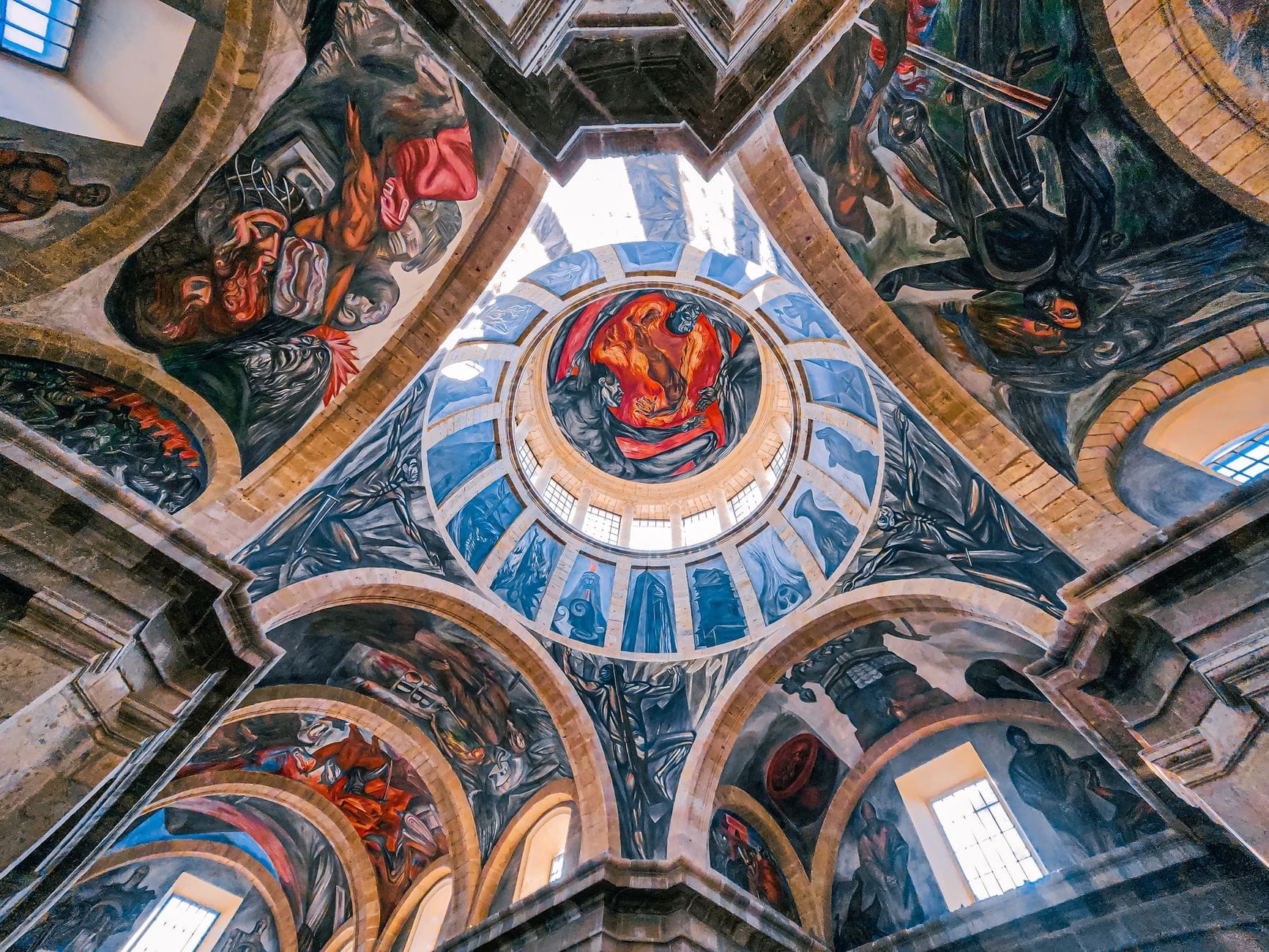
The Capilla Mayor, the large central chapel in the heart of the complex, is the destination most visitors come specifically to see. Between 1936 and 1939, the muralist José Clemente Orozco painted more than 50 fresco murals across its walls, vaults, and ceiling. The most iconic single image is El hombre de fuego, or "The Man of Fire", painted on the interior dome of the chapel. In it, a human figure is consumed by and simultaneously rises from fire, arms flung outward, ascending into a spiral of flames. Looking straight up at it produces a kind of mild vertigo.
Orozco's palette in this chapel runs to blacks, deep reds, ochres, and ashen grays. The imagery is not celebratory in any conventional sense. Conquest, suffering, the machinery of war, and the ambivalence of civilization are recurring themes. Panels depicting the Spanish conquistadors, the mechanization of modern life, and figures representing indigenous peoples surround the nave. Visitors who take time to walk slowly around the full perimeter of the chapel will find that the murals function as a single extended argument about history, not a decorative scheme.
Orozco is Guadalajara's greatest artistic figure, and his murals appear in several locations across the city. Understanding what he was attempting at Cabañas is easier if you've also seen his earlier work in the Palacio de Gobierno. For more context on his full body of work in the city, the guide to Orozco's murals in Guadalajara covers the key sites and what to look for in each.
ℹ️ Good to know
The chapel is usually dim, lit primarily by natural light filtered through high windows and a lantern in the dome. Bring patience: your eyes take a few minutes to adjust fully, and the murals read very differently once they do. Avoid visiting in early afternoon when direct sunlight can cause strong glare in certain sections.
Tickets & tours
Hand-picked options from our booking partner. Prices are indicative; availability and final rates are confirmed when you complete your booking.
Lake Chapala and Ajijic guided tour from Guadalajara
From 68 €Instant confirmationFree cancellationGuadalajara and Tlaquepaque guided tour
From 73 €Instant confirmationFree cancellation
The Architecture: 23 Patios and Four Decades of Building
Manuel Tolsá was the most important architect working in New Spain at the turn of the 19th century, and Hospicio Cabañas represents one of his most ambitious commissions. The plan is organized around a central axis with the Capilla Mayor at its heart, surrounded by a series of interconnected patios that originally served as exercise yards, workshops, and residential quarters for the orphanage's inhabitants.
The exterior facade facing Plaza Tapatía is austere neoclassical, with a symmetrical composition of pilasters, a central arched portal, and restrained stone ornamentation. Inside, the proportions shift. The patios vary considerably in scale, from intimate courtyards where the stone arcades feel almost close enough to touch, to larger open areas where the sky above takes on the quality of a ceiling. The stone used throughout is cantera, the same warm volcanic material seen across the historic center. By midmorning, when sunlight falls at an angle into the interior courtyards, the cantera glows a pale amber.
This is one of the defining examples of colonial and early-republican architecture in western Mexico. Visitors with a deeper interest in how the city's built environment developed will find additional context in the Guadalajara architecture guide.
How the Visit Changes by Time of Day
The museum opens at 10:00. Early visitors, arriving in the first thirty minutes, will often have the Capilla Mayor almost entirely to themselves. The silence in there at that hour is noticeable: footsteps echo off stone floors, and the only sounds are the faint hum of climate-control equipment and occasional birdsong from the exterior patios. This is the best window for photography, when the light is still low and lateral, raking across the painted surfaces to reveal texture and depth.
By late morning, school groups and tour buses begin arriving. The corridors fill with sound, and the patios become genuinely crowded from around 11:30 onward. The experience changes substantially: more energy, more life, but less opportunity for unhurried looking. If your priority is the murals themselves rather than the broader atmosphere of the complex, aim for the opening hour or arrive after 15:00 when early visitors have moved on.
Late afternoon, from around 16:00 to closing at 18:00, offers a third distinct experience. The angle of light shifts in the western patios, and the interior temperature, which can feel warm in summer months, cools noticeably. The building has a different quality at this hour, a little emptier and more introspective, with long shadows cutting across the stone arcades.
Practical Walkthrough: Getting There and Around
Hospicio Cabañas sits at the eastern end of Plaza Tapatía, a large pedestrian esplanade that connects it visually and physically to the main cluster of historic plazas near the Cathedral. The walk from the Cathedral along Plaza Tapatía takes roughly 10 to 15 minutes at a leisurely pace and passes several other significant sites along the way. This route is one of the most rewarding urban walks in Guadalajara.
The complex is single-storey with flat, even floors throughout, which makes it more accessible than many historic buildings of comparable age. Visitors using wheelchairs or strollers will find the main circulation routes manageable, though the uneven stone surfaces in some of the older patios may require care. For visitors combining this with a broader day in the historic center, the nearby Mercado San Juan de Dios is a five-minute walk and makes a natural complement for the afternoon.
The museum is open Tuesday through Sunday from 10:00 to 18:00; it is closed on Mondays. Admission at time of research was approximately MXN $80 for general entry and MXN $55 for Mexican nationals with valid ID; entry is free on Tuesdays. These prices should be verified on arrival, as they are subject to change. No large bags are typically permitted in the Capilla Mayor; there is usually a bag-check area near the entrance.
⚠️ What to skip
The museum is closed on Mondays. A surprisingly large number of visitors arrive on Monday to find it shut. If you are in Guadalajara for only one or two days, plan around this carefully.
Context: From Orphanage to World Heritage Site
For most of its existence, Hospicio Cabañas was not a museum at all. Bishop Cabañas founded it in 1810 as the Casa de la Caridad y la Misericordia, a charitable institution intended to shelter orphans, the elderly, and the poor of Guadalajara. Through the late colonial period and into the 19th and 20th centuries, thousands of children grew up within these walls. The institution operated continuously through independence, the Reform War, the Revolution, and beyond, functioning as an orphanage until 1980.
The commission to paint the Capilla Mayor murals came to Orozco in 1936, when the building was still an active orphanage. He worked for three years, completing the cycle in 1939. Children lived and studied in the surrounding patios while one of the most significant mural programs of the 20th century was being created overhead. That layering of the quotidian and the monumental is still present in the building: it reads simultaneously as a work of high art and a place built for the practical, unglamorous work of sheltering people.
Guadalajara has several strong museums, but none carries comparable historical weight. For visitors trying to build a fuller picture of what the city's cultural institutions offer, the guide to the best museums in Guadalajara provides useful comparisons across the main options.
Who Should Reconsider This Visit
Visitors with very limited time who are primarily interested in colonial-era religious architecture, rather than muralist painting or institutional history, may find that the Cathedral, the Palacio de Gobierno, or the Templo Expiatorio offer a more concentrated experience in less walking time. The sheer scale of Hospicio Cabañas means that a rushed 30-minute visit leaves most of it unseen and can feel anticlimactic.
Children under around age eight tend to find the building interesting for perhaps 20 minutes, after which the scale works against engagement rather than for it. The murals in the Capilla Mayor are not violent in a gratuitous sense, but they are dark, intense imagery depicting conquest and suffering. Parents should make their own judgment about age-appropriateness. The long corridors between patios, on the other hand, are genuinely captivating for children who respond to big spaces and echoing stone.
Insider Tips
- Arrive at opening time on a weekday (not Tuesday) for the quietest possible experience of the Capilla Mayor. The murals are best absorbed in near-silence, which is difficult to achieve once tour groups arrive after 11:00.
- Bring a wide-angle lens or use your phone's ultra-wide mode for the dome of the Capilla Mayor. Standard focal lengths cannot capture the full composition from the floor below.
- The interior patios are planted with mature trees and flowering shrubs. In spring, late February through April, some of them bloom, adding a counterpoint to the stone that most photos of the building do not show.
- The complex runs temporary exhibitions in rooms alongside the permanent Orozco murals. These vary considerably in quality. Check the official website before your visit if contemporary art is a priority, as the temporary shows are sometimes the most engaging thing on offer.
- The pedestrian route along Plaza Tapatía connecting the Cathedral plaza to Hospicio Cabañas passes the Palacio de Gobierno and Teatro Degollado. Walking the full length of the esplanade first, then entering Cabañas, gives the visit a clearer sense of how the historic center was planned as a connected whole.
Who Is Instituto Cultural Cabañas (Hospicio Cabañas) For?
- Art and mural enthusiasts who want to understand the Mexican muralist movement in depth
- Architecture and heritage travelers interested in colonial and early-republican building traditions
- History-focused visitors who want to connect Guadalajara's past with its contemporary identity
- Photographers seeking the interplay of natural light, stone, and large-scale painted surfaces
- Travelers with a full day in the historic center who want to move through the area slowly and attentively
Nearby Attractions
Other things to see while in Centro Histórico:
- Calandrias (Horse-Drawn Carriage Rides)
Calandrias are Guadalajara's traditional horse-drawn carriages, operating through the colonial streets of the Centro Histórico since the early 20th century. A slow, unhurried circuit past cathedral facades, plazas, and pedestrian corridors, they offer a different pace from the city's foot traffic. This guide covers what to expect, when to go, and whether it's worth your time.
- Guadalajara Cathedral (Catedral de Guadalajara)
The Catedral Basílica de la Asunción de María Santísima anchors Guadalajara's historic center, surrounded by four plazas and centuries of layered history. Its twin neo-Gothic spires are the city's most recognized silhouette, and entry is free. Here is everything you need to know before you go.
- Lienzo Charro de Jalisco
The Lienzo Charro Charros de Jalisco, on Av. R. Michel near Parque Agua Azul, is one of Mexico's most storied charro arenas. Home to one of Mexico's oldest charro associations, this is where Jalisco's equestrian traditions are kept alive through competitive charreadas, pageantry, and music.
- Mercado Corona
Mercado Corona is a three-floor public market in the heart of Guadalajara's historic center, about one block from the Municipal Palace and a short walk from the Cathedral. Free to enter, open from early morning, and packed with fresh produce, street food, and everyday goods, it offers a ground-level look at how the city actually feeds and sustains itself.