Plaza de Armas Guadalajara: The Historic Heart of the City
Plaza de Armas, whose official name is Plaza de la Constitución but is more commonly known by its popular name, is the main square of Guadalajara's Centro Histórico. Free to enter at any hour, it anchors the colonial core with a landmark French art nouveau bandstand, views of the Cathedral, and the daily rhythm of tapatío street life.
Quick Facts
- Location
- Avenida Ramón Corona 31, Zona Centro, 44100 Guadalajara, Jalisco, Mexico
- Getting There
- Plaza Universidad station (SITEUR light rail), short walk to the square
- Time Needed
- 30–60 minutes on its own; 2–3 hours combined with surrounding landmarks
- Cost
- Free; open 24 hours daily
- Best for
- Architecture lovers, history seekers, photographers, casual walkers
What Plaza de Armas Actually Is
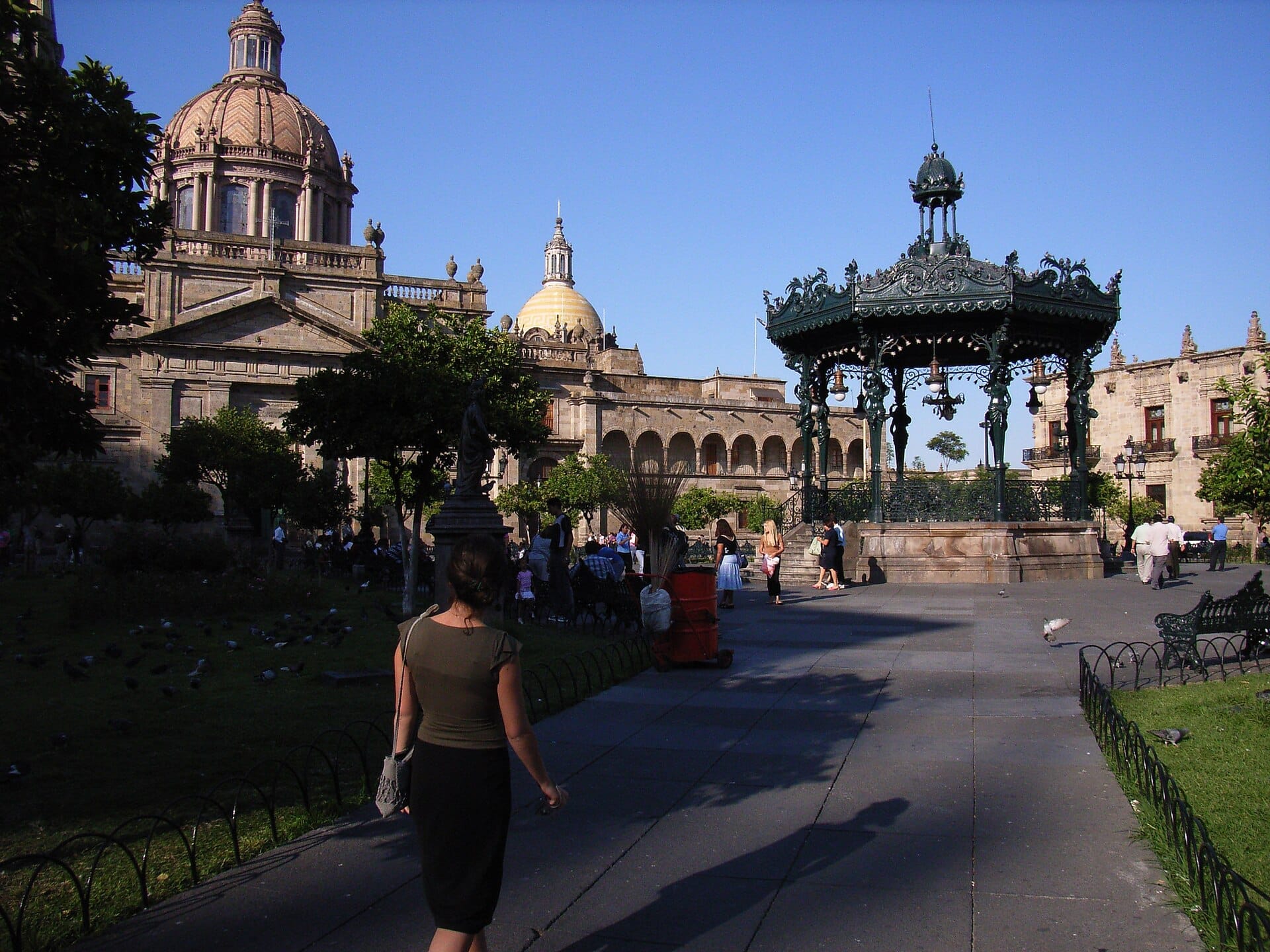
Plaza de Armas, officially named Plaza de la Constitución but better known by its popular name, is the principal public square of Guadalajara's historic center. It sits at the geographic and symbolic core of the city, bordered on one side by the Guadalajara Cathedral and on another by the Palacio de Gobierno del Estado de Jalisco. For visitors, it functions as the clearest orientation point in the entire downtown district: find the bandstand, and you have found the center of everything.
The square is not a theme park or a ticketed attraction. It is a living civic space where school groups, office workers on lunch breaks, elderly couples on benches, and tourists with guidebooks all occupy the same flat paved ground. That mix, unfiltered and unscripted, is part of what gives the plaza its texture.
💡 Local tip
The plaza is free and open around the clock. There are no gates, no queues, and no ticket counters. You can walk in at 6 a.m. for the morning calm or at 9 p.m. when the bandstand is lit up and street vendors line the perimeter.
The Bandstand: More Than a Photo Subject
The centerpiece of the plaza is a French art nouveau wrought-iron bandstand, installed during the Porfiriato in the early 20th century, around the time of the centenary of Mexican independence. The structure was imported from France and assembled here as a statement of modernization and national pride during the final years of the Porfiriato. That context matters: the kiosk is not just decorative, it is a period artifact that reflects a specific political moment in Mexican history.
Look closely at the pillars and the four corners of the structure. Female and Grecian figures represent the four seasons, a classicist European motif applied to a colonial Mexican square. The ironwork is intricate, painted in dark green, and holds up well under direct afternoon light for photography. At dusk, when the plaza lights come on, the bandstand takes on a warmer tone that most photographers prefer.
The bandstand is occasionally used for live musical performances, particularly on weekends and during local festivals. If you are visiting during one of Guadalajara's many cultural events, check whether a performance is scheduled. For deeper context on the city's musical traditions, the Guadalajara mariachi guide covers where and when to find live performances across the centro.
Tickets & tours
Hand-picked options from our booking partner. Prices are indicative; availability and final rates are confirmed when you complete your booking.
Lake Chapala and Ajijic guided tour from Guadalajara
From 68 €Instant confirmationFree cancellationGuadalajara and Tlaquepaque guided tour
From 73 €Instant confirmationFree cancellation
The Architecture That Frames the Square
No visit to Plaza de Armas makes sense without acknowledging what surrounds it. To the north stands the Guadalajara Cathedral, whose distinctive twin yellow towers dominate the skyline above the plaza. The Cathedral was begun in 1558 and consecrated in 1618, with subsequent reconstructions and additions over later centuries, meaning its architecture spans styles from Gothic to Baroque to Neoclassical. Standing in the plaza and looking toward it, the scale is immediately clear: the towers rise to roughly 65–65.5 meters, a height that was deliberately meant to assert the Church's presence over the colonial city grid.
To the east, the Palacio de Gobierno de Jalisco presents a Baroque facade in stone with wrought-iron balconies. Inside this building, José Clemente Orozco painted his famous staircase murals depicting Miguel Hidalgo bearing a torch. While the murals themselves are inside the Palacio, not in the plaza, they are close enough to combine into a single visit without backtracking.
Together with the adjacent Plaza de la Liberación and Plaza Tapatía, Plaza de Armas forms part of a connected sequence of public spaces that stretches eastward from the Cathedral toward the Hospicio Cabañas. The full route can be walked in a straight line, making the downtown core unusually legible for a city of this size.
How the Plaza Changes Through the Day
Early mornings, roughly 7 to 9 a.m., belong to locals. Vendors set up their carts, office workers cut across the square on their way to nearby government buildings, and the light falls at a low angle across the stone paving. The air carries the faint smell of roasting corn from a nearby cart and diesel from the buses that idle on Avenida Hidalgo. At this hour, the plaza is quiet enough that you can hear the pigeons and the distant bell of the Cathedral.
Midday brings the largest crowds. The benches fill up. Street photographers and portrait photographers set up near the bandstand, and shoe-shiners work the perimeter. The stone surfaces reflect heat, and the open plaza offers almost no shade except under the bandstand itself. If you visit in May or June, when Guadalajara averages daily highs of 30 to 32 degrees Celsius, midday is genuinely uncomfortable unless you are in motion.
Late afternoon, from around 5 p.m., is when the square finds its best rhythm. Temperatures drop, school children appear with parents, and the quality of light against the Cathedral facade becomes notably richer. By dusk, the illuminated bandstand and Cathedral towers create a scene that holds well for photography even without professional equipment. Weekend evenings sometimes bring informal musicians to the plaza edge.
⚠️ What to skip
During Guadalajara's rainy season (June to September), afternoon downpours can arrive quickly and flood the open paving. The square offers almost no shelter. Check forecasts if you plan to spend significant time here in those months, and carry a compact rain layer.
Practical Walkthrough: Getting There and Moving On
The nearest SITEUR light rail stop is Plaza Universidad, which connects via Line 1 to points across the city including the bus terminal and Zapopan. From the station, the plaza is a short walk north through the pedestrian corridors of the centro. Orientation is simple: follow the Cathedral towers.
Ride-hailing services such as Uber and DiDi drop off reliably on Avenida Hidalgo or Avenida Corona, both of which border the plaza. Driving to the plaza yourself is discouraged: parking in the immediate centro is severely limited, and the surrounding streets operate under rotating restrictions.
The plaza is flat, paved, and step-free throughout, making it accessible for wheelchairs and strollers. From here, the logical next stop is the sequence of plazas eastward toward the Hospicio Cabañas, a UNESCO World Heritage Site housing Orozco's most important murals and one of the most significant colonial-era buildings in western Mexico. The walk takes roughly 10 to 15 minutes through connected pedestrian space.
Photography Notes and Honest Limitations
Plaza de Armas photographs well under two conditions: early morning light before crowds accumulate, and dusk when the monument lighting activates. The bandstand is the strongest single subject, particularly from a low angle looking up through the ironwork toward the Cathedral towers. Wide-angle lenses work well given the open space.
Be honest about what this plaza is not. It lacks the large shaded gardens of Parque Morelos, the artisan market energy of Tlaquepaque, or the dramatic river views of the Barranca de Huentitán. As a standalone destination for someone traveling from outside Guadalajara, it would not justify a separate trip. Its value is almost entirely contextual: it is the physical anchor of a historic district that contains several genuinely world-class attractions within walking distance.
Visitors who want a structured walk that connects the plaza to its surrounding landmarks would benefit from following a Guadalajara walking tour itinerary. The centro is compact enough that the Cathedral, Palacio de Gobierno, Teatro Degollado, and Hospicio Cabañas can all be reached on foot from the plaza within a single morning.
Insider Tips
- Visit on a Thursday or Sunday evening when the Jalisco State Band sometimes performs free concerts near the bandstand. Check local event listings through the Guadalajara municipal government website in advance, as schedules vary.
- For the cleanest photographs of the Cathedral facade from the plaza, position yourself near the bandstand at dusk looking northwest. The warm lighting on the stone and the towers framed above the ironwork is the shot most visitors miss because they arrive midday.
- The informal shoe-shiners who work the benches around the plaza are a legitimate and long-standing service. A shine costs a small fee in pesos and is a normal part of using the square, not a tourist trap.
- The plaza sits at roughly 1,550 meters above sea level. First-time visitors coming from sea level may notice mild fatigue more quickly than expected when walking the extended plaza sequence eastward. Pace accordingly, especially in midday heat.
- If you want a coffee with a view of the bandstand, the nearest options are on Avenida Corona just off the plaza. Avoid the most prominent tourist-facing cafés directly facing the Cathedral, which tend to charge a significant premium for the view.
Who Is Plaza de Armas For?
- First-time visitors to Guadalajara using the square as an orientation base for the centro histórico
- Architecture and history enthusiasts interested in Porfirian-era urban design alongside colonial landmarks
- Photographers looking for landmark shots of the Cathedral and the 1910 French bandstand
- Travelers building a walkable half-day route through the UNESCO-adjacent historic core
- Budget travelers: the plaza itself, the Cathedral, the Palacio de Gobierno murals, and the connected plazas can all be visited for free
Nearby Attractions
Other things to see while in Centro Histórico:
- Calandrias (Horse-Drawn Carriage Rides)
Calandrias are Guadalajara's traditional horse-drawn carriages, operating through the colonial streets of the Centro Histórico since the early 20th century. A slow, unhurried circuit past cathedral facades, plazas, and pedestrian corridors, they offer a different pace from the city's foot traffic. This guide covers what to expect, when to go, and whether it's worth your time.
- Guadalajara Cathedral (Catedral de Guadalajara)
The Catedral Basílica de la Asunción de María Santísima anchors Guadalajara's historic center, surrounded by four plazas and centuries of layered history. Its twin neo-Gothic spires are the city's most recognized silhouette, and entry is free. Here is everything you need to know before you go.
- Instituto Cultural Cabañas (Hospicio Cabañas)
A UNESCO World Heritage Site at the heart of Guadalajara's Centro Histórico, Hospicio Cabañas houses José Clemente Orozco's most celebrated murals inside a neoclassical complex of staggering scale. This is the single most significant cultural site in western Mexico, and one of the most important in all of Latin America.
- Lienzo Charro de Jalisco
The Lienzo Charro Charros de Jalisco, on Av. R. Michel near Parque Agua Azul, is one of Mexico's most storied charro arenas. Home to one of Mexico's oldest charro associations, this is where Jalisco's equestrian traditions are kept alive through competitive charreadas, pageantry, and music.