Palacio de Gobierno de Jalisco: Orozco Murals, History, and Free Entry in Downtown Guadalajara
The Palacio de Gobierno del Estado de Jalisco is one of the most historically loaded buildings in western Mexico. Built between 1750 and 1774, it houses José Clemente Orozco's monumental murals and sits at the heart of Guadalajara's Centro Histórico, facing Plaza de Armas. Entry is free.
Quick Facts
- Location
- Pedro Moreno / Maestranza / Ramón Corona / Morelos, Centro Histórico, Guadalajara, Jalisco
- Getting There
- Guadalajara Centro (Line 3) and Plaza Universidad (Line 2), both within walking distance
- Time Needed
- 45–90 minutes
- Cost
- Free entry (verify on arrival)
- Best for
- History lovers, art and mural enthusiasts, architecture visitors, first-time travelers to Guadalajara
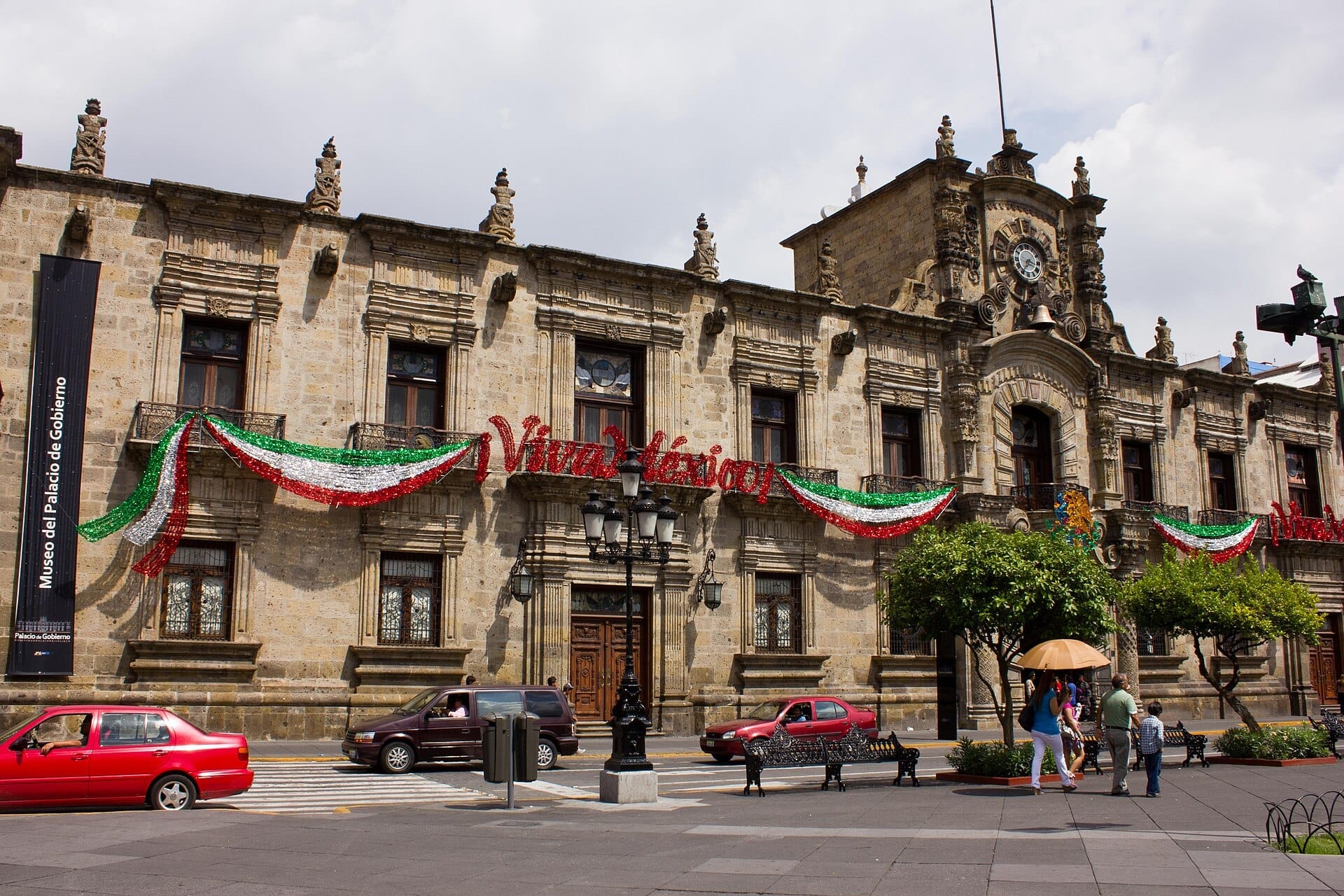
What Is the Palacio de Gobierno de Jalisco?
The Palacio de Gobierno del Estado de Jalisco is the official seat of Jalisco's state government, a working administrative building that also opens its courtyard and staircase murals to the public free of charge. It occupies a full city block facing Plaza de Armas in Guadalajara's Centro Histórico, and from the outside it presents a sober, two-story colonial baroque facade in pale stone that doesn't immediately telegraph the visual intensity waiting inside.
Construction began in 1750 and was completed in 1774, placing the building squarely in the late colonial period of New Spain. Over the following centuries, it became a node for some of the most pivotal moments in Mexican history: Miguel Hidalgo issued his abolition-of-slavery decree here in 1810, and Benito Juárez used the palace as a seat of national government twice during the Reform War period around 1858. Neither of those facts is merely ceremonial; the rooms where those decisions were made still exist.
For visitors following a walking route through the Centro Histórico, the Palacio de Gobierno is typically paired with the Cathedral, the Rotunda, and the Teatro Degollado, all within the same few blocks. But the palace deserves more than a quick pass-through.
ℹ️ Good to know
Opening hours are reported as Tuesday–Saturday 10:00–18:00, Sunday 10:00–15:00, closed Monday. Hours for the site museum (Museo de Sitio de Palacio de Gobierno) may differ slightly. Confirm current hours on arrival or contact the Secretaría de Cultura Jalisco before visiting.
The Orozco Murals: The Real Reason to Come
The artistic centerpiece of the palace is a set of murals by José Clemente Orozco, one of the three giants of Mexican muralism alongside Diego Rivera and David Alfaro Siqueiros. Orozco painted the main staircase mural in 1937, and it is among the most viscerally powerful works of public art in Mexico.
The staircase composition centers on Miguel Hidalgo, rendered not as a saintly founding father but as a figure of fire and fury, torch raised above a churning mass of bodies and chains. The palette is all scorched oranges, blacks, and deep reds. Orozco was not making a commemorative portrait; he was making a statement about revolution, liberation, and the violence those things require. Standing at the base of the staircase and looking up, the scale is genuinely overwhelming.
A second smaller mural by Orozco is located in the Sala de Gobierno (the Governor's Meeting Room), depicting symbolic allegorical figures. These works sit within the broader context of Guadalajara's extraordinary mural heritage; the Hospicio Cabañas holds Orozco's most complete mural cycle and is a UNESCO World Heritage Site, but the Palacio murals are more immediately accessible and free to see without an admission fee.
💡 Local tip
Photography is generally permitted in the public areas of the palace. The staircase mural photographs best in the morning when natural light from the courtyard windows reduces glare. Avoid midday if you're bringing a camera with limited dynamic range.
Tickets & tours
Hand-picked options from our booking partner. Prices are indicative; availability and final rates are confirmed when you complete your booking.
Lake Chapala and Ajijic guided tour from Guadalajara
From 68 €Instant confirmationFree cancellationGuadalajara and Tlaquepaque guided tour
From 73 €Instant confirmationFree cancellation
The Architecture: Colonial Baroque in the Centro
The palace's exterior is colonial baroque in character, built from the same pale cantera stone used for the Guadalajara Cathedral nearby. The facade is measured and formal without the theatrical ornamentation of some Mexican baroque buildings; the real architectural drama is internal. Two stories of arcaded corridors wrap around a rectangular central courtyard, and it's in this courtyard that the proportions become clear: the stone is honey-colored in morning light and cooler, almost grey, by late afternoon.
The lower arcade columns are thick and grounded, while the upper arcade opens into narrower arches that let in more sky. The courtyard floor is typically occupied by a small number of visitors moving between the ground-level administrative functions and the staircase entrance to the upper floor. Because this is a working government building, not a pure museum, the atmosphere has an interesting friction between official bureaucratic life and cultural tourism.
The palace sits on the south side of Plaza de Armas, Guadalajara's main civic square, and frames one edge of the historic ceremonial center along with the Cathedral to the north and the Teatro Degollado to the east. From the upper corridor of the palace, the view across the rooftops toward the Cathedral's twin towers is worth a photograph.
What the Visit Actually Feels Like
Entering from the street on the Morelos or Ramón Corona side, you pass through a security checkpoint; expect a bag check, similar to entering any government building. The process is quick. The ground floor corridors are often quietly busy on weekday mornings with people on official business, creating a different texture from a purely touristic site.
The courtyard itself is calm, and the stone keeps it cool even when temperatures outside are pushing toward the low 30s in May or June. On Sunday mornings especially, when foot traffic in the centro is lighter, the courtyard has an almost contemplative quality: echoing footsteps, pigeons occasionally cutting across the open sky above, and the low sound of the city filtering in through the arcade.
The staircase mural is on the upper floor, accessible via the main ceremonial staircase off the courtyard. This is where most visitors spend the majority of their time, standing at various distances from the painting to take in its different scales. The surrounding rooms, including the Sala de Gobierno and connected ceremonial spaces, are sometimes open for public viewing and sometimes not, depending on whether official meetings or events are scheduled. There is no formal tour structure; visitors move independently.
⚠️ What to skip
Because the palace is a functioning government building, certain rooms and corridors may be closed to visitors without notice. Don't base your visit around guaranteed access to every room; the staircase mural and courtyard are the most reliably accessible areas.
Historical Significance: Beyond the Architecture
Few buildings in Guadalajara carry the documentary weight of this one. When Miguel Hidalgo arrived in the city in late 1810 during the early phase of the independence movement, he issued his decree abolishing slavery from this palace on December 6, 1810. The decree predated the U.S. Emancipation Proclamation by more than fifty years and made Jalisco one of the first territories in the Americas to formally abolish the institution.
During the War of Reform in the late 1850s, the liberal president Benito Juárez also used Guadalajara and this building as a base of operations at a moment when his government was effectively a government in exile after leaving Mexico City. The room where Juárez reportedly came close to being executed by mutinous soldiers in 1858 is part of the palace's historical narrative, though access to specific rooms tied to these events varies.
For a deeper reading of Orozco's muralism and its political context, the guide to Orozco's murals in Guadalajara covers the full arc of his work across the city, including the Hospicio Cabañas and the University of Guadalajara.
Practical Information for Your Visit
Getting There
The palace is in the geometric center of Guadalajara's historic core. From the light rail system (SITEUR), the closest stations are Guadalajara Centro on Line 3 and Plaza Universidad on Line 2, both within a few minutes' walk. Ride-hailing apps (Uber, DiDi) will get you to within a block, though the street grid immediately around the plaza can be one-way and slightly confusing for drivers unfamiliar with the area.
Best Time to Visit
Weekday mornings between 10:00 and 12:00 offer the quietest conditions inside the palace. Weekends bring more tourist foot traffic around Plaza de Armas, which spills into the palace to some degree. Sunday afternoons are the most crowded and also have shorter hours (closing at 15:00). For photography of the staircase mural, morning natural light from the east-facing courtyard windows is the most favorable.
Climate-wise, the most comfortable months to be in this part of the centro are November through February, when temperatures sit between roughly 15 and 25°C and rainfall is minimal. The June-to-September rainy season brings afternoon downpours but also cools the city; the stone interior of the palace remains comfortable regardless of outside weather.
What to Bring and Wear
This is a government building and a public cultural space; smart-casual or neat casual attire is appropriate. There is no formal dress code beyond the general norms for entering an official Mexican government facility. A small bag or daypack is fine through security. If you plan to photograph the murals, a smartphone with a good wide-angle lens will handle the tight staircase space better than a large telephoto setup.
Accessibility
No detailed official accessibility documentation for the palace (ramps, elevators, adapted facilities) has been published by state authorities at the time of writing. Visitors with mobility requirements should contact the Secretaría de Cultura Jalisco or inquire on arrival. The ground floor courtyard is at street level; the staircase mural is, by definition, only accessible via stairs.
Who Should Skip This
The Palacio de Gobierno is not a hands-on or interactive experience. There are no audio guides, no interpretive displays in English, and the site museum format is minimal. Visitors expecting a curated museum experience with labeled context panels in multiple languages may find it sparse. Children without a specific interest in murals or colonial architecture may also find the visit short on engagement. If your priority is a broader survey of Guadalajara's museums, the Museo Regional de Guadalajara or the Hospicio Cabañas offer more structured experiences.
Insider Tips
- The upper corridor facing Plaza de Armas gives you a straight-on view of the Cathedral's twin yellow-tiled towers; it's one of the cleaner architectural photography angles in the centro and almost no one stops there.
- Government officials and employees move through the building throughout the day. Being respectful and low-key gets you further than treating the place like a pure tourist attraction; staff are generally helpful to visitors who approach them politely.
- If you arrive and find a particular room closed, check back in 20–30 minutes. Closures for brief official meetings or document signings are common and don't always last long.
- Pair the palace with a counter-clockwise walking loop through the centro: start at Plaza de Armas, enter the palace, cross to the Cathedral, follow the covered walkway to the Plaza de la Liberación, and finish at the Teatro Degollado. The whole loop takes under two hours at a relaxed pace.
- The Orozco staircase mural reads differently depending on where you stand. Spend time at the base looking straight up, then move to the landing mid-staircase and turn around. The figure of Hidalgo shifts in emphasis and scale significantly between these two positions.
Who Is Palacio de Gobierno de Jalisco For?
- First-time visitors to Guadalajara who want to understand the city's political and cultural identity in one stop
- Mural art enthusiasts building an itinerary around Orozco's work across the city
- History travelers interested in Mexican independence and the Reform War period
- Architecture visitors tracing colonial baroque construction in western Mexico
- Budget travelers: free entry makes this one of the highest-value stops in the Centro Histórico
Nearby Attractions
Other things to see while in Centro Histórico:
- Calandrias (Horse-Drawn Carriage Rides)
Calandrias are Guadalajara's traditional horse-drawn carriages, operating through the colonial streets of the Centro Histórico since the early 20th century. A slow, unhurried circuit past cathedral facades, plazas, and pedestrian corridors, they offer a different pace from the city's foot traffic. This guide covers what to expect, when to go, and whether it's worth your time.
- Guadalajara Cathedral (Catedral de Guadalajara)
The Catedral Basílica de la Asunción de María Santísima anchors Guadalajara's historic center, surrounded by four plazas and centuries of layered history. Its twin neo-Gothic spires are the city's most recognized silhouette, and entry is free. Here is everything you need to know before you go.
- Instituto Cultural Cabañas (Hospicio Cabañas)
A UNESCO World Heritage Site at the heart of Guadalajara's Centro Histórico, Hospicio Cabañas houses José Clemente Orozco's most celebrated murals inside a neoclassical complex of staggering scale. This is the single most significant cultural site in western Mexico, and one of the most important in all of Latin America.
- Lienzo Charro de Jalisco
The Lienzo Charro Charros de Jalisco, on Av. R. Michel near Parque Agua Azul, is one of Mexico's most storied charro arenas. Home to one of Mexico's oldest charro associations, this is where Jalisco's equestrian traditions are kept alive through competitive charreadas, pageantry, and music.