Teatro Degollado: Inside Guadalajara's Grand Opera House
Teatro Degollado is Guadalajara's most storied performance venue, a neoclassical opera house inaugurated in 1866 that still hosts the Orquesta Filarmónica de Jalisco today. Whether you visit for a concert or simply to see the interior, it anchors the historic center in a way few buildings can.
Quick Facts
- Location
- C. Degollado s/n, Zona Centro, Guadalajara, Jalisco — on the main plaza between Av. Hidalgo and Av. Morelos
- Getting There
- Centro Histórico is served by light rail Lines 2 and 3; the theater is a short walk from Plaza Universidad (Line 2) or Guadalajara Centro (Line 3) stations
- Time Needed
- 30–45 min for an interior visit; 2–3 hours for a full performance
- Cost
- Interior visits: free during public hours (currently publicized as Tue–Fri 13:00–15:00, subject to rehearsal schedules). Performance tickets vary by event; priced in MXN — check the Orquesta Filarmónica de Jalisco website for current listings
- Best for
- Architecture lovers, classical music fans, history seekers, and travelers doing a Centro Histórico walking circuit
- Official website
- en.ofj.com.mx/teatro-degollado
What Is Teatro Degollado?
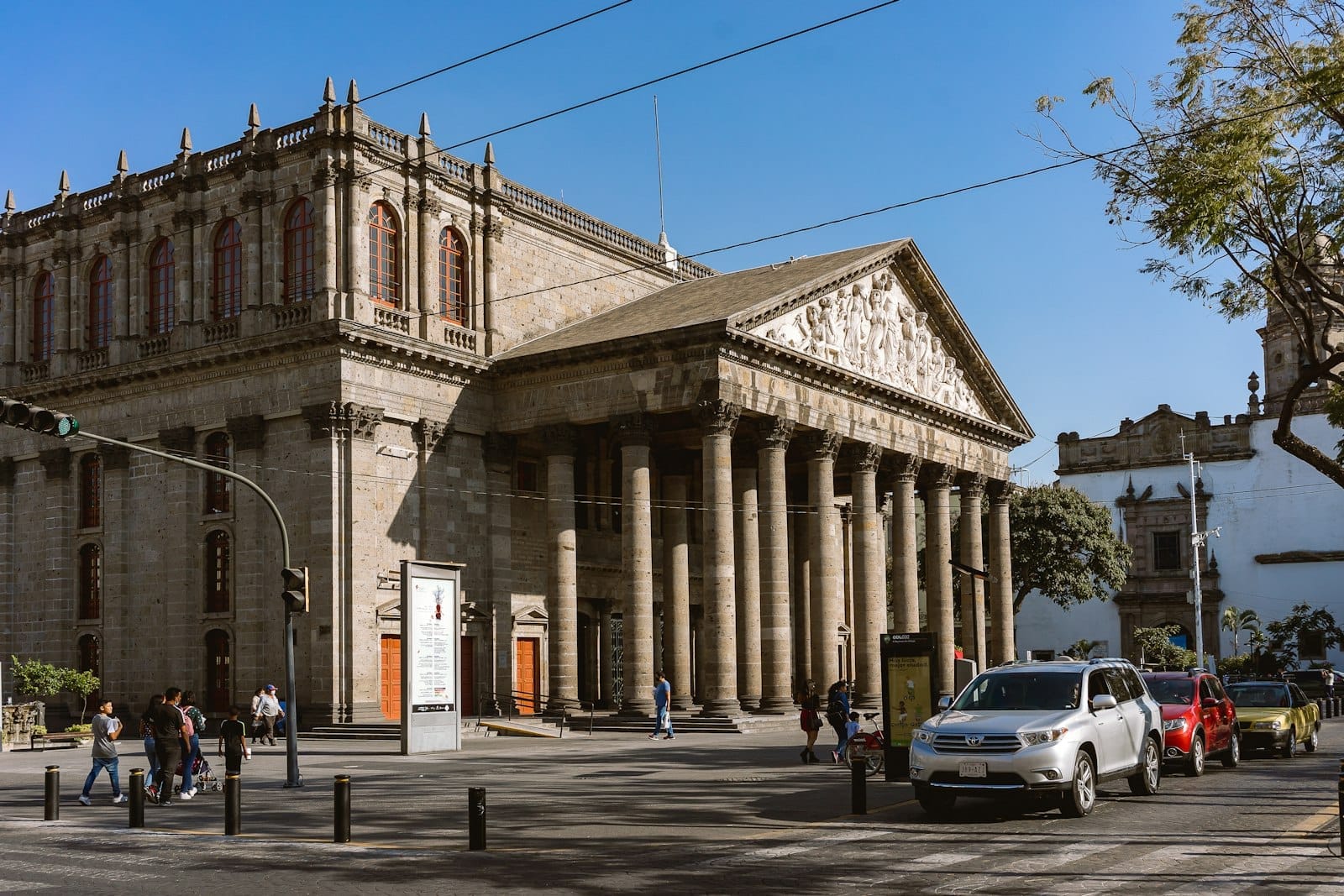
Teatro Degollado is Guadalajara's principal opera house and one of the finest surviving examples of 19th-century neoclassical theater architecture in Mexico. It stands at the eastern edge of the city's central plaza complex, its columned portico facing Plaza de la Liberación along the open pedestrian corridors that connect Guadalajara Cathedral and Plaza Tapatía into a single monumental urban axis.
The building measures roughly 97 meters long, 36.4 meters wide, and about 22 meters high. That scale is easy to miss from the outside because the surrounding plazas are so spacious, but once you walk through the entrance colonnade, the proportions become clear. The main hall seats 1,027 people across multiple tiers. A smaller chamber hall in the basement seats 120 and hosts more intimate recitals and chamber music performances.
Today it is the home venue of the Orquesta Filarmónica de Jalisco and regularly hosts opera, ballet, and international touring productions. For travelers exploring Guadalajara's historic center, the theater is a logical anchor point in any walking route.
History and Architectural Context
The cornerstone was laid by architect Jacobo Gálvez in 1856, when construction began. Construction stretched across a decade of political turmoil in Mexico, including the Reform War and the French intervention, which explains why the building took ten years to complete. It was inaugurated on September 13, 1866, with a performance of Donizetti's Lucia di Lammermoor featuring soprano Ángela Peralta, then one of the most celebrated opera voices in Mexico and the Americas.
The theater was named after Santos Degollado, a general and liberal politician from Jalisco who died in 1861. The name connects the building to a specific moment in Mexican nation-building, and that context matters when you look at the monumental friezes and allegorical figures on the facade. They are not just decorative — they situate the theater within a very deliberate civic ideology: culture as a pillar of the new republic.
Architecturally, the building draws on the Italian neoclassical tradition that Mexican elites of the period associated with civilization and progress. The portico features a row of Corinthian columns surmounted by a tympanum relief depicting Apollo and the nine Muses. Above the stage inside, the dome ceiling is painted with a scene from Dante's Divine Comedy — a choice that tells you something about the aspirations of Guadalajara's intellectual class in the 1860s.
💡 Local tip
Look up at the dome ceiling the moment you enter the main hall. The Dante fresco is the single most impressive interior detail and easy to miss if you get distracted by the tiered balconies at eye level.
Tickets & tours
Hand-picked options from our booking partner. Prices are indicative; availability and final rates are confirmed when you complete your booking.
Lake Chapala and Ajijic guided tour from Guadalajara
From 68 €Instant confirmationFree cancellationGuadalajara and Tlaquepaque guided tour
From 73 €Instant confirmationFree cancellation
What the Visit Actually Feels Like
During public visiting hours on weekday afternoons (often publicized as Tuesday through Friday, 13:00 to 15:00), the theater opens its main hall to walk-in visitors when no rehearsals or events are scheduled. The experience depends heavily on what is happening that day. On quiet afternoons with no rehearsal, you can stand in the center of the stalls and look up at the full auditorium in near-silence — the red velvet seats, the gilded balcony rails, the painted dome — with almost no one else around. It is one of the more striking architectural interiors in the city, and the absence of crowds makes it more so.
If a rehearsal is in progress, access may be restricted to the lobby and lower vestibule. Staff are generally courteous about explaining what is accessible on any given day. The lobby itself has polished stone floors, high ceilings, and a pair of sweeping staircases worth seeing even if the hall is closed. The building smells faintly of old wood and stone polish — the kind of sensory detail that confirms you are in a working institution, not a frozen museum piece.
Attending a performance is a different experience entirely. The Orquesta Filarmónica de Jalisco maintains a regular season, and seeing a full symphony concert here, with the acoustics the hall was designed to carry, is the reason this building was built. Ticket prices vary by program and seat location; check the orchestra's official website for current listings.
⚠️ What to skip
Public visiting hours (often Tue–Fri 13:00–15:00) are subject to change without notice based on rehearsal and event schedules. Always verify before visiting by checking the Orquesta Filarmónica de Jalisco website or calling ahead. Arriving mid-afternoon on a weekday without checking is a gamble.
How the Theater Fits Into the Plaza Circuit
Teatro Degollado sits at one end of a remarkable sequence of connected public spaces. To its west is Plaza de la Liberación, then Guadalajara Cathedral and Plaza de Armas. Behind the theater to the east stretches Plaza Tapatía, an expansive pedestrian boulevard that leads toward the Hospicio Cabañas. This entire axis can be walked in one direction in about twenty minutes, and Teatro Degollado is its natural midpoint.
The theater's main facade faces Plaza de la Liberación, which means you approach it from the west with the cathedral at your back. At this angle in the morning, the portico is in shadow and the columns read clearly against the stone. By mid-afternoon, the sun moves around and the facade glows a pale amber. Photographers who want a clean shot of the colonnade without backlit contrast should aim for overcast mornings or the hour before sunset when the light is even.
The plaza immediately in front of the theater is a constant social space. Vendors sell corn, fruit, and snacks from carts. Retired men play dominoes on the low stone benches. School groups pass through regularly, led by teachers pointing up at the columns. In the evenings before performances, the crowd changes: couples in formal dress, international tourists with programs, families settling in for a night out. The theater does not exist in isolation — it is embedded in Guadalajara's daily life in a way that major performance venues in other cities often are not.
Practical Information for Visitors
The theater is located on Calle Degollado, flanked by Avenida Hidalgo and Avenida Morelos, in the heart of Guadalajara's historic center. It is reachable on foot from the Metro's Juárez station (Line 1) or San Juan de Dios station (Line 2) in under ten minutes. Ride-hailing apps including Uber and DiDi serve the area; ask to be dropped at 'Teatro Degollado, Centro Histórico.' Taxis from the centro are straightforward.
If you are planning a full day in the historic center, consider pairing a theater visit with the Palacio de Gobierno (two minutes on foot) and the Rotonda de los Jaliscienses Ilustres, which is visible from the cathedral atrium. The entire circuit is covered in the Guadalajara walking tour guide if you want a structured route with timing.
On the question of dress code: casual clothing is fine for an interior visit during public hours. For performances, smart casual is appropriate for most events. Opera and formal gala evenings may see a dressier crowd, but there is no enforced dress code beyond general tidiness. Regarding accessibility, official sources confirm the building has been recently restored but do not publish detailed information on step-free access or elevator availability. Visitors with specific mobility needs should contact the Orquesta Filarmónica de Jalisco or the Secretaría de Cultura Jalisco directly before visiting.
Who Should Visit and Who Might Not
The theater's interior visit is genuinely worth making if you have any interest in architecture, 19th-century Mexican history, or classical performance spaces. The hall is impressive without being overwhelming, and the Dante fresco alone sets it apart from generic civic buildings. For travelers doing a full Centro Histórico day, the visit costs nothing and takes under an hour.
Travelers with children may find the interior visit underwhelming for younger kids unless they have a specific interest in historical buildings. There is no interactive element, no café inside, and the visiting window is narrow. For family-focused itineraries, the theater is best treated as a brief stop within the plaza circuit rather than a destination in itself.
Visitors who are primarily interested in contemporary art or street culture will find more to engage with in Colonia Americana a few kilometers west. The theater is a 19th-century institution, and the experience reflects that: formal, quiet, and historically dense.
Insider Tips
- Check the Orquesta Filarmónica de Jalisco website a few weeks before your trip. Tickets for popular programs sell out, and some events are priced very accessibly by international standards — attending a full symphony concert here can cost less than a museum ticket in many European cities.
- The chamber hall in the basement seats only about 120 people and hosts more intimate concerts. These events are less publicized but often more atmospheric than the main hall performances. Look for chamber music listings specifically when browsing the schedule.
- If you want the interior to yourself, arrive right at 13:00 when public visiting hours open on a weekday. By 14:00, tour groups and school visits often start arriving and the stalls get crowded.
- Photography inside the main hall is generally permitted during visiting hours (not during performances). Use the wide-angle setting on your phone and position yourself at the back of the stalls, centered, to capture the full sweep of the balconies and dome in one frame.
- The best exterior photographs of the colonnade are taken from the center of Plaza de la Liberación, far enough back to include the full portico and tympanum. Moving too close flattens the columns and loses the architectural proportions.
Who Is Teatro Degollado For?
- Architecture enthusiasts who want to see a preserved 19th-century neoclassical interior without a tour group
- Classical music fans seeking a world-class acoustic venue on a modest budget
- History travelers connecting the building to Jalisco's Reform-era political history
- Photographers working a Centro Histórico walking circuit and looking for strong interior shots
- Couples looking for a cultural evening that doesn't require advance planning — walk-in ticket availability for many performances is common outside peak events
Nearby Attractions
Other things to see while in Centro Histórico:
- Calandrias (Horse-Drawn Carriage Rides)
Calandrias are Guadalajara's traditional horse-drawn carriages, operating through the colonial streets of the Centro Histórico since the early 20th century. A slow, unhurried circuit past cathedral facades, plazas, and pedestrian corridors, they offer a different pace from the city's foot traffic. This guide covers what to expect, when to go, and whether it's worth your time.
- Guadalajara Cathedral (Catedral de Guadalajara)
The Catedral Basílica de la Asunción de María Santísima anchors Guadalajara's historic center, surrounded by four plazas and centuries of layered history. Its twin neo-Gothic spires are the city's most recognized silhouette, and entry is free. Here is everything you need to know before you go.
- Instituto Cultural Cabañas (Hospicio Cabañas)
A UNESCO World Heritage Site at the heart of Guadalajara's Centro Histórico, Hospicio Cabañas houses José Clemente Orozco's most celebrated murals inside a neoclassical complex of staggering scale. This is the single most significant cultural site in western Mexico, and one of the most important in all of Latin America.
- Lienzo Charro de Jalisco
The Lienzo Charro Charros de Jalisco, on Av. R. Michel near Parque Agua Azul, is one of Mexico's most storied charro arenas. Home to one of Mexico's oldest charro associations, this is where Jalisco's equestrian traditions are kept alive through competitive charreadas, pageantry, and music.