Plaza de la Liberación: Guadalajara's Grand Civic Heart
Plaza de la Liberación is one of the largest of the four interconnected plazas forming Guadalajara's historic center. Stretching between the Cathedral and Teatro Degollado, this open public square is free to enter at any hour and offers some of the most photogenic views in the city.
Quick Facts
- Location
- Calle Degollado entre Calle Morelos y Avenida Hidalgo, Zona Centro, Guadalajara, Jalisco — between the Cathedral and Teatro Degollado
- Getting There
- Walk from San Juan de Dios station (Line 2) or take any bus to Centro Histórico; ride-hailing drop-off on Calle Morelos
- Time Needed
- 20–45 minutes for the plaza itself; 2–3 hours if combining with adjacent plazas and monuments
- Cost
- Free. Open 24 hours as a public space
- Best for
- History lovers, architecture enthusiasts, photographers, walkers exploring the historic center
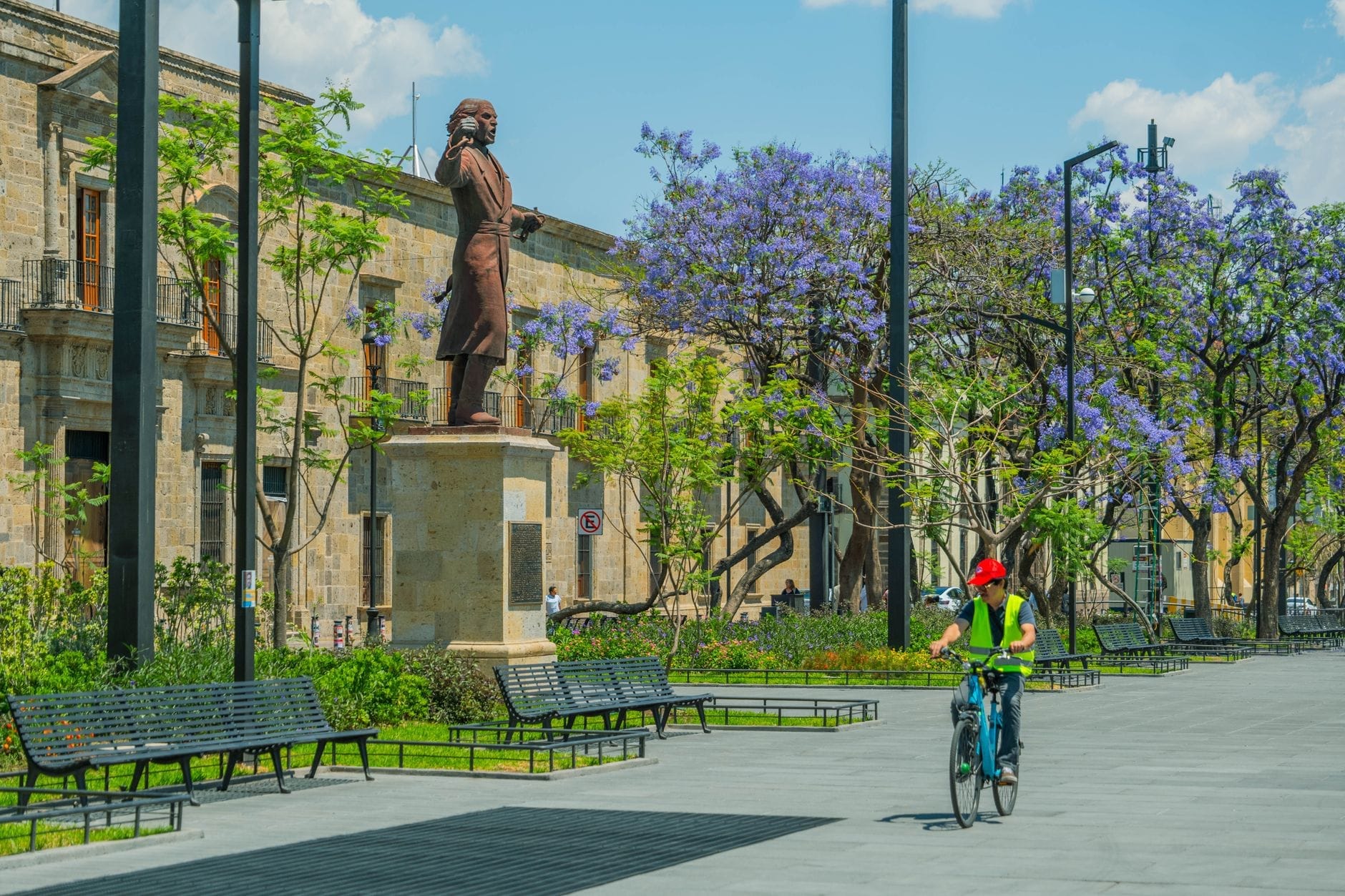
What Is Plaza de la Liberación?
Plaza de la Liberación is the most expansive of the four plazas that form Guadalajara's celebrated "cruz de plazas" (cross of plazas) in the Centro Histórico. Covering roughly 9,500–10,000 square meters, it functions as both a visual corridor and a social gathering point, anchored at its western end by the Guadalajara Cathedral and at its eastern end by the neoclassical Teatro Degollado. The result is one of the most dramatically framed public spaces in western Mexico.
The plaza is also known locally by two informal names: "Plaza de los Tres Poderes" and "Plaza de las Dos Copas," the latter a reference to its two large ornamental fountains that anchor the central axis. Neither name appears on official signage, but both circulate freely among tapatíos (Guadalajara locals), so you may hear either in conversation.
💡 Local tip
The plaza is free and open around the clock. Lighting and security are maintained at night, making it reasonably comfortable for evening walks, though the surrounding streets quiet down considerably after 10 pm on weekdays.
A Square Built on Demolished History
Plaza de la Liberación did not exist before the mid-20th century. It was conceived in the late 1940s and early 1950s as part of an ambitious urban redesign of Guadalajara's historic core, in which architect Ignacio Díaz Morales played a leading role. To create the open plaza, two city blocks of colonial-era buildings dating from the viceregal period were demolished — a decision that remains controversial among heritage preservationists even today.
The plaza's original planned name was "Plaza de los Poderes," a reference to the three branches of government whose buildings border it. Governor González Gallo later renamed it Plaza de la Liberación to align it thematically with Mexican independence. That political reframing is embodied most literally in the plaza's centerpiece: a bronze statue of Miguel Hidalgo y Costilla, the Catholic priest whose call to arms in 1810 launched the Mexican War of Independence. The statue, designed within Díaz Morales’s broader project and installed in the early 1950s, depicts Hidalgo physically breaking chains, a pose that reads as deliberately theatrical at close range.
The demolition of colonial structures to make way for this plaza puts it in a complicated position within Guadalajara's architectural history. The buildings lost were not minor — they were part of a continuous urban fabric going back centuries. What replaced them is undeniably impressive in scale, but the trade-off is worth knowing before you visit, particularly if architecture or heritage is your primary interest.
Tickets & tours
Hand-picked options from our booking partner. Prices are indicative; availability and final rates are confirmed when you complete your booking.
Lake Chapala and Ajijic guided tour from Guadalajara
From 68 €Instant confirmationFree cancellationGuadalajara and Tlaquepaque guided tour
From 73 €Instant confirmationFree cancellation
The View Down the Axis: What You Actually See
Stand near the Hidalgo statue and look west: you have an unobstructed sightline to the Cathedral's twin yellow-tiled towers rising against the sky. Turn 180 degrees and the neoclassical facade of Teatro Degollado fills your field of vision. Few city squares in Mexico offer this kind of composed bilateral symmetry — two major monuments at either end of a single open corridor.
The two fountains along the central walkway are substantial — wide, low basins with upward jets that catch afternoon light in a way that photographs well from low angles. In the dry season (roughly November through April), the light is sharp and the sky tends toward a deep blue that sets off the Cathedral's towers cleanly. During the rainy season (June through September), afternoon thunderstorms roll in quickly and turn the sky dramatic, sometimes producing strong photographic contrast. Bring a light jacket or compact umbrella from June onward — the afternoon rains arrive fast.
The plaza also connects naturally into a broader walking circuit. To the north, the Rotonda de los Jaliscienses Ilustres is a short walk. To the south, the Plaza de Armas opens beside the Palacio de Gobierno. The full circuit of all four plazas can be walked comfortably in under an hour at a slow pace.
How the Plaza Changes Through the Day
Early morning, between 7 and 9 am, the plaza is nearly empty. The light hits the Cathedral towers at a shallow angle and the stone underfoot is cool and quiet. Street sweepers work through the space, and the fountains are sometimes switched off until later in the morning. This is the calmest window for photography and slow observation.
By mid-morning, the square fills with a characteristic mix: government workers crossing through toward surrounding buildings, school groups moving in loose formations toward the Cathedral or Teatro Degollado, vendors near the perimeter selling snacks and newspapers, and tourists stopping at the Hidalgo statue for photographs. The benches along the main walkway are occupied throughout the day, mostly by locals resting or eating rather than tourists sightseeing.
Late afternoon, particularly on weekends, the plaza takes on a livelier character. Families gather near the fountains, caricature artists set up near the Teatro Degollado end, and the volume of foot traffic increases markedly. During major holidays, civic events, and festivals, the square becomes a significant gathering point for public ceremonies — Independence Day celebrations in September being among the most attended.
ℹ️ Good to know
The plaza underwent a notable rehabilitation of its paving, landscaping, and street furniture that was completed very recently. The current surface is level and well-maintained, making it accessible for visitors with limited mobility. Note that detailed information about accessible restrooms in the immediate area is not readily available — plan accordingly.
Surrounding Landmarks Worth Combining
The plaza's position makes it an effective base for exploring the densest concentration of historic landmarks in Guadalajara. The Teatro Degollado on the eastern edge is worth examining even if you do not attend a performance — its neoclassical columns and Apollo and the Muses fresco above the entrance are visible from the plaza's edge. Check the theater's schedule in advance if you want to see the interior, which requires a ticket to a performance or a guided tour when available.
Directly to the west, the Cathedral anchors the entire plaza sequence. The Palacio de Gobierno is a two-minute walk south and houses the José Clemente Orozco murals that many visitors consider the most important artworks in the city. Combining all three in a single half-day walk is straightforward and requires no advance booking for the open spaces.
If you want to extend the walk eastward after the plaza, the Hospicio Cabañas — a UNESCO World Heritage Site housing Orozco's most celebrated murals — is approximately a 10-minute walk along Calle Morelos. This is the single highest-priority cultural stop in the Centro Histórico for most visitors interested in art or history.
Photography Practical Notes
The east-west orientation of the plaza means morning light falls on the Teatro Degollado facade and afternoon light illuminates the Cathedral towers. If the Cathedral is your main subject, plan to be here between 3 and 5 pm on a clear day. For the Teatro Degollado, early morning before 9 am gives the softest light and the fewest people crossing your frame.
A wide-angle lens captures the full axis in a single frame from near the Hidalgo statue. The fountains work well as foreground elements when shooting toward either end. At night, both the Cathedral and Teatro Degollado are illuminated, and the fountain jets catch the light interestingly — though the overall scene is darker than most cameras handle well without a tripod.
⚠️ What to skip
Like any crowded public square, keep an eye on bags and cameras. The plaza itself is well-patrolled and generally safe, but the surrounding streets see the petty opportunism common to any high-traffic tourist zone.
Who This Plaza Suits — and Who Might Be Underwhelmed
For anyone exploring the Centro Histórico on foot, Plaza de la Liberación is not optional — it connects the key landmarks and provides the visual context that makes the district readable as a whole. First-time visitors to Guadalajara will find it essential simply for orientation.
That said, travelers seeking intimacy or greenery may find the plaza slightly stark. The space is large, paved, and exposed. There are benches and two fountains, but relatively little shade and minimal vegetation compared to, say, Parque Revolución or Parque Agua Azul. If you want a relaxed green space rather than a civic monument, this is not the right stop.
Visitors focused purely on colonial architecture may also find the plaza's 1950s origin slightly disappointing once they realize the colonial blocks it replaced are gone. The surrounding buildings are genuinely historic, but the plaza itself is a modern intervention into a much older urban fabric.
Insider Tips
- Arrive before 8 am on a weekday to photograph the Cathedral-to-Teatro Degollado axis without crowds in the frame. The fountains may not be running yet, but the light and the stillness more than compensate.
- The low viewing angle from near the central fountains looking west toward the Cathedral gives a sense of scale that standard eye-level shots miss — crouch down to get the fountain basins in the foreground.
- If you are in Guadalajara in September, the civic ceremonies around Mexican Independence Day (September 15–16) fill this plaza with large crowds and official pageantry. Spectacular to witness, but expect very limited mobility in the square.
- The nearest sit-down café options are on the streets flanking Teatro Degollado and along Plaza Tapatía to the east — do your reconnaissance walk first and then settle in for a coffee with a view before the midday heat peaks.
- Combine this plaza with the full "cruz de plazas" circuit: Plaza Guadalajara, Plaza de Armas, Rotonda de los Jaliscienses Ilustres, and Plaza de la Liberación form a continuous pedestrian route that most visitors walk in 45–75 minutes total, depending on how long they linger at each stop.
Who Is Plaza de la Liberación For?
- First-time visitors to Guadalajara who want to understand the city's civic layout in a single walk
- Architecture and urban history enthusiasts interested in 20th-century Mexican civic design alongside colonial-era buildings
- Photographers looking for the most compositionally framed views of the Cathedral and Teatro Degollado
- Travelers building a half-day Centro Histórico walking itinerary anchored around the cruz de plazas
- Anyone attending an event at Teatro Degollado who wants to arrive early and take in the surroundings
Nearby Attractions
Other things to see while in Centro Histórico:
- Calandrias (Horse-Drawn Carriage Rides)
Calandrias are Guadalajara's traditional horse-drawn carriages, operating through the colonial streets of the Centro Histórico since the early 20th century. A slow, unhurried circuit past cathedral facades, plazas, and pedestrian corridors, they offer a different pace from the city's foot traffic. This guide covers what to expect, when to go, and whether it's worth your time.
- Guadalajara Cathedral (Catedral de Guadalajara)
The Catedral Basílica de la Asunción de María Santísima anchors Guadalajara's historic center, surrounded by four plazas and centuries of layered history. Its twin neo-Gothic spires are the city's most recognized silhouette, and entry is free. Here is everything you need to know before you go.
- Instituto Cultural Cabañas (Hospicio Cabañas)
A UNESCO World Heritage Site at the heart of Guadalajara's Centro Histórico, Hospicio Cabañas houses José Clemente Orozco's most celebrated murals inside a neoclassical complex of staggering scale. This is the single most significant cultural site in western Mexico, and one of the most important in all of Latin America.
- Lienzo Charro de Jalisco
The Lienzo Charro Charros de Jalisco, on Av. R. Michel near Parque Agua Azul, is one of Mexico's most storied charro arenas. Home to one of Mexico's oldest charro associations, this is where Jalisco's equestrian traditions are kept alive through competitive charreadas, pageantry, and music.