Plaza Tapatía: Guadalajara's Grand Pedestrian Heart
Stretching seven city blocks through the historic center of Guadalajara, Plaza Tapatía is one of Latin America's largest urban pedestrian plazas. Free to enter, lined with public sculpture, and flanked by one UNESCO-recognized landmark and other major civic buildings, it functions as the connective tissue of downtown life.
Quick Facts
- Location
- Entre Avenida Hidalgo y Calle Morelos, Zona Centro, Guadalajara, Jalisco, Mexico
- Getting There
- Multiple city bus lines along Calzada Independencia; Centro Histórico is served by the SITEUR light rail network, including nearby stations like San Juan de Dios and Guadalajara Centro on Line 2 and Line 3
- Time Needed
- 45 minutes to walk end-to-end; 2–3 hours if visiting adjacent landmarks
- Cost
- Free — public plaza, no admission charge
- Best for
- Architecture lovers, cultural walkers, photography, casual people-watching
What Plaza Tapatía Actually Is
Plaza Tapatía is not a single square. It is a sequence of connected open-air spaces covering about 70,000 square meters of pedestrian territory in the heart of Guadalajara's Centro Histórico. Inaugurated on 5 February 1982, it was designed to link two of the city's most significant landmarks: the neoclassical Teatro Degollado to the west and the Museo Cabañas (Instituto Cultural Cabañas) to the east. The result is an urban corridor that replaced several older city blocks, creating a car-free spine through downtown that Tapatíos — as Guadalajara residents are known — use daily for transit, leisure, and informal gathering.
The plaza is divided into several named sub-plazas: Plaza de los Fundadores, Plaza Degollado, Plaza Morelos, Plaza López Portillo, Plaza Weber, the Explanada Central, and the Paseo del Hospicio. Understanding this structure helps you navigate it with intention rather than drifting through it. If you are planning a full walk through the Centro Histórico, treating Plaza Tapatía as your organizing axis makes sense — most major downtown sights are reachable within a short walk of it.
💡 Local tip
Start your visit at the Teatro Degollado end in the morning, when the light hits the stone facades from the east. Walk toward Hospicio Cabañas and finish with the interior murals there, which require a separate admission ticket.
The Quetzalcóatl Fountain: The Plaza's Centerpiece
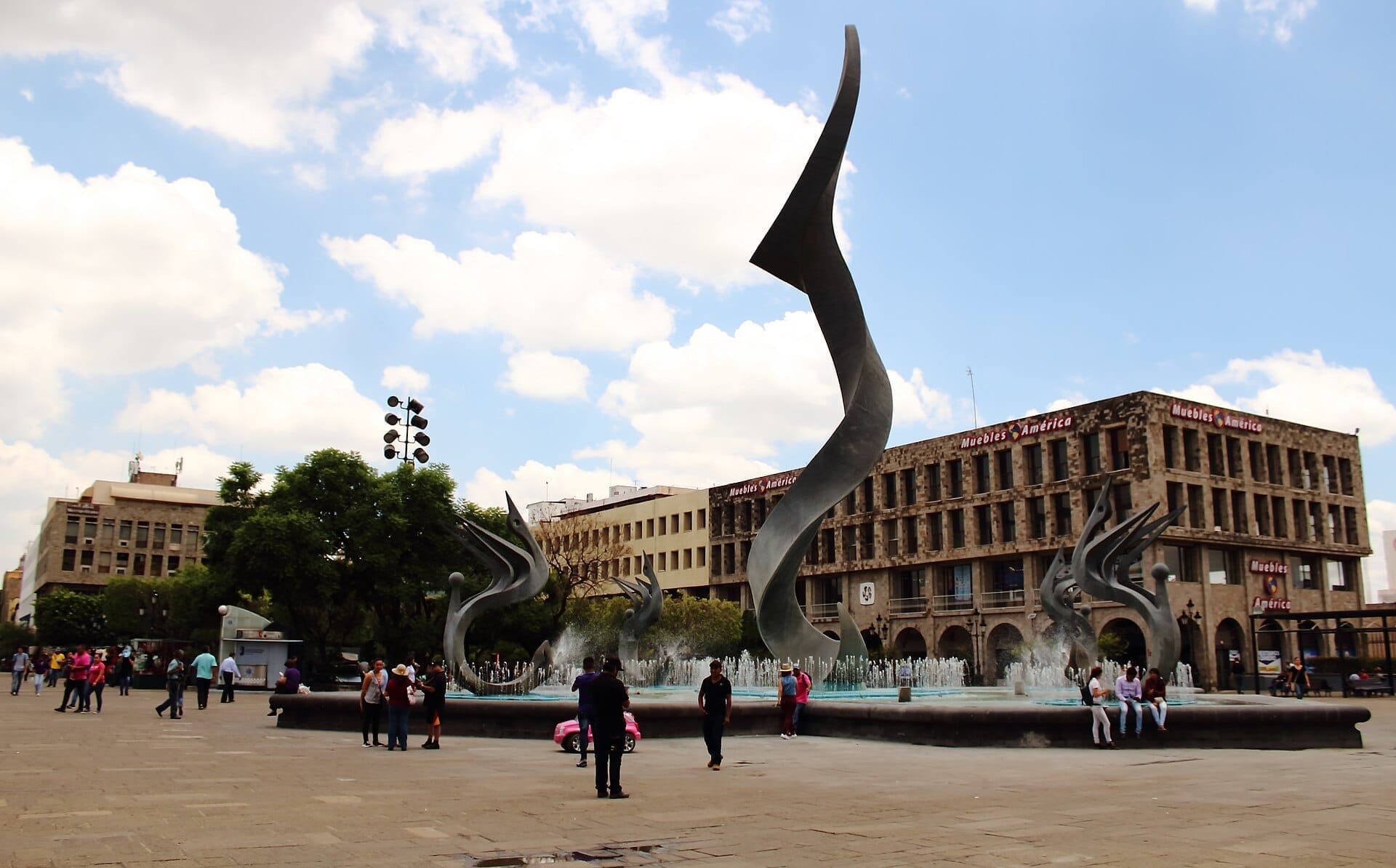
The dominant sculptural element of Plaza Tapatía is the Fuente de la Inmolación a Quetzalcóatl, created by sculptor Víctor Manuel Contreras (1934–2021). The fountain sits at the heart of the central esplanade and depicts the mythological sacrifice of the feathered serpent deity Quetzalcóatl — a reference to pre-Hispanic cosmology that feels deliberately grounding in a plaza otherwise defined by Spanish colonial and 20th-century civic architecture.
The fountain is the practical landmark most visitors use to orient themselves on the plaza. A municipal tourist information module is positioned nearby, staffed at set hours and able to assist with basic orientation and queries. If you arrive without a plan, this is a logical first stop.
In the evenings, the fountain is lit and often surrounded by couples, families with children, and street performers. The surrounding paving stays warm underfoot from a full day of sun, and the scale of the open esplanade gives the space a civic formality that quiets down only after 10 p.m. on weeknights.
Tickets & tours
Hand-picked options from our booking partner. Prices are indicative; availability and final rates are confirmed when you complete your booking.
Lake Chapala and Ajijic guided tour from Guadalajara
From 68 €Instant confirmationFree cancellationGuadalajara and Tlaquepaque guided tour
From 73 €Instant confirmationFree cancellation
How the Plaza Changes Through the Day
Early morning, roughly 7–9 a.m., belongs to commuters cutting through on foot and vendors setting up along the edges. The stone surfaces are cool, the light is horizontal, and the crowds are purposeful rather than touristic. This is the hour when you notice the scale of the place most clearly, with few people around to fill it.
By midday, especially on weekends, the plaza fills with families, informal merchants, balloon sellers, and the occasional political demonstration near the Plaza de los Fundadores end. The sun overhead is relentless between May and August, and the lack of significant shade across the main esplanade becomes a real factor. Daytime temperatures in Guadalajara often reach around 30–32°C during those months, and the stone and concrete surfaces amplify the heat. Bring water, wear a hat, and consider moving through quickly during peak afternoon hours.
Late afternoon, around 5–7 p.m., is when the plaza finds its most photogenic state. The sun drops toward the western end, silhouetting the Teatro Degollado's neoclassical colonnade and casting long shadows across the paving. Street musicians tend to appear at this hour. The Hospicio Cabañas glows amber on its facade when the light catches it right, which makes the eastern end of the Paseo del Hospicio worth walking to at sunset even if you have already visited the building.
⚠️ What to skip
Shade is minimal across the central esplanade. During June through September — Guadalajara's rainy season — afternoon thunderstorms can develop quickly. There is limited shelter on the open plaza itself; the colonnades of Teatro Degollado and the arcade near Hospicio Cabañas provide refuge.
The Architectural Frame: What Surrounds the Plaza
Plaza Tapatía owes much of its visual authority to what sits at its ends. To the west, the Teatro Degollado presents one of Mexico's finest neoclassical theater facades, its pediment carved with a frieze representing Apollo and the nine Muses. Begun in 1856 and inaugurated in 1866, the building defines the western entrance to the plaza corridor and creates an institutional gravitas that sets the tone for the entire walk.
At the eastern end, the Hospicio Cabañas is a UNESCO World Heritage Site, one of the most important monuments in the Americas. Founded in the early 19th century as a hospital and orphanage (construction began in 1805 and it was inaugurated in 1810), the building houses José Clemente Orozco's monumental mural cycle, including the famous 'Man of Fire' painted in the main chapel dome. It is worth noting clearly: Hospicio Cabañas is a separate paid attraction. Visiting the exterior from the plaza is free, but the interior murals — the main reason to come — require a ticket. Do not skip the interior.
The Calzada Independencia bisects the plaza corridor at its midpoint, creating a brief interruption in the pedestrian experience. Crossing here connects you to the Mercado San Juan de Dios to the south, one of the largest covered markets in Mexico. The crossing point is worth pausing at: looking north from Calzada Independencia gives a clear sightline up toward the Barranca de Huentitán, while looking south you see the mass of the market building.
Practical Walkthrough: Navigating the Seven Blocks
The full length of Plaza Tapatía typically takes under 30 minutes to walk at a comfortable pace without stopping. Most visitors naturally move faster than that, but the sub-plazas reward slower attention. Plaza de los Fundadores, near the Teatro Degollado end, contains bronze statues commemorating Guadalajara's founding figures and serves as a popular resting point with benches and some shade from surrounding buildings.
The Plaza Weber section, closer to the Hospicio Cabañas end, is generally quieter and more local in character. Street food vendors operate along the edges here, and it is a reasonable place to stop for a snack before entering the Hospicio. Typical offerings include elote (corn), tortas, and aguas frescas from mobile carts.
The paving throughout the plaza is largely flat and wide, making it accessible for wheelchairs and strollers in most sections. Uneven joints and occasional step transitions exist in some sub-plaza areas. A tourist information module near the central fountain can provide on-site guidance.
ℹ️ Good to know
Plaza Tapatía is a public space with no controlled access or closing time. However, the surrounding area of the Centro Histórico becomes notably quieter after 10 p.m. on weeknights. Use standard urban common sense at night, as in any large city center.
Photography and Visual Approach
For photography, the single best moment is the late afternoon window between 5 and 6:30 p.m. from October through March, when the sun is low enough to create warm, directional light without being directly overhead. Standing at the Hospicio Cabañas end and shooting west captures the length of the plaza with the Teatro Degollado colonnade in the background, and gives a strong sense of depth.
The Quetzalcóatl fountain photographs best at dusk when its illumination is activated, or in the very early morning when its reflection surfaces are calm. The surrounding esplanade offers enough open space to use a wide-angle lens effectively without distortion, though the midday sun creates harsh contrasts on the light-colored stone.
If you are primarily interested in architectural photography across the historic center, the Guadalajara architecture guide covers shooting angles and context for the cathedral, Palacio de Gobierno, and other nearby landmarks that can be combined with a Plaza Tapatía visit in a single half-day route.
Who Should Temper Their Expectations
Plaza Tapatía is a functional city plaza rather than a designed garden or curated experience. There are no cafes built into the space, no formal landscaping to speak of in the central areas, and limited seating in the main esplanade. Visitors expecting a European-style plaza with outdoor restaurants, tree-lined promenades, or a contained, picturesque space may find it underwhelming in isolation. Its real value is as a connector between landmarks, and the experience depends heavily on also visiting Teatro Degollado and Hospicio Cabañas.
Travelers sensitive to heat or crowds on weekends may find midday visits in summer genuinely uncomfortable. The lack of shade trees across much of the main esplanade is a real limitation in hot months. Visitors planning to linger should aim for early morning or early evening.
Insider Tips
- The tourist information module near the Quetzalcóatl fountain can provide basic tourist information and occasionally has promotional material for nearby attractions. It is easy to walk past without noticing it.
- The crossing at Calzada Independencia can be noisy and traffic-heavy. Cross at the designated pedestrian crossings; traffic flows fast here and the intersection is not always intuitive for visitors unfamiliar with the layout.
- On Sunday mornings, the Plaza de los Fundadores end of the plaza often hosts informal book and magazine sellers, alongside folk art vendors. It is one of the better times to see the plaza operating as a neighborhood space rather than a tourist corridor.
- The Paseo del Hospicio section — the easternmost stretch leading up to Hospicio Cabañas — is paved with a different stone and feels architecturally distinct from the rest of the plaza. Slow down here and look at the Hospicio facade before entering; it reads very differently from ground level than in photos.
- If you are visiting Hospicio Cabañas, buy your ticket before spending time on the plaza rather than after. The building closes in the early evening and it is easy to lose track of time on the plaza itself.
Who Is Plaza Tapatía For?
- First-time visitors to Guadalajara building a mental map of the historic center
- Architecture and urban design enthusiasts interested in 20th-century Mexican civic planning
- Photographers seeking wide, unobstructed compositions of colonial and modern Mexican facades
- Travelers on a tight budget who want a full half-day of cultural content for free (the plaza itself) plus one paid museum ticket
- Families with children who need open, flat space to walk through without pressure
Nearby Attractions
Other things to see while in Centro Histórico:
- Calandrias (Horse-Drawn Carriage Rides)
Calandrias are Guadalajara's traditional horse-drawn carriages, operating through the colonial streets of the Centro Histórico since the early 20th century. A slow, unhurried circuit past cathedral facades, plazas, and pedestrian corridors, they offer a different pace from the city's foot traffic. This guide covers what to expect, when to go, and whether it's worth your time.
- Guadalajara Cathedral (Catedral de Guadalajara)
The Catedral Basílica de la Asunción de María Santísima anchors Guadalajara's historic center, surrounded by four plazas and centuries of layered history. Its twin neo-Gothic spires are the city's most recognized silhouette, and entry is free. Here is everything you need to know before you go.
- Instituto Cultural Cabañas (Hospicio Cabañas)
A UNESCO World Heritage Site at the heart of Guadalajara's Centro Histórico, Hospicio Cabañas houses José Clemente Orozco's most celebrated murals inside a neoclassical complex of staggering scale. This is the single most significant cultural site in western Mexico, and one of the most important in all of Latin America.
- Lienzo Charro de Jalisco
The Lienzo Charro Charros de Jalisco, on Av. R. Michel near Parque Agua Azul, is one of Mexico's most storied charro arenas. Home to one of Mexico's oldest charro associations, this is where Jalisco's equestrian traditions are kept alive through competitive charreadas, pageantry, and music.