Parque Agua Azul: Guadalajara's Garden Escape in the City Center
Parque Agua Azul is a 10.3-hectare urban park on Calzada Independencia Sur, just south of Guadalajara's historic center. Built between 1946 and 1952 on the site of natural springs, it offers tree-lined paths, tropical greenhouses, an aviary, and a children's area with free general admission. It's one of the few large green spaces within easy reach of downtown.
Quick Facts
- Location
- Calzada Independencia Sur 973, Centro Histórico, Guadalajara, Jalisco
- Getting There
- City bus or Mi Macro Calzada (BRT) along Calzada Independencia; approx. 15 min from downtown by taxi or rideshare
- Time Needed
- 1 to 2 hours for a relaxed visit; more if you explore the greenhouse and aviary
- Cost
- Free general admission (verify on site; some internal areas such as guided aviary or orchid house visits may have separate fees)
- Best for
- Families with children, travelers needing a calm midday break, morning walkers
- Official website
- bosquesamg.mx/bosques-urbanos/parque-agua-azul
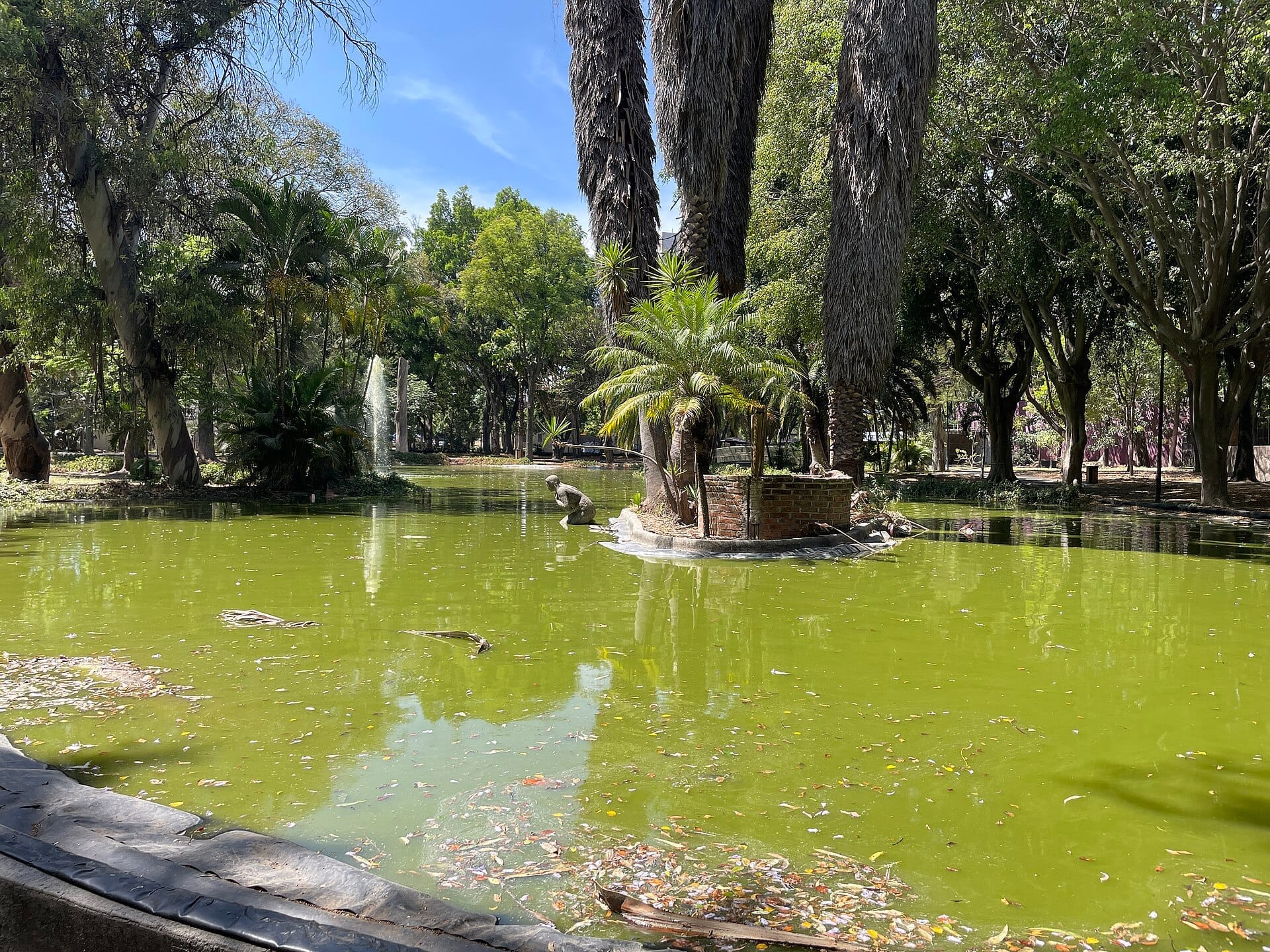
What Parque Agua Azul Actually Is
Parque Agua Azul is a 10.3-hectare public park on Calzada Independencia Sur, roughly 15 minutes south of Guadalajara's cathedral by car. The name refers to a blue-water lagoon that once occupied the site before the park was constructed between 1946 and 1952. Today it functions as one of the city's main urban green spaces just south of the Centro Histórico, managed as part of Guadalajara's Bosques Urbanos network and open daily from around 7:00 AM to 6:30 PM.
The park is not a wilderness retreat or a large botanical garden in the European sense. It is a well-used, moderately maintained urban park with paved paths, shade trees, a tropical greenhouse, an aviary with birds native to Mexico, a children's play zone, and open lawns. With free general admission, it is one of the most affordable ways to spend an hour or two away from Guadalajara's busier streets.
ℹ️ Good to know
Admission is currently free for general entry. Some internal areas, including the greenhouse and aviary, may require separate tickets or be included depending on current park policy. Verify at the entrance gates before visiting, as pricing can change.
History: Springs, Lagoons, and a Mid-Century Makeover
The land now occupied by Parque Agua Azul has a longer story than the park itself suggests. Natural springs and shallow lagoons dotted this part of southern Guadalajara through the 19th century, and locals used the water sources as informal gathering areas long before any formal landscaping took place. The blue-tinged water of the original lagoon gave the park its name.
The planned park took shape between 1946 and 1952, part of a mid-20th century effort to give Guadalajara organized green space as the city expanded rapidly after World War II. The formal design replaced the natural wetland with paths, gardens, and institutional buildings inside the grounds. Several of those original structures, including the greenhouse and certain pavilion areas, remain part of the park today. What you see is essentially a 1950s public garden that has been maintained and gradually updated without any dramatic overhaul.
Tickets & tours
Hand-picked options from our booking partner. Prices are indicative; availability and final rates are confirmed when you complete your booking.
Lake Chapala and Ajijic guided tour from Guadalajara
From 68 €Instant confirmationFree cancellationGuadalajara and Tlaquepaque guided tour
From 73 €Instant confirmationFree cancellation
What You Will See Inside
The park covers its 10.3 hectares in a roughly rectangular layout. Paved paths connect the main attractions, which keeps the walking relatively easy even for visitors who are not particularly mobile. The paths are generally level, which makes this one of the more wheelchair-accessible green spaces in the central city, though specific provisions such as tactile signage or accessible toilet facilities should be confirmed at the entrance.
The tropical greenhouse is one of the park's more interesting structures. Inside, the humidity rises noticeably and the dense planting creates an enclosed, slightly theatrical atmosphere distinct from the open lawns outside. Exotic plants and ferns fill the space, and the contrast between the greenhouse interior and the dry-season air outside is immediately physical. The aviary houses a collection of birds including species native to Mexico and is compact enough that even young children hold attention throughout.
Beyond the greenhouse and aviary, the park offers shaded benches, open grassy areas where families spread out on weekends, a children's play zone, and food vendors near the entrance selling snacks and drinks. The overall atmosphere is that of a neighborhood park used genuinely by locals rather than a curated attraction performing primarily for tourists.
Visitors interested in paleontology should note that the Museo de Paleontología de Guadalajara is located within or directly adjacent to the park grounds. Its collection of fossil specimens from the Jalisco region is worth factoring into your visit time, particularly for families traveling with curious children.
How the Park Feels at Different Times of Day
Early mornings, from opening around 7:00 AM until about 9:00 AM, are the quietest window. The temperature in Guadalajara's dry season months sits comfortably in the low 20s Celsius at that hour, and the park draws joggers, dog walkers, and older residents doing slow laps on the paths. The light through the tree canopy is sharp and clear, and there is very little traffic noise from Calzada Independencia yet. If you want to photograph the greenhouse or the aviary without crowds, this is the time.
By mid-morning on weekdays, small school groups begin to arrive, particularly on days when local schools are visiting the paleontology museum. The park does not become overwhelming at these times, but the energy shifts. Weekends from around 10:00 AM onward see families occupying the lawns, and the food vendors near the entrance do steady business. Sundays in particular have a relaxed, extended-family atmosphere that makes the park feel like a genuine slice of tapatío life.
Afternoons between 14:00 and 16:00 in the dry season (November to April) can be warm. Temperatures in Guadalajara commonly reach 28 to 30 degrees Celsius in the warmest months, and the open sections of the park offer little relief from direct sun. The shade trees around the perimeter paths are more comfortable during these hours. The park closes at approximately 18:30, so late-afternoon visits are possible but do not offer much buffer time.
💡 Local tip
Rainy season runs June through September. Afternoon thunderstorms are common in July and August. If you visit during these months, arrive in the morning to avoid being caught in rain with limited shelter inside the park.
Getting There and Practical Logistics
The park's address is Calzada Independencia Sur 973, at the intersection of González Gallo and Washington streets. The Mi Macro Calzada BRT line, which runs along Calzada Independencia, serves the surrounding corridor and puts the park within walking distance of nearby stations along that route. City buses operating on Calzada Independencia also pass the park entrance regularly. A rideshare from the historic center via Uber or DiDi typically takes 10 to 15 minutes depending on traffic and costs a modest fare.
If you are building an itinerary around this part of the city, Parque Agua Azul fits naturally alongside the area's other landmarks. The Hospicio Cabañas, a UNESCO World Heritage Site housing José Clemente Orozco's famous murals, is located in the eastern part of the historic center and makes a logical pairing for a morning or afternoon. Both can be covered in a half-day without rushing.
Travelers planning a broader walking route through the historic center can reference the Guadalajara walking tour guide which covers the major landmarks and squares within the Centro Histórico in a logical sequence.
Photography Notes
The greenhouse offers the most photogenic interior in the park, with layered green fronds and filtered light that work well with a wide-angle lens or a phone camera in portrait mode. The aviary is more challenging to photograph through mesh enclosures, but patient visitors can find angles near the gaps in the mesh that allow for cleaner shots of the birds. The park's ornamental fountain areas and entry gates have a mid-century Mexican public architecture quality that rewards close-up details over wide establishing shots.
Overcast days, which are more common during the rainy season, actually produce better light for photography inside the park than harsh midday sun. If you are visiting for photography specifically, an overcast morning in the dry season strikes the best balance between diffuse light and comfortable weather.
Who Should Consider Skipping This
Travelers with very limited time in Guadalajara and a priority focus on architecture, murals, and colonial heritage may find that Parque Agua Azul competes with higher-priority sites nearby. The park is pleasant but not exceptional by international standards. Visitors expecting a formal botanical garden with labeled specimens and curated horticultural collections will be underwhelmed. Similarly, those hoping for a large natural space for hiking or wildlife observation should look elsewhere.
If green space and nature are your main interest, the Bosque Los Colomos in northern Guadalajara offers a larger and more ecologically varied environment, including a Japanese garden, and is better suited to longer outdoor walks.
Insider Tips
- Arrive before 9:00 AM on weekdays for the calmest experience. The park is noticeably less crowded before school group visits begin mid-morning.
- Bring cash in small denominations. There is no entrance fee and vendors inside sell snacks and drinks, but card payment is unlikely to be accepted at informal stands.
- Check the Parque Agua Azul Facebook page before visiting for any event closures or changes to hours. The city occasionally uses the park grounds for fairs and cultural events that can affect normal access.
- The paleontology museum within the park grounds is worth combining with your visit, especially if you are traveling with children. Factor in an extra 30 to 45 minutes if you plan to go inside.
- On Sundays the park fills with local families and the atmosphere is at its most social. If you prefer a quieter experience, a Tuesday or Wednesday morning is significantly calmer.
Who Is Parque Agua Azul For?
- Families with young children looking for a low-cost, walkable outdoor space near the city center
- Travelers wanting a calm midday break from the sensory intensity of the historic center's plazas and markets
- Morning joggers or walkers based in downtown Guadalajara hotels
- Photography enthusiasts interested in mid-century Mexican public architecture and tropical greenhouse interiors
- Budget-conscious visitors who want to spend a few hours outdoors without paying museum prices
Nearby Attractions
Other things to see while in Centro Histórico:
- Calandrias (Horse-Drawn Carriage Rides)
Calandrias are Guadalajara's traditional horse-drawn carriages, operating through the colonial streets of the Centro Histórico since the early 20th century. A slow, unhurried circuit past cathedral facades, plazas, and pedestrian corridors, they offer a different pace from the city's foot traffic. This guide covers what to expect, when to go, and whether it's worth your time.
- Guadalajara Cathedral (Catedral de Guadalajara)
The Catedral Basílica de la Asunción de María Santísima anchors Guadalajara's historic center, surrounded by four plazas and centuries of layered history. Its twin neo-Gothic spires are the city's most recognized silhouette, and entry is free. Here is everything you need to know before you go.
- Instituto Cultural Cabañas (Hospicio Cabañas)
A UNESCO World Heritage Site at the heart of Guadalajara's Centro Histórico, Hospicio Cabañas houses José Clemente Orozco's most celebrated murals inside a neoclassical complex of staggering scale. This is the single most significant cultural site in western Mexico, and one of the most important in all of Latin America.
- Lienzo Charro de Jalisco
The Lienzo Charro Charros de Jalisco, on Av. R. Michel near Parque Agua Azul, is one of Mexico's most storied charro arenas. Home to one of Mexico's oldest charro associations, this is where Jalisco's equestrian traditions are kept alive through competitive charreadas, pageantry, and music.