Bosque Los Colomos: Guadalajara's Urban Forest Worth the Trip
Spanning roughly 92 hectares in northwestern Guadalajara, Bosque Los Colomos is a protected urban forest with ponds, pine-scented trails, and a Japanese garden donated by the city of Kyoto. Admission is free, and the park draws everyone from pre-dawn joggers to Sunday families.
Quick Facts
- Location
- Calle El Chaco 3200, Colonia Providencia, Guadalajara, Jalisco
- Getting There
- Plaza Patria light-rail station (approx. 30-min walk west along Av. Patria); ride-hailing apps drop off at main entrance
- Time Needed
- 1–3 hours depending on pace and whether you visit the Japanese garden
- Cost
- Free entry for all visitors; some specific activities or permits (such as professional photography or the Japanese garden) may carry separate fees (verify on site — prices subject to change)
- Best for
- Joggers, families, photographers, anyone needing a break from the city grid
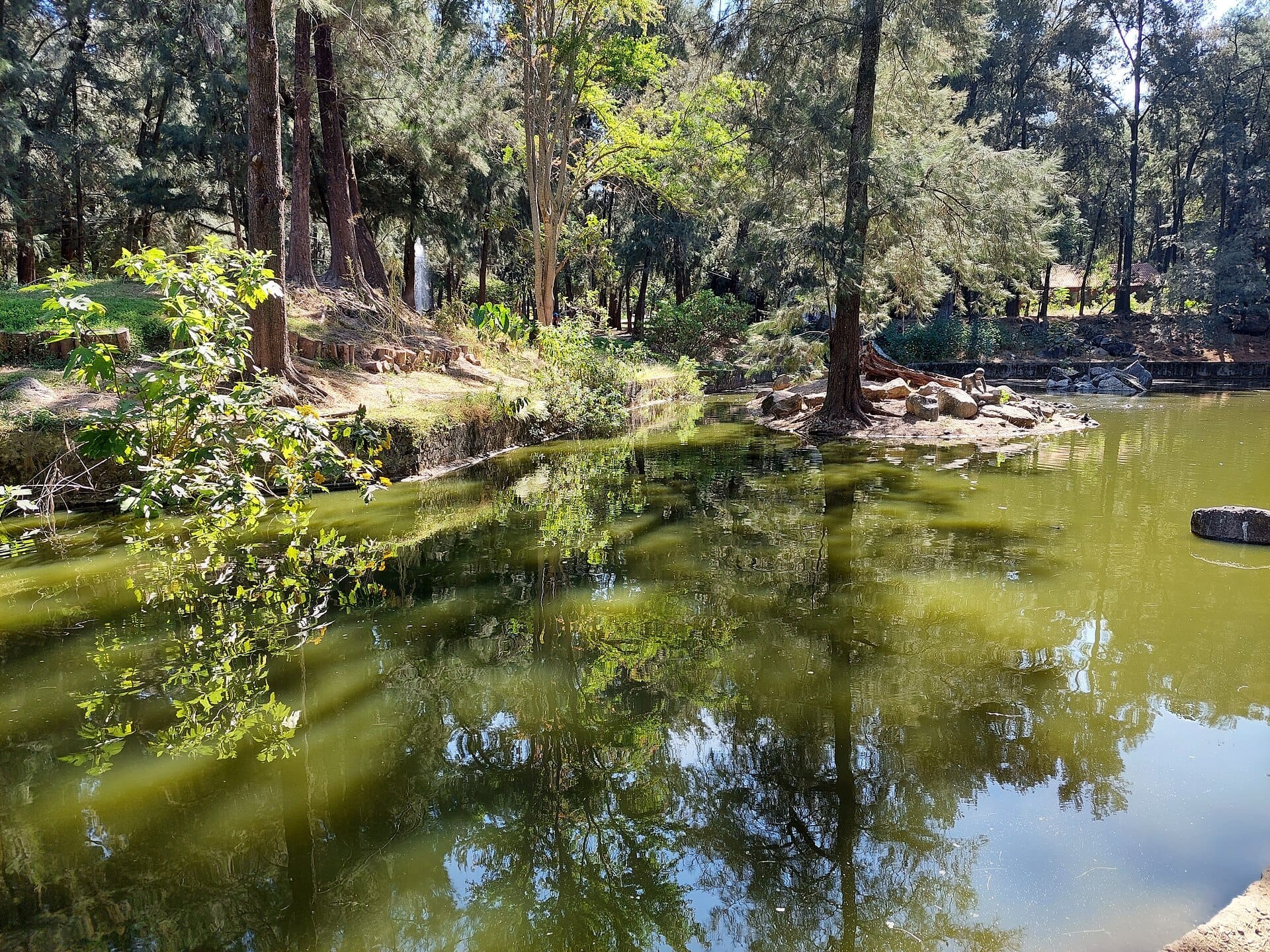
What Bosque Los Colomos Actually Is
Bosque Los Colomos is a protected urban forest covering approximately 92 hectares on the northwestern edge of Guadalajara, right on the boundary with Zapopan. It holds about 32,000 trees — pine, eucalyptus, cedar, and others — and includes a network of walking and jogging paths, several ponds, and a formal Japanese garden. It was declared an Área Natural de Protección Hidrológica (hydrological protection natural area) in 2011, giving it legal status that limits development inside its boundaries.
The park's origins are less romantic than its current appearance suggests. In the late 19th century, the site was developed as part of Guadalajara's waterworks infrastructure. The springs and water channels that fed the city's supply gave the area its name — 'Colomos' derives from the local word for the spring sources. Governor Luis del Carmen Curiel later converted the land into a public park, and the transition from utility infrastructure to green lung has shaped its character ever since: you still walk past stone channels and old water features between the trees.
For context on how Los Colomos fits into Guadalajara's broader park network, the full guide to things to do in Guadalajara covers the city's green spaces alongside its cultural sites.
How the Park Changes Through the Day
Arrive before 8:00 AM and the park belongs to runners and dog walkers. The light filters in low through the pine canopy, the air smells of damp earth and eucalyptus, and the jogging track around the perimeter is busy enough to feel lively but not crowded. This is genuinely the best window for photography: soft light, no harsh shadows, and a mist that sometimes sits over the ponds in the cooler months.
By mid-morning, families start arriving, especially on weekends. Children head for the open grassed areas and the pond edges. Vendors set up near the main entrance selling snacks and drinks. The atmosphere shifts toward something more social and unhurried. Midday in summer can be warm, but the tree cover keeps interior paths noticeably cooler than the surrounding streets. Guadalajara sits at roughly 1,550 meters elevation, which softens the heat compared to coastal cities, but shade still matters from about 11:00 AM onward.
Late afternoon, from around 4:00 PM, brings another wave of visitors as the workday ends. The golden light through the pines at this hour is genuinely worth seeking out if you have a camera. The park’s official closing time is currently 7:00–7:30 PM depending on the managing authority’s listing, so plan to arrive with enough buffer and confirm hours locally — they may vary slightly by entrance or season.
💡 Local tip
Entry is free year-round. If your schedule is flexible, Sunday morning before 9:00 AM gives you manageable crowds before families arrive in force.
Tickets & tours
Hand-picked options from our booking partner. Prices are indicative; availability and final rates are confirmed when you complete your booking.
Lake Chapala and Ajijic guided tour from Guadalajara
From 68 €Instant confirmationFree cancellationGuadalajara and Tlaquepaque guided tour
From 73 €Instant confirmationFree cancellation
The Japanese Garden: A Specific Reason to Come
The Japanese garden inside Bosque Los Colomos is one of the more unexpected places in Guadalajara. It was donated by the people of Kyoto and opened in 1987, a product of the sister-city relationship between Guadalajara and Kyoto. The garden follows traditional Japanese design principles: a central koi pond, stone lanterns, arched wooden bridges, bamboo groves, and carefully shaped plantings. Within a Mexican urban forest, the tonal contrast is striking.
The garden is compact enough to walk through in 20 minutes, but most visitors slow down considerably inside it. The sound shifts: the ambient noise of the city disappears almost entirely, replaced by water movement and birdsong. In the rainy season (roughly June through September), the vegetation is at its densest and the koi pond at its fullest. In the dry winter months, the garden is quieter and the structure of the planting becomes more visible.
This garden has its own dedicated guide — see the Japanese garden at Bosque Los Colomos for practical details on visiting, photography, and what to expect seasonally.
Walking the Trails: What to Expect Practically
The trail network inside Los Colomos is a mix of concrete paths and compacted dirt tracks. The concrete sections are generally flat and suitable for steady walkers; the dirt tracks through the forest interior can be uneven, with exposed roots and soft ground after rain. Wheelchair users and visitors with limited mobility should be aware that not all sections are accessible — there is no detailed official accessibility specification published for the park, so it is worth contacting the park administration directly before visiting if this matters for your group.
Wear closed-toe shoes rather than sandals if you plan to leave the main paved loop. The interior trails are worth the slight detour: the density of the tree canopy increases sharply away from the main paths, and you get a better sense of the 32,000-tree scale of the forest. Navigation is straightforward enough that you are unlikely to get seriously lost, but the park is large enough that it is possible to spend 45 minutes on an unmarked fork without realising you have been going in circles.
⚠️ What to skip
The rainy season (June–September) turns dirt paths muddy quickly. If you visit after recent rainfall, stick to the concrete perimeter track unless you do not mind muddy footwear.
Dogs are commonly walked inside the park and the atmosphere toward animals is relaxed, though there is no formal off-leash area. Cyclists use the perimeter paths as well — pedestrians and cyclists share space without strict lane separation, so be aware of that if you are walking with small children.
Getting There and Practical Logistics
The main entrance is at Calle El Chaco 3200, Colonia Providencia. The park sits at the northwestern edge of Guadalajara proper, bordering Zapopan. By ride-hailing app (Uber, DiDi, or Cabify all operate in Guadalajara), the journey from the Centro Histórico typically takes around 20–30 minutes depending on traffic, and the fare to this part of the city is generally in the lower range for cross-city trips. Drop-off at the main entrance is straightforward.
By public transit, a nearby light‑rail reference point is the Plaza Patria station on the SITEUR network. From there, the park is roughly a 25–30‑minute walk west along Avenida Patria. City buses also serve routes through the Providencia and Chapalita neighborhoods — the Mi Transporte system covers this area, though specific route numbers should be confirmed using the Gobierno de Jalisco's Mi Movilidad information before you travel. Fares on city buses are low, typically single-digit to low tens of pesos, but confirm before boarding.
Parking is available at the park. Reported parking fees range roughly from MXN $30 to $50 depending on length of stay, though this is from a secondary source and should be confirmed on arrival. Parking carries a separate fee (currently around MXN 31–52 depending on duration; verify on arrival).
If you are orienting yourself across the city's transport options more broadly, the guide to getting around Guadalajara covers the metro, BRT, and ride-hailing in practical detail.
Honest Assessment: Who This Is For and Who Should Skip It
Bosque Los Colomos is not a destination in the way that the Hospicio Cabañas or the Teatro Degollado are destinations. It does not offer a single focused experience or a specific cultural insight you cannot find elsewhere. What it offers is green space, breathing room, and a genuine sense of being away from the city's noise and traffic without leaving city limits. If your itinerary is packed with museums and plazas and you are trying to maximise cultural content, this probably does not compete for your limited time.
For visitors who are spending three or more days in Guadalajara, or who are working or living in the city for a stretch, Los Colomos provides something the city's central neighborhoods cannot: actual forest. The scale of it, 92 hectares and about 32,000 trees, makes it feel substantially wilder than a city park. Joggers, cyclists, and anyone who finds their thinking clarified by walking under trees will find it valuable out of proportion to its cultural weight.
Travelers on a short trip who want to concentrate on the city's historic core might prioritize sites like the Hospicio Cabañas or the Teatro Degollado before adding a park visit.
Families with young children get particularly good value here. The open grassed areas, the pond edges to peer into, the relative safety of closed-off traffic-free paths, and the near-zero entry cost make it a practical option for an afternoon when children need space to move. The Japanese garden holds the attention of older children and adults who appreciate the design contrast within the forest setting.
ℹ️ Good to know
There are no formal food stalls or restaurants inside the park — only occasional snack vendors near the main entrance. Bring water, especially between April and June when daytime temperatures in Guadalajara can reach 30–32°C (86–90°F).
Insider Tips
- Sunday mornings before 9:00 AM are rarely crowded. Most families arrive mid-morning, so an early Sunday visit gives you a quieter forest before the crowds build.
- The ponds in the interior section, away from the Japanese garden, are less photographed and often more atmospheric. Look for them on the dirt trails northeast of the garden — the reflections are best in still morning air.
- If you are visiting during the rainy season, come in the first hour after rain stops. The forest smell intensifies dramatically and the eucalyptus canopy steams slightly in the warmth. It is one of the more vivid sensory experiences the park offers.
- Bring exact change for parking if you drive. The booths at the parking entrance do not reliably have change for larger bills, particularly early in the morning before trading builds up.
- The perimeter jogging track is concrete and measurable — regular runners in Guadalajara use it for interval training. If you are traveling with running gear and want a predictable surface rather than trail conditions, stick to the outer loop rather than the interior dirt paths.
Who Is Bosque Los Colomos For?
- Joggers and cyclists looking for a traffic-free route through genuine tree cover
- Families with children who need open outdoor space at minimal cost
- Photographers seeking soft natural light in the early morning hours
- Digital nomads or longer-stay visitors who need a mental reset from urban density
- Anyone with an interest in Japanese garden design in an unexpected context
Nearby Attractions
Combine your visit with:
- Ajijic (Lake Chapala Village)
Ajijic sits on the north shore of Lake Chapala, about an hour south of Guadalajara. With pre-conquest roots, cobblestone streets lined with art galleries, and one of Mexico's largest expat communities, it offers a completely different pace from the city. There is no admission fee to visit, and the town is accessible year-round.
- Bosque de La Primavera
Just 12 km west of Guadalajara, Bosque de La Primavera is a 30,500-hectare protected forest area offering hiking, birdwatching, hot springs, and rare ecological zones. It is one of the few places near a major Mexican city where you can genuinely disconnect from urban noise within 30 minutes.
- Japanese Garden — Bosque Los Colomos
Tucked inside the 93-hectare urban forest of Bosque Los Colomos, the Jardín Japonés is a formal Japanese-style garden donated by the people of Kyoto in 1994. It offers koi ponds, stone lanterns, arched bridges, and the kind of deliberate stillness that is genuinely hard to find in a city of over 1.5 million people.
- Agave Fields of Tequila (UNESCO Landscape)
The Agave Landscape and Ancient Industrial Facilities of Tequila is one of Mexico's most significant UNESCO World Heritage Sites, covering 34,658 hectares of blue agave fields, volcanic foothills, pre-Columbian terraces, and historic distilleries in Jalisco. Located roughly 67 km (about 42 km as the crow flies) northwest of Guadalajara, it is both a working agricultural landscape and a layered record of 2,000 years of human culture.