Agave Landscape and Ancient Industrial Facilities of Tequila: A Complete Visitor Guide
The Agave Landscape and Ancient Industrial Facilities of Tequila is one of Mexico's most significant UNESCO World Heritage Sites, covering 34,658 hectares of blue agave fields, volcanic foothills, pre-Columbian terraces, and historic distilleries in Jalisco. Located roughly 67 km (about 42 km as the crow flies) northwest of Guadalajara, it is both a working agricultural landscape and a layered record of 2,000 years of human culture.
Quick Facts
- Location
- Municipalities of Tequila, Amatitán, El Arenal, Magdalena, and Teuchitlán, Jalisco — approx. 67 km northwest of Guadalajara
- Getting There
- ~45–60 min drive from Guadalajara via highway toward Tepic; tourist train (Jose Cuervo Express) takes approx. 2 hours from Guadalajara
- Time Needed
- Half day minimum for a focused distillery visit; full day recommended to explore the landscape, town, and archaeological zone
- Cost
- No admission fee to the landscape itself; distillery tours and the tourist train charge separate fees — verify current prices with individual operators
- Best for
- Cultural history, agro-tourism, photography, spirits enthusiasts, day-trippers from Guadalajara
- Official website
- whc.unesco.org/en/list/1209
What Is This Place, Exactly
The Agave Landscape and Ancient Industrial Facilities of Tequila, inscribed on the UNESCO World Heritage List on 12 July 2006, is not a park with a ticket booth and a guided path. It is a living, working cultural landscape of 34,658 hectares stretching from the volcanic foothills of Volcán de Tequila down through the Rio Grande valley. The fields are still farmed. The distilleries still operate. The agave is still harvested by hand, the same way it has been for centuries.
That distinction matters for managing expectations. There is no single entrance, no central visitor center for the landscape as a whole, and no standardized admission fee to the UNESCO site itself. What you can visit are the components that make it up: the agave fields themselves, the town of Tequila as the most accessible gateway, individual distilleries that offer tours, the Teuchitlán archaeological zone, and the surrounding agricultural towns. The experience you have depends almost entirely on how you structure your day.
ℹ️ Good to know
The UNESCO designation covers a 34,658-hectare area within the municipalities of Tequila, Amatitán, El Arenal, Magdalena, and Teuchitlán. The town of Tequila is the most visited entry point, but the broader landscape rewards travelers who venture beyond the main distillery strip.
Two Thousand Years in a Field of Blue
The agave plant has been woven into the fabric of this region for at least 2,000 years. Long before the Spanish arrived, pre-Columbian communities fermented agave sap into a ritual drink called pulque, used the fibrous leaves for rope and cloth, and shaped the volcanic slopes into agricultural terraces that are still visible today. The Teuchitlán culture, which flourished in this area roughly from AD 200 to 900, left behind ceremonial mounds, ball courts, and an elaborate circular architectural tradition that UNESCO recognized as part of the site's outstanding universal value.
The shift to distilled tequila production began in the 16th century following the Spanish introduction of distillation technology. By the 19th century, the town of Tequila had become the commercial center of an industry that would eventually carry the name of the place itself around the world. The haciendas and tabernas (early distilleries) that processed agave during that era still stand throughout the landscape, many of them now operating as modern production facilities layered over colonial-era foundations. Walking through one of the older distilleries, you can often see stone tahona wheels used to crush the agave pinas sitting alongside contemporary stainless steel fermentation tanks.
For a deeper reading of Jalisco's architectural and cultural history, the Guadalajara architecture guide offers useful context on how colonial-era industrial design evolved across the state.
Tickets & tours
Hand-picked options from our booking partner. Prices are indicative; availability and final rates are confirmed when you complete your booking.
Lake Chapala and Ajijic guided tour from Guadalajara
From 68 €Instant confirmationFree cancellationGuadalajara and Tlaquepaque guided tour
From 73 €Instant confirmationFree cancellation
What the Landscape Actually Looks Like
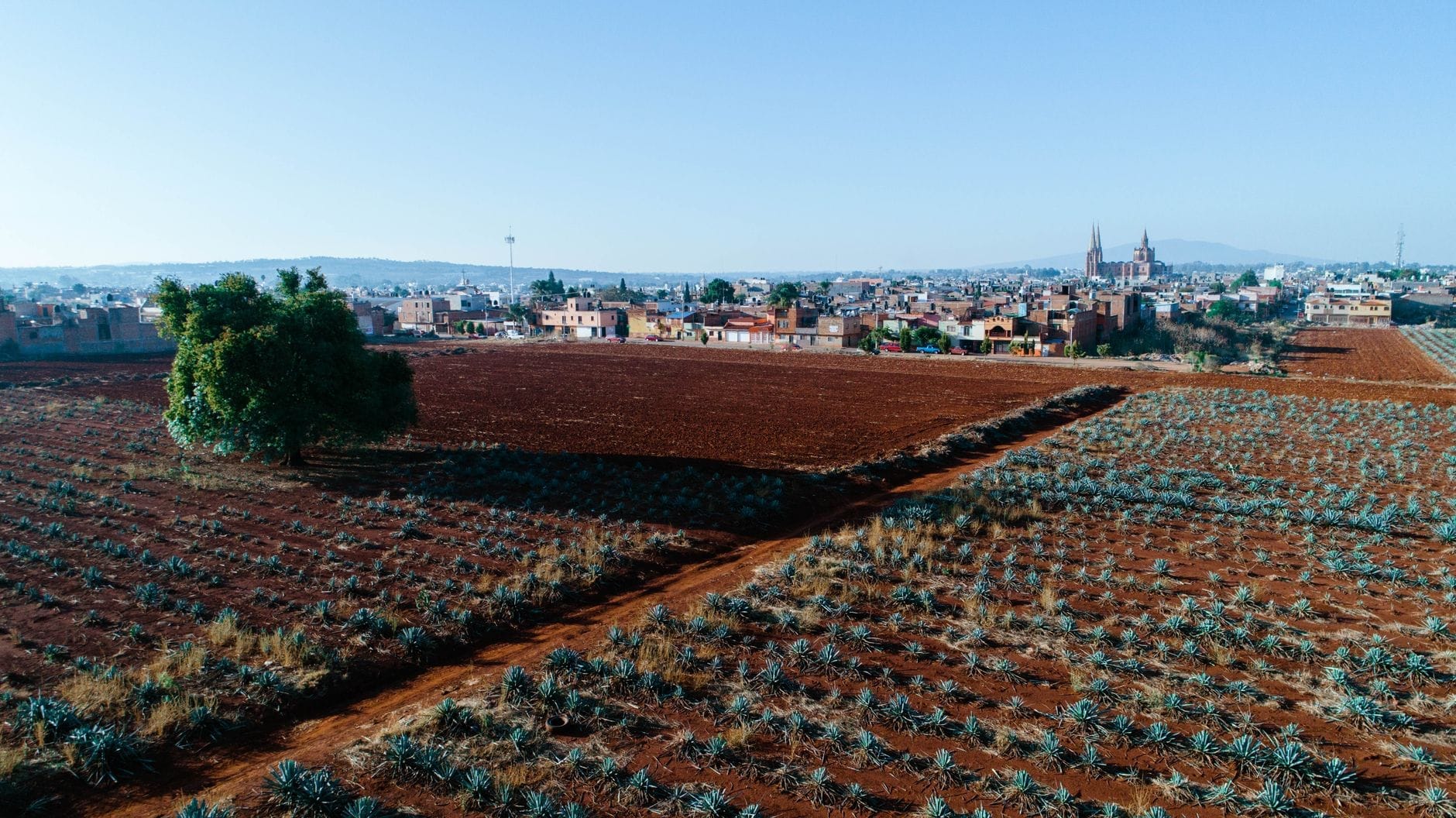
The visual character of the agave fields is unlike any wine region or grain belt. Blue agave (Agave tequilana Weber) grows in dense, low formations across the volcanic slopes, each plant a cluster of rigid, blue-green spikes radiating from a central core. Rows of agave stretch across hillsides in geometric formations, and the texture of the landscape shifts with the angle of the light. In the early morning, when the fields are still cool and slightly misted, the blue-green spikes catch the light at an angle that makes the whole hillside appear almost metallic.
The smell of the countryside around Tequila is earthy and faintly sweet, a combination of volcanic soil, agave sap, and the faint, smoky sweetness that drifts from distillery operations nearby. Near the actual production facilities, the scent intensifies: fermentation vats produce a pungent, yeasty aroma, and the cooking of agave pinas releases a caramelized sweetness that carries several blocks. If you have never smelled an active distillery, it is an unexpectedly powerful part of the experience.
The town of Tequila itself is a Pueblo Mágico, a Mexican government designation for towns of cultural and historical significance. Its central streets are lined with distillery entrances, small tasting rooms, and craft shops selling bottles, ceramics, and regional food. On weekends, the pedestrian areas fill up quickly, and the town takes on a festive character. On weekday mornings, the same streets are quieter, and you can walk through the agave fields on the outskirts of town with almost no other visitors around.
How to Get There from Guadalajara
The town of Tequila sits approximately 67 km northwest of Guadalajara, making it one of the most popular day trips from the city. By car, the drive takes roughly 45 minutes via the highway toward Tepic, and the road passes through increasingly rural Jalisco countryside before the volcanic cone of Volcán de Tequila comes into view on the horizon.
The most theatrical way to arrive is on the Jose Cuervo Express, a tourist train that departs from Guadalajara and takes approximately two hours each way. The train includes entertainment, open bars, and views of the agave landscape as you approach Tequila. It is more of an experience than a transport option, and its pricing and schedule vary by operator. Verify current departure times and ticket costs directly with the operator before booking.
For independent travelers, bus services connect Guadalajara's central bus stations with Tequila, and ride-hailing apps operate in Guadalajara for the initial leg of the journey. The getting around Guadalajara guide covers transit options in detail, including how to navigate from the city center to longer-distance bus departures.
💡 Local tip
If you drive, consider arriving by 9 AM on a weekday. The main distillery tours fill up fast on weekends, and the agave fields on the outskirts of town are at their most photogenic in low-angle morning light before the midday sun flattens the landscape.
What to Actually Do There
Distillery Tours
The most structured way to experience the industrial heritage of the landscape is through a distillery tour. Several producers in and around the town of Tequila offer guided visits that take you through the full production process: harvesting, cooking the agave pinas in stone or brick ovens, crushing, fermentation, distillation, and aging in barrel warehouses. The quality and depth of tours varies considerably by producer. Some are polished, bilingual, and include tastings at each stage. Others are more informal, conducted in Spanish, and provide closer access to working production areas.
Each distillery sets its own hours and fees. Many of the larger facilities require advance booking, especially for weekend visits. Because conditions and pricing change frequently, confirm details directly with each distillery before your visit rather than relying on third-party listings.
The Agave Fields Themselves
The fields surrounding the town are working agricultural land, not public parkland. You can view them clearly from roadways, hillside overlooks, and the edges of distillery properties, but walking directly into the rows of agave generally requires permission from the landowner or a guided tour that includes field access. The jimador, the skilled worker who harvests mature agave using a specialized tool called a coa, can sometimes be seen working in the fields during harvest periods. Watching a jimador separate the heavy pina from its root is a striking piece of living agricultural tradition.
Teuchitlán Archaeological Zone
Located within the broader UNESCO landscape, the archaeological zone of Teuchitlán preserves the circular ceremonial structures associated with the Teuchitlán tradition. These concentric mound complexes, oriented around central platforms, represent a distinctive architectural form found almost exclusively in this region of western Mexico. The site requires a separate visit and is located outside the town of Tequila itself, so plan accordingly if this is on your itinerary. Current visiting hours and fees should be verified through official Mexican archaeological site authorities (INAH) before travel.
When to Visit and What to Expect by Season
The landscape looks dramatically different depending on the season. During the dry season, roughly November through April, the volcanic hillsides are sun-bleached and golden, and the blue-green of the agave stands out in sharp contrast against the pale soil. This is the easiest season for walking and photography, and the roads are predictably dry.
The rainy season, June through September, transforms the surrounding vegetation. The hills turn green, wildflowers appear at the edges of the fields, and the volcanic cone occasionally disappears into cloud cover. The agave itself is largely unaffected, but the roads between sites can become muddy, and afternoon downpours can shorten outdoor time. Mornings in the rainy season, however, offer some of the most dramatic lighting for photography.
Weekends in Tequila fill up with domestic tourists, particularly from Guadalajara. If you are primarily interested in the landscape and production heritage rather than the festive atmosphere of the town, a weekday visit in the dry season gives you significantly better conditions.
⚠️ What to skip
The terrain around the agave fields and archaeological zones includes volcanic rock, uneven rural paths, and sloped hillsides. Wear closed-toe shoes with grip. Sun exposure is intense, especially at midday in the dry season — sunscreen, a hat, and water are not optional.
Photography and Practical Notes
The agave landscape is one of the most photogenic agricultural settings in Mexico. The geometric rows of spiky plants, the volcanic topography, and the colonial-era distillery facades all photograph well. Early morning and the hour before sunset produce the most dimensional light on the fields. The town of Tequila's church and central plaza also offer classic Mexican small-town composition.
For accessibility, the landscape as a whole is not designed for visitors with significant mobility limitations. The town of Tequila has paved streets, but distillery facilities, archaeological zones, and field access points vary considerably in their terrain. Visitors with specific mobility needs should contact individual facilities in advance to confirm what is accessible.
The agave fields make a natural pairing with a visit to the Pueblo Mágico of Tequila for a full day that combines landscape, cultural heritage, and the town itself. If you are planning a broader itinerary around Jalisco's cultural sites, the day trips from Guadalajara guide covers this and other options with logistical detail.
Who Should Probably Skip This
Travelers looking for a polished, fully interpreted heritage site with consistent visitor infrastructure may be disappointed. This is a landscape, not a museum. If you are not interested in agricultural history, spirits production, or rural Mexico, the experience may feel like a lot of driving for fields and a small town. The town of Tequila itself, particularly on busy weekends, can feel oriented primarily toward alcohol tourism, which is not for everyone.
Visitors with significant mobility limitations should research specific sites carefully before committing to the trip, as conditions vary widely and the overall landscape is not universally accessible. Families with very young children may also find the distillery tour format less engaging than other Guadalajara-area attractions.
Insider Tips
- The fields on the outskirts of Amatitán, a smaller municipality within the UNESCO zone, see far fewer visitors than those near the town of Tequila. If you have a car, the drive through Amatitán gives you a quieter, more intimate sense of what the working landscape actually looks like.
- Ask distillery tour guides specifically about the tahona process, the traditional stone-wheel crushing method. Fewer distilleries still use it, and those that do typically offer a more hands-on sensory experience than industrial-scale producers.
- The Jose Cuervo Express train sells out on holiday weekends well in advance. If your travel dates fall near a Mexican public holiday, book weeks ahead or plan to drive independently instead.
- The Teuchitlán archaeological zone is within the UNESCO landscape boundary but requires a separate detour and visit. Many day-trippers never make it there. If pre-Columbian history interests you, building this into your itinerary rather than treating it as an afterthought is worth the additional planning.
- Most distillery tours are conducted primarily in Spanish. Larger producers typically offer English-language options, but availability varies. If you need English narration, confirm language options when booking rather than assuming.
Who Is Agave Fields of Tequila (UNESCO Landscape) For?
- Spirits enthusiasts who want to see tequila production in its geographic and cultural context
- Photographers looking for landscapes that combine agriculture, volcanic geology, and colonial architecture
- History and archaeology travelers interested in pre-Columbian western Mexico and the Teuchitlán culture
- Day-trippers from Guadalajara seeking a full cultural experience beyond the city
- Travelers pursuing UNESCO World Heritage sites in Mexico
Nearby Attractions
Combine your visit with:
- Ajijic (Lake Chapala Village)
Ajijic sits on the north shore of Lake Chapala, about an hour south of Guadalajara. With pre-conquest roots, cobblestone streets lined with art galleries, and one of Mexico's largest expat communities, it offers a completely different pace from the city. There is no admission fee to visit, and the town is accessible year-round.
- Bosque de La Primavera
Just 12 km west of Guadalajara, Bosque de La Primavera is a 30,500-hectare protected forest area offering hiking, birdwatching, hot springs, and rare ecological zones. It is one of the few places near a major Mexican city where you can genuinely disconnect from urban noise within 30 minutes.
- Bosque Los Colomos
Spanning roughly 92 hectares in northwestern Guadalajara, Bosque Los Colomos is a protected urban forest with ponds, pine-scented trails, and a Japanese garden donated by the city of Kyoto. Admission is free, and the park draws everyone from pre-dawn joggers to Sunday families.
- Japanese Garden — Bosque Los Colomos
Tucked inside the 93-hectare urban forest of Bosque Los Colomos, the Jardín Japonés is a formal Japanese-style garden donated by the people of Kyoto in 1994. It offers koi ponds, stone lanterns, arched bridges, and the kind of deliberate stillness that is genuinely hard to find in a city of over 1.5 million people.