Temple of Azure Clouds (Biyun Temple): Beijing's Most Underestimated Imperial Monastery
Tucked inside Xiangshan Park in Haidian District, the Temple of Azure Clouds (碧云寺, Biyun Temple) is a layered Yuan-to-Qing dynasty complex that rewards visitors who look beyond the park's famous autumn foliage. With a towering diamond throne pagoda, a hall of 508 gilded Luohan statues, and a quiet courtyard tied to modern Chinese history, it earns its entry fee many times over.
Quick Facts
- Location
- No. 40 Maimaijie, Xiangshan Park, Haidian District, Beijing
- Getting There
- Bus 360, 333, or 318 to Xiangshan Station; no direct metro link
- Time Needed
- 1.5 to 2.5 hours for the temple; pair with Xiangshan Park for a half-day
- Cost
- ¥10 per person (temple admission; separate from Xiangshan Park entry)
- Best for
- History enthusiasts, architecture fans, quieter temple experiences away from central Beijing
What Is Biyun Temple and Why Does It Matter?
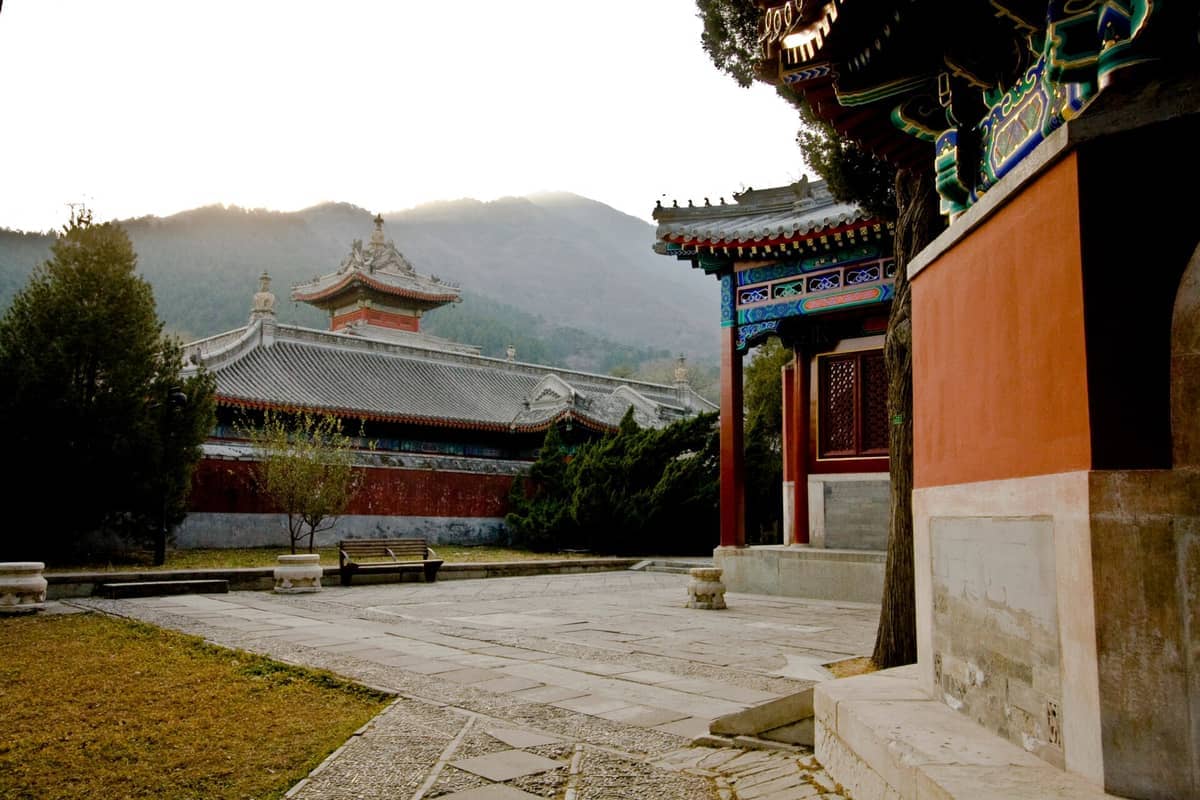
The Temple of Azure Clouds, known in Mandarin as 碧云寺 (Bìyún Sì), has Yuan-dynasty origins, with a major reconstruction in 1331. Over the following five centuries it was enlarged twice by Ming eunuch officials and then comprehensively rebuilt under Qing emperors, producing a complex that reads like a textbook of successive Chinese imperial patronage. The result is not a single architectural statement but a sequence of courtyards that rise steadily up the western slope of Fragrant Hills, each level revealing a different era's ambitions.
What separates Biyun Temple from other Beijing monasteries is its crown: a diamond throne pagoda completed in 1748 during the Qianlong reign, modeled explicitly on the Yuan dynasty Five Pagoda Temple in Haidian. The sight of that ornate stone tower emerging above a line of traditional Chinese hall roofs is genuinely unexpected, and it photographs exceptionally well against a clear blue sky.
The temple also holds a significant place in twentieth-century Chinese history. After Sun Yat-sen died in Beijing in March 1925, his coffin was temporarily placed at Biyun Temple before being transported to Nanjing for burial in 1929. A memorial hall dedicated to him remains on site. Visitors with an interest in modern Chinese political history will find this layer adds real weight to the visit. For broader context on Beijing's layered imperial past, the Beijing imperial history guide is worth reading before you arrive.
ℹ️ Good to know
Opening hours: April 1–November 15, 08:00–17:30; November 16–March 31, 08:30–17:00. Closed Mondays except statutory public holidays. Admission: ¥10. Verify current prices and hours before visiting.
Getting There: The Logistics Are Straightforward, Not Trivial
Biyun Temple sits on the northern side of Xiangshan Park in Haidian District, roughly 28 kilometres northwest of central Beijing. There is no direct metro connection. The practical options are bus or taxi. Buses 360 and 318 serve the Xiangshan area, from which the park entrance is a short walk.
A taxi or DiDi from central Beijing takes 45 to 60 minutes in moderate traffic, longer during morning rush hours. The trip back is often easier to arrange than it looks: taxis queue near the Xiangshan Park main gate on busy days. If you plan to visit in autumn, note that Xiangshan is one of Beijing's most popular foliage destinations, and traffic and bus occupancy on weekends in October and early November can be intense. A weekday visit or an early start (arriving before 09:00) makes a measurable difference.
Biyun Temple has its own ticket booth inside Xiangshan Park. The ¥10 temple admission is separate from any Xiangshan Park gate fee, so budget accordingly. If you plan to combine the temple with a walk up the hill, the Xiangshan Park page covers the broader area in detail.
Tickets & tours
Hand-picked options from our booking partner. Prices are indicative; availability and final rates are confirmed when you complete your booking.
Small group tour of Tian'anmen Square and the Forbidden City
From 43 €Instant confirmationFree cancellationBeijing Summer Palace Entrance Ticket
From 7 €Instant confirmationFree cancellationMutianyu Great Wall and Summer Palace small-group tour from Beijing
From 171 €Instant confirmationFree cancellationPrivate Guided Tour to Temple of Heaven, Panda House and Summer Palace
From 67 €Instant confirmationFree cancellation
Walking the Complex: A Courtyard-by-Courtyard Orientation
The temple is organized along a central axis that climbs the hillside through six main courtyards. You enter through a mountain gate flanked by the Four Heavenly Kings, a standard layout for Chinese Buddhist complexes. What changes with each successive courtyard is the elevation and the architectural scale: the buildings grow more elaborate and the views over the pine canopy improve as you ascend.
The Hall of the Luohan is the most visually arresting interior space. It contains about 500 gilded statues of Luohan, the Buddhist figures who have achieved enlightenment but remain in the world, arranged in dense, floor-to-ceiling rows. Each figure is individually characterized, with a distinct posture, expression, and hand gesture. The lighting inside is dim by design, which creates an immersive effect. Allow at least 20 minutes here rather than passing through quickly.
The Sun Yat-sen Memorial Hall occupies a separate courtyard to one side of the main axis. It contains the empty crystal coffin associated with Sun Yat-sen, along with photographs, personal effects, and inscriptions. Even visitors unfamiliar with Chinese republican history will find the room quietly affecting. The contrast between this sombre space and the richly decorated Buddhist halls a few steps away is part of what makes Biyun Temple an unusually layered place.
At the top of the complex, the diamond throne pagoda is reached via a steep staircase. The pagoda's five towers are covered in carved Buddhist imagery, and the stone railings along the viewing platform give you a clear sightline across the rooftops below. Early morning light hits the stone carvings at a low angle, bringing out the relief detail in a way that flat midday light does not.
How the Experience Changes by Time and Season
On weekday mornings from April through June, Biyun Temple is quiet enough that you can stand in the main courtyards and hear birdsong rather than other visitors. The pine and cypress trees that line the approach are old and dense, and the shade they provide keeps the upper courtyards noticeably cooler than the open hillside. The air smells of incense from the active worship areas, mixed with the resinous scent of the conifers.
Autumn weekends are a different calculation. Xiangshan Park draws large crowds specifically for its red smoke tree leaves in October and early November, and Biyun Temple, sitting inside the same park, absorbs spillover. The temple itself never reaches the density of central Beijing attractions, but you will share the Luohan Hall and the pagoda staircase with steady streams of visitors. If your priority is the temple rather than the foliage, a weekday in late September or early October gives you the colour without the crowds.
Winter visits between November and March are genuinely underrated. Admission is lower-traffic, the bare branches of the deciduous trees expose the architecture fully, and the cold air tends to be clear. The stone pagoda photographed against a bright blue winter sky is one of the better compositions this temple offers. Bring a warm layer: the upper courtyards are exposed and the stone surfaces hold the cold.
💡 Local tip
For photography: the diamond throne pagoda faces south-southwest. Afternoon light in autumn and winter gives the best direct illumination on the carved stone surface. Morning is better for the lower halls, which face east.
Architectural and Historical Context
Biyun Temple's founding in 1331 places it in the Yuan dynasty, when the Mongol rulers of China were significant patrons of Tibetan and Chinese Buddhism. The site was later expanded during the Ming dynasty, and Qing-era reconstruction during the reign of the Qianlong Emperor produced much of what visitors see today, including the diamond throne pagoda and the Luohan Hall. occurred during the reign of the Qianlong Emperor, a prolific builder whose projects also shaped the Summer Palace and the Old Summer Palace nearby.
The diamond throne pagoda design is worth understanding before you see it. The form derives ultimately from Indian stupa architecture as interpreted and transmitted through Central Asian Buddhist traditions. Qianlong's court adapted it twice over: first through the existing Five Pagoda Temple model in Beijing, and then with elaborations specific to Qing imperial taste. The carvings on the pagoda's base panels include Tibetan Buddhist iconography, Sanskrit inscriptions, and Chinese motifs. It is a genuinely syncretic monument, not a single cultural statement.
Visitors interested in exploring Beijing's Buddhist temple landscape more broadly will find useful comparisons at the Five Pagoda Temple in Haidian, which uses the same architectural typology, and at the Lama Temple in Dongcheng, which shows Qing Tibetan Buddhist patronage in a more urban and more visited setting.
Practical Notes: What to Know Before You Go
Dress conservatively for temple visits. Shoulders and knees should be covered as a courtesy, though enforcement at Biyun Temple is not typically strict. Comfortable walking shoes with grip matter more: the upper courtyards involve uneven stone steps, and the staircase to the pagoda platform is steep with worn treads.
Photography is permitted throughout the temple grounds. Interior spaces in the Luohan Hall are dimly lit, so a phone with a capable low-light mode or a camera with a fast prime lens will produce better results than a standard kit setup. Flash use near the gilt statues is inadvisable and likely to attract requests to stop.
The official listing publishes two contact numbers for the temple: +86 10 6259 1222 and +86 10 6259 1264. Visitors with mobility requirements should call ahead to confirm conditions, since no detailed accessibility information is published online. The lower courtyards are navigable on relatively level ground, but the upper sections of the complex and the pagoda staircase are not step-free.
⚠️ What to skip
Biyun Temple is closed on Mondays except when Monday falls on a statutory public holiday. Arriving on a Monday without checking will mean a wasted journey from central Beijing.
If you are building a day trip around this area, combining Biyun Temple with a walk in Xiangshan Park is the natural choice. Alternatively, the nearby Beijing Botanical Garden is sometimes mentioned alongside Xiangshan in itinerary planning — verify its operating status before including it. For those building a broader Haidian itinerary, the 3 days in Beijing guide offers a framework for sequencing western Beijing attractions.
Who Will Get the Most From This Temple, and Who Might Not
Biyun Temple suits visitors who want to move through space rather than simply look at a facade. The sequential courtyard layout, the variety of architectural forms, and the historical narrative carried by the Sun Yat-sen memorial mean that attentive visitors will find new details on every level. A two-hour visit feels well-paced and complete rather than rushed.
Visitors looking for a quick iconic photograph and little else will find the temple requires more investment than they might expect. The most photogenic element, the pagoda, is at the top of a climb, and the interior spaces reward patience rather than a quick scan. First-time visitors to Beijing with very limited time would be better served by prioritising the Forbidden City, Temple of Heaven, or Lama Temple before considering Biyun.
Families with young children should know that there is no dedicated infrastructure for small visitors, no cafeteria inside the temple, and limited flat, open areas for restless children to run. The Xiangshan Park grounds adjacent to the temple entrance offer more space. Travellers with significant mobility limitations will find the upper sections of the complex inaccessible and should manage expectations accordingly.
Insider Tips
- Buy your temple ticket before walking up to the gate. The ticket office is at the base of the approach path and the queue, when it exists, is smaller early in the morning than at midday.
- The courtyards on the west side of the main axis, away from the central processional route, are almost always empty. They offer the best quiet corners and some of the oldest stonework in the complex.
- If you visit in October for the Xiangshan foliage, enter Xiangshan Park through the northern gate near Biyun Temple rather than the main southern gate. The northern entrance is less crowded, deposits you directly at the temple, and gives you the option to walk down through the coloured trees rather than fighting uphill crowds.
- The gilded Luohan statues in the main hall include figures with distinctive individual expressions and gestures. Guides may point out particular figures; if you are visiting without one, look closely at the varied facial expressions and postures.
- Combine the temple visit with the Five Pagoda Temple in Haidian if you want to compare the diamond throne pagoda typology directly. The two sites are not walkable from each other, but both are accessible by bus or taxi in a single morning.
Who Is Temple of Azure Clouds (Biyun Temple) For?
- Architecture enthusiasts interested in the fusion of Indian, Tibetan, and Chinese Buddhist building traditions
- History travellers who want to connect imperial Beijing with the early twentieth-century republican period
- Photographers seeking a less-visited temple with strong vertical subjects and good seasonal colour
- Visitors pairing a temple with a half-day in Xiangshan Park, especially in September and early October
- Travellers who have already seen the main-circuit temples and want a more considered, quieter alternative
Nearby Attractions
Other things to see while in Haidian District:
- Beijing Aquarium
Beijing Aquarium is one of the largest indoor aquariums in Asia, located within the grounds of Beijing Zoo in Haidian District. This guide covers what you'll actually see, how to plan your visit efficiently, and whether it's worth the ticket price for your specific travel style.
- Big Bell Temple (Dazhongsi)
Tucked along the North 3rd Ring West Road in Haidian, the Big Bell Temple Ancient Bell Museum houses one of the largest surviving bronze bells in the world. It is a serious museum experience, combining a working Qing-dynasty temple complex with a specialist collection of historic bells that draws scholars, photographers, and curious travelers in equal measure.
- Five Pagoda Temple (Wuta Temple)
Officially the Beijing Stone Carving Art Museum, the Five Pagoda Temple sits on the grounds of the former Ming-dynasty Zhenjue Temple in Haidian. It combines one of China's most distinctive Buddhist structures with an outdoor museum of stone carvings that rewards visitors who take time to look closely.
- Military Museum of the Chinese People's Revolution
The Military Museum of the Chinese People's Revolution stands at No. 9 Fuxing Road in Haidian District, presenting extensive collections across more than 40,000 square meters of exhibition space. It is one of the largest military history museums in China, admission is free, and it makes for a genuinely substantial half-day visit for anyone curious about modern Chinese history.