Süleymaniye Mosque: Istanbul's Most Accomplished Ottoman Monument
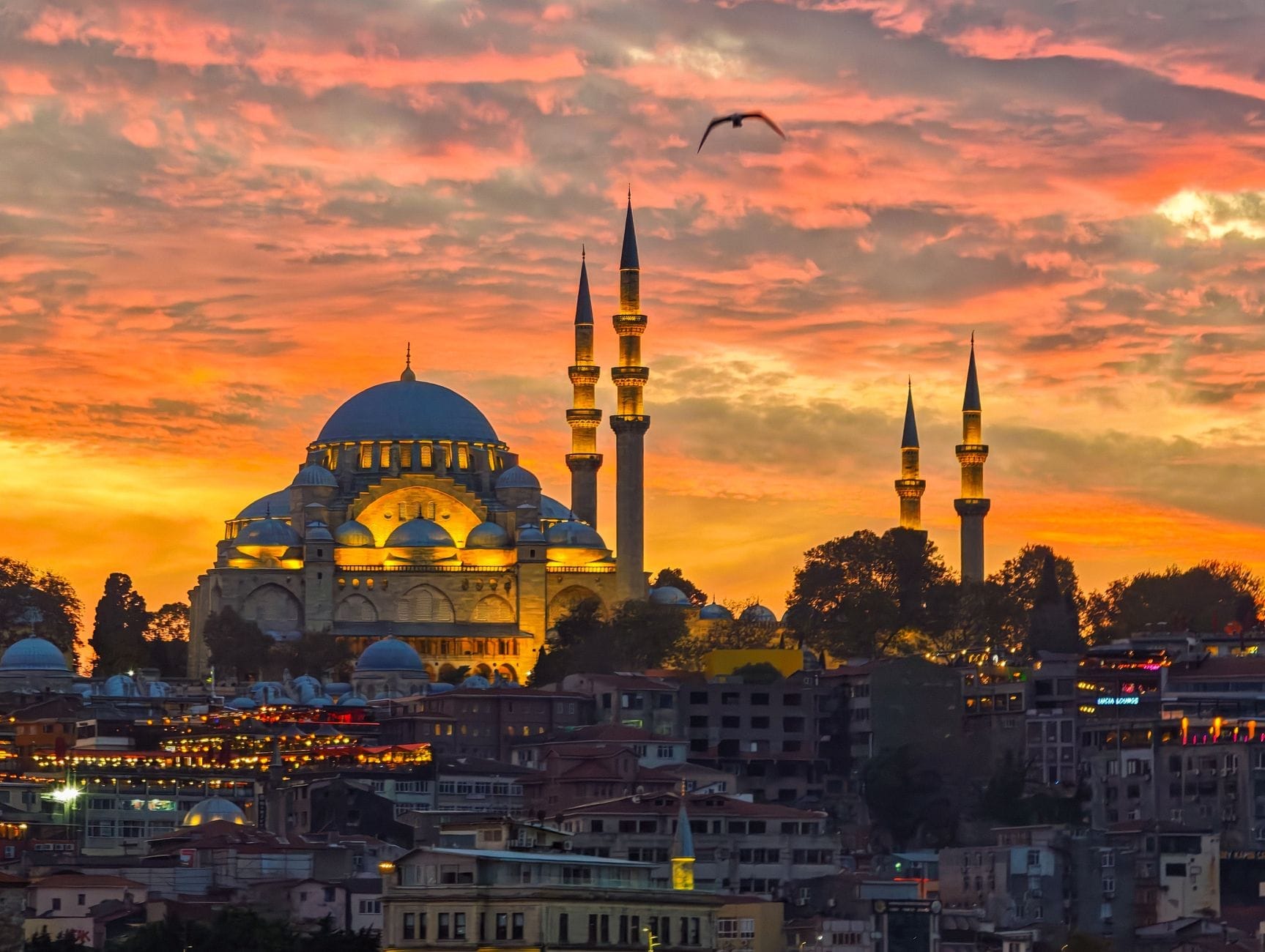
Rising above the Golden Horn on Istanbul's Third Hill, Süleymaniye Mosque is widely regarded as the finest work of Ottoman imperial architecture. Built between 1550 and 1557 under the direction of master architect Mimar Sinan for Sultan Suleiman the Magnificent, it remains a functioning mosque with free admission and considerably fewer visitors than the Blue Mosque in Sultanahmet.
Quick Facts
- Location
- Prof. Sıddık Sami Onar Cd. No:1, Süleymaniye Mah., Fatih, Istanbul 34116
- Getting There
- T1 tram to Beyazıt-Kapalıçarşı, then 5–10-min uphill walk; or Eminönü stop and walk up the hill (about 10 minutes, via stairs)
- Time Needed
- 45–90 minutes for the mosque and courtyard; add 30 min for the surrounding complex and cemetery
- Cost
- Free admission
- Best for
- Architecture enthusiasts, history travelers, anyone seeking a calmer alternative to Sultanahmet's busiest sites
What Süleymaniye Mosque Actually Is
Süleymaniye Mosque, known in Turkish as Süleymaniye Camii, is an imperial Ottoman mosque complex completed in 1557 on the Third Hill of the historic peninsula. It was commissioned by Sultan Suleiman I, commonly called Suleiman the Magnificent, who was at the height of his reign when construction began in 1550. The architect was Mimar Sinan, the Ottoman Empire's most celebrated engineer and builder, who considered this mosque among his finest achievements.
The main dome rises 53 meters above the floor and spans 27 meters in diameter. The footprint of the prayer hall measures roughly 59 meters long by 49–51 meters wide. These are not merely impressive numbers: the spatial effect inside is one of unusual lightness for a structure of this scale, an outcome that Sinan achieved by carefully managing the transition of weight through semi-domes and arcade systems rather than relying on heavy walls alone.
The mosque forms the centerpiece of a külliye, the Ottoman term for a mosque complex that included a school, library, hospital, soup kitchen, and hammam. Many of these supporting buildings still stand and are in use. The complex is part of the Historic Areas of Istanbul, a UNESCO World Heritage Site. For context on Istanbul's wider Ottoman architectural heritage, see our guide to Istanbul's Ottoman history.
ℹ️ Good to know
Süleymaniye Mosque is an active place of worship. Entry is free, but the interior closes briefly during each of the five daily prayer times. Arriving just after a prayer ends gives you a longer uninterrupted viewing window.
The Approach: Reading the Building Before You Enter
Most visitors approach from the direction of the Grand Bazaar to the south, climbing streets that grow quieter and steeper as the mosque comes into view. The silhouette is unmistakable: a central dome flanked by two semi-domes, four minarets marking the corners of the complex, all of it sitting on a platform on the slope of the Third Hill. From the Golden Horn below or from Galata across the water, Süleymaniye Mosque reads as one of the major historic features of the European skyline today.
The outer courtyard walls and the entrance gate give a first signal of the care taken with proportion. Stone details in the gate's calligraphic inscription bands are crisp even after nearly five centuries. The inner courtyard, enclosed by a domed arcade on three sides and the mosque facade on the fourth, has a central ablution fountain that is smaller and less ornate than those in some other imperial mosques, which keeps the space feeling uncluttered. The pavement is smooth stone, cool underfoot in summer.
If you are visiting multiple mosques on the same day, Süleymaniye pairs naturally with Rüstem Pasha Mosque about 15 minutes' walk downhill toward Eminönü, which is smaller but contains some of the finest Iznik tile work in the city.
Tickets & tours
Hand-picked options from our booking partner. Prices are indicative; availability and final rates are confirmed when you complete your booking.
Skip the line Topkapi Palace and Suleymaniye Mosque
From 60 €Instant confirmationFree cancellationHalf day Morning Ottoman Splendors tour, including the Blue Mosque
From 48 €Instant confirmationFree cancellationIstanbul Basilica Cistern, Blue Mosque and Hagia Sophia tour
From 83 €Instant confirmationFree cancellationIstanbul mosaics and Blue Mosque 1-day small group tour
From 62 €Instant confirmationFree cancellation
Inside the Prayer Hall: What to Look For
Remove your shoes at the entrance and place them in a bag or use the shelves provided. Women are asked to cover their hair; scarves are sometimes available at the entrance if you do not have one. The interior is vast, and the first impression on entering is of brightness: the walls are a pale cream stone, and the original windows, restored in various campaigns over the centuries, flood the hall with light. The stained glass in the qibla wall, facing Mecca, is Ottoman work attributed to a craftsman known as Sarhoş Ibrahim and uses deep reds and blues that shift as sunlight moves through them.
Look upward at the transition between the main dome and the semi-domes on either side of the nave axis. Sinan resolved this structural challenge with a row of arches that feels almost skeletal from below, far more open than the equivalent zones in Hagia Sophia, which Sinan had studied carefully. The calligraphic roundels suspended from the dome are enormous, painted with the names of Allah, the Prophet, and the first four caliphs, a common Ottoman interior convention but executed here at an unusual scale.
The floor is carpeted and divided into rows for prayer. Visitors are welcome to walk quietly through the aisles along the sides of the hall. The mihrab, the niche indicating the direction of prayer, and the minbar, the stepped pulpit, are both original Ottoman work in white marble with restrained carved detail. There are no figurative decorations anywhere in the interior, consistent with Islamic tradition, but the geometric patterns in the carved stone and the subtle shifts in window color give the space a sustained visual complexity.
💡 Local tip
Photography without flash is generally tolerated in the visitor areas, but be attentive to whether worshippers are present. During prayer times, all visitors are asked to wait outside or remain at the rear of the hall without moving through the space.
The Cemetery, Tombs, and the Rest of the Complex
Behind the mosque, in the walled garden to the east, are the tombs of Sultan Suleiman and his wife Hürrem Sultan, known in the West as Roxelana. Both structures are octagonal domed buildings of similar modest scale, and both are generally accessible to visitors during opening hours. Suleiman's tomb interior is lined with Iznik tiles of exceptional quality, deep cobalt and turquoise on a white ground, which are in considerably better condition than the tiles in many other Ottoman buildings of the same period.
The surrounding graveyard contains the graves of other Ottoman-era figures and is a quiet, shaded space with old cypress trees. It is frequently empty of other visitors even when the mosque itself is moderately busy. Mimar Sinan's own tomb is located just outside the complex walls, in a small triangular plot near the northern corner, a deliberately modest structure that he is said to have designed himself.
The broader Fatih district that surrounds Süleymaniye contains several other significant monuments that repay exploration. The Valens Aqueduct, a fourth-century Roman structure that once supplied water to the city, runs through the district and is visible from various streets near the mosque complex.
Time of Day and Crowd Patterns
Süleymaniye generally draws smaller crowds than the Blue Mosque or Hagia Sophia, and this difference is often noticeable, especially outside peak tour hours. That said, the experience varies meaningfully by time of day. Mornings between 9 and 11 AM tend to be the calmest, with good light entering from the eastern windows and very few tour groups present. By early afternoon, organized tour buses arrive, and the courtyard and interior become noticeably more crowded, though never to the degree of the most visited Sultanahmet sites.
Late afternoon light, particularly in the hour before sunset, illuminates the western-facing courtyard facades warmly and makes for the best exterior photographs. The view from the terrace area on the north side of the complex, overlooking the Golden Horn and the rooftops of Eminönü, is one of the underappreciated panoramas of the city and is clearest in the late afternoon before the haze of a summer day has fully set in.
Friday midday prayers draw the largest local congregation of the week and the interior is not accessible to visitors during this time. If you plan to visit on a Friday, aim for early morning or mid-afternoon rather than the noon hour.
⚠️ What to skip
The mosque closes to visitors during the five daily prayer times (approximately dawn, early afternoon, mid-afternoon, sunset, and evening). Closures typically last around 30 minutes, and the midday Friday prayer closure is longer. Checking local prayer time schedules for your visit date will help you plan your arrival.
Getting There and Practical Logistics
The T1 tram line, which connects Kabataş with Bağcılar via Sultanahmet and Eminönü, stops at Beyazıt-Kapalıçarşı, roughly a 5–10-minute uphill walk from the mosque. Alternatively, Eminönü tram stop is slightly further but the walk from there passes through steep streets and gives a clearer sense of the mosque's position on the hill.
Payment on the tram uses the Istanbulkart contactless card, which is the standard method for most public transport in the city. For a full overview of getting around, see the guide to getting around Istanbul. The mosque is within walking distance of the Grand Bazaar to the south and of the Spice Bazaar and Eminönü waterfront to the north.
The streets immediately surrounding the complex are steep and cobblestoned in places, which can be difficult for visitors with mobility limitations. The main entrance to the mosque courtyard is on relatively level ground once you have made the climb from the tram stop. Shoe removal at the entrance is required on all visitors.
Dress modestly: covered shoulders and legs for all visitors, and a headscarf for women. The mosque provides scarves at the entrance, but bringing your own is more reliable. Carry a small bag for your shoes, as the shelves at busier entrances can fill quickly during peak hours.
Historical and Architectural Context
When Suleiman commissioned the mosque, the Ottoman Empire stretched from parts of North Africa such as Algeria to the borders of Persia and from Hungary to Yemen. The scale and permanence of the building were deliberate statements of dynastic authority. Mimar Sinan, who served as chief architect of the Ottoman court from the late 1530s until his death in 1588, used Süleymaniye as an opportunity to test structural ideas he would later refine in his acknowledged masterpiece, the Selimiye Mosque in Edirne.
Sinan had studied Hagia Sophia, the massive sixth-century Byzantine church a short distance away on the First Hill, and one of his stated goals was to equal or surpass it in engineering terms. The result is not a copy but a rethinking: where Hagia Sophia achieves its scale partly through the sheer mass of its walls and piers, Süleymaniye distributes loads more elegantly, leaving the interior arcade columns almost slender in appearance despite supporting enormous structural weight.
For travelers interested in the Byzantine architecture that preceded and influenced Ottoman building, the guide to Istanbul's Byzantine history covers the wider context, and the Hagia Sophia itself is about 15 minutes' walk south.
The mosque has survived several significant earthquakes and a major fire, as well as use as a barracks during one period of its history. Restoration work has been ongoing at various points in the twentieth and twenty-first centuries. Some visitors notice patches of newer stonework or paint that differ subtly from surrounding areas; this is an honest record of the building's survival rather than evidence of poor conservation.
Who Might Not Enjoy This Visit
Visitors who are primarily seeking interactive exhibits, signage in English, or guided audiovisual experiences will find Süleymaniye relatively bare of interpretation. There is no on-site museum, no audio guide system, and the available information boards are limited in language coverage. The building rewards those who arrive with some background knowledge or a willingness to look carefully at architectural detail. If you want rich contextual interpretation of Ottoman history alongside the visual experience, the Museum of Turkish and Islamic Arts in Sultanahmet provides that framework and is worth visiting either before or after.
The required walk uphill from any transit point may also be a deterrent for visitors with significant mobility difficulties, though the route can be managed slowly without steps if approached from certain directions.
Insider Tips
- Sinan's own tomb is in a small triangular enclosure just outside the northern wall of the complex, not inside the mosque grounds. Most visitors walk past it without realizing what it is. Look for the low domed structure tucked against the outer wall near the corner; it is one of the few places in Istanbul where you can stand at the grave of the person who built what you just visited.
- The terrace on the north side of the complex, just outside the cemetery wall, has an unobstructed view over the Golden Horn toward Galata and the new city. It is almost entirely free of other visitors and offers one of the better elevated vantage points on this side of the historic peninsula, especially effective in late afternoon light.
- If you visit the tombs of Suleiman and Hürrem Sultan at the rear of the mosque, go slowly in Suleiman's tomb: the Iznik tiles lining the interior are among the finest examples in the city, and the quality of the cobalt coloring in particular is exceptional and often not mentioned in general itineraries.
- The tea houses and small restaurants on the streets immediately below the northern side of the complex, looking out over the Golden Horn, serve straightforward Turkish food at prices significantly lower than the tourist-facing restaurants near the Grand Bazaar or Sultanahmet. They cater primarily to local students and workers from the nearby university buildings.
- Check the local prayer schedule before you go and plan to arrive 30 minutes after a prayer has finished rather than just before one begins. A mid-morning arrival on a weekday, after the early morning prayer, typically gives you the longest uninterrupted access window and the lightest crowd levels.
Who Is Süleymaniye Mosque For?
- Architecture and history enthusiasts who want to understand Ottoman building at its peak, without the crowd intensity of the Sultanahmet core
- Travelers who have already visited the Blue Mosque and Hagia Sophia and want to see what Mimar Sinan considered his more refined work
- Photographers seeking a combination of interior sacred space and elevated exterior city views in a single location
- Visitors interested in visiting an Ottoman imperial mosque that is still in active daily use and feels embedded in its neighborhood rather than purely tourist-facing
- Those following the broader historic peninsula on foot, for whom Süleymaniye is a natural anchor point midway between the Grand Bazaar and the Eminönü waterfront
Nearby Attractions
Other things to see while in Fatih:
- Chora Church (Kariye Mosque)
The Chora Church, now Kariye Mosque, preserves the most complete cycle of late Byzantine mosaics and frescoes anywhere in the world. Tucked inside the Fatih district near the ancient Theodosian Walls, it rewards visitors who make the effort to reach it — but requires some planning around prayer times and dress codes.
- Fatih Mosque
Commissioned by Sultan Mehmed II a decade after the Ottoman conquest of Constantinople, Fatih Mosque stands as one of Istanbul's most historically charged religious sites. Unlike the tourist-heavy mosques of Sultanahmet, this one belongs primarily to the local neighborhood — and that contrast is exactly what makes it worth visiting.
- Panorama 1453 History Museum
The Panorama 1453 History Museum in Istanbul's Fatih district puts visitors at the center of one of history's most decisive moments: the Ottoman conquest of Constantinople on May 29, 1453. Housed in Topkapı Culture Park beside the ancient Theodosian Walls, the museum wraps a 38-meter-high, 238-meter-long cylindrical painting around a raised viewing platform, blending painted canvas with three-dimensional foreground figures to create an effect that is disorienting in the best possible way.
- Theodosian Walls
Built in the 5th century CE and stretching roughly 5.7 kilometers from the Golden Horn to the Sea of Marmara, the Theodosian Walls stood for over a thousand years as the most formidable defensive barrier in the medieval world. Today they form one of Istanbul's most atmospheric and undervisited monuments: free, open-air, and bracingly honest about the passage of time.