Rüstem Paşa Mosque: The Ottoman Tile Masterpiece Hidden Above a Bazaar
Rüstem Paşa Mosque is a 16th-century Ottoman mosque designed by Mimar Sinan, famous for its extraordinary density of hand-painted Iznik tiles covering almost every interior surface. Free to enter and tucked above the traders of Tahtakale near the Spice Bazaar, it rewards the curious traveler willing to climb a narrow staircase.
Quick Facts
- Location
- Hasırcılar Caddesi No. 62, Tahtakale (Eminönü), Fatih, Istanbul
- Getting There
- Eminönü tram stop (T1 line), approx. 5-minute walk via the Spice Bazaar
- Time Needed
- 30–60 minutes
- Cost
- Free (voluntary donations welcomed)
- Best for
- Architecture enthusiasts, Ottoman history, Islamic art, photography
What Makes Rüstem Paşa Mosque Extraordinary
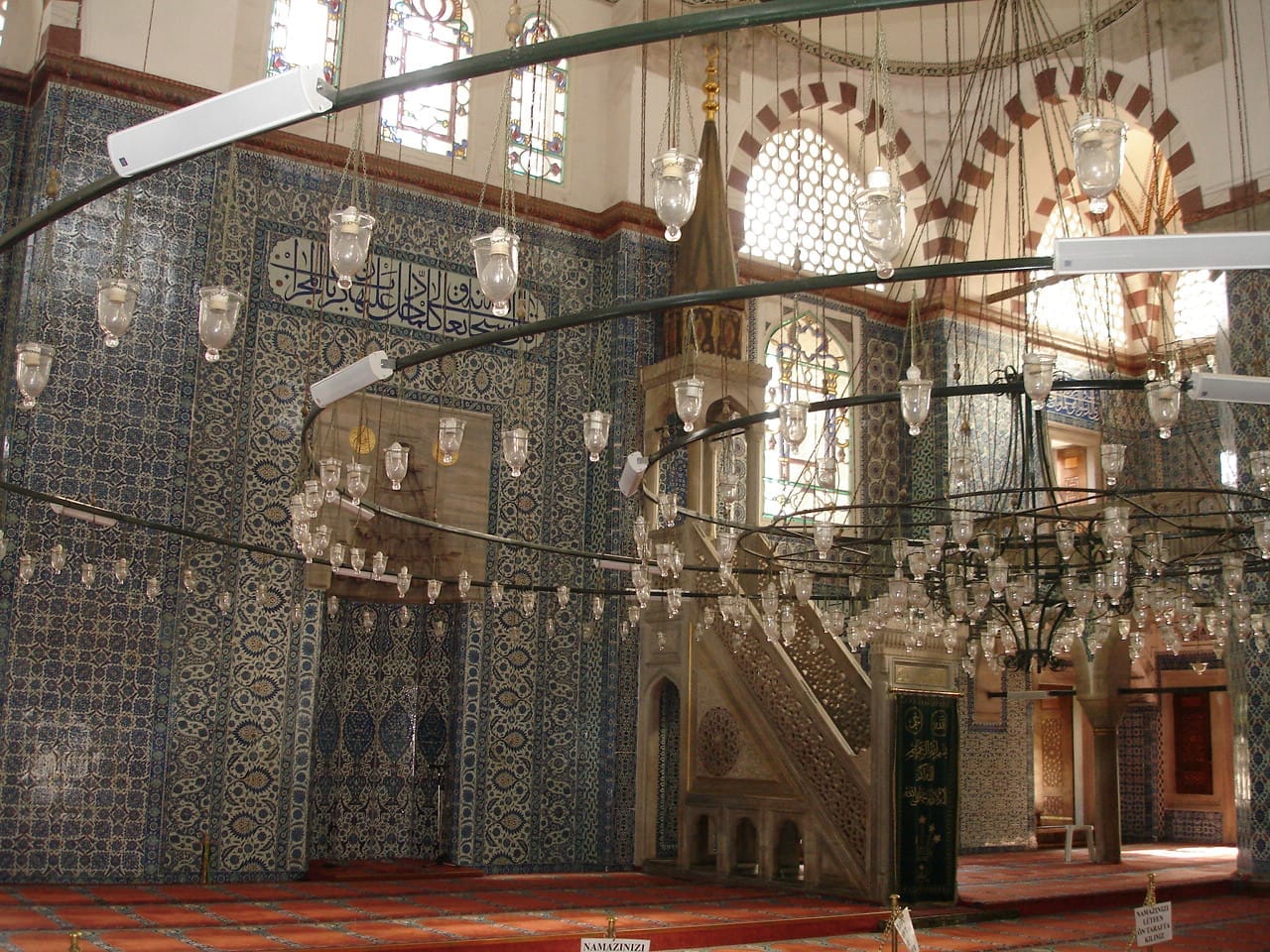
Most visitors to Istanbul's historic peninsula are drawn to the grand silhouettes of Hagia Sophia and the Blue Mosque on the skyline. Rüstem Paşa Mosque offers something fundamentally different: an intimate, almost overwhelming encounter with color and craft at close range. Step inside and the walls, columns, arches, and even the floor-level dados are blanketed in Iznik tiles of such quantity and quality that architectural historians consider this interior one of the finest surviving examples of 16th-century Ottoman decorative arts anywhere in the world.
The mosque was commissioned by Rüstem Paşa, twice Grand Vizier to Sultan Süleyman the Magnificent and husband of the sultan's daughter Mihrimah Sultan. Construction was completed around 1563, two years after Rüstem Paşa's death, to a design by the imperial architect Mimar Sinan. Unlike Sinan's larger imperial commissions, this is a compact structure, which makes the tile coverage feel even more intense. You are never more than a few meters from a wall of blue, white, turquoise, coral, and sage green.
💡 Local tip
The mosque entrance is not street-level. Look for an unobtrusive doorway on Hasırcılar Caddesi and climb the interior staircase to reach the mosque platform and courtyard above. Many first-time visitors walk past it entirely.
The Architecture and the Tiles: What You Are Looking At
Mimar Sinan raised the mosque on a platform above a network of shops and storage rooms, a practical solution to an irregular sloping site and a source of rental income that helped support the mosque's upkeep. This elevated position also means that arriving at the open terrace courtyard feels like surfacing from the market noise below into a pocket of relative calm.
The prayer hall itself is roughly square in plan, surmounted by a central dome flanked by four semidomes. The structural logic is Sinan at his most confident: the dome appears to float above the space with minimal visual obstruction from support piers. But the architecture, impressive as it is, plays second role to the tiles.
The Iznik tiles here were produced during the peak period of the Iznik workshops, roughly the 1550s to 1580s, when the distinctive tomato red pigment (sometimes called Armenian bole or Iznik red) was being used with particular success. You can see that vivid, slightly raised red in the tulip, carnation, and arabesque patterns that repeat across the walls. No two panels are identical. Some show large-scale floral compositions; others use geometric interlace. The mihrab niche and the area surrounding the minbar are the most concentrated displays, but tiles also wrap around the exterior of the mosque beneath the portico, so even waiting outside you are already inside a gallery.
For context on how Iznik tilework developed across Istanbul's Ottoman mosques, the guide to Istanbul's best mosques places Rüstem Paşa alongside other key examples and explains what sets each building apart.
Tickets & tours
Hand-picked options from our booking partner. Prices are indicative; availability and final rates are confirmed when you complete your booking.
Half day Morning Ottoman Splendors tour, including the Blue Mosque
From 48 €Instant confirmationFree cancellationIstanbul Basilica Cistern, Blue Mosque and Hagia Sophia tour
From 83 €Instant confirmationFree cancellationIstanbul mosaics and Blue Mosque 1-day small group tour
From 62 €Instant confirmationFree cancellationIstanbul combo tour of Hagia Sophia and Blue Mosque
From 114 €Instant confirmationFree cancellation
How the Visit Feels at Different Times of Day
Visiting in mid-morning, after the opening hour of around 10:00 and before tour groups consolidate around 11:00, gives you the best combination of natural light and relative quiet. The windows in the side walls admit a soft, even light during morning hours that makes the tile colors glow without the harsh reflection you get later in the day.
By midday the mosque receives more visitors, particularly during peak tourist months from April through September. The space is small enough that even a dozen people simultaneously inside can feel dense. If you arrive and find it crowded, the terrace courtyard is a worthwhile place to wait: you can study the exterior tilework on the portico columns and observe the market streets below, where sacks of dried herbs and rolls of synthetic fabric create a low, dusty aroma that drifts up from Hasırcılar Caddesi.
Access is suspended during the five daily prayer times. The most significant disruption for daytime visitors is typically the early afternoon prayer around midday. If you are turned away at the entrance, the Spice Bazaar is a two-minute walk east and makes a natural interlude.
ℹ️ Good to know
Visiting hours are generally listed as about 10:00–18:00 daily, but the mosque is a working place of worship. Always check locally for current prayer-time closures before planning a tight schedule around this stop.
How to Get There: Finding the Hidden Entrance
Take the T1 tram to Eminönü and walk west along the waterfront, past Yeni Cami and toward the Spice Bazaar. Turn right onto Hasırcılar Caddesi near the Mehmet Efendi coffee shop. After about 100 meters, look for a small sign or the arched doorway on the right side of the street. There is no grand forecourt, no ticket booth, and no queue. The entrance is deliberately understated.
This area sits at the heart of the Eminönü and Golden Horn district, one of Istanbul's most commercially active neighborhoods, where wholesale spice traders, tea merchants, and textile dealers operate from premises that have barely changed in layout since the Ottoman period.
Once through the street-level door, you climb a fairly steep staircase of worn stone steps. There is no elevator and no ramp alternative. At the top, you reach an open portico terrace that wraps around the mosque entrance. Shoes are removed before entering the prayer hall. Socks are useful both for mosque etiquette and because the marble floor is cold in winter months.
⚠️ What to skip
The staircase from street level involves multiple steps and no accessibility ramp. Visitors with mobility limitations should be aware that the mosque interior cannot be reached without climbing stairs.
Practical Details: Dress Code, Photography, and Etiquette
Standard mosque dress applies: shoulders and knees must be covered for all visitors, and women should bring a scarf or headcovering for inside the prayer hall. Scarves are sometimes available at the entrance for those who arrive without one, but this is not guaranteed. Carrying a light layer in your bag is the reliable solution.
Photography is generally permitted inside. The challenge is not permission but geometry: the prayer hall is compact, the tiles are floor-to-ceiling, and the light sources are uneven. A wide-angle lens captures more of the dome and wall panels in a single frame. For close-up tile detail, the portico columns and the mihrab surround are the most accessible and best-lit surfaces. Avoid using flash, which flattens the raised texture of the Iznik glaze and disturbs worshippers.
If photography of Islamic architecture is a priority on your trip, the Süleymaniye Mosque nearby offers Sinan's largest Istanbul commission and a very different spatial experience, with a vast courtyard and interior that rewards a longer visit.
Who This Mosque Is For, and Who Might Be Disappointed
Rüstem Paşa Mosque is not a monument that rewards passive sightseeing. Its exterior is almost invisible from the street, its interior is modest in scale, and there are no guided audio tours or interpretive panels. What it offers is pure visual intensity for anyone willing to slow down and look carefully. The tile patterns reward sustained attention: the more time you give them, the more variation and craft you notice.
Travelers focused on grand scale, dramatic skylines, or checking off the city's most famous landmarks may find the visit too brief and the location confusing. If your Istanbul itinerary is already packed with Topkapi Palace, the Blue Mosque, and the Basilica Cistern, this can feel like a detour into a neighborhood you had no other reason to visit. But for anyone with a genuine interest in Ottoman craftsmanship, decorative arts, or architecture, it is among the most rewarding thirty minutes available in the city.
The mosque pairs naturally with a walk through the Spice Bazaar two minutes away, and a stop at the nearby Galata Bridge rounds out a half-day in the Eminönü area without requiring much extra walking.
Historical Context: Rüstem Paşa and the Politics of Patronage
Rüstem Paşa was one of the most powerful and controversial figures of Süleyman's reign. He served as Grand Vizier twice, accumulated enormous personal wealth, and wielded influence over state appointments and treasury decisions on a scale that made him deeply unpopular with segments of the Ottoman court. He also played a role in the execution of Şehzade Mustafa, Süleyman's son from another relationship, a succession crisis that left a lasting stain on his reputation in Ottoman historical memory.
Commissioning a mosque of this quality, in this location, was a deliberate act of public piety and legacy-building. The choice of Mimar Sinan as architect and the evident decision to spare no expense on Iznik tilework sent a clear message about wealth, taste, and religious seriousness. Whether that message has been received charitably by history is debatable, but the building itself has outlasted the controversies of its patron by nearly five centuries.
For broader context on the Ottoman period in Istanbul and the network of monuments it produced, the Istanbul Ottoman history guide covers key sites, figures, and the architectural legacy of the empire across the city.
Insider Tips
- Arrive on a weekday morning between 10:00 and 11:00 to have the interior largely to yourself. Weekend afternoons see the heaviest tourist traffic.
- Look at the tiles on the portico columns before entering the prayer hall. The outdoor tilework is often overlooked but shows the full palette used inside, and the natural light is better for appreciating the glaze quality.
- The Mehmet Efendi Kurukahveci coffee shop, a landmark roaster operating since 1871, sits at the turn from the main road onto Hasırcılar Caddesi. Buy a small bag of freshly ground Turkish coffee here before or after your visit.
- Bring a small pair of binoculars if you have them. The upper gallery and the dome pendentives carry tilework that is impossible to appreciate clearly from floor level with the naked eye.
- The vaulted shops and storerooms beneath the mosque platform are still in commercial use. Look for the low arched entrances on the street: buying something from the traders whose rent has historically supported the mosque's upkeep is one of the more unusual ways to connect with how Ottoman charitable foundations actually worked.
Who Is Rüstem Paşa Mosque For?
- Architecture and Islamic art enthusiasts who want to study Iznik tilework up close
- Photographers looking for an interior subject with extraordinary color and pattern
- History travelers interested in Sinan's career beyond his most famous commissions
- Visitors combining a half-day in the Eminönü bazaar district with a cultural anchor
- Repeat Istanbul visitors who have already covered the headline monuments and want depth
Nearby Attractions
Other things to see while in Grand Bazaar & Bazaar Quarter:
- Grand Bazaar (Kapalıçarşı)
Founded in the 1460s under Sultan Mehmed II, the Grand Bazaar is one of the oldest and largest covered markets in the world. With 61 streets, over 4,000 shops, and about 30,700 square metres of covered space, it is an architectural and commercial landmark at the heart of Istanbul's historic peninsula.
- Spice Bazaar (Mısır Çarşısı)
Built in 1664 as part of the Yeni Camii complex, the Spice Bazaar is a covered L-shaped market hall in Eminönü with around 85 shops selling spices, dried fruits, sweets, and lokum. Entry is free, the atmosphere is dense and sensory-rich, and the surrounding streets are just as interesting as the market itself.