Galata Bridge: Istanbul's Most Lived-In Crossing
Galata Bridge spans the Golden Horn between Eminönü and Karaköy, carrying trams, traffic, and dozens of rod-wielding anglers at any hour. It costs nothing to cross, takes about 15 minutes to walk, and offers some of the most layered views in the city. This guide tells you what to expect at each time of day, and how to make the most of the lower deck.
Quick Facts
- Location
- Between Eminönü (Fatih side) and Karaköy (Beyoğlu side), spanning the Golden Horn, Istanbul
- Getting There
- Tram T1 stops at Eminönü and Karaköy at each end; numerous city buses serve both squares
- Time Needed
- 15–30 min to cross; 1–2 hrs if you stop for tea, fishing views, or a meal on the lower deck
- Cost
- Free to cross on foot at any hour, 24/7
- Best for
- Sunset and early-morning views, street photography, connecting Sultanahmet to Galata Tower on foot
- Official website
- www.ibb.istanbul
What Galata Bridge Actually Is
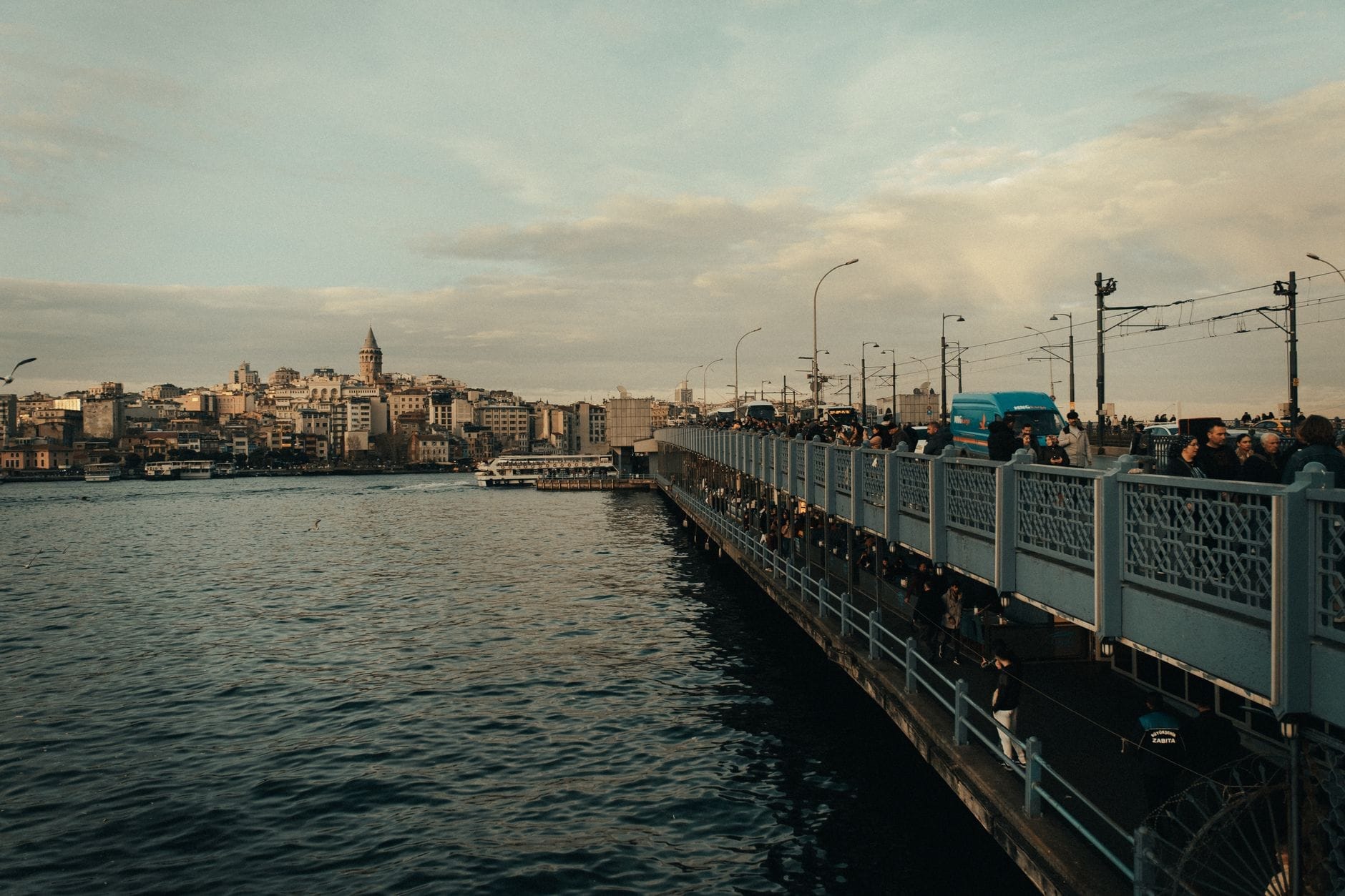
Galata Bridge, known in Turkish as Galata Köprüsü, is a 490-meter bascule bridge connecting Eminönü on the Fatih (historic peninsula) side with Karaköy on the Beyoğlu side. It spans the mouth of the Golden Horn where that long inlet meets the Bosphorus, placing the bridge at one of the most geographically charged points in Istanbul. The current structure, the fifth bridge to occupy this crossing, was completed in 1994. It carries two lanes of vehicle traffic, the T1 tram line, and a pedestrian walkway on each side.
The bridge is not a monument you visit in the conventional sense. There is no ticket booth, no queue, and no audio guide. It is a working part of the city's circulatory system: trams rattle across it every few minutes, minibuses idle at each end, and ferry smoke drifts up from the Eminönü docks below. What makes it worth your time is precisely that ordinariness, seen from an extraordinary vantage point.
The bridge sits at the junction of the city's two most historically significant districts. To the south liesEminönü and the Golden Horn waterfront, with the Spice Bazaar and Yeni Cami within a five-minute walk. To the north, Karaköy feeds directly into theGalata and Karaköy neighborhood, with the Galata Tower rising on the hill above.
💡 Local tip
Walk the bridge from Eminönü toward Karaköy in the afternoon so that the light falls on the minarets of the historic peninsula behind you and the Galata Tower ahead. It is the most photogenic direction at that hour.
The Anglers: A Permanent Feature of the Bridge
At almost any hour, the upper walkways of Galata Bridge are lined with fishermen. On weekday mornings you might count twenty or thirty rods; on weekend afternoons the number can reach well over a hundred. The lines hang down into the Golden Horn below, and the anglers stand in near-total silence, watching the water. The scene is so consistent that it has become one of the defining images of Istanbul street life.
The fish they are after are mostly small species from the Golden Horn and the adjacent Bosphorus waters. The catch is real and matters to some of the older regulars, but for many this is also a form of slow socializing. Small plastic stools appear, thermoses of tea are passed around, and conversations drift on without urgency. Walking through this arrangement requires a little patience: fishing lines cross the walkway at ankle height occasionally, and the rods protrude outward at face level. Move with awareness, especially when carrying a bag.
Do not photograph individual fishermen close-up without a small gesture of acknowledgment first. Most are unbothered, but some prefer privacy. A brief nod or a word of greeting tends to be enough.
Tickets & tours
Hand-picked options from our booking partner. Prices are indicative; availability and final rates are confirmed when you complete your booking.
Galata Tower Skip-the-Line Ticket with Audio Guided Tour
From 47 €Instant confirmationFree cancellationBasilica Cistern, Galata Tower, Topkapi Palace, Hagia Sophia ticket
From 178 €Instant confirmationFree cancellationIstanbul Audio Guide Tour from Taksim Square Through Galata Tower
From 12 €Instant confirmationFree cancellationTopkapi Palace and Galata Tower Skip-the-Line Ticket
From 110 €Instant confirmationFree cancellation
How the Bridge Changes by Time of Day
Early morning, roughly 6:00 to 8:00, is when the bridge carries its most atmospheric light. The Bosphorus fog sometimes reaches the Golden Horn at this hour, softening the silhouette of the Süleymaniye Mosque and the minarets on the peninsula. Ferry traffic begins before dawn, and the smell of salt water and diesel is strongest before the city warms up. The anglers are already out. Foot traffic is thin, which makes this the best time for photography without crowds in the frame.
Midday is the least rewarding window. The light is flat and overhead, the pedestrian walkways are congested with commuters and tourists moving between Eminönü and Karaköy, and the lower-deck restaurants have their most aggressive touts outside. If you are simply crossing to get somewhere, this is fine. If you want to linger, it is not the ideal time.
Sunset is the bridge at its most dramatic. In the 40 minutes before and after the sun drops behind the European hills to the west, the Golden Horn takes on a copper-orange color that reflects off the water and catches the underside of the ferries still running their routes. Both walkways fill with people stopping to photograph the scene. The fishermen stay through all of it. This is also when the lower-deck restaurants begin filling in earnest, so arrive early if you plan to eat.
Night on the bridge is quieter than you might expect for a major urban crossing. The tram still runs, the anglers do not all go home, and the lower deck glows with restaurant lighting. Looking back toward Eminönü after dark, the floodlit Yeni Cami and the Spice Bazaar silhouette are clean and striking against a dark sky.
The Lower Deck: Restaurants and What to Expect
Below the traffic and tram level, reached by stairs descending from the quays on either side, is a continuous row of restaurants built into the structure of the bridge itself. These are fish restaurants almost exclusively, serving grilled and fried seafood, meze plates, and raki. The setting is unlike any other in Istanbul: you are sitting inside a bridge, with the Golden Horn visible through arched openings, and the sounds of the water and the city mixing overhead.
The quality varies considerably between establishments. Some are good; others rely entirely on location. Prices are moderately high by Istanbul standards. Touts at the top of the stairs will approach you and some are quite persistent. A practical approach is to walk the full length of the lower deck before sitting down, look at what other tables have ordered, and choose based on what you see rather than the menu handed to you outside.
⚠️ What to skip
Check the bill carefully before paying on the lower deck. Overcharging and adding items not ordered is not universal but does happen often enough that it warrants attention. Ask for an itemized receipt.
If you want a proper meal near the bridge without the tourist markup, the side streets of Eminönü hold several lokanta-style lunch spots that are almost entirely frequented by locals. TheSpice Bazaar is a two-minute walk and the surrounding streets have some of the best cheap food in the city.
Historical Context: Five Bridges in One Place
A crossing at this location has existed in various forms since the 19th century. The current bridge is the fifth structure to span the Golden Horn at this point. Earlier crossings included a pontoon bridge constructed in the 1840s and subsequent replacements that grew in scale as the city expanded. Each version was a commercial and social center of its time: the old floating bridges were famous for the coffee houses, taverns, and shops crammed onto their lower levels, which is a tradition the current restaurant deck continues in spirit if not in form.
The 1994 structure is a bascule design, meaning a central section can be raised to allow tall vessels through the Golden Horn. In practice this rarely happens today given the reduced commercial traffic on the inlet, but the mechanism remains functional. The bridge is 42 meters wide, which is why it can carry four lanes of vehicle traffic, the T1 tram line, and walkways on both sides.
For deeper context on Istanbul's relationship with the water that defines its geography, theBosphorus cruise guide covers how the strait, the Golden Horn, and the Sea of Marmara shape the city's layout and daily life.
Getting There and Practical Notes
The T1 tram is the simplest connection from Sultanahmet. Board at Sultanahmet or Gülhane stop and ride two stops to Eminönü, which places you at the south end of the bridge. From Beyoğlu and Taksim, walk downhill through Galata to Karaköy, or take the T1 from Kabataş direction and exit at Karaköy. The journey on foot from Galata Tower to the north end of the bridge takes about 10 minutes downhill.
City buses from across Istanbul converge on both Eminönü and Karaköy, making the bridge an unavoidable transit node even if you do not intend to cross it on foot. The ferry terminals at Eminönü are immediately adjacent: Şehir Hatları ferries depart from here to Kadıköy, Üsküdar, and Bosphorus destinations, so combining a bridge walk with a ferry ride makes practical geographic sense.
The bridge is accessible 24 hours a day and free to cross on foot. There is no admission, no ticket, and no registration. Vehicle lanes carry traffic throughout the day and into the night. The tram operates on its regular schedule, which runs from early morning until late evening.
ℹ️ Good to know
Accessibility: The bridge approaches are street-level from both Eminönü and Karaköy squares and are navigable for most visitors. The lower-deck restaurant level is accessed by stairs from the quayside. Confirm current wheelchair access conditions locally before visiting if this is a priority.
If your Istanbul itinerary is tight, the bridge works as a connector rather than a standalone stop. A logical sequence is to walk across from Eminönü after visiting theYeni Cami or theSpice Bazaar, then continue uphill to theGalata Tower. This covers a logical walking arc across the Golden Horn without retracing steps.
Who Should Temper Expectations
Galata Bridge is not a grand architectural set piece. The 1994 structure is functional and unglamorous up close: concrete, tram tracks, diesel fumes from the idling traffic, and persistent restaurant hawkers on the lower level. Visitors expecting a photogenic bridge in the manner of the Bosphorus suspension bridges or a historic landmark with museum-quality presentation will find it unremarkable in those terms.
The bridge also gets very crowded at peak hours, particularly weekend afternoons in summer. If crowds are a significant concern for your visit, the early-morning window is genuinely different in character and worth the effort of an earlier start. The views do not require good weather to be interesting, but heavy rain eliminates the appeal of the outdoor walkway without much compensation.
Insider Tips
- The best unobstructed photo of the bridge itself is taken from a Şehir Hatları ferry leaving Eminönü dock, looking back toward the shore within the first 60 seconds of departure. You get the full length of the bridge, the fishing rods, and the mosque skyline in a single frame.
- If you want tea with a view, skip the lower-deck restaurants and look for the small tea sellers who set up on the upper walkway near the midpoint of the bridge. A glass of çay costs a fraction of what you pay inside any establishment, and you drink it standing at the railing with the Golden Horn below.
- The bascule mechanism at the center of the bridge is visible from below if you look up from the lower deck. Most visitors walk straight past it, but it is an engineering detail worth a pause if you are interested in how the structure actually works.
- Eminönü square at the south end of the bridge has some of the best balık ekmek (fish sandwich) boats moored alongside. These grilled mackerel sandwiches cost very little and are best eaten leaning on the railing with a view of the bridge. Arrive before 1pm for the freshest fish.
- On clear evenings in autumn and spring, both the Princes' Islands and the Asian shore are visible from the bridge's eastern walkway. This is the quieter side during sunset, since most people face west toward the light.
Who Is Galata Bridge For?
- Walkers connecting Sultanahmet and the historic peninsula with Galata and Beyoğlu on foot
- Photographers working the golden hour, especially in the 30 minutes before sunset from the western walkway
- Travelers wanting an unmediated slice of everyday Istanbul without paying any entry fee
- Food explorers interested in the balık ekmek boats at Eminönü or a seafood meal on the lower deck
- First-time visitors to Istanbul who want geographic orientation: standing at the midpoint of the bridge puts the city's layout into immediate, tangible perspective
Nearby Attractions
Other things to see while in Eminönü & the Golden Horn:
- Sirkeci Train Station
Sirkeci Train Station in Eminönü is one of Istanbul's most storied buildings, built in 1890 as the Istanbul terminus of the Orient Express. Today it serves Marmaray commuters while its ornate façade and tiled halls quietly narrate a century of continental travel.
- Yeni Cami (New Mosque)
Standing at the edge of the Golden Horn where ferries, trams, and the Spice Bazaar converge, Yeni Cami is one of Istanbul's most recognizable Ottoman mosques. Construction began in 1597 and the mosque was completed in 1663, making it centuries old despite its misleading name. Entry is free, the architecture is impressive, and the surrounding square is one of the city's great people-watching spots.