Panorama 1453 History Museum: Istanbul's Immersive Window into the Ottoman Conquest
The Panorama 1453 History Museum in Istanbul's Fatih district puts visitors at the center of one of history's most decisive moments: the Ottoman conquest of Constantinople on May 29, 1453. Housed in Topkapı Culture Park beside the ancient Theodosian Walls, the museum wraps a 38-meter-high, 238-meter-long cylindrical painting around a raised viewing platform, blending painted canvas with three-dimensional foreground figures to create an effect that is disorienting in the best possible way.
Quick Facts
- Location
- Topkapı Kültür Park İçi Yolu, Merkez Efendi Mahallesi, Zeytinburnu, Istanbul 34015
- Getting There
- Topkapı station on the T1 and T4 tram lines
- Time Needed
- 45–90 minutes
- Cost
- Paid admission; verify current ticket prices at the official website before visiting
- Best for
- History enthusiasts, families with older children, Ottoman and Byzantine history buffs
- Official website
- www.panoramikmuze.com
What Is the Panorama 1453 History Museum?
The Panorama 1453 History Museum opened in 2009 after construction that began in 2005 and was completed in 2008. It claims the title of the world's first fully panoramic museum, a format that surrounds the visitor with a continuous 360-degree painted canvas rather than presenting art on isolated walls. The subject of that canvas is the Ottoman siege and conquest of Constantinople, which concluded on May 29, 1453, when Sultan Mehmed II and his forces breached the Theodosian Walls and entered the Byzantine capital after a 53-day siege.
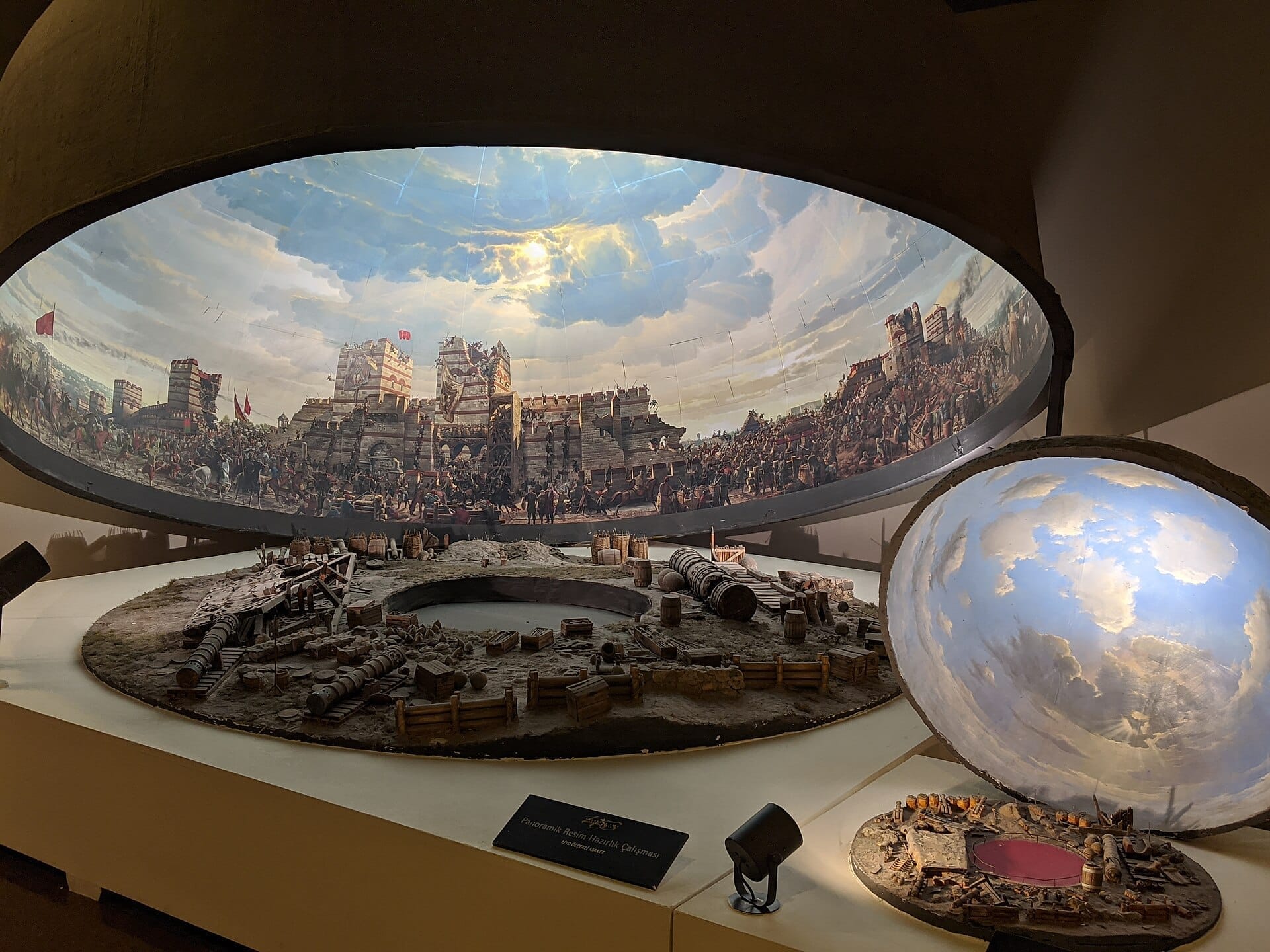
The scale of the installation is hard to appreciate until you are standing on the raised circular platform at its center. The panoramic painting measures 38 meters in height and 238 meters in length. Cannons, tent poles, ropes, and scattered weapons occupy the foreground as physical props, merging with the painted scene behind them so gradually that the boundary between sculpture and canvas dissolves. The effect works because the lighting is carefully controlled: the foreground objects are lit from above, while the painting itself is evenly illuminated to eliminate shadows that would reveal the illusion.
💡 Local tip
Allow your eyes a few minutes to adjust when you enter the main panorama hall. The transition from the bright entrance area to the controlled interior lighting is significant, and the full depth of the painting only becomes clear once your vision has settled.
The History Behind the Image
The fall of Constantinople to the Ottoman forces under Sultan Mehmed II is one of the events historians consistently cite as a marker of the end of the medieval period in European history. The city had served as the capital of the Eastern Roman (Byzantine) Empire for over a thousand years, and its walls, especially the triple-layered Theodosian Walls built in the fifth century under Emperor Theodosius II, had repelled dozens of sieges before 1453.
What made the 1453 siege different was a combination of military technology, including large-caliber bombards capable of breaching medieval fortifications, and the sheer scale of the Ottoman forces. The museum's panorama focuses on the final assault, depicting Ottoman soldiers, siege equipment, and the defended walls simultaneously. Walking the circular platform feels less like reading history and more like standing inside it. For visitors who want to understand the physical geography of that moment, the Theodosian Walls themselves run immediately outside the museum grounds and are freely accessible.
The panorama format itself has a long history in European art. Large-scale cylindrical paintings depicting battles were popular throughout the 19th century as a form of mass entertainment and patriotic commemoration, before cinema replaced them. The 1453 museum revives that tradition with modern digital assistance: Turkish artists created the composition using computer modeling to ensure correct perspective at every viewing angle before painting the canvas by hand.
Tickets & tours
Hand-picked options from our booking partner. Prices are indicative; availability and final rates are confirmed when you complete your booking.
Bosphorus sunset cruise on luxury yacht with guide
From 55 €Free cancellationIstanbul and Bosphorus cruise on private boat - half day afternoon tour
From 40 €Instant confirmationFree cancellationWhirling Dervishes live show and exhibition
From 29 €Instant confirmationBasilica Cistern fast-track entry ticket and optional audio guide
From 34 €Instant confirmation
Visiting the Museum: What to Expect Room by Room
The entrance building is modest in scale. After ticketing, visitors move through a series of preparatory galleries that provide historical context: maps of the Byzantine city, timelines of the siege, models of Ottoman siege equipment, and display cases containing period artifacts or reproductions. These galleries are informative but not exceptional on their own. Their real function is to orient visitors so that the panorama, when it arrives, carries narrative weight.
The central panorama hall is accessed through a short corridor that opens dramatically onto the viewing platform. The ceiling disappears into the painting above. Foreground structures, including a recreated section of Ottoman camp, extend outward from the platform railings. Sound effects and ambient audio, including the sounds of battle, cannons, and prayer calls, play continuously through a speaker system embedded in the structure. Some visitors find this atmospheric; others find it intrusive. If you are sensitive to sound at high volume, be aware that the audio is not optional.
The viewing platform is fixed. There is no rotation or movement. Visitors are expected to walk around the circular railing themselves to take in different sections of the painting. The full circuit takes roughly ten to fifteen minutes at a moderate pace; longer if you stop to examine the painted details, which include individual portraits of soldiers, horses, and siege engineers rendered with considerable care.
ℹ️ Good to know
Photography is generally permitted inside the panorama hall without flash. The circular composition makes it difficult to capture in a single frame; a wide-angle lens or a panoramic phone mode produces the most useful shots.
Timing Your Visit: Morning vs. Afternoon
The museum is open every day from 8:30 AM to 4:30 PM, except Monday. Because the main attraction is an interior installation with controlled lighting, the experience is not affected by outdoor weather or time of day in the way that an outdoor monument would be. However, crowd levels do vary meaningfully.
Weekday mornings, particularly between 9:00 AM and 11:00 AM, are consistently quieter. School groups arrive in force on weekday late mornings and early afternoons, which can make the viewing platform feel crowded and the audio environment more chaotic. Weekend afternoons are the most congested, especially during Turkish school holiday periods and in the peak summer months of July and August. If you are visiting with children and want to make the experience manageable, an early weekday arrival is strongly advisable.
The museum sits within Topkapı Culture Park, a green space that can be pleasant to walk through before or after your visit. The park itself is free to enter and provides a setting that softens the transition between the museum's intensity and the surrounding city.
Getting There and the Surrounding Area
The most straightforward route is the T1 or T4 tram to Topkapı station. From the tram stop, the museum entrance in Topkapı Culture Park is a short walk. The area around the museum sits within the Fatih district, the historic peninsula that contains the largest concentration of significant monuments in Istanbul. Visitors can combine a trip to the museum with a walk along the adjacent city walls, which stretch north and south from the museum grounds.
Fatih is not a neighborhood that caters primarily to tourists. The streets around the museum are residential and commercial in a local sense, with small teahouses, bakeries, and neighborhood grocers rather than souvenir shops. This gives the area an authenticity that parts of Sultanahmet lack, but it also means fewer English menus and less obvious wayfinding. The historic peninsula guide covers the wider area in detail and is worth reading before you plan a full-day itinerary in this part of the city.
Taxis and ride-hailing apps (Uber operates through licensed taxis in Istanbul, and local apps like BiTaksi are reliable) can drop you directly at the park entrance. If you are coming from Sultanahmet, the journey is roughly three kilometers by road and can also be done on foot in about 35 to 40 minutes along the walls, which is itself a worthwhile walk.
Who This Museum Is For
The Panorama 1453 History Museum is not subtle. It is unambiguously a monument to Ottoman military achievement, and the perspective it adopts, that of the victorious besieging force, is presented without significant counter-narrative from the Byzantine defenders. Visitors approaching the museum as a piece of balanced historical education should calibrate their expectations accordingly. It is a commemorative artwork as much as it is a history museum.
That said, as a visual and sensory experience, it is genuinely impressive. The scale of the painting rewards careful attention in a way that a smaller artwork cannot. Children who might struggle to engage with a conventional history museum often respond strongly to the immersive format. For adults with existing knowledge of the Byzantine-Ottoman period, the visual representation adds a spatial dimension to events they may have only read about. Pairing this visit with the Hagia Sophia and the Chora Church creates a coherent full-day exploration of Byzantine and early Ottoman Istanbul.
Visitors who may not enjoy this museum: those who prefer archaeological depth to spectacle, anyone with sensitivity to loud enclosed spaces, and travelers with a full itinerary who cannot spare 60 to 90 minutes for a single-theme attraction. The museum is also relatively far from Sultanahmet's main cluster of monuments, so unless you are specifically interested in the 1453 conquest or planning a walls-and-Fatih day, it may not fit efficiently into a short Istanbul visit.
⚠️ What to skip
Ticket prices are not published in real-time on all third-party booking platforms. Check the official website at panoramikmuze.com or the ticket window on arrival for current pricing before budgeting your visit.
Accessibility and Practical Notes
The museum's central viewing platform is accessed via ramps or steps depending on the entry point; the available sources do not confirm full step-free access throughout the facility. Visitors with mobility considerations are advised to contact the museum directly before visiting to confirm accessibility details. The interior is climate-controlled, which makes it a comfortable stop during Istanbul's hot summers or wet winters regardless of outdoor conditions.
If you are building a broader Fatih itinerary, note that the Süleymaniye Mosque and the Valens Aqueduct are both accessible from Fatih on the same day, though each requires its own travel time across the district.
Insider Tips
- Arrive within the first hour of opening on a weekday. The panorama hall is quietest before 10:00 AM, and the audio environment is significantly more atmospheric without a crowd talking over it.
- Walk the exterior of Topkapı Culture Park before entering the museum. The surviving sections of the Theodosian Walls adjacent to the park give immediate physical scale to the walls you are about to see depicted in paint.
- Bring binoculars if you own compact ones. The upper sections of the 38-meter painting contain detailed figures that are impossible to read clearly from the platform with the naked eye.
- The park café outside the museum is a reasonable place to sit after your visit. It is cheaper than cafés in Sultanahmet and serves standard Turkish tea and snacks.
- If you are visiting with children under ten, the ambient battle sounds in the main hall can be startling. Brief them in the approach corridor before entering, so the audio does not overwhelm the visual experience.
Who Is Panorama 1453 History Museum For?
- Travelers with a specific interest in Ottoman or Byzantine history who want a visual rather than purely textual encounter with the 1453 conquest
- Families with children aged 8 and older who respond well to immersive, large-scale experiences
- Visitors on a second or third trip to Istanbul who have already covered Sultanahmet's core monuments and want to explore further into Fatih
- Photography enthusiasts interested in the technical challenge of capturing a 360-degree cylindrical painting
- Travelers visiting during summer or winter who want a climate-controlled indoor attraction that justifies a full hour of engagement
Nearby Attractions
Other things to see while in Fatih:
- Chora Church (Kariye Mosque)
The Chora Church, now Kariye Mosque, preserves the most complete cycle of late Byzantine mosaics and frescoes anywhere in the world. Tucked inside the Fatih district near the ancient Theodosian Walls, it rewards visitors who make the effort to reach it — but requires some planning around prayer times and dress codes.
- Fatih Mosque
Commissioned by Sultan Mehmed II a decade after the Ottoman conquest of Constantinople, Fatih Mosque stands as one of Istanbul's most historically charged religious sites. Unlike the tourist-heavy mosques of Sultanahmet, this one belongs primarily to the local neighborhood — and that contrast is exactly what makes it worth visiting.
- Süleymaniye Mosque
Rising above the Golden Horn on Istanbul's Third Hill, Süleymaniye Mosque is widely regarded as the finest work of Ottoman imperial architecture. Built between 1550 and 1557 under the direction of master architect Mimar Sinan for Sultan Suleiman the Magnificent, it remains a functioning mosque with free admission and considerably fewer visitors than the Blue Mosque in Sultanahmet.
- Theodosian Walls
Built in the 5th century CE and stretching roughly 5.7 kilometers from the Golden Horn to the Sea of Marmara, the Theodosian Walls stood for over a thousand years as the most formidable defensive barrier in the medieval world. Today they form one of Istanbul's most atmospheric and undervisited monuments: free, open-air, and bracingly honest about the passage of time.