Valens Aqueduct (Bozdoğan Kemeri): Istanbul's Roman Engineering Marvel
The Valens Aqueduct, known in Turkish as Bozdoğan Kemeri, is one of the best-preserved Roman structures in Istanbul. Spanning nearly a kilometre across Atatürk Boulevard in Fatih, this 4th-century engineering achievement is free to visit at any hour and sits in plain view of the street, requiring no ticket, no queue, and no tour group.
Quick Facts
- Location
- Kalenderhane, Fatih, Istanbul (crosses Atatürk Bulvarı)
- Getting There
- Vezneciler–Istanbul University station (M2 metro), 5–10 min walk
- Time Needed
- 30–60 minutes to walk the length and explore Sarachane Park
- Cost
- Free — no ticket required, open at all hours
- Best for
- History enthusiasts, photographers, early-morning walkers, urban explorers
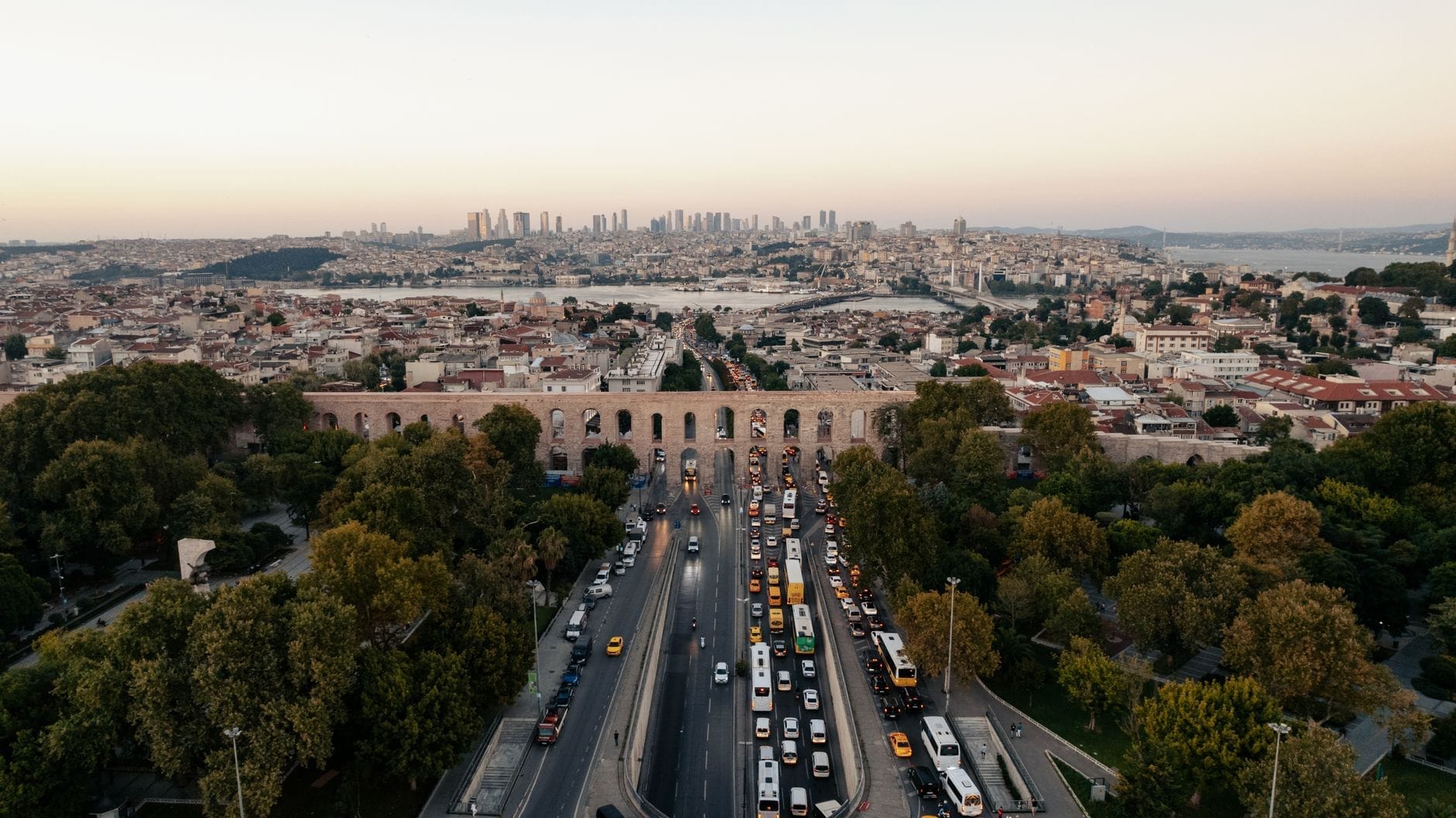
What You're Looking At: Scale and First Impressions
The Valens Aqueduct does not ease you in gently. Walking north along Atatürk Boulevard, the structure simply appears above the rooftops: two tiers of stone arches, each arch wide enough to drive a truck through, climbing to around 29 metres at its highest point. At roughly 921 metres in length, it is long enough that neither end is visible from the middle. In a city where Roman, Byzantine, and Ottoman layers compete for attention, the Bozdoğan Kemeri stands apart because of sheer physical presence rather than ornament.
Stand directly beneath the central arches where the aqueduct crosses the boulevard and the effect is arresting. Traffic flows underneath in both directions, minibuses and taxis passing through a Roman gateway that has watched armies, empires, and republics come and go. The stone is a warm honey-grey, worn smooth in places and colonised by thin lines of moss and lichen where rainwater traces its routes down the piers.
💡 Local tip
The best single photograph is taken from the pavement on the south side of Atatürk Boulevard, framing both tiers of arches against the sky. Early morning gives the warmest light on the stone and eliminates the bus traffic that obscures the base of the piers during peak hours.
Historical Context: From Constantinople's Lifeline to City Landmark
Construction of the aqueduct began under Emperor Constantius II around 345 CE and was completed in the later 4th century under Emperor Valens, whose name the structure still carries. At the time, Constantinople was being built up as the new eastern capital of the Roman Empire, and a reliable water supply was not a luxury — it was the condition on which urban life depended. The aqueduct carried water from forests and springs in Thrace, west of the city, across a valley between two of the city's seven hills, feeding cisterns, baths, and the imperial palace complex.
The broader water distribution network connected to the aqueduct was immense: recent research estimates the full system of channels, pipes, and branches extended several hundred kilometres. The visible bridge section in Fatih is simply the most dramatic surviving piece of that infrastructure. What is extraordinary is not just its age but its continuity of use: the aqueduct remained operational, repaired and adapted by successive Byzantine emperors and later by Ottoman sultans, until roughly the 18th century. For more than 1,400 years, it moved water.
The Fatih district where it stands preserves other traces of the Byzantine city, and exploring the aqueduct makes most sense as part of a broader walk through the historic peninsula. The Byzantine history of Istanbul is dense in this neighbourhood, and the aqueduct is one of the most tangible physical remnants of that period that visitors can actually touch.
Tickets & tours
Hand-picked options from our booking partner. Prices are indicative; availability and final rates are confirmed when you complete your booking.
Bosphorus sunset cruise on luxury yacht with guide
From 55 €Free cancellationIstanbul and Bosphorus cruise on private boat - half day afternoon tour
From 40 €Instant confirmationFree cancellationWhirling Dervishes live show and exhibition
From 29 €Instant confirmationBasilica Cistern fast-track entry ticket and optional audio guide
From 34 €Instant confirmation
The Visit by Time of Day
Early morning, roughly 7–9 am, is the quietest and most photogenic window. Sarachane Park on the southern side of the aqueduct has a handful of local residents walking dogs or sitting on benches, and the light falls across the stone at a low angle that reveals texture and depth. The noise level is manageable, and you can stand at the base of the piers without dodging pedestrian traffic.
By mid-morning, tour groups begin arriving from Sultanahmet, often as a secondary stop after the nearby Şehzade Mosque. The aqueduct never gets overwhelmingly crowded — it is not that kind of attraction — but the pavement narrows near the central crossing point and groups can block sightlines for photographs. Midday in summer is punishing if you are standing in direct sun on the boulevard, as there is no shade directly under the arches on the road-level sections.
Late afternoon and early evening bring a different character. The stone picks up a warmer tone as the sun drops toward the western horizon, and the surrounding streets of Fatih fill with the end-of-day rhythms of a working neighbourhood: schoolchildren, market traders packing up, and the call to prayer echoing from nearby mosques. This is when the aqueduct feels most integrated into a living city rather than a museum exhibit in the open air.
ℹ️ Good to know
The aqueduct is an outdoor, unenclosed monument on a public boulevard. It is accessible at all hours, in all weather, with no admission fee. There is no visitor centre, no signage infrastructure beyond a small information board, and no guided tour apparatus on site.
Walking the Aqueduct: A Practical Route
The most rewarding approach is to walk the full length of the surviving structure, which requires moving through side streets parallel to Atatürk Boulevard rather than along the boulevard itself. Starting from the Sarachane Park end to the west, you can trace the aqueduct eastward as it rises toward the crest of the hill. The western end of the structure sits lower to the ground and the arches are partially embedded in later construction — a good illustration of how the city grew around and into the Roman infrastructure rather than removing it.
Walking east, the arches increase in height as the terrain drops away beneath them. Small workshops, tea houses, and repair shops occupy the ground floor of buildings that press right up against the aqueduct's piers on the northern side. This relationship between ancient structure and daily commerce is one of the most interesting things to observe: a tyre shop operates literally within a stone's throw of a 4th-century Roman arch.
The eastern terminus of the aqueduct sits near the Fatih district's central streets, a short walk from the Fatih Mosque and within easy reach of the broader historic peninsula. If you are planning a full day in Fatih, the aqueduct pairs naturally with the Zeyrek neighbourhood and the Chora Church to the north.
Getting There and Getting Around
The M2 metro line stops at Vezneciler–Istanbul University station, which puts you 5 to 10 minutes on foot from the central section of the aqueduct. Exit the station and walk west along Şehzadebaşı Caddesi; the aqueduct arch crossing becomes visible ahead of you. Multiple IETT bus lines — including the 33, 35, 73, and 80 among others — stop near Sarachane Park and the İBB (Istanbul Metropolitan Municipality) headquarters, which sits immediately adjacent to the monument.
If you are combining the aqueduct with other sites in the historic peninsula, the T1 tram stops at Laleli–Istanbul University, roughly a 12-minute walk south. For broader planning across Fatih and the surrounding area, the guide to getting around Istanbul covers the Istanbulkart system and which transport modes work best for each part of the city.
⚠️ What to skip
Atatürk Boulevard carries heavy traffic including large buses. Crossing the road directly beneath the arches requires care — use the marked pedestrian crossings and do not assume drivers will yield. The noise level on the boulevard during peak hours (8–10 am, 5–7 pm) is substantial.
Photography, Accessibility, and Practical Notes
Photography is unrestricted and no permit is needed for personal or editorial use from street level. The most compelling compositions come from two positions: standing on the south pavement of Atatürk Boulevard and shooting north through the arches toward Sarachane Park, or walking into the side streets on the northern face and shooting upward along the line of piers. A wide-angle lens is useful; the structure is too large to capture adequately with a standard smartphone field of view from close range.
Accessibility at street level is reasonable — paved sidewalks exist along Atatürk Boulevard and around Sarachane Park. However, some of the side streets on the northern face of the aqueduct are narrow, cobbled, and uneven, and there are no ramps or formal visitor paths. There is no access to the top of the aqueduct, no lift, and no official viewing platform. The monument is experienced entirely from ground level.
For travellers building an itinerary around outdoor monuments and historic architecture, the aqueduct sits at a logical midpoint between Sultanahmet's concentrated cluster of monuments and the quieter streets of the Fatih neighbourhood. It rewards those who are willing to walk rather than those who prefer to arrive by taxi, stand briefly, and leave.
Who Will Love It (and Who Won't)
The Valens Aqueduct is not a site that offers interpretation, guided context, or comfortable visitor infrastructure. If you arrive without some prior knowledge of Byzantine or Roman history, it is easy to walk past and see only a large old bridge in a traffic-heavy street. The absence of an on-site museum, audio guide, or even substantive signage means the experience depends heavily on what you bring to it.
Travellers with limited time in Istanbul who are working through a list of headline attractions may find the aqueduct a detour that delivers less immediate reward than Hagia Sophia or Topkapi Palace. But for anyone interested in the physical texture of ancient cities, in how Roman infrastructure survives and gets absorbed into later urban fabric, or simply in walking a neighbourhood that feels genuinely local rather than tourist-oriented, the aqueduct is one of the most distinctive things Istanbul offers.
It is also completely free and open at any hour, which makes it an excellent early-morning or evening stop that requires no planning beyond knowing where to walk. Pair it with the Chora Church to the northwest or the Zeyrek Mosque uphill, and you have a half-day Byzantine walking route that most visitors to Istanbul never take.
Insider Tips
- Walk the northern face of the aqueduct through the back streets rather than staying on Atatürk Boulevard. The view from the narrow lanes beside the piers — with the arches rising directly above rooftops and shopfronts — is far more atmospheric than the boulevard perspective.
- Sarachane Park is a genuine local park used by Fatih residents. Sit here for 20 minutes at any time of day and the aqueduct makes sense as part of a living neighbourhood rather than as an isolated monument. The park also offers the best unobstructed southern view of the arches.
- The stone of the aqueduct shows distinct phases of repair and reconstruction — you can identify sections where the original Roman coursing gives way to later Byzantine or Ottoman repointing. Look for changes in mortar colour and brick size as you walk west to east along the structure.
- The Istanbul Metropolitan Municipality building immediately south of the aqueduct contains an outdoor terrace area that offers an elevated view of the monument. It is a public building and the ground-floor exterior can be accessed freely during office hours, giving a slightly elevated vantage point.
- Combine the aqueduct with a visit to the Kalenderhane Mosque, which is a converted Byzantine church immediately adjacent. It is rarely visited and provides direct architectural context for the late Roman and early Byzantine period the aqueduct represents.
Who Is Valens Aqueduct For?
- History and archaeology enthusiasts who want physical contact with Roman and Byzantine Istanbul beyond the Sultanahmet cluster
- Photographers looking for dramatic urban-scale structures with strong geometric lines and warm stone tones
- Walkers building a half-day route through Fatih that connects major and minor Byzantine monuments
- Travellers on a tight budget who want serious historical depth without any admission cost
- Repeat visitors to Istanbul who have already covered the headline sites and want to explore less-trafficked neighbourhoods
Nearby Attractions
Other things to see while in Fatih:
- Chora Church (Kariye Mosque)
The Chora Church, now Kariye Mosque, preserves the most complete cycle of late Byzantine mosaics and frescoes anywhere in the world. Tucked inside the Fatih district near the ancient Theodosian Walls, it rewards visitors who make the effort to reach it — but requires some planning around prayer times and dress codes.
- Fatih Mosque
Commissioned by Sultan Mehmed II a decade after the Ottoman conquest of Constantinople, Fatih Mosque stands as one of Istanbul's most historically charged religious sites. Unlike the tourist-heavy mosques of Sultanahmet, this one belongs primarily to the local neighborhood — and that contrast is exactly what makes it worth visiting.
- Panorama 1453 History Museum
The Panorama 1453 History Museum in Istanbul's Fatih district puts visitors at the center of one of history's most decisive moments: the Ottoman conquest of Constantinople on May 29, 1453. Housed in Topkapı Culture Park beside the ancient Theodosian Walls, the museum wraps a 38-meter-high, 238-meter-long cylindrical painting around a raised viewing platform, blending painted canvas with three-dimensional foreground figures to create an effect that is disorienting in the best possible way.
- Süleymaniye Mosque
Rising above the Golden Horn on Istanbul's Third Hill, Süleymaniye Mosque is widely regarded as the finest work of Ottoman imperial architecture. Built between 1550 and 1557 under the direction of master architect Mimar Sinan for Sultan Suleiman the Magnificent, it remains a functioning mosque with free admission and considerably fewer visitors than the Blue Mosque in Sultanahmet.