The Theodosian Walls: Walking Constantinople's Last Line of Defense
Built in the 5th century CE and stretching roughly 5.7 kilometers from the Golden Horn to the Sea of Marmara, the Theodosian Walls stood for over a thousand years as the most formidable defensive barrier in the medieval world. Today they form one of Istanbul's most atmospheric and undervisited monuments: free, open-air, and bracingly honest about the passage of time.
Quick Facts
- Location
- Fatih district, Istanbul — running along the western edge of the historic peninsula from Yedikule (Sea of Marmara) to Ayvansaray (Golden Horn)
- Getting There
- T1 tram to Topkapı or Pazartekke; Marmaray suburban rail to Yedikule; municipal buses serve multiple points along the wall, including the Edirnekapı area.
- Time Needed
- 1–2 hours for a focused section; 3–5 hours for the full length on foot
- Cost
- Free — no entry fee for the walls themselves; walking the accessible sections does not require a ticket.
- Best for
- History enthusiasts, Byzantine-era architecture, slow walkers, photographers, off-the-beaten-path explorers
What Are the Theodosian Walls?
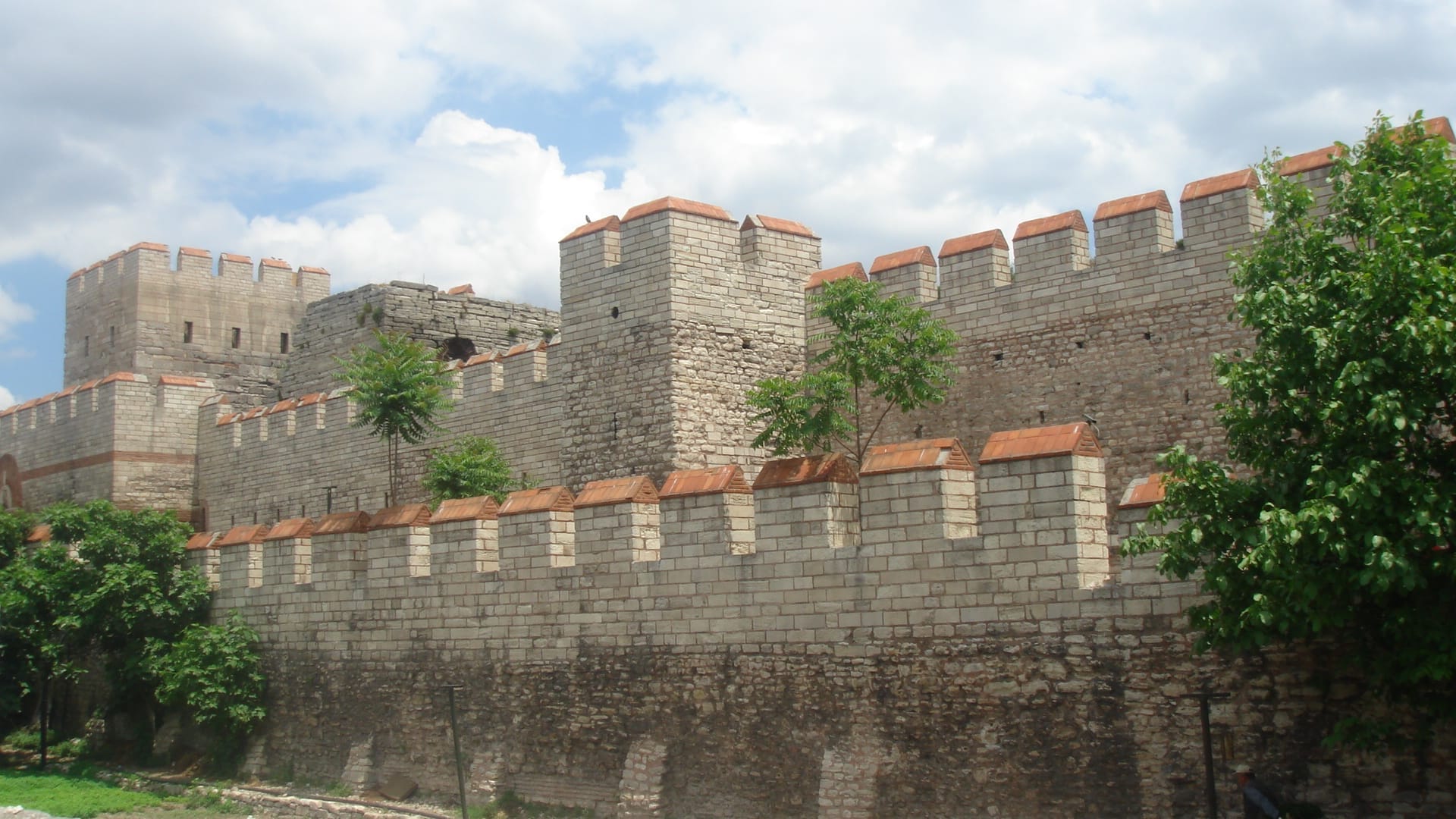
The Theodosian Walls (Turkish: İstanbul Surları, also widely called the Walls of Constantinople) are a late antique fortification system that once sealed off the landward side of Constantinople from the rest of the Balkan peninsula. Construction began under Emperor Theodosius II in the early 5th century CE and was completed in stages by 447 CE, when an earthquake compelled rapid repairs and reinforcements. The result was a triple-layered defensive system: a wide outer moat, a low outer wall with 92 towers, and a taller inner wall approximately 10 meters above the outer terrace (and around 13 meters above the city itself), studded with 96 towers spaced roughly 55 meters apart.
Surviving sections span approximately 5.5 kilometers in total. For over a millennium, from the fall of Rome to the gunpowder age, these walls held. They repelled attacks by Huns, Avars, Arabs, Bulgars, and Rus forces. When Constantinople finally fell on May 29, 1453, it was largely the concentrated firepower of Ottoman cannon that cracked what sieges had failed to do for a thousand years. Walking alongside the walls today, that longevity registers physically in a way no textbook can replicate.
💡 Local tip
Start your walk at Yedikule (the Castle of the Seven Towers) at the southern, Sea of Marmara end, and head north. The Yedikule section has some of the best-preserved stonework and provides an immediate sense of scale before the walls become more fragmentary further north.
The Experience: What You Actually See
The Theodosian Walls do not present themselves like a curated museum. There are no manicured lawns, no interpretive plaques every hundred meters, no souvenir kiosks. What you get instead is a raw, enormously scaled landscape of stone, mortar, and rubble stretching through residential Fatih neighborhoods. Laundry dries on balconies facing the wall. Cats sleep on tumbled limestone blocks. A chai garden operates in the shadow of a tower that has stood for 1,600 years.
The inner wall is the most visually commanding element. Even in its partially ruined state, the alternating courses of limestone and red brick — a distinctly Byzantine construction technique — rise to an imposing height. The towers, which originally provided flanking fire and sheltered troops, are square or polygonal, and several remain largely intact. At other points, entire sections have collapsed or been cannibalized for later construction, leaving gaps that give the wall a jagged, medieval-siege quality.
The stretch near Yedikule Fortress at the southern end is the most photogenic and the most complete. The fortress itself, constructed by Mehmed II after the Ottoman conquest, was built into and around the existing wall, incorporating its towers. Further north, particularly around Edirnekapı (the Gate of Adrianople), the walls pass through a lively neighborhood where tea houses and small grocers operate steps from Byzantine stonework. The Edirnekapı area marks the highest point of the historic peninsula and was, historically, where the final Ottoman assault broke through.
Tickets & tours
Hand-picked options from our booking partner. Prices are indicative; availability and final rates are confirmed when you complete your booking.
Bosphorus sunset cruise on luxury yacht with guide
From 55 €Free cancellationIstanbul and Bosphorus cruise on private boat - half day afternoon tour
From 40 €Instant confirmationFree cancellationWhirling Dervishes live show and exhibition
From 29 €Instant confirmationBasilica Cistern fast-track entry ticket and optional audio guide
From 34 €Instant confirmation
How the Experience Changes by Time of Day
Early morning is the most rewarding time to visit, and the difference from midday is substantial. Before 9 AM, the wall corridors are almost empty of tourists. The light from the east catches the brick and limestone at a low angle, highlighting the texture of individual courses and the shadows cast by tower embrasures. The sound landscape is neighborhood Istanbul: the call to prayer from a minaret somewhere in Fatih, the clatter of a tea glass, the distant horn of a ferry on the Golden Horn.
By midday in summer, the exposed southern sections between Yedikule and Topkapı Gate can become uncomfortably hot. There is minimal shade along much of the route, and the pale stone radiates heat. Carry water. The northern sections near the Golden Horn stay cooler and are worth saving for the afternoon hours.
Late afternoon brings a different quality of light and a different crowd: local residents walking, children playing near the outer moat, elderly men sitting on low walls. This is one of the few major Istanbul monuments where you will routinely find yourself more or less alone. That absence of crowds is either the walls' greatest selling point or, depending on your travel style, a signal that the experience requires you to do some imaginative work.
⚠️ What to skip
Some sections of the wall, particularly isolated stretches far from active neighborhoods, are poorly lit after dark and not recommended for solo walkers at night. Stick to daylight hours, especially for less-frequented northern segments.
Historical and Cultural Context
The Theodosian Walls were never just military infrastructure. They defined the legal and psychological boundaries of Constantinople for over a millennium. To be inside the walls was to be inside the city, inside the empire, inside civilization as Byzantines understood it. The walls appear repeatedly in Byzantine chronicles, religious texts, and military histories. Today, Istanbul's Byzantine heritage is often reduced to Hagia Sophia and the Basilica Cistern, both of which have been heavily repurposed and restored. The Theodosian Walls, by contrast, survive largely as they were: massive, imperfect, and indifferent to tourism.
Several of the original gates remain identifiable, including the Porta Aurea (Golden Gate), now incorporated into Yedikule Fortress, through which emperors entered the city in triumph, and the Edirnekapı (Gate of Adrianople), still in active use as a road junction. The gates were not just functional passages: they were ceremonial architecture, built with marble columns and decorated with carved panels announcing the power of the empire to those who approached. Most of that decoration is long gone, but the gate arches themselves endure.
For travelers interested in how this era connects to the city's broader Ottoman history, the walls serve as a tangible before-and-after marker. The same stones that defined Byzantine Constantinople became the foundation of an Ottoman city. Ottoman Istanbul was built in conscious dialogue with the Byzantine city it inherited, and nowhere is that layering more visible than here.
Planning Your Walk: A Practical Walkthrough
The walls stretch about 5.7 kilometers from Yedikule in the south to the Ayvansaray neighborhood near the Golden Horn in the north. Walking the full length at a moderate pace, with stops to examine towers and gates, takes roughly three to five hours. Most visitors choose a section rather than the full route.
- Yedikule to Belgrad Kapı: Primarily inside the fortress grounds; this is the most structured part of the route, with clearest paths and best-preserved stonework.
- Topkapı Gate area (not to be confused with Topkapı Palace): A major surviving gate, still used as a road crossing, with a stretch of intact inner wall on either side. Accessible by T1 tram.
- Edirnekapı: The highest point of the wall, with views across the historic peninsula. A tea house nearby makes a useful break point.
- Ayvansaray (Golden Horn end): The northern terminus, where the walls meet the water. Less visited, more atmospheric, and close to the Fener and Balat neighborhoods.
The easiest transit access points are the T1 tram stop at Topkapı (about midway along the walls), and buses that run along the outer road. For the southern section, Yedikule station on the suburban rail network (Marmaray/suburban lines) puts you directly at the fortress entrance. If you plan to combine the walk with a visit to the Chora Church (Kariye Mosque), which is a short walk north of the Edirnekapı gate area, plan that as a natural endpoint to a northward walk.
Wear comfortable shoes with grip. The ground along the wall corridors is uneven: packed earth, loose rubble, and wet stone depending on recent weather. The outer moat, now largely dry and in many areas used as community gardens, is occasionally accessible via informal paths but is not an official route. Climbing on ruined wall sections is common among visitors but does carry risk from unstable stonework.
ℹ️ Good to know
The walls are an open-air monument with no formal admission or set hours; you can walk accessible sections during daylight hours year-round without charge. Some sections are currently under restoration, and scaffolding may obstruct views at certain points. Conditions vary significantly by segment.
Photography and Weather Considerations
The Theodosian Walls reward photographers who are interested in texture and scale over polished compositions. The alternating brick-and-limestone banding is endlessly variable, and the towers catch light differently depending on the hour and season. Wide-angle lenses capture the full height of the inner wall; a longer lens picks out the detail of individual courses, Ottoman-era repairs in mismatched stone, and the Byzantine monograms sometimes carved into blocks.
Spring (April to June) and autumn (September to October) are the best seasons to visit. The temperatures are comfortable for a multi-hour outdoor walk, the light is warm without being harsh, and wildflowers sometimes grow in the old moat. Summer visits are manageable with an early start. Winter walks have their own atmospheric quality, particularly in fog or after rain when the stone darkens and the city sounds are muffled, but some sections become muddy and slippery. For the best overall Istanbul timing, see the best time to visit Istanbul guide.
Who Should Reconsider Visiting
The Theodosian Walls are not for everyone, and honesty serves travelers better than enthusiasm. If you have limited mobility, the uneven terrain and absence of paved paths through most sections make this route genuinely difficult. Wheelchair access is effectively impossible along most of the walk. Visitors with very limited time in Istanbul will likely find their hours better spent at monuments that pack more concentrated visual reward into a smaller area, such as Hagia Sophia, the Topkapı Palace complex, or the Basilica Cistern.
Travelers who want every monument to explain itself through signage and guided audio will find the walls frustrating. The interpretive infrastructure is minimal. But for those willing to bring a little background knowledge and let the scale of the thing do the rest, the walls offer something most of Istanbul's famous sites no longer can: genuine solitude in the presence of something immense and very, very old. If you want to understand the city's layers from the ground up, pair this with a visit to the Istanbul Archaeology Museums, where Byzantine-era artifacts and maps help contextualize what you have seen.
Insider Tips
- The dry moat between the inner and outer walls has been converted into community vegetable gardens in several sections between Topkapı and Edirnekapı. Local residents tend plots here and are generally unbothered by respectful walkers who stick to the paths. This is one of the more quietly remarkable urban spaces in Istanbul.
- The Porta Aurea (Golden Gate) inside Yedikule Fortress preserves marble cladding and partial arch structures that give the clearest sense of the walls' original grandeur. Spend extra time here rather than rushing along the more ruined northern sections.
- Edirnekapı is the highest elevation point along the walls and offers sight lines across the rooftops of Fatih in both directions. A small tea house nearby, on the street just east of the gate, is a good place to regroup before or after the walk.
- Byzantine-era inscriptions and carved monograms survive on individual stone blocks throughout the wall. They are easy to miss at walking pace. Slow down near tower bases and look at the blocks at eye level rather than the upper courses.
- If you are combining the walls with the Chora Church (Kariye Mosque), note that the church is a short uphill walk from the Edirnekapı gate, making a logical end point for a northward walk rather than requiring a separate journey.
Who Is Theodosian Walls For?
- History and archaeology enthusiasts with an interest in Byzantine and late Roman civilization
- Photographers looking for large-scale architectural texture away from tourist crowds
- Walkers who want a long outdoor route that passes through authentic Fatih neighborhoods rather than tourist zones
- Travelers on a return visit to Istanbul who have already covered the major sites and want something deeper
- Anyone specifically following Istanbul's Byzantine history trail alongside Hagia Sophia, the Chora Church, and the Basilica Cistern
Nearby Attractions
Other things to see while in Fatih:
- Chora Church (Kariye Mosque)
The Chora Church, now Kariye Mosque, preserves the most complete cycle of late Byzantine mosaics and frescoes anywhere in the world. Tucked inside the Fatih district near the ancient Theodosian Walls, it rewards visitors who make the effort to reach it — but requires some planning around prayer times and dress codes.
- Fatih Mosque
Commissioned by Sultan Mehmed II a decade after the Ottoman conquest of Constantinople, Fatih Mosque stands as one of Istanbul's most historically charged religious sites. Unlike the tourist-heavy mosques of Sultanahmet, this one belongs primarily to the local neighborhood — and that contrast is exactly what makes it worth visiting.
- Panorama 1453 History Museum
The Panorama 1453 History Museum in Istanbul's Fatih district puts visitors at the center of one of history's most decisive moments: the Ottoman conquest of Constantinople on May 29, 1453. Housed in Topkapı Culture Park beside the ancient Theodosian Walls, the museum wraps a 38-meter-high, 238-meter-long cylindrical painting around a raised viewing platform, blending painted canvas with three-dimensional foreground figures to create an effect that is disorienting in the best possible way.
- Süleymaniye Mosque
Rising above the Golden Horn on Istanbul's Third Hill, Süleymaniye Mosque is widely regarded as the finest work of Ottoman imperial architecture. Built between 1550 and 1557 under the direction of master architect Mimar Sinan for Sultan Suleiman the Magnificent, it remains a functioning mosque with free admission and considerably fewer visitors than the Blue Mosque in Sultanahmet.