Cathedral of Saints Cyril and Methodius: Prague's Most Sobering WWII Memorial
Beneath a functioning Orthodox cathedral in Prague's New Town lies one of Europe's most affecting WWII memorials. The crypt of the Cathedral of Saints Cyril and Methodius was the final refuge of the paratroopers who assassinated Nazi SS-Obergruppenführer Reinhard Heydrich in 1942. The bullet marks are still in the walls.
Quick Facts
- Location
- Resslova 9a, Nové Město (New Town), Prague 2
- Getting There
- Karlovo náměstí (Metro Line B); trams stop at Karlovo náměstí
- Time Needed
- 45–90 minutes
- Cost
- Cathedral: free entry. Crypt memorial: free entry or donation-based — verify before visiting as pricing may vary
- Best for
- WWII history, Czech resistance history, quiet reflection
- Official website
- www.katedrala.info
Why This Place Stops People in Their Tracks
Most visitors to Prague spend their time among medieval towers and Baroque facades. The Cathedral of Saints Cyril and Methodius offers something entirely different: a physical encounter with one of the most dramatic episodes of European resistance during the Second World War. This is not a reconstructed exhibit or a heritage display behind glass. The crypt beneath the cathedral is where it actually happened, and the scars are visible.
On 27 May 1942, Czech and Slovak paratroopers trained by Britain's Special Operations Executive assassinated Reinhard Heydrich, the Reich Protector of Bohemia and Moravia and one of the principal architects of the Holocaust. The operation, known as Operation Anthropoid, was the only state-sanctioned assassination of a senior Nazi official during the entire war. After the attack, seven of the paratroopers took refuge in the crypt of this cathedral, aided by the Czech Orthodox bishop Gorazd and the local congregation. They held out for three weeks.
ℹ️ Good to know
The crypt entrance is on the west side of the building along Resslova Street. Look for a low stone staircase descending below street level. Opening hours differ by season: September to June, Tuesday to Sunday 8:00–17:00; July to August, Tuesday to Saturday 8:00–17:00, Sunday 8:00–14:00. Closed Mondays year-round. Verify current hours and admission before visiting.
The Building Itself: Baroque Exterior, Orthodox Interior
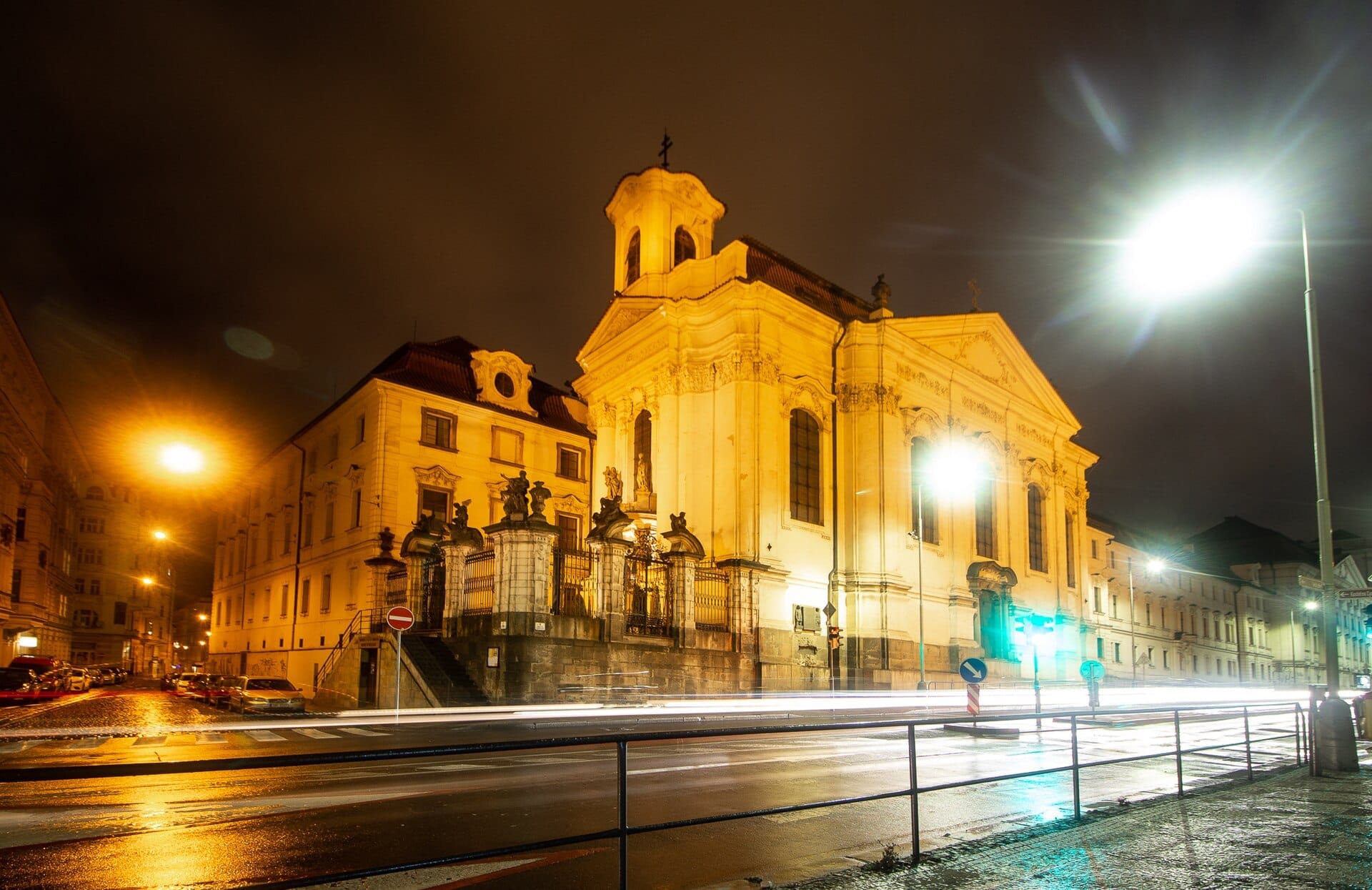
The cathedral was constructed between 1730 and 1736, originally as a Roman Catholic church dedicated to Saint Charles Borromeo. Its Baroque facade along Resslova Street is restrained by Prague standards — symmetrical, stone-faced, with a modest pediment — and it would be easy to walk past without a second look. That understatement is almost fitting given what is hidden beneath.
The interior of the cathedral is functioning Orthodox Christian space. Visitors entering the nave encounter the distinctive visual language of Eastern Orthodox worship: icon screens, candlelight, and devotional imagery quite different from the Roman Catholic and Protestant churches that dominate the rest of Prague's ecclesiastical landscape. The cathedral serves the Czech Orthodox Church and remains an active place of worship, which means access to the nave can be restricted during services. Dress accordingly and enter quietly.
Visitors with a strong interest in Prague's religious architecture might also explore the Church of St. Nicholas in Malá Strana, one of the finest Baroque interiors in Central Europe, or the Loreto Sanctuary near Prague Castle for a very different devotional tradition.
Tickets & tours
Hand-picked options from our booking partner. Prices are indicative; availability and final rates are confirmed when you complete your booking.
Kutna Hora walking tour and St Barbara Cathedral from Prague
From 55 €Instant confirmationFree cancellationKutna Hora with St.Barbara's Cathedral and Bone Church
From 72 €Instant confirmationFree cancellationSelf guided tour with interactive city game of Prague
From 5 €Instant confirmationFree cancellationPrague by night city tour
From 27 €Instant confirmationFree cancellation
The Crypt: What You Actually See
Descend the stairs on Resslova Street and the temperature drops noticeably. The crypt is low-ceilinged and narrow, with bare stone walls and minimal decoration. This is not a polished museum experience. The exhibition is modest in scale but precise in its documentation: photographs, maps, weapons, personal effects of the paratroopers, and detailed accounts of the operation and its aftermath.
The most affecting element is the wall itself. On 18 June 1942, the Gestapo and SS surrounded the cathedral with over 700 soldiers. The paratroopers in the crypt refused surrender. After hours of combat — during which the Nazis attempted to flood the crypt through a ventilation shaft — the remaining men died either in the fighting or by their own hands. The bullet marks and damage from that battle are preserved in the stone. There is no reconstruction here. You are looking at the actual surface where the final confrontation took place.
A small window near the top of the crypt wall, now sealed, was used by the Nazis to direct water into the space. The narrow dimensions of the room make the reality of the siege visceral in a way that a conventional museum cannot replicate. Several visitors leave in silence. Children old enough to understand the context are generally affected by the experience, though the exhibition requires reading Czech or English text panels and some historical background.
💡 Local tip
Read at least a brief account of Operation Anthropoid before you visit. The crypt's exhibition is informative, but the emotional weight of the space increases dramatically when you arrive knowing the sequence of events. The 2016 film 'Anthropoid' is a reasonable primer, though some details are dramatized.
Visiting by Time of Day: What Changes
The cathedral sits on a reasonably busy street in New Town, a few blocks south of Karlovo náměstí. Morning visits — particularly on weekdays before 10:00 — tend to be quieter in the crypt. The low ceiling and small floor area mean that a group of even ten or fifteen visitors fills the space considerably, and the atmosphere shifts when it is crowded. Late morning and early afternoon on weekends bring the most visitors, many of them on guided tours.
The exterior of the building photographs best in the morning when the light falls directly on the Resslova Street facade. There is a small commemorative plaque on the exterior wall listing the names of the paratroopers, which is worth reading before you descend. In summer, the street can be warm and busy; the crypt itself stays cool regardless of season, which is a practical consideration if you are visiting during a July heat spell.
Historical Weight: Context That Matters
The assassination of Reinhard Heydrich had consequences far beyond the cathedral. Nazi reprisals were severe: the villages of Lidice and Ležáky were destroyed and their populations killed or deported. Bishop Gorazd and several other church officials who sheltered the paratroopers were executed. The seven paratroopers who died in or connected to the cathedral — Jozef Gabčík, Jan Kubiš, Jaroslav Švarc, Jan Hrubý, Adolf Opálka, Josef Bublík, and Karel Čurda — are commemorated both here and in the national memory.
For a broader understanding of Czech wartime and Cold War history, the Museum of Communism provides context on the decades that followed the war. Those interested in the full sweep of Czech history can also consult our Prague history guide as background reading.
The cathedral was designated a National Cultural Monument. Bishop Gorazd was later canonized by the Orthodox Church as a martyr. The building functions simultaneously as an active religious site, a national memorial, and a war grave — a combination that gives it a gravity almost impossible to manufacture.
Getting There and Practical Logistics
The cathedral is straightforward to reach. From Karlovo náměstí metro station (Line B, the yellow line), walk south along Resslova Street. The building is visible on your left. Multiple tram lines serve Karlovo náměstí as well, making this accessible from most parts of central Prague without needing the metro specifically.
New Town is a walkable district, and the cathedral fits naturally into a broader New Town Prague itinerary. Wenceslas Square is about a 15-minute walk north, and the Dancing House is a comparable walk south along the river embankment.
The crypt memorial is entered from street level on Resslova Street and involves a short staircase descent. The space is not wheelchair accessible. The nave of the cathedral above is accessible from the main entrance, though the interior floor is stone and uneven in places. There is no on-site café or visitor shop of note.
⚠️ What to skip
The cathedral is an active place of worship. If you arrive during a service, access to the nave will be restricted. The crypt entrance is separate and may still be accessible — check the signage on Resslova Street. Keep voices low throughout the visit regardless of whether a service is in progress.
Honest Assessment: Is It Worth Your Time?
For visitors with any interest in WWII history or the history of European resistance, the Cathedral of Saints Cyril and Methodius is one of the most authentic sites in Prague. It is not a large attraction and it does not need to be. The crypt takes perhaps 30 to 40 minutes to move through carefully. The experience is compact, quiet, and genuinely moving in a way that larger memorial museums sometimes are not.
Those who should consider skipping: visitors with very young children who would find the enclosed crypt uncomfortable and would not yet engage with the historical content; anyone without at least basic context for WWII history in Central Europe, as the exhibition requires some prior knowledge to be fully meaningful; and visitors who are physically unable to manage stairs, as the crypt is not accessible by any alternative route.
It is not overhyped. If anything, it remains less visited than its historical significance warrants, partly because it sits outside the main tourist corridor between Old Town and Prague Castle. That relative quietness is part of what makes the visit work. You are unlikely to be jostled through it.
Insider Tips
- The names of the seven paratroopers are inscribed on the exterior plaque on Resslova Street. Read them before you go inside — it reframes the entire visit.
- Visit on a Tuesday or Wednesday morning if possible. Weekend afternoons bring guided tour groups that fill the crypt quickly and make quiet reflection difficult.
- The Czech Orthodox liturgical calendar means the cathedral is more likely to have active services on Sunday mornings. If you want full access to the nave, aim for a weekday.
- The 2016 British-Czech film 'Anthropoid' was partially filmed in Prague and reconstructs the assassination and siege in reasonable detail. Watching it before your visit substantially deepens the experience — though treat dramatic elements with appropriate skepticism.
- Combine this visit with Karlovo náměstí itself, one of Prague's largest historic squares and only a few minutes' walk away. The square's history as a medieval cattle market and public execution site adds further layers to the area's dark past.
Who Is Cathedral of St. Cyril and Methodius (WWII Memorial) For?
- WWII and wartime history enthusiasts
- Visitors interested in Czech and Slovak national history
- Travelers seeking quiet, non-commercial historical sites away from the tourist core
- Those with an interest in Eastern Orthodox religious architecture in a Western European context
- Students and researchers studying European resistance movements
Nearby Attractions
Other things to see while in New Town (Nové Město):
- Dancing House (Tančící dům)
Designed by Frank Gehry and Vlado Milunić and completed in 1996, the Dancing House stands on the Vltava embankment as one of Prague's most photographed and debated buildings. Here's what the experience actually looks like from the outside, from the rooftop bar, and from the gallery inside.
- Franciscan Garden
Hidden behind the commercial noise of Wenceslas Square, the Franciscan Garden (Františkánská zahrada) is a free, walled courtyard garden Hidden behind the commercial noise of Wenceslas Square, the Franciscan Garden (Františkánská zahrada) is a free, walled courtyard garden with roots in the 14th century, a Baroque pavilion, and rose beds that offer genuine quiet in the middle of Prague's busiest district. Entry is free, and the contrast with the streets outside is immediate., a Baroque pavilion, and rose beds that offer genuine quiet in the middle of Prague's busiest district. Entry is free, and the contrast with the streets outside is immediate.
- Jerusalem Synagogue
Built in 1904–1906, the Jerusalem Synagogue is the largest synagogue of Prague's Jewish community and one of the most visually arresting religious buildings in the city. Its exterior fuses Moorish Revival arches with Art Nouveau ornament, while the interior overwhelms with color, pattern, and scale.
- Kafka's Rotating Head (Franz Kafka Sculpture)
Standing 11 metres tall outside the Quadrio shopping centre in New Town, the Head of Franz Kafka is a kinetic sculpture of 42 polished stainless steel layers that slowly rotate out of sync, fragmenting and reassembling Kafka's face. It is free to see at any time, though the programmed rotation runs at set intervals between morning and late evening, and it is one of the most photographed modern artworks in the Czech Republic.