Basilica of Saint Nicholas: Amsterdam's Grand Gateway Church
Standing directly opposite Amsterdam Centraal Station, the Basilica of Saint Nicholas is one of the city's most striking Neo-Baroque buildings and an active Catholic co-cathedral. Built between 1884 and 1887, it offers free entry, elaborate interior decoration, and a rare pocket of calm in one of Amsterdam's most trafficked corners.
Quick Facts
- Location
- Prins Hendrikkade 73, 1012 AD Amsterdam (De Wallen)
- Getting There
- Amsterdam Centraal Station — 2 to 4 minute walk
- Time Needed
- 30 to 60 minutes
- Cost
- Free entry (donations welcome)
- Best for
- Architecture lovers, first-time visitors, quiet moments mid-trip
- Official website
- nicolaas-parochie.nl/nicolaas/enes/english
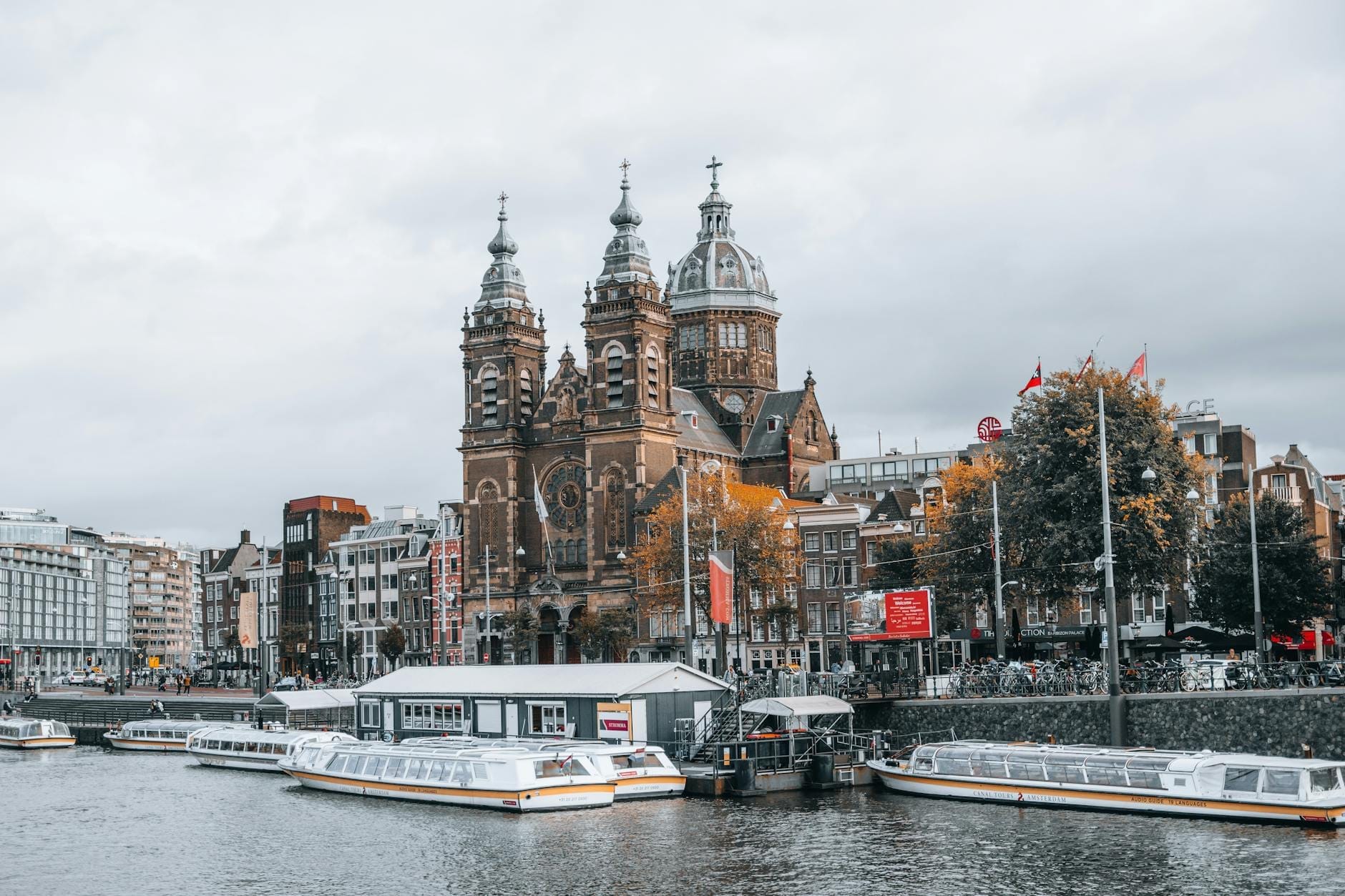
First Impressions: A Church That Stops You in Your Tracks
Most people arriving at Amsterdam Centraal are already scanning for trams, checking Google Maps, or dragging luggage toward their hotels. Then they turn around. The Basilica of Saint Nicholas, known locally as the Sint-Nicolaasbasiliek, fills the view across Prins Hendrikkade with twin copper-green towers and an imposing facade in warm brick and stone. It is one of the first monumental buildings a visitor sees upon arriving in Amsterdam, yet it is consistently overlooked in favor of the canals and museums further south.
That oversight is worth correcting. The basilica is free to enter during sightseeing hours, takes less than an hour to explore properly, and delivers an interior that genuinely rewards attention. This is not a stripped-down Protestant church or a modest parish hall. It is a full-scale 19th-century Catholic basilica, elevated to co-cathedral status in 2012, with an interior to match that ambition.
💡 Local tip
Sightseeing is generally permitted Monday and Saturday from 12:00 to 15:00, and Tuesday to Friday from 11:00 to 16:00, though hours can vary with services. Sunday visits are reserved for services. Arrive before 14:30 to have enough time to explore without feeling rushed.
The Architecture: Neo-Baroque Confidence in a Protestant City
The Sint-Nicolaasbasiliek was designed by architect Adrianus Bleijs (1842 to 1912) and built between 1884 and 1887. The style blends Neo-Baroque and Neo-Renaissance influences — a deliberate choice that made the building visually assertive at a time when Amsterdam's Catholic community was finally allowed to build prominent places of worship again. For roughly two centuries after the Alteratie of 1578, when Amsterdam officially turned Calvinist, Catholic worship had been driven indoors and out of sight. Churches like this one were the architectural announcement of a changed legal and social landscape.
The facade is symmetrical and densely detailed, with pilasters, arched windows, and carved stone ornament framing the central entrance. The two flanking towers do not soar to Gothic heights but carry their own solidity. From the waterfront at Prins Hendrikkade, the church reads as a confident counterpoint to the horizontal spread of Centraal Station behind you.
Inside, the nave opens under a barrel-vaulted ceiling painted in deep reds, blues, and gold. The light entering through the stained-glass windows shifts across the painted surfaces throughout the day. Visit early in the sightseeing window, around noon, and the interior feels cool and slightly dim. By early afternoon, natural light from the upper windows moves across the gilded altar and ornate side chapels.
Tickets & tours
Live prices and dates from our booking partner. If you book, we may earn a commission at no extra cost to you.
Gray Line Canal Cruise with snackbox & Heineken Experience
From 48 €Instant confirmationFree cancellationAmsterdam evening canal cruise
From 18 €Instant confirmationFree cancellationJewish Museum and Portuguese Synagogue entrance ticket
From 20 €Instant confirmationFree cancellationAdmission ticket for Artis Royal Zoo and Micropia
From 39 €Instant confirmationFree cancellation
What to Look for Inside
The main altar is the focal point, framed by columns and crowned with elaborate carved decoration. The side chapels are individually dedicated and decorated, and the quality of the craftsmanship in the ironwork, tilework, and painted panels holds up to close inspection. This is not a church to walk through in five minutes; it rewards slow movement along the side aisles.
Look up at the nave ceiling regularly as you walk. The painted decoration changes character from the entrance toward the apse, and the transitions between architectural elements are worth studying if you have any interest in 19th-century ecclesiastical design. The pipe organ, positioned in the upper gallery at the rear of the nave, is also noteworthy for its scale and decorative casing.
ℹ️ Good to know
The church is an active place of worship and hosts regular Mass. Check the parish website for current service times if you want to attend or specifically want to avoid overlapping with a service during your sightseeing visit.
Atmosphere and Crowd Behavior at Different Hours
Noon on a weekday is the quietest time to visit. The streets outside are already filling with lunch crowds and tourists moving between the station and the old center, but the interior of the basilica tends to hold only a handful of visitors. The contrast between the noise of Prins Hendrikkade and the relative hush inside is immediate and pronounced.
By early afternoon, especially on weekends, the visitor count rises. The church remains respectful and quiet by the standards of popular Amsterdam attractions, but the pews near the front can be occupied by people resting their feet as much as praying. The atmosphere is genuine rather than staged: this is a working parish church that happens to welcome visitors.
The smell inside is that of old stone, candle wax, and the faint trace of incense used during services. The floor is cool underfoot and the acoustic is rich. Even background conversations from other visitors tend to blur into the general reverberation rather than becoming intrusive.
Getting There and Practical Notes
The basilica's location could not be more straightforward. It sits at Prins Hendrikkade 73, a two-to-four minute walk from the front exits of Amsterdam Centraal Station. Every train, metro line, tram route, and long-distance bus that serves Centraal brings you within easy walking distance. If you arrive in Amsterdam by train from Schiphol Airport or anywhere else in the country, the Sint-Nicolaasbasiliek is essentially on your doorstep. For full guidance on getting around the city, see the getting around Amsterdam guide.
Entry is free, and no advance booking is required. Sightseeing hours are generally Monday and Saturday, 12:00 to 15:00, and Tuesday to Friday, 11:00 to 16:00, though they may be shortened or suspended during services. The church is closed to sightseers on Sundays and during services on other days.
Accessibility information is not detailed on the official parish website. Visitors with mobility requirements should contact the parish office directly via the contact details listed at nicolaas-parochie.nl before visiting. The surrounding streets near Centraal can be crowded and involve tram tracks and bicycle lanes, so approach on foot and pay attention to the traffic flow.
⚠️ What to skip
Photography is generally permitted inside the church, but use judgment about timing and behavior. Flash photography during services or when others are praying is inappropriate. When in doubt, follow posted signs or ask a staff member.
Fitting the Basilica Into a Broader Amsterdam Visit
The Sint-Nicolaasbasiliek sits in the De Wallen neighborhood, Amsterdam's oldest district, which surrounds the two oldest surviving churches in the city: the Oude Kerk and the nearby Nieuwe Kerk on Dam Square. Visiting the basilica alongside those two puts Amsterdam's religious architecture into useful chronological perspective: medieval Catholic churches that were seized by Protestants in 1578, contrasted with a 19th-century building erected when Catholics could finally build openly again.
The waterfront location also makes the basilica an easy first or last stop on a walk through the canal ring or De Wallen. After visiting, you are a short walk from Nieuwmarkt to the south-east, or you can continue along Prins Hendrikkade toward the eastern docklands. If you are planning a structured day in the city center, a two-day Amsterdam itinerary can help you sequence the key stops without backtracking.
Travelers interested in Amsterdam's architectural range beyond the canals will find Amsterdam's architecture guide useful for understanding how the basilica fits into the city's broader building history.
Who Should Skip This, and Why
If religious architecture holds no interest for you and your Amsterdam time is short, this is not where to spend it. The basilica is not a museum with exhibits, interactive displays, or a dedicated audio guide. It is a church interior — beautiful and historically significant, but asking you to engage on its own quiet terms.
Families with young children who have limited patience for slow interior spaces may find the restricted sightseeing window and the need for quiet behavior a mismatch for a low-energy moment in a long day. The visit also lacks the kind of climactic reveal, a rooftop view, a single unmissable artwork, a dramatic natural feature, that tends to make an attraction memorable for all ages.
That said, for anyone arriving by train who has 40 minutes before their hotel check-in time, or anyone who finds the main tourist circuit relentlessly busy, the basilica offers something genuinely in short supply in central Amsterdam: silence, scale, and craft.
Insider Tips
- Arrive at 11:00–12:00 on a weekday to have the interior almost entirely to yourself. By 13:30 on a Saturday, the pews fill with resting tourists and the atmosphere changes noticeably.
- The best exterior photographs are taken from the pedestrian area directly in front of Centraal Station, looking south across Prins Hendrikkade. Late morning light in spring and summer hits the facade from a favorable angle before midday.
- The basilica was elevated to co-cathedral status only in 2012 — relatively recently — which means it carries a status that its modest public profile does not reflect. It is now one of two cathedrals in the Diocese of Haarlem–Amsterdam.
- If you hear organ music while approaching the building, a rehearsal or scheduled concert may be taking place. The parish occasionally holds evening concerts; check the official website calendar if you want to attend one.
- The immediate surroundings on Prins Hendrikkade can be chaotic with trams, cyclists, and pedestrians. Cross carefully and give yourself a moment to stop and look at the facade before going inside — the exterior is as worth studying as the interior.
Who Is Basilica of Saint Nicholas For?
- Architecture and design enthusiasts interested in 19th-century Neo-Baroque and Neo-Renaissance ecclesiastical styles
- First-time Amsterdam visitors who arrive by train and want to orient themselves with a slow, calm start
- Travelers seeking free attractions that do not require advance booking or long queues
- History-focused visitors tracing Amsterdam's Catholic emancipation and religious architecture across the centuries
- Anyone needing a quiet, covered space in the middle of a busy day in the city center
Nearby Attractions
Other things to see while in De Wallen (Red Light District):
- The Amsterdam Dungeon
The Amsterdam Dungeon puts 500 years of the Netherlands' darkest history on stage inside a historic former church on Rokin. With live actors, special effects, and ride elements, it is one of the few attractions in Amsterdam that genuinely aims to unsettle you. Here is what the experience is actually like, and whether it belongs in your itinerary.
- Amsterdam Museum
Historically housed in the former Burgerweeshuis, a centuries-old civilian orphanage on Kalverstraat, the Amsterdam Museum explores how this canal city grew from a modest fishing settlement into one of Europe's most recognizable capitals. The building itself is as much the exhibit as the collection inside.
- Begijnhof
Tucked behind an unmarked gate in the heart of Amsterdam, the Begijnhof is a walled courtyard of historic houses, two chapels, and a garden that has existed for more than 600 years. Entry is free, the setting is genuinely quiet, and few places in the city offer this much history in such a compact space.
- Beurs van Berlage
Completed in 1903 and designed by Hendrik Petrus Berlage, the Beurs van Berlage is a national monument that helped define Dutch modern architecture. Today it operates as a conference and events venue, but the building itself remains one of the most rewarding architectural stops in Amsterdam's historic centre.
Planning a trip? Discover personalized activities with the Nomado app.