Shimogamo Shrine (Kamomioya Shrine): Kyoto's Ancient Forest Sanctuary
One of Kyoto's oldest and most significant Shinto shrines, Shimogamo Shrine sits at the confluence of two rivers within a primeval forest called Tadasu no Mori. Entry to the main grounds is free, the atmosphere is genuinely calm even on weekdays, and the UNESCO World Heritage designation is fully deserved. Here is everything you need to plan a worthwhile visit.
Quick Facts
- Location
- 59 Shimogamo Izumigawa-cho, Sakyo-ku, Kyoto City (northern edge of downtown Kyoto)
- Getting There
- Demachiyanagi Station (Keihan Line), about 10–12 min walk; or Shimogamo Jinja-mae bus stop (Kyoto City Bus 4 or 205), a short walk
- Time Needed
- 45 minutes to 1.5 hours depending on pace and whether you visit Oidono Hall
- Cost
- Main grounds: Free. Special viewing of Oidono Hall: ¥1,000 adults, free for junior high and younger
- Best for
- Slow cultural exploration, photography in natural light, early-morning quiet, history seekers
- Official website
- www.shimogamo-jinja.or.jp/en
What Shimogamo Shrine Actually Is
Shimogamo Shrine, formally known as Kamomioya Shrine (賀茂御祖神社), is among the oldest active Shinto shrines in Japan. It predates the founding of Kyoto as a capital city in 794 CE, with roots traced back well over a thousand years. The shrine is dedicated to the ancestral deities of the Kamo clan, specifically Tamayorihime and her father Kamotaketsunumi no mikoto, making it a site of deep familial and spiritual lineage in Japanese religious history.
In 1994, Shimogamo Shrine was inscribed as part of the UNESCO World Heritage Site collectively known as the Historic Monuments of Ancient Kyoto. Its two main sanctuaries, or honden, are designated National Treasures of Japan, placing Shimogamo in the same category of protected heritage as the country's most irreplaceable cultural assets. These sanctuaries are not routinely open to the public, which is actually part of what gives the shrine its sense of reserved, living sanctity.
Shimogamo pairs naturally with the Kamigamo Shrineto the north, the two shrines forming a paired set within Kyoto's Kamo shrine system. If you are building an itinerary around Kyoto's most significant cultural sites, both are worth including, though each stands fully on its own. For a broader view of the city's shrine landscape, thebest shrines in Kyoto guide offers useful comparisons.
Tadasu no Mori: The Forest Before the Shrine
The approach to Shimogamo Shrine is not a paved lane or a cascade of torii gates. It is a forest. Tadasu no Mori, which translates roughly as the Forest of Truth or the Forest of Correction, is a rare surviving patch of primeval woodland at the confluence of the Kamo and Takano rivers. Walking through it feels like a decompression chamber between the city and the sacred.
The trees here, some of them several centuries old, create a dense canopy that changes the quality of light noticeably. On a hot summer afternoon, the air beneath the canopy is several degrees cooler than on the street outside. In spring, dappled light filters through new green growth. In autumn, the forest floor collects fallen leaves in copper and ochre layers. The path underfoot is compressed earth, not gravel or stone, which muffles footsteps and adds to the quietude.
💡 Local tip
Enter Tadasu no Mori from the southern gate and walk the full length of the forested approach rather than cutting through from the sides. The roughly 700-meter forest path is the best part of the visit for many people, and rushing it misses the point entirely.
Locals use the forest as a walking and jogging route in the early morning, and you will often see residents from nearby neighborhoods moving through quietly. This is not a sterile attraction space: it is actively embedded in daily Kyoto life in a way that most UNESCO-listed sites are not.
Tickets & tours
Hand-picked options from our booking partner. Prices are indicative; availability and final rates are confirmed when you complete your booking.
Kyoto temples, shrines, and Kimonos guided day tour
From 8.800 €Instant confirmationFree cancellationShiga Day Trip with Miho Museum, Lake Biwa and Waterbird Shrine
From 70 €Instant confirmationFree cancellationKyoto Coast, Amanohashidate and Ine Bay 1-Day Trip from Osaka or Kyoto
From 46 €Instant confirmationFree cancellationKyoto Sanzen-in, Arashiyama and Bamboo Grove Full Day Tour
From 47 €Instant confirmationFree cancellation
Inside the Shrine Precinct
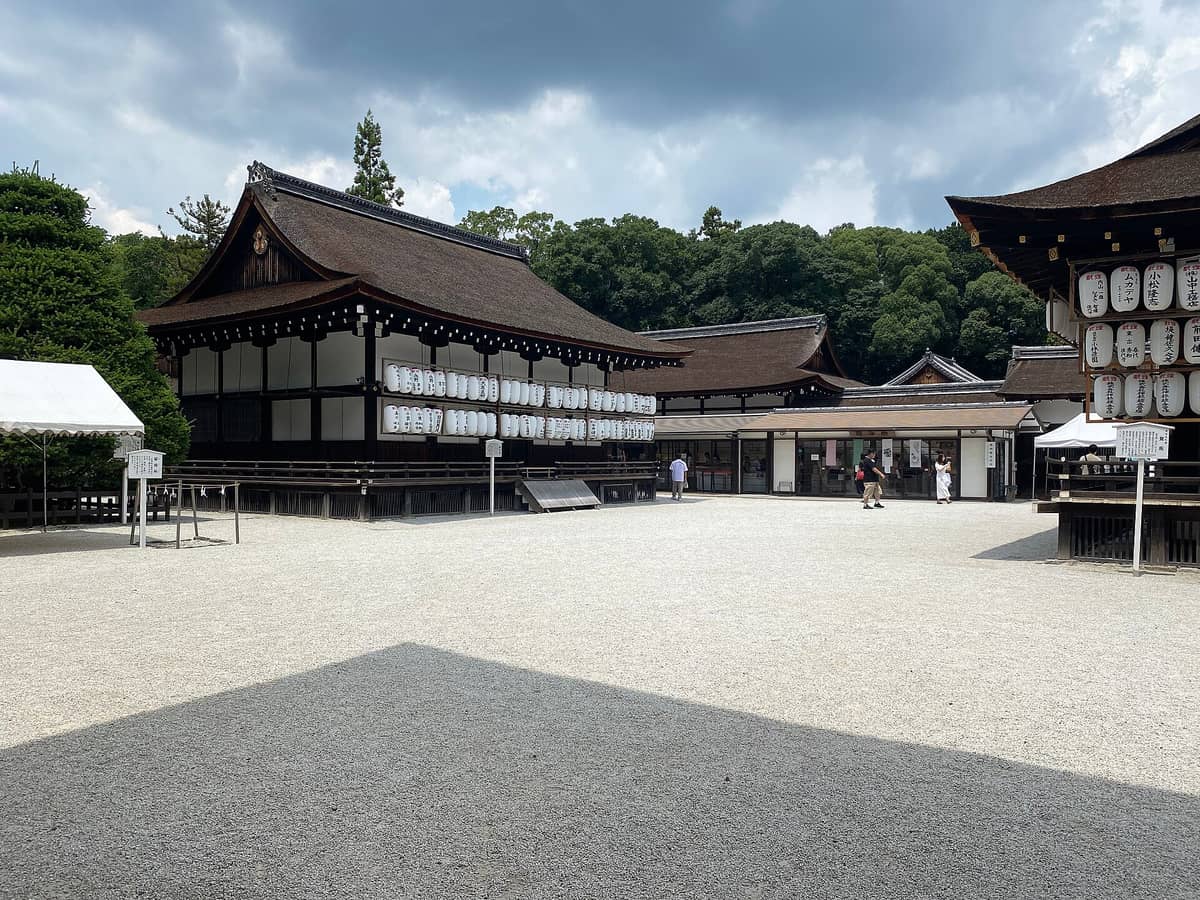
Once past the forest, you enter the formal precinct through the imposing Romon Gate, a vermilion-lacquered structure that signals a clear architectural shift from natural to sacred space. The compound is large by urban shrine standards, organized around several sub-shrines and ceremonial areas leading toward the honden at the center.
The Mitarashi Pond, fed by underground springs near the entrance to the precinct, is one of the most photographed features of the shrine. In mid-summer, the Mitarashi Festival takes place here, during which visitors wade through the shallow water to receive purification blessings. Outside of festival periods, the pond sits quietly with a small cluster of food stalls and omamori charm sellers nearby.
The special viewing area at Oidono Hall (open 10:00 to 16:00, admission ¥500 for adults) allows access to the inner precinct that is otherwise closed. This is worth it if you want to see the architectural details of the honden more closely or are particularly interested in shrine carpentry and Shinto ritual spaces. For most first-time visitors, however, the freely accessible outer precinct offers more than enough to absorb.
How the Experience Changes by Time of Day
Shimogamo is one of the few major Kyoto shrines where early morning visits are meaningfully better, not just marginally so. The grounds open around 06:30. In the hour after opening, the light through Tadasu no Mori is soft and directional, catching mist that rises from the river confluence in cooler months. The vermilion of the Romon Gate reads differently in morning light than it does at midday: richer, less tourist-poster. The main paths through the compound will have almost no visitors.
By mid-morning, school groups and tour buses begin arriving, and the atmosphere becomes more managed. Midday on weekends during cherry blossom or autumn foliage season can be genuinely crowded along the forest approach. Afternoon visits are pleasant in winter and autumn when the lower sun creates long shadows across the compound, but in summer the lack of shade inside the formal precinct (as opposed to the forest) becomes uncomfortable.
ℹ️ Good to know
During major festivals, particularly the Aoi Matsuri held each May, the shrine is the destination of an elaborate imperial procession that departs from the Kyoto Imperial Palace. This is one of Kyoto's three great annual festivals and draws large crowds. The atmosphere is extraordinary, but access to certain areas may be restricted. Verify current festival schedules before planning.
Getting There and Practical Logistics
From central Kyoto, the most straightforward route is the Keihan Electric Railway to Demachiyanagi Station, then about a 10-12 minute walk north along the river. Alternatively, Kyoto City Bus lines 4 and 205 from Kyoto Station stop at Shimogamo Jinja-mae, leaving a short walk to the southern entrance.
If you are visiting as part of a broader day in the area, thePhilosopher's Path and the temple district around Ginkaku-jiare both accessible within a 20 to 30-minute walk to the south. ThePhilosopher's Path areamakes a logical pairing for an unhurried half-day in northern Kyoto.
Wear shoes that can handle unpaved forest paths, particularly after rain when sections of Tadasu no Mori can be muddy. There are no significant accessibility ramps noted for the main forest approach, and the ground surface is uneven in places. Visitors with mobility limitations should contact the shrine directly regarding accessible routes. There are coin lockers at Demachiyanagi Station if you are carrying bags.
Photography and Seasonal Conditions
Shimogamo is a genuinely photogenic site year-round, but the rewards shift by season. In spring, cherry trees along the Kamo River approach bloom in late March to early April, and the forest path itself carries faint blossoms from other species in the understory. Autumn brings the most dramatic color to Tadasu no Mori: the canopy turns from green to gold to brown across October and November, and on clear mornings the forest glow is exceptional.
Winter visits after light snowfall produce a different quality entirely: the vermilion gates against white ground, the snow sitting in the crevices of old bark. The shrine is open year-round, and snow at this latitude is occasional but not rare in January and February.
For timing Kyoto visits around seasonal foliage or cherry blossoms, theKyoto cherry blossom guide and the guide to Kyoto in autumn both include practical month-by-month context.
⚠️ What to skip
Photography inside the Oidono Hall special viewing area may be restricted. Respect any posted signage regarding photography near the main sanctuaries and during active ceremonies. Visitors who photograph shrine rituals or priests without permission risk causing genuine offense.
Honest Assessment: Who Should and Should Not Visit
Shimogamo is not a high-spectacle attraction. There are no sweeping panoramas, no thousand-gate tunnel, no gold-lacquered pavilion. What it offers is a sense of age, quiet, and genuine ongoing religious life. If you are trying to maximize visual landmarks per hour, this is probably not your priority.
Travelers who appreciate atmosphere over spectacle, who are interested in how Shinto shrines actually function as living institutions rather than museum pieces, and who want to spend time in nature inside a city will find Shimogamo rewarding. It is also one of the few significant Kyoto shrines where you can spend an hour and spend nothing, which matters on a budget.
For visitors who want to understand how to behave respectfully within shrine precincts, theKyoto temple etiquette guide covers the key points succinctly.
Insider Tips
- Arrive within the first hour after the 06:30 opening. The forest path is genuinely atmospheric in the early light, and you will have the vermilion Romon Gate almost entirely to yourself before 08:00.
- The Mitarashi Festival in late July is one of Kyoto's more participatory ritual events: you remove your shoes and wade through the spring-fed pond as part of a purification rite. It is free, unusual, and crowded in a festive rather than tedious way. Check the shrine's official site for exact dates each year.
- The forest path along the western edge of Tadasu no Mori, closer to the Kamo River, is quieter than the central approach and often has better light for photography in the late afternoon.
- There is a small selection of seasonal sweets and local products sold near the Mitarashi Pond area. Mitarashi dango, the sweet soy-glazed rice dumplings that take their name from this very pond, are worth trying here rather than at a generic souvenir shop.
- Shimogamo Shrine hosts seasonal events and festivals on the grounds. If your visit happens to coincide, they can add a different, more communal dimension to the visit.
Who Is Shimogamo Shrine For?
- Travelers who want a major UNESCO site without crowds or entrance fees
- Early risers and photographers working in natural light
- Anyone interested in living Shinto religious practice, not just architecture
- Visitors pairing a morning cultural visit with an afternoon along the Philosopher's Path
- Budget travelers who want depth without cost: the main grounds are entirely free
Nearby Attractions
Other things to see while in Downtown Kyoto (Kawaramachi & Shijo):
- Kamo River (Kamogawa)
The Kamo River runs north to south through central Kyoto, serving as the city's most democratic public space. Free to access at any hour, the riverbanks draw joggers at dawn, couples at dusk, and everyone in between. This is not a ticketed sight — it is the living backdrop of Kyoto daily life.
- Kyoto Gyoen National Garden
Kyoto Gyoen National Garden is a 65-hectare public park wrapped around the Kyoto Imperial Palace, free to enter year-round. Once the residential precinct of Heian-era court nobles, it is now one of the few places in central Kyoto where you can walk for an hour without being asked to buy a ticket.
- Kyoto Imperial Palace
Kyoto Imperial Palace, known in Japanese as 京都御所 (Kyōto Gosho), served as the seat of Japan's imperial family until the capital transferred to Tokyo in the late 19th century. Set within the broad, park-like grounds of Kyoto Gyoen National Garden, the palace complex is free to enter and open to the public year-round, making it one of downtown Kyoto's most accessible historic sites. That said, 'accessible' doesn't mean 'spectacular' in the conventional sense — this is a place of restraint, not grandeur, and knowing what to expect shapes the experience entirely.
- Kyoto International Manga Museum
Housed in a beautifully repurposed elementary school in central Kyoto, the Kyoto International Manga Museum holds roughly 300,000 manga-related items spanning over a century of the medium. It is part library, part archive, part cultural institution, and one of the few places in Japan where you can pull a vintage manga off a wall-to-ceiling shelf and read it on the grass.