Kyoto Imperial Palace (Kyōto Gosho): What to Expect Inside the Former Imperial Residence
Kyoto Imperial Palace, known in Japanese as 京都御所 (Kyōto Gosho), served as the seat of Japan's imperial family until the capital transferred to Tokyo in the late 19th century. Set within the broad, park-like grounds of Kyoto Gyoen National Garden, the palace complex is free to enter and open to the public year-round, making it one of downtown Kyoto's most accessible historic sites. That said, 'accessible' doesn't mean 'spectacular' in the conventional sense — this is a place of restraint, not grandeur, and knowing what to expect shapes the experience entirely.
Quick Facts
- Location
- 3, Kyoto Gyoen National Garden, Kamigyo-ku, Kyoto — inside Kyoto Gyoen National Garden
- Getting There
- Imadegawa Station or Marutamachi Station (Karasuma Subway Line); multiple city bus routes serve Kyoto Gyoen
- Time Needed
- 45–90 minutes for the palace circuit; add 30–60 minutes to walk the surrounding Kyoto Gyoen grounds
- Cost
- Free admission — no ticket or advance registration currently required
- Best for
- History enthusiasts, architecture lovers, peaceful morning walks, travelers curious about imperial Japan
- Official website
- kyoto-gosho.kunaicho.go.jp/en
What Kyoto Imperial Palace Actually Is (And What It Isn't)
Kyoto Imperial Palace is not a museum with curated exhibitions. It is not a lavish royal showcase like Versailles or the Forbidden City. What it is, is something rarer in Japan's heavily visited historic core: a genuine imperial compound that you can walk through at your own pace, for free, without booking in advance.
The palace, formally called Kyōto Gosho (京都御所), has its roots in the late 8th century, when Emperor Kammu established the capital at Heian-kyo in 794 CE, and Kyoto remained the seat of Japan's imperial court until 1869, when Emperor Meiji relocated the seat of power to Tokyo. What you see today, however, is not ancient. The current structures date primarily from a 19th-century reconstruction completed in 1855 after a major fire in the 1850s, built in the architectural style of the Heian period as an act of deliberate historical continuity.
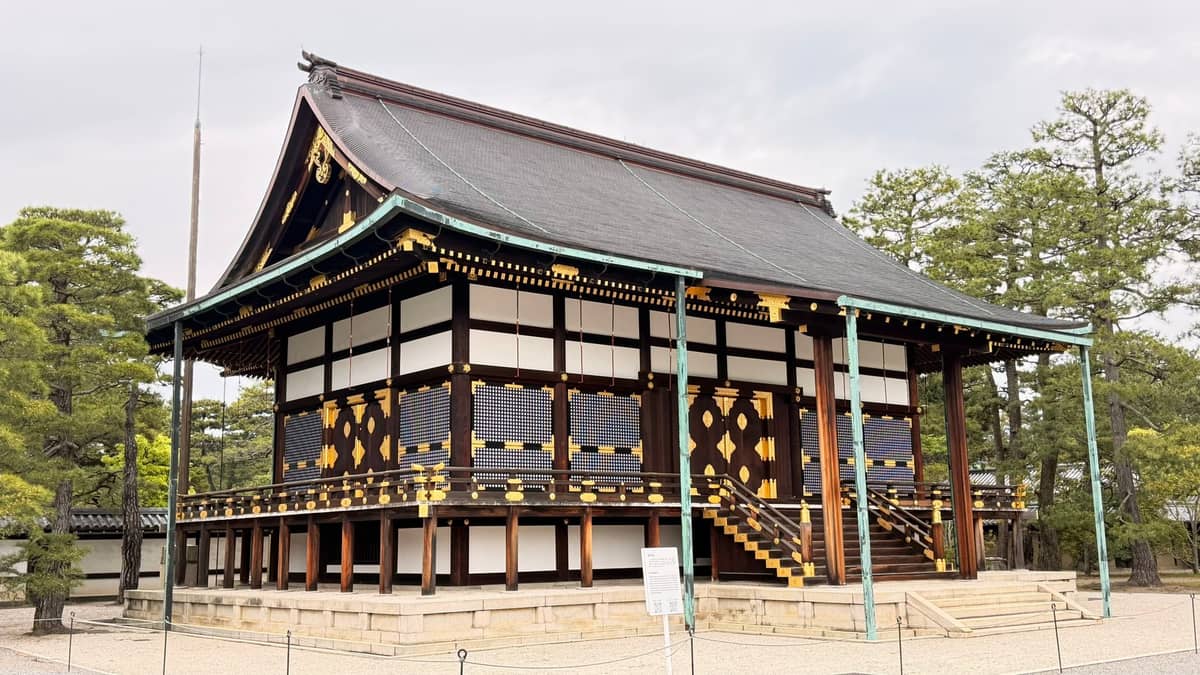
This distinction matters. The buildings are carefully preserved and authentically styled, but visitors hoping for ancient timbers and centuries-old patina will need to recalibrate their expectations. The aesthetic is refined to the point of severity: white gravel raked smooth, unpainted cypress wood, sweeping tile-edged rooflines, and empty ceremonial spaces that feel more symbolic than theatrical.
ℹ️ Good to know
Opening hours change by season. April–August: 09:00–17:00 (last admission 16:20). September and March: 09:00–16:30 (last admission 15:50). October–February: 09:00–16:00 (last admission 15:20). Closed Mondays (or Tuesday if Monday is a national holiday), and December 28–January 4. The palace may also close temporarily for imperial events or operational reasons.
Getting There: Subway Is the Simplest Option
The Kyoto Municipal Subway's Karasuma Line runs directly beneath Karasuma-dori, the broad avenue that borders the palace grounds to the west. Imadegawa Station (K06) puts you at the northern edge of Kyoto Gyoen National Garden, while Marutamachi Station (K07) deposits you at the southern end. Either works; the walk through the garden to the palace entrance is around 10–12 minutes from Marutamachi and slightly shorter from Imadegawa.
Multiple city bus lines also stop near the garden's main gates. If you're combining this visit with other sites along thePhilosopher's Path or coming from Higashiyama, a bus or taxi is often easier than backtracking to the subway. Allow 20–25 minutes from Kyoto Station by subway.
Once inside Kyoto Gyoen National Garden — the vast, publicly accessible parkland that surrounds the palace — navigation is straightforward. Signage in both Japanese and English points toward the palace entrance. The palace itself sits inside a walled compound within this larger green space, and you enter through the designated visitor gate.
Tickets & tours
Hand-picked options from our booking partner. Prices are indicative; availability and final rates are confirmed when you complete your booking.
Kyoto Coast, Amanohashidate and Ine Bay 1-Day Trip from Osaka or Kyoto
From 46 €Instant confirmationFree cancellationKyoto Sanzen-in, Arashiyama and Bamboo Grove Full Day Tour
From 47 €Instant confirmationFree cancellationKyoto Arashiyama insider walking tour
From 66 €Instant confirmationFree cancellationMatcha green tea tour in Kyoto's Uji Market
From 130 €Instant confirmationFree cancellation
The Walk Through the Palace Grounds
The visitor route through the palace compound follows a fixed circuit of roughly 1.3 kilometers, broadly mirroring the garden's north–south span. You cannot wander freely into buildings or deviate from the prescribed path, but the route is well-designed and covers the most significant structures. Guards are present but unobtrusive, and the atmosphere is calm rather than restrictive.
The first structure that commands attention is the Kenreimon, the southern main gate reserved historically for imperial use. Painted vermilion with heavy double doors and a peaked roof, it's the visual anchor of the south facade — and for most visitors, the best photographic moment of the entire circuit. Just north stands the Shishinden, the ceremonial throne hall where imperial accession rituals and formal audiences were conducted. The building sits within an expansive white gravel courtyard flanked by a cherry tree (right) and an orange tree (left), both centuries old. In spring, when the cherry blossoms, this courtyard becomes briefly extraordinary.
Further along the circuit, the Seiryoden (formerly the emperor's living quarters) and the Kogosho (a smaller audience hall) demonstrate the shift from ceremonial grandeur to human-scale domesticity. The Oikeniwa garden, a pond landscape with stepping stones, raked gravel, and moss-covered banks, is the aesthetic high point for visitors with an appreciation for classical Japanese garden design. It's also the section of the route where foot traffic slows — people linger here in a way they don't elsewhere on the circuit.
💡 Local tip
Photography is permitted throughout the visitor circuit, including in the main courtyard facing the Shishinden. Morning light (09:00–10:30) falls on the courtyard from the east and makes the white gravel glow without harsh shadows. By midday, the light flattens and the gravel becomes bleaching white on camera.
How the Experience Changes Through the Day
Arriving at opening time rewards visitors with near-solitude. The palace receives a fraction of the foot traffic of sites like Kinkaku-ji or Kiyomizu-dera, but it's not empty — school groups, retired Japanese visitors, and foreign tourists all appear through the morning hours. By 11:00, the circuit can feel moderately busy near the most-photographed spots. Afternoons in summer are uncomfortable: the gravel courtyards trap heat and there is virtually no shade on parts of the route.
Autumn (October and November) is arguably the best season for the visit. The large ginkgo and maple trees within Kyoto Gyoen National Garden turn gold and red around late November, and the palace grounds themselves, while not a designated autumn foliage destination, benefit from the cooler temperatures and lower humidity. Winter visits are quiet and the bare trees give the compound a more austere quality that actually suits the architecture. Avoid visiting during rain if possible: the gravel paths and cypress buildings look beautiful wet, but the viewing circuit provides almost no shelter.
For context on how Kyoto's seasonal patterns affect this and other attractions, thebest time to visit Kyotoguide breaks down weather, crowds, and event calendars by month.
Kyoto Gyoen National Garden: The Wider Context
The palace compound sits within Kyoto Gyoen National Garden, a roughly 65-hectare public park administered by Japan's Ministry of the Environment. This larger space is worth at least equal time to the palace itself. The garden contains the sites of former courtier mansions — now marked by stone markers and surviving gates — along with wide gravel paths, plum and cherry groves, a small cafe, and public restrooms. On weekday mornings, it's largely populated by locals: elderly residents doing tai chi exercises, joggers looping the perimeter, and office workers cutting through on their way to the subway.
The garden's scale (roughly a 1.3-kilometer walk from south to north) means that combining a circuit of the garden with the palace visit adds significantly to the total time required, but it also turns what could be a 45-minute tick-box stop into a more grounded morning in historic central Kyoto. The gravel underfoot crunches audibly with every step, sparrows pick at the edges of stone-bordered paths, and the low hum of Karasuma-dori traffic fades entirely once you move into the garden's interior.
The garden is also adjacent to Kyoto Gyoen National Garden, which has its own entry on this site with more detail on the seasonal cherry blossom and plum viewing within the grounds.
Historical Weight and Cultural Significance
For over a thousand years, Kyoto's imperial palaces formed the literal center of Japanese imperial power. Emperors were enthroned here, succession disputes played out within palace walls, and the court culture that produced classical Japanese literature, noh theater, and the formalized arts of the Heian period all radiated outward from this milieu. The Tale of Genji, written by court lady Murasaki Shikibu in the early 11th century — widely considered the world's first novel — is set in a world physically and culturally rooted in the Heian-era imperial court and its attendant society.
The move to Tokyo in 1869 was more than a logistical relocation: it was a symbolic break with a millennium of concentrated imperial presence in Kyoto. The palace continues to serve occasional ceremonial functions and remains under the care of the Imperial Household Agency. The current buildings, reconstructed in 1855, follow the architectural conventions of the Heian period with considerable precision: joinery without nails, hinoki cypress that weathers to a silver-grey over decades, and spatial proportions governed by classical court hierarchy rather than visual drama.
Accessibility and Practical Details
The Imperial Household Agency confirms that wheelchair access is possible at Kyoto Imperial Palace, which distinguishes it from several other imperial properties in the Kyoto area where stone steps and stepping stones make independent wheelchair access difficult. Visitors with mobility considerations should check the official site before visiting, as specific access arrangements and routes may vary and some gravel surfaces can still be challenging.
There are no bag lockers inside the palace compound, though Kyoto Gyoen National Garden has limited facilities. Bring water in summer — the circuit has no vending point inside the walls, and the exposed gravel courts get intensely hot between June and September. Comfortable walking shoes are essential: the entire route is on gravel or packed earth, and no seating is available along the circuit itself.
⚠️ What to skip
The palace closes on Mondays (or Tuesday when Monday is a public holiday) and from December 28 to January 4 each year. It may also close without advance notice for imperial ceremonies or operational reasons. Check the Imperial Household Agency's official site before visiting: https://kyoto-gosho.kunaicho.go.jp/en
Who Should Reconsider This Visit
Kyoto Imperial Palace is a place of architectural restraint and historical resonance. Visitors expecting a palace in the European sense, with gilded interiors, state apartments, and accumulated royal possessions, will find it austere to the point of disappointment. You view all buildings from outside; interior rooms are not accessible. The significance is contextual and historical rather than visually immediate. Travelers with only a day or two in Kyoto and limited knowledge of Japanese imperial history may get more per hour from other sites.
Those drawn specifically to Kyoto's temple and shrine culture might findNijo Castle— a 10-minute taxi ride west — a more immediately rewarding experience: it has accessible interior rooms, Edo-period painted screens, and garden grounds that tell a comparable political story through different means. The castle charges admission but delivers a richer sensory variety.
Insider Tips
- The palace opens at 09:00, and the first 30–45 minutes see the lightest crowds. The Shishinden courtyard, which can feel crowded when tour groups arrive around 10:00, is effectively yours in that early window.
- Kyoto Gyoen National Garden's plum grove (near the south gate area) typically blooms in late February to early March — earlier than the more-publicized cherry blossoms elsewhere in the city, and with almost no crowds. It's one of the quieter seasonal spectacles in central Kyoto.
- The large ginkgo trees along the garden's internal paths turn a vivid yellow in mid-to-late November. The timing varies by a week or two each year, but this is genuinely one of the better free autumn foliage spots in central Kyoto without the crowds of dedicated foliage sites.
- Free guided tours in English are currently offered by the Imperial Household Agency (typically twice daily); availability and times can change over the years, so check the official site for the latest tour schedule before your visit, as guided access can significantly deepen the historical context.
- If you're visiting with children, the garden grounds rather than the palace circuit itself tend to hold their attention longer. The wide open gravel paths, large trees, and open lawns make it a good rest stop on a busy temple-and-shrine day.
Who Is Kyoto Imperial Palace For?
- Travelers with an interest in Japanese imperial history and classical court culture
- Architecture enthusiasts focused on Heian-period design principles and traditional Japanese joinery
- Visitors looking for a free, uncrowded morning activity in central Kyoto that doesn't require advance planning
- Those combining a downtown Kyoto walk with nearby sites like Nijo Castle or the Nishiki Market area
- Families needing a large, calm outdoor space with no admission pressure and room to move
Nearby Attractions
Other things to see while in Downtown Kyoto (Kawaramachi & Shijo):
- Kamo River (Kamogawa)
The Kamo River runs north to south through central Kyoto, serving as the city's most democratic public space. Free to access at any hour, the riverbanks draw joggers at dawn, couples at dusk, and everyone in between. This is not a ticketed sight — it is the living backdrop of Kyoto daily life.
- Kyoto Gyoen National Garden
Kyoto Gyoen National Garden is a 65-hectare public park wrapped around the Kyoto Imperial Palace, free to enter year-round. Once the residential precinct of Heian-era court nobles, it is now one of the few places in central Kyoto where you can walk for an hour without being asked to buy a ticket.
- Kyoto International Manga Museum
Housed in a beautifully repurposed elementary school in central Kyoto, the Kyoto International Manga Museum holds roughly 300,000 manga-related items spanning over a century of the medium. It is part library, part archive, part cultural institution, and one of the few places in Japan where you can pull a vintage manga off a wall-to-ceiling shelf and read it on the grass.
- Nijō Castle
Nijō Castle is one of Kyoto's most revealing historic sites, where the architecture itself was built to expose intruders through deliberately squeaking floorboards. A UNESCO World Heritage Site since 1994, it offers a rare look inside the physical world of Edo-period power.