Philosopher's Path (Tetsugaku no Michi): The Canal Walk That Earns Its Name
The Philosopher's Path is a 1.5–2 km stone-paved walkway along the Meiji-era Lake Biwa Canal in Kyoto's Sakyō-ku district. Free to walk at any hour, it links Ginkaku-ji in the north to the Eikan-dō and Nanzen-ji area in the south, passing roughly 500 cherry trees, independent cafes, and small galleries along the way. The walk takes 30 to 45 minutes at a relaxed pace, though most visitors linger considerably longer.
Quick Facts
- Location
- Sakyō-ku, Kyoto City – between Ginkaku-ji (north) and Nyakuoji Bridge/Eikan-dō (south)
- Getting There
- Kyoto City Bus to 'Ginkakuji-michi' (north end) or 'Eikan-do-mae' (south end)
- Time Needed
- 45 min – 2 hours (depending on temple detours)
- Cost
- Free; open 24 hours year-round
- Best for
- Sakura season, autumn foliage, quiet morning walks, independent café-hopping
- Official website
- kyoto.travel/en/destinations/philosophers-path-tetsugakunomichi
What the Philosopher's Path Actually Is
The Philosopher's Path, known in Japanese as Tetsugaku no Michi (哲学の道), is a narrow stone-paved pedestrian canal walk running roughly 1.5 to 2 km through the quiet residential northeast of Kyoto. It follows the western bank of the Lake Biwa Canal, a Meiji-era waterway completed in the late 19th century to channel water from Lake Biwa into Kyoto. The canal itself is functional infrastructure, not a decorative garden feature, which is part of what gives the path its understated, unhurried character.
The walk is named after Nishida Kitarō, one of Japan's most influential modern philosophers, who reportedly strolled this route regularly as he walked between his home and Kyoto University while working through ideas. Whether or not every anecdote about him here is entirely accurate, the name has stuck and now frames the entire experience: this is a place where you move slowly, and that's the point.
The path runs through Sakyō-ku, the northeastern ward that also containsGinkaku-ji (Silver Pavilion) and Nanzen-ji, meaning the walk is best understood not as a standalone attraction but as the connective tissue between a cluster of temples and gardens. Most visitors treat it as the spine of a half-day itinerary.
How the Experience Changes by Time of Day
Early morning, before 8 a.m., the Philosopher's Path is genuinely quiet. The canal water reflects whatever light is in the sky, the neighborhood cats emerge from doorways, and the only sounds are birdsong and the occasional bicycle. The small stone bridges that cross the canal every hundred meters or so have virtually no foot traffic, and the whole stretch feels closer to a residential lane than a tourist attraction. This is when the path is at its most honest.
By mid-morning, especially on weekends and during cherry blossom season, the character shifts considerably. The narrow path does not widen to accommodate crowds, and on peak spring days it can feel genuinely congested in stretches. Tour groups move in both directions. The cafes and craft shops that line the path begin opening from around 10 a.m., and the smell of roasting coffee mingles with the damp stone of the canal edge.
Late afternoon brings a softer light that works especially well in autumn when the maples lining parts of the route turn orange and red. By early evening, most of the shops are closed and the crowds have thinned significantly. The path is technically walkable at night and is sometimes lit softly during special seasonal events, but for most of the year, after dark it is simply a quiet canal with minimal lighting.
💡 Local tip
The north end near Ginkaku-ji gets crowds first, as temple visitors spill onto the path after touring the Silver Pavilion. Starting your walk from the south end, near Nyakuoji Bridge, means you begin in the quieter stretch and move toward the Ginkaku-ji crowds only near the end, when they're beginning to disperse.
Tickets & tours
Hand-picked options from our booking partner. Prices are indicative; availability and final rates are confirmed when you complete your booking.
Kyoto Coast, Amanohashidate and Ine Bay 1-Day Trip from Osaka or Kyoto
From 46 €Instant confirmationFree cancellationKyoto Sanzen-in, Arashiyama and Bamboo Grove Full Day Tour
From 47 €Instant confirmationFree cancellationKyoto Arashiyama insider walking tour
From 66 €Instant confirmationFree cancellationMatcha green tea tour in Kyoto's Uji Market
From 130 €Instant confirmationFree cancellation
Cherry Blossoms and Autumn Foliage: Managing Your Expectations
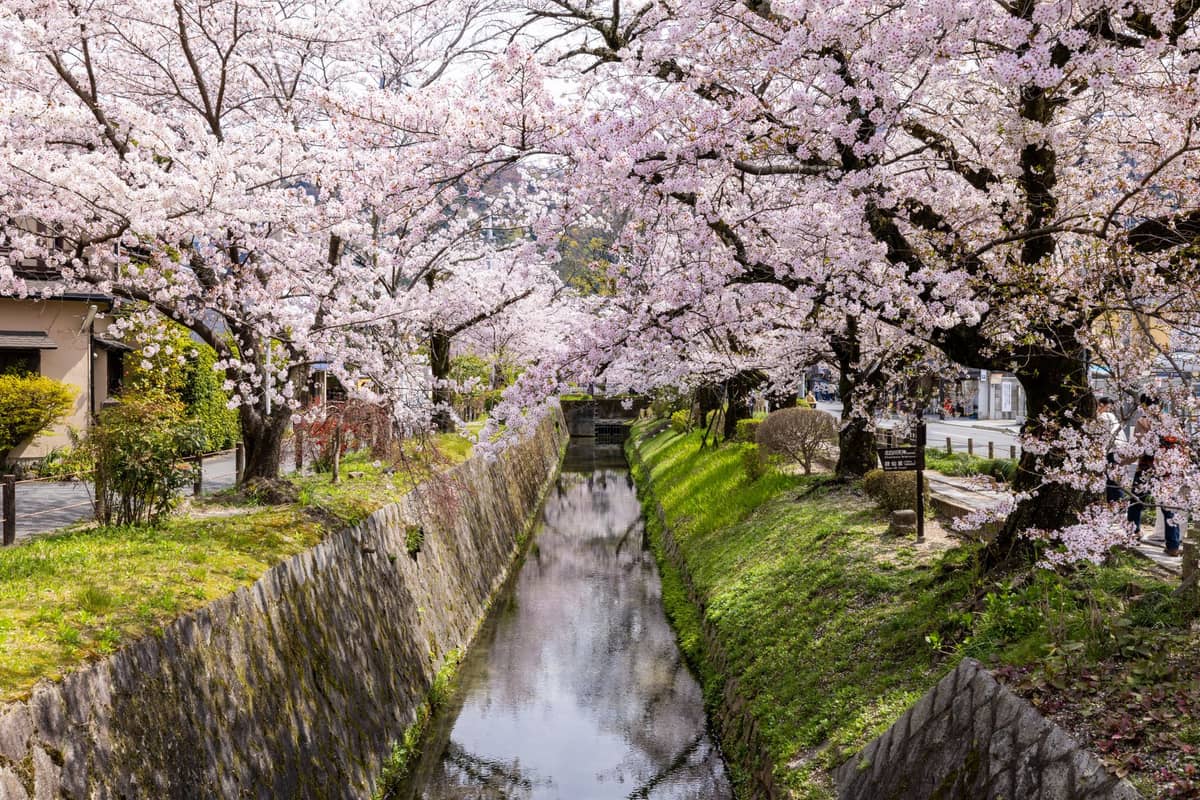
Around 500 cherry trees line the Philosopher's Path, most of them somei-yoshino, the pale pink variety that blooms across Japan in late March to mid-April. During peak bloom, the trees form a low canopy over the canal, and fallen petals accumulate on the water surface. Photographs of this scene are widely circulated, and the reality does match the image. However, the crowds during full bloom on weekends are substantial, and the narrow path creates bottlenecks.
The safest strategy for cherry blossom season is a weekday visit at opening time (before 9 a.m.) or on a weekday afternoon after 4 p.m. The bloom window is short, typically five to ten days before significant petal drop, so timing matters. A light shower can clear the path quickly, which is another reason not to skip a slightly cloudy spring morning.
Autumn is arguably the more manageable season. The foliage colour peaks in November, typically mid-to-late November in Kyoto, and the crowds, while present, are more evenly distributed than during cherry blossom weeks. The nearbyEikan-dō Zenrin-jiis famous for autumn leaves and makes an excellent pairing with the path walk. For broader context on visiting Kyoto in autumn, see theKyoto in Autumn guide.
ℹ️ Good to know
Kyoto's cherry blossom timing shifts year to year. Check the Japan Meteorological Corporation's annual sakura forecast or the Kyoto City official tourism site for current-year predictions before booking spring travel.
A Practical Walkthrough of the Route
The walk is typically done from north to south, beginning near Ginkaku-ji and ending near Nyakuoji Bridge, which is close to both Eikan-dō and Nanzen-ji. The path itself takes 30 to 45 minutes at a continuous pace, but almost no one walks it without pausing.
The stone paving is irregular in places, with some sections showing noticeable unevenness. Small arched bridges cross the canal at intervals, each wide enough for two people to pass each other comfortably. The canal banks have been planted with ornamental shrubs and grasses, and the overall aesthetic is closer to a maintained neighborhood lane than a formal garden. There are no fences or railings along most of the canal edge.
Cafes, tofu restaurants, small galleries, and a few shops selling local crafts are scattered along both sides of the path. Opening hours vary considerably; many places keep inconsistent schedules, and a shop open last month may be closed on your visit. Independent cafes here tend to serve carefully made coffee and simple food rather than tourist-volume menus, which is part of their appeal.
The path is not suitable for wheelchair users in its current state. Uneven paving, small steps at some bridges, and the general narrowness of the route create real barriers. Visitors with strollers can navigate much of it with care, but expect some awkward sections.
Combining the Path With Nearby Temples
The Philosopher's Path sits within easy walking distance of several major temples. At the north end,Ginkaku-jiis a five-minute walk from the path's starting point and requires a separate admission fee (verify current pricing). At the south end,Eikan-dō Zenrin-ji and Nanzen-jiare both within a ten-minute walk of Nyakuoji Bridge. A half-day can reasonably cover the path plus one or two of these temples.
For a longer day in this part of Kyoto, consider continuing south past Nanzen-ji toward the Okazaki museum district, which includes the Kyoto City Kyocera Museum of Art and the Heian Shrine, both a 20-minute walk away. The whole northeastern corridor of Kyoto is among the least car-dependent parts of the city, and most of it is best experienced on foot.
⚠️ What to skip
Temple admission fees in this area are not included in any city transport pass. Ginkaku-ji, Eikan-dō, and Nanzen-ji all charge separate entry fees. Verify current prices at each official temple website before your visit, as they are updated periodically.
Photography, Weather, and What to Bring
The Philosopher's Path runs roughly north-south, which means the light falls differently depending on which direction you face. Morning light favors the north-facing stretches, while afternoon sun works better when you're walking north toward Ginkaku-ji. In cherry blossom season, overcast skies often produce more even, flattering light for photography than direct sun, which can wash out the pale pink blossoms.
Kyoto's spring weather can be unpredictable. Temperatures in late March and April typically range between roughly 13 and 24°C, but rain is possible at any time, and cold snaps occasionally delay the bloom. A compact umbrella is worth carrying from March through June. Autumn visits in October and November tend to be more stable, with daytime temperatures around 17 to 24°C and lower humidity than summer.
Summer visits (July and August) are possible but the heat and humidity in Kyoto's basin geography make a midday walk uncomfortable. If you're visiting in summer, stick to early morning. For a broader view of when to visit Kyoto across the year, thebest time to visit Kyoto guide covers seasonal trade-offs in detail.
Comfortable, flat shoes are worth more here than anywhere else in Kyoto's tourist circuit. The stone paving is uneven enough to make high heels or unsupportive footwear a poor choice. There are public restrooms at a few points along the route, though they are not evenly spaced.
Insider Tips
- The path is at its most peaceful on weekday mornings before 9 a.m., even during cherry blossom season. If your schedule allows only one early start in Kyoto, make it this one.
- Most visitors walk south to north (Nanzen-ji toward Ginkaku-ji) because bus lines deposit people near Ginkaku-ji first. Reversing the direction means you're walking against the grain of the crowd and have clearer sightlines in front of you.
- Several of the independent cafes on the path do not take reservations and have only a handful of seats. If you have your heart set on a specific place, walk past it first to check the queue before committing.
- The small stone bridges crossing the canal every 100 to 150 meters offer the best overhead views of the cherry blossom canopy in spring. Position yourself on a bridge rather than on the path itself for the most photogenic angles.
- Honen-in, a small temple set back slightly from the northern stretch of the path, has no standard admission fee for its outer garden and attracts far fewer visitors than Ginkaku-ji. It's a genuinely quiet stop and the moss-covered sand mounds at the entrance gate are worth the short detour.
Who Is Philosopher's Path For?
- Spring cherry blossom visitors who want a walkable alternative to crowded temple gardens
- Autumn foliage seekers combining the path with Eikan-dō and Nanzen-ji
- Slow travelers who prefer neighborhood atmosphere over set-piece sightseeing
- Photographers looking for early-morning canal light without admission queues
- Budget travelers: the path itself is entirely free, making it one of the most rewarding no-cost experiences in Kyoto
Nearby Attractions
Other things to see while in Philosopher's Path Area:
- Daimonji-yama
Daimonji-yama is a forested mountain in eastern Kyoto offering one of the city's most rewarding free hikes. Rising above the Philosopher's Path area, the trail leads to an open summit with sweeping views across the Kyoto basin, and once a year the hillside becomes the stage for the city's most spectacular Buddhist fire ritual.
- Eikan-do (Zenrin-ji Temple)
Eikan-do Zenrin-ji is a sprawling hillside temple in eastern Kyoto, celebrated for some of the city's most spectacular autumn foliage and home to a uniquely expressive Amida Buddha who turns to look back over his shoulder. Tucked just north of Nanzen-ji along the Philosopher's Path corridor, it rewards visitors year-round but reaches its full power in November.
- Ginkaku-ji (Silver Pavilion)
Officially known as Tozan Jishō-ji, Ginkaku-ji is a Zen temple in northeastern Kyoto whose sculpted sand garden, moss-covered hillside path, and understated wooden pavilion offer a counterpoint to the city's flashier showpieces. Admission is ¥1,000 for adults from April 2026, and the walk there along the Canal of Philosophy makes it one of Kyoto's most satisfying half-day outings.
- Heian Shrine
Built in 1895 to mark Kyoto's 1,100th anniversary as Japan's imperial capital, Heian Jingu Shrine combines monumental Heian-period architecture with one of the city's finest strolling gardens. Entry to the shrine precincts is free, while the Shin'en Garden rewards visitors willing to pay the small admission fee.