Eikan-do Zenrin-ji Temple: Kyoto's Autumn Foliage Masterpiece
Eikan-do Zenrin-ji is a sprawling hillside temple in eastern Kyoto, celebrated for some of the city's most spectacular autumn foliage and home to a uniquely expressive Amida Buddha who turns to look back over his shoulder. Tucked just north of Nanzen-ji along the Philosopher's Path corridor, it rewards visitors year-round but reaches its full power in November.
Quick Facts
- Location
- 48 Eikando-cho, Sakyo-ku, Kyoto 606-8445 — east Kyoto, north of Nanzen-ji
- Getting There
- Keage Station (Tozai Subway Line), ~15–20 min walk; city buses to Nanzen-ji/Eikando-michi stop
- Time Needed
- 1.5–2.5 hours for a thorough visit; allow extra time during autumn season
- Cost
- Adults ¥600, children ¥400 (regular); adults ¥1,000 during autumn special exhibition; evening illumination tickets (typically around ¥700 for junior-high age and above) sold separately
- Best for
- Autumn foliage, Buddhist art, reflective temple walks, photographers
- Official website
- www.eikando.or.jp/English/index_eng.html
What Is Eikan-do Zenrin-ji?
Eikan-do Zenrin-ji Temple — formally known as Shojuraigousan Muryojuin Zenrin-ji — is one of the most historically layered temples in Kyoto, and also one of the most visually striking. Founded in the 9th century during the mid-Heian period as a Shingon sect temple, it later became affiliated with Jodo (Pure Land) Buddhism, a transition that shaped much of what you see today. The complex climbs a forested hillside in the Sakyo ward, just north of Nanzen-ji, and is made up of more than a dozen interconnected halls, corridors, gardens, and pagodas strung together across multiple levels.
Its formal name rarely appears on signage. Everyone calls it Eikan-do, and the name itself carries a story. The monk Eikan, a devoted 11th-century practitioner of Pure Land Buddhism, is said to have been circling the altar in meditation when the Amida Buddha statue stepped down and turned to walk alongside him, glancing back over its shoulder. That act of compassion became the defining image of this temple. The statue today, with its face turned to one side in a gesture that reads almost as invitation, is unlike any other Amida you will see in Japan.
ℹ️ Good to know
Regular hours: reception open 09:00–16:00, gates close at 17:00. During the autumn foliage special exhibition (typically early November to early December), evening illuminations generally run 17:30–21:00, last entry around 20:30. Check the official site for confirmed dates each year.
The Grounds: What You Actually See
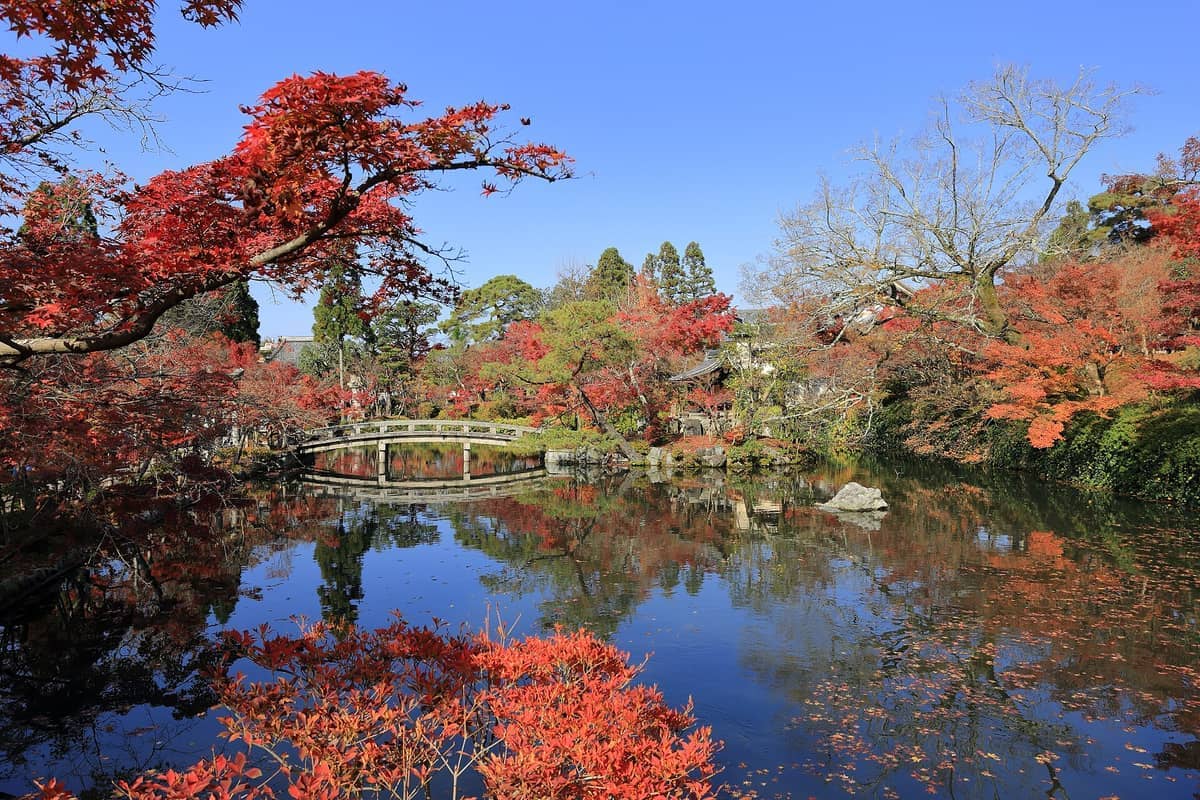
Entry leads into a lower garden area centered on Hojo-ike, a still pond surrounded by maples and moss-covered stones. The reflection of the trees in the water is the image you see on every Eikan-do brochure, and it earns its reputation. But the garden is only the beginning. A covered wooden walkway leads from the lower buildings upward through the hillside, connecting the Garan (main hall), the Amidado (Amida Hall), the Kaisan-do, and eventually the multi-storied Tahoto pagoda, which sits at the highest accessible point of the complex.
The ascent through the covered corridors is one of Eikan-do's underappreciated pleasures. The wood floors creak slightly underfoot. Light filters through the lattice panels. At certain corners, narrow windows frame a single branch of maple against the hillside. The effect is deliberate and has been refined over centuries. Many visitors rush through to reach the pagoda viewpoint, but the corridors themselves deserve slow, unhurried attention.
From the pagoda platform, the city spreads westward below you. On clear days the mountains beyond downtown Kyoto are visible, and the roofline of the temple complex descends below your feet in a layered geometry of grey tiles and dark timber. This is one of the better elevated vantage points in eastern Kyoto, and it is almost never mentioned in the same breath as the famous viewpoints elsewhere.
Visitors who want to extend their time in this part of the city can combine the visit with a walk along thePhilosopher's Path, which begins just to the north and connects southward through the canal-lined residential lanes of the Higashiyama foothills.
Tickets & tours
Hand-picked options from our booking partner. Prices are indicative; availability and final rates are confirmed when you complete your booking.
Kyoto Coast, Amanohashidate and Ine Bay 1-Day Trip from Osaka or Kyoto
From 46 €Instant confirmationFree cancellationKyoto Sanzen-in, Arashiyama and Bamboo Grove Full Day Tour
From 47 €Instant confirmationFree cancellationKyoto Arashiyama insider walking tour
From 66 €Instant confirmationFree cancellationMatcha green tea tour in Kyoto's Uji Market
From 130 €Instant confirmationFree cancellation
The Backward-Glancing Amida: What to Know Before You Enter
The Mikaeri Amida, literally the 'looking back Amida,' is housed in the Amidado Hall. The statue is not large by temple standards, but it has an immediate presence. The face is turned approximately 45 degrees to the left, gazing backward over the left shoulder with an expression that is harder to read than the typical frontal Amida. Some visitors describe it as melancholy. Others find it welcoming. The theological interpretation, that the Buddha pauses and looks back for those who have fallen behind, tends to surface afterward in reflection rather than in the moment.
Photography inside the hall is generally not permitted, which means most visitors will see the statue only once, standing before it in person. This is worth knowing before you arrive, because it changes how you pay attention. Take the time to stand still.
💡 Local tip
Remove your shoes before entering the interior halls. Socks are advisable, especially in cooler months, as the wooden floors and tatami areas can be cold. Shoe storage bags are usually provided.
Autumn at Eikan-do: What the Crowds Are Actually Coming For
Eikan-do holds a specific rank in Kyoto's autumn foliage hierarchy. The temple grounds contain hundreds of Japanese maple trees of varying cultivars, meaning the color transition happens across a range of weeks rather than all at once. Vermilion, orange, and yellow appear in different corners of the garden at different times, with peak color typically arriving in mid-to-late November, though the exact timing shifts year to year with temperature patterns.
During the special autumn exhibition, additional cultural artifacts and painted screens are put on display inside the main halls. The daytime admission fee increases to around ¥1,000 for adults during this period. Crowds are substantial, particularly on weekends between late October and late November. The queue to enter can stretch well beyond the gate by mid-morning. Arriving at opening time (09:00) or on a weekday morning makes a significant difference.
The evening illumination is a separate event, usually beginning around 17:30 with a separate ticket. The maples are lit from below against a dark sky and the pond reflection doubles the effect. It is genuinely beautiful, but expect dense crowds on any evening from early to mid-November. Lines to enter form before the opening time. If the experience of standing with hundreds of others does not appeal, the daytime visit is more spacious and shows the colors in natural light, which is truer to the palette.
For broader context on timing your visit to catch autumn color across the city, theKyoto in autumn guidecovers the full foliage season across neighborhoods and gives useful reference windows for planning.
⚠️ What to skip
Autumn weekends at Eikan-do are among the most crowded temple experiences in Kyoto. If you are sensitive to crowds or traveling with young children, consider a weekday morning visit or prioritizing the spring and summer seasons when the garden is quieter and genuinely lovely.
Visiting Outside Autumn: The Quieter Seasons
Eikan-do is worth visiting in spring and summer, though it attracts a fraction of its autumn attendance. The garden in spring has fresh moss growth, azalea blooms in April, and an almost completely unhurried atmosphere. You can walk the covered corridors alone, take your time at the Amidado, and climb to the pagoda without waiting. The light in early morning is soft and flat, ideal for photography without harsh shadows.
Summer brings a different atmosphere: the garden is deeply green, and the hillside trees create genuine shade. Kyoto's summers are hot and humid, with daytime temperatures reaching the low to mid-30s Celsius, but the temple's elevation and tree cover make it noticeably cooler than the city streets below. Early morning visits in summer are highly advisable. By midday, the heat is intense regardless of shade.
Winter visits offer near-solitude. On cold December or January mornings, the garden holds a stillness that the autumn crowds obliterate entirely. If there has been overnight frost, the stone paths glitter faintly and the bare maple branches make precise drawings against the sky. This is not a heavily marketed season for Eikan-do, which means it is genuinely pleasant.
If you are visiting Kyoto in the colder months and want guidance on what the season is actually like, theKyoto in winter guideprovides a clear-eyed account of conditions and which sites remain rewarding.
Getting There and Getting Around
Eikan-do sits in a part of Kyoto that is not immediately served by a nearby subway station, which is part of why the surrounding area feels less frenetic than central Gion or Arashiyama. The most practical subway option is Keage Station on the Tozai Line, from which the walk takes roughly 15–20 minutes through the Nanzen-ji approach and then south along a quiet residential lane. This walk is pleasant and passes through one of the more atmospheric parts of eastern Kyoto.
City buses from Kyoto Station serve stops near Nanzen-ji and Eikando-michi, making the area accessible without a subway transfer. Bus routes in this part of the city can be slow during peak tourist season, particularly on autumn weekends. Factor in extra travel time if coming by bus in November.
The nearest parking is limited, and driving to the area during autumn is strongly inadvisable. The surrounding lanes become congested and there is no practical parking at the temple itself. Public transit or cycling from central Kyoto are the most sensible options.
For a full overview of navigating Kyoto's transit network, thegetting around Kyoto guidecovers subway, bus, and cycling options with current context on coverage and IC card use.
Accessibility and Practical Logistics
Eikan-do is a functioning hillside temple complex built across uneven terrain, and accessibility for visitors with limited mobility is genuinely limited. The lower garden is partially navigable, but the interior corridors involve steps, tatami areas, and raised thresholds throughout. The ascent to the pagoda requires climbing a significant number of outdoor stone stairs. No formal step-free route through the full complex exists. Visitors with mobility needs should contact the temple directly before visiting to clarify which sections are accessible.
The temple accepts visitors individually and in groups. Group admission (30 or more people) carries a slightly reduced per-person fee compared with the standard individual rate. There are no lockers on site, so large bags and luggage should be left at your accommodation. The indoor areas are shoe-free, and the wooden floors can be cold outside of summer.
Insider Tips
- The pond reflection shot that fills every autumn photo of Eikan-do requires calm air. Wind ripples the water and ruins the mirror effect. Early morning, before 09:30, is typically the stillest time — and also when the crowds are thinnest.
- The covered wooden corridors connect all the buildings without requiring you to step back outside. If rain starts during your visit, you can continue exploring the interior route comfortably without getting wet — the network is more extensive than most visitors expect.
- The Tahoto pagoda at the top of the hillside offers a city view that few visitors mention. After the crowds at the main halls, the pagoda platform is often quiet, making it a good place to pause and orient yourself across the eastern Kyoto skyline.
- During the autumn evening illumination, the queue outside can be long. Bring something warm and arrive at least 20 minutes before the listed opening time if you want to be in the first group entering. The first 30 minutes after the lights go on tend to be the most photogenic.
- If you combine Eikan-do with Nanzen-ji on the same morning, start at Eikan-do at 09:00 when both open, then walk north to Nanzen-ji as tour groups begin to arrive later in the morning. This order means you catch both temples in relative quiet.
Who Is Eikan-do (Zenrin-ji Temple) For?
- Autumn foliage seekers: Eikan-do is consistently rated among Kyoto's top two or three spots for maple color and is worth planning your schedule around in November
- Photography enthusiasts who want architectural detail and garden reflections in the same location, with good light from different angles throughout the morning
- Visitors interested in Pure Land Buddhist history and iconography, particularly the unusual and thought-provoking Mikaeri Amida statue
- Travelers using the Philosopher's Path area as a base, since Eikan-do sits at the natural southern anchor of that corridor and pairs well with Nanzen-ji and Ginkaku-ji in a single half-day
- Off-season visitors to Kyoto who want a major temple without major crowds — spring and winter visits here are genuinely quiet and the garden retains its quality
Nearby Attractions
Other things to see while in Philosopher's Path Area:
- Daimonji-yama
Daimonji-yama is a forested mountain in eastern Kyoto offering one of the city's most rewarding free hikes. Rising above the Philosopher's Path area, the trail leads to an open summit with sweeping views across the Kyoto basin, and once a year the hillside becomes the stage for the city's most spectacular Buddhist fire ritual.
- Ginkaku-ji (Silver Pavilion)
Officially known as Tozan Jishō-ji, Ginkaku-ji is a Zen temple in northeastern Kyoto whose sculpted sand garden, moss-covered hillside path, and understated wooden pavilion offer a counterpoint to the city's flashier showpieces. Admission is ¥1,000 for adults from April 2026, and the walk there along the Canal of Philosophy makes it one of Kyoto's most satisfying half-day outings.
- Heian Shrine
Built in 1895 to mark Kyoto's 1,100th anniversary as Japan's imperial capital, Heian Jingu Shrine combines monumental Heian-period architecture with one of the city's finest strolling gardens. Entry to the shrine precincts is free, while the Shin'en Garden rewards visitors willing to pay the small admission fee.
- Kyoto City KYOCERA Museum of Art
Originally opened in 1933, the Kyoto City KYOCERA Museum of Art is one of Japan's oldest public art museums. Renovated and reopened in 2020, it now combines a landmark Imperial-era building with contemporary gallery spaces, making it one of the most architecturally interesting cultural venues in the city.