Heian Jingu Shrine: Kyoto's Grand Meiji-Era Shrine and Its Hidden Garden
Built in 1895 to mark Kyoto's 1,100th anniversary as Japan's imperial capital, Heian Jingu Shrine combines monumental Heian-period architecture with one of the city's finest strolling gardens. Entry to the shrine precincts is free, while the Shin'en Garden rewards visitors willing to pay the small admission fee.
Quick Facts
- Location
- 97 Okazaki Nishitenno-cho, Sakyo-ku, Kyoto 606-8341
- Getting There
- Higashiyama Station (Tozai Subway Line) or Jingu-Marutamachi Station (Keihan Line), both within walking distance
- Time Needed
- 1–2 hours for precincts and garden combined
- Cost
- Shrine precincts: free. Shin'en Garden: ¥600 adults, ¥300 children (verify before visiting)
- Best for
- Architecture, garden walks, photography, spring cherry blossoms, autumn colour
- Official website
- www.heianjingu.or.jp/english
What Heian Jingu Shrine Actually Is
Heian Jingu Shrine is not an ancient relic. It was built in 1895, during Japan's Meiji era, as a deliberate act of civic pride to commemorate the 1,100th anniversary of Kyoto's founding as the imperial capital. The shrine is dedicated to Emperor Kanmu, who established the city of Heian-kyo in 794, and to Emperor Komei, the last emperor to reign from Kyoto before the capital moved to Tokyo in 1869. Understanding this context matters: what you are visiting is a meticulous architectural recreation of the original Heian-period imperial palace, not a structure that dates back a thousand years. That distinction makes it no less impressive, but it reframes what you are looking at.
The shrine sits in the Okazaki district of Sakyo-ku, a neighborhood that also houses several museums and the broad, leafy Okazaki Park. Arriving from the south, the first thing you encounter is the towering vermilion torii gate at the edge of the boulevard. It announces the shrine from several blocks away and functions as a landmark for the entire district. Walk through it and you are still a short distance from the main gate, which gives the procession an unusually grand sense of approach by Kyoto standards.
Heian Jingu sits within the broader Philosopher's Path area, making it an easy pairing with Nanzen-ji or a leisurely walk along the canal path to the south.
The Precincts: Scale, Colour, and the Inner Courtyard
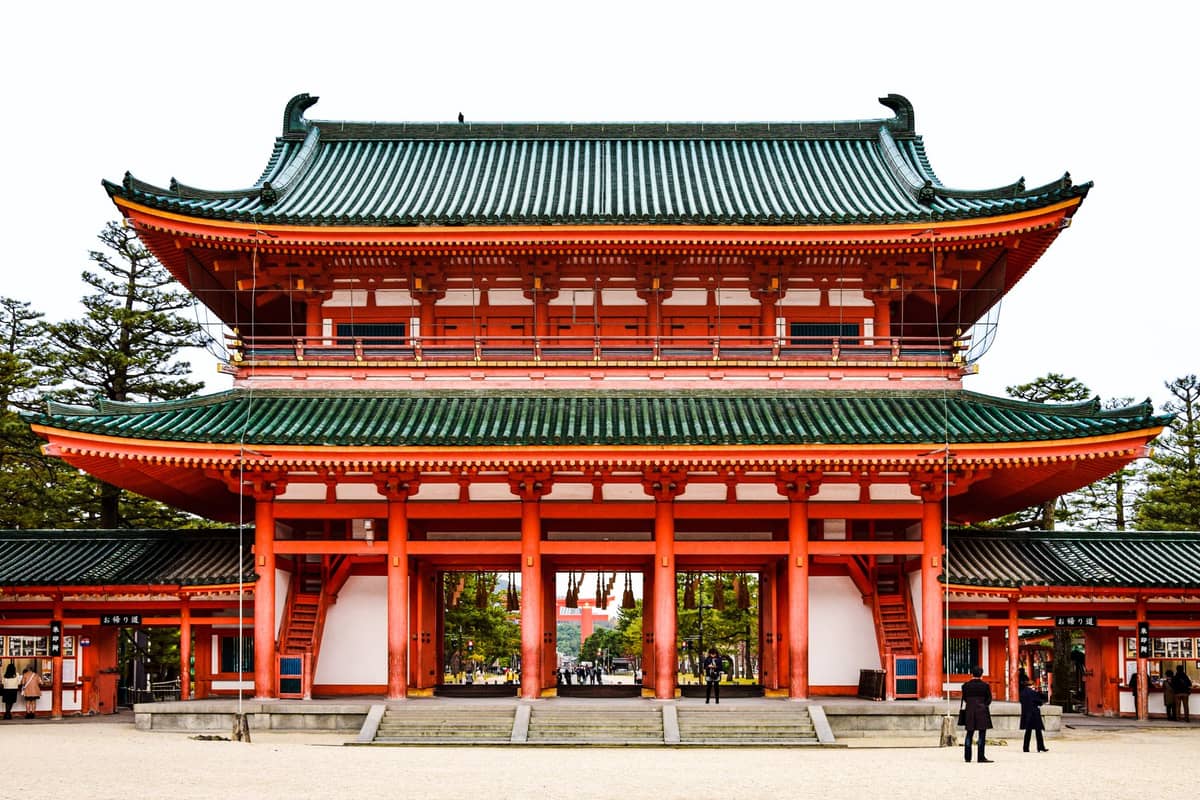
Passing through the Otenmon gate, visitors enter the broad white-gravel courtyard, the shrine precincts. The scale is deliberately imposing. The main hall, the Daigokuden, sits at the far end, its vermilion columns and sweeping green-tiled roofline modelled on the Chodo-in of the original Heian Palace. In full sunlight, the colour contrast between the red lacquered wood, the white gravel, and the blue sky overhead is stark and photogenic. Overcast days mute the palette considerably, but also reduce the glare that can make midday photography difficult.
The courtyard itself is largely unshaded and can feel relentlessly hot in July and August. Kyoto's basin geography traps summer heat, and the white gravel reflects it upward. Arriving before 9:00 makes a genuine practical difference in summer: the gravel is still cool, the light is softer, and the tour groups that arrive mid-morning have not yet appeared. Weekday mornings in spring and autumn offer the most comfortable experience.
💡 Local tip
The precincts open at 6:00, which is earlier than most of Kyoto's major shrines and temples. Early arrival on spring mornings, particularly during late March and early April, lets you experience the space with almost no other visitors and in exceptional light.
Smaller secondary halls flank the courtyard on east and west, each painted in the same vermilion and white scheme. Unlike many of Kyoto's older shrines, there is no patina of age here: the paint is maintained in vivid condition, and the overall effect is of a living ceremonial space rather than a historic ruin. That immaculate quality is part of what draws architectural photographers, but it can also feel slightly sterile to visitors expecting weathered wood and quiet moss.
Tickets & tours
Hand-picked options from our booking partner. Prices are indicative; availability and final rates are confirmed when you complete your booking.
Kyoto temples, shrines, and Kimonos guided day tour
From 8.800 €Instant confirmationFree cancellationShiga Day Trip with Miho Museum, Lake Biwa and Waterbird Shrine
From 70 €Instant confirmationFree cancellationKyoto Coast, Amanohashidate and Ine Bay 1-Day Trip from Osaka or Kyoto
From 46 €Instant confirmationFree cancellationKyoto Sanzen-in, Arashiyama and Bamboo Grove Full Day Tour
From 47 €Instant confirmationFree cancellation
The Shin'en Garden: Four Zones Worth the Admission Fee
The Shin'en, or Sacred Garden, wraps around three sides of the shrine precincts and is entered from inside the courtyard. The admission fee of ¥600 for adults covers all four sub-gardens: the Nishi-Shin'en (west), Naka-Shin'en (central), and Higashi-Shin'en (east), which together form a continuous circuit of roughly 33,000 square metres. The design was completed in the Meiji and Taisho periods and draws on classical Japanese garden principles, centering on the Seiho-ike and Eien-ike ponds, crossed by a covered wooden bridge called the Taihei-kaku.
The garden changes dramatically across the seasons. In late March and early April, weeping cherry trees (shidare-zakura) overhang the pond edge, their trailing branches reflected in still water. This is genuinely one of Kyoto's most arresting spring images, and the garden justifiably draws crowds at that time. In May, irises bloom in the boggy margins. Autumn brings maples along the garden perimeter, though the colour here is less concentrated than at dedicated autumn foliage sites.
If cherry blossoms are your primary motivation, the Kyoto cherry blossom guidegives detailed bloom timing and site comparisons to help you plan your visit around peak flowering.
The Taihei-kaku bridge, roofed with traditional timber, spans the central pond and is the garden's most photographed element. In peak cherry blossom season, a queue can form to cross it. Outside peak season, the garden path is quiet enough that you can hear water birds settling on the surface of the pond. The east garden in particular has a wilder, less manicured feel than the western sections, with larger trees and denser planting around the water's edge.
ℹ️ Good to know
The Shin'en Garden has separate seasonal opening hours from the shrine precincts. Hours are typically shorter in winter. Confirm current garden hours on the official website before visiting: heianjingu.or.jp/english/
Getting There and Moving Around the Area
The most straightforward transit option is the Tozai Subway Line to Higashiyama Station, from which the shrine is a ten-minute walk north through the Okazaki district. The route passes the Kyoto Municipal Museum of Art and the Okazaki canal, both pleasant in their own right. Alternatively, Jingu-Marutamachi Station on the Keihan Line puts you slightly to the north, with a short walk south along Marutamachi Street.
City buses also serve the area directly, with stops near the shrine including Okazaki Koen Bijutsukan/Heian Jingu-mae. If you are visiting on a busy spring weekend and coming from central Kyoto, the subway is generally faster than the bus, which can slow significantly in traffic. Cycling is a practical option: the streets around Okazaki are comparatively flat, and bike parking is available near the shrine.
For a full picture of transport options across the city, thegetting around Kyoto guide covers subway, bus, and cycling in detail.
Photography and Practical Conditions
The vermilion architecture photographs well throughout the day, but early morning and the hour before sunset offer the most flattering light. The courtyard faces roughly south, so the main hall is front-lit in the morning and side-lit in the afternoon. At midday in summer, the contrast between the bright gravel and the shaded halls can be too extreme for good results without exposure bracketing.
Inside the garden, the best positions for pond reflections are on the northern bank of the Seiho-ike, particularly in calm, windless mornings when the water surface is undisturbed. During cherry blossom season, the wooden Taihei-kaku bridge with blossoms behind it is a standard composition, but it requires patience. Come before 8:30 or after 16:30 to avoid the densest crowds around the bridge.
⚠️ What to skip
During cherry blossom season (typically late March to early April), the garden can become significantly crowded by mid-morning. An evening visit on a weekday, if the garden hours permit, offers a noticeably quieter experience with warm light.
Tripods may be restricted in some areas, so check on arrival and keep gear clear of walkways. Photography inside the inner shrine buildings is restricted, as is standard across most Shinto shrines in Kyoto.
Cultural Context and Who Should Manage Expectations
Heian Jingu Shrine is a working Shinto shrine, not purely a tourist site. Several major festivals take place here, including the Jidai Matsuri (Festival of the Ages) in October, one of Kyoto's three principal festivals, which ends with a large procession arriving at the shrine. If your visit coincides with a major ceremony or festival day, access to parts of the precincts may be restricted or the area may be significantly busier.
Visitors primarily interested in older, more historically layered sites may find Heian Jingu less satisfying than, say,Nanzen-ji or Shimogamo Shrine, both of which have deeper historical roots and a more weathered atmosphere. Heian Jingu's value lies in its architectural ambition and its garden, not in ancient patina.
Visitors who find large, open ceremonial spaces underwhelming without interpretive context may also benefit from reading about Heian-period court culture before their visit. The shrine's design references a specific historical moment in Kyoto's history, and understanding that moment makes the architecture considerably more interesting than it might appear at first glance.
For broader context on Kyoto's shrine culture and etiquette, thebest shrines in Kyoto guide and the temple and shrine etiquette guide are useful preparation.
Insider Tips
- The massive vermilion torii gate on Jingu-michi boulevard is not technically part of the shrine precincts; you can photograph it for free from the street at any hour, including at night when it is lit.
- The Naka-Shin'en garden section tends to hold the largest crowds near the Taihei-kaku bridge. The Higashi-Shin'en, the easternmost zone, is quieter and less photographed, with a more naturalistic feel and larger tree cover.
- On New Year's, Heian Jingu is one of Kyoto's busiest hatsumode (first shrine visit) destinations. If you are in Kyoto in early January, arriving before dawn on January 1st means shorter queues but intense cold.
- The Okazaki district around the shrine has several good cafes and the Kyoto City Kyocera Museum of Art nearby. Plan at least 30 minutes of buffer time for the walk from Higashiyama Station if you want to browse the canal path.
- A simple paper fortune (omikuji) at the shrine office costs only a few hundred yen and is a low-key way to engage with the site's active Shinto practice rather than treating it purely as a visual attraction.
Who Is Heian Shrine For?
- Architecture and design enthusiasts interested in Meiji-era reconstructions of classical Japanese building styles
- Garden lovers visiting in late March to early April for weeping cherry blossoms over the ornamental pond
- Photographers seeking the combination of vermilion architecture and reflective water in one site
- Travellers pairing the Philosopher's Path with a broader Okazaki cultural district half-day
- Visitors attending Kyoto's Jidai Matsuri festival in October, for which Heian Jingu is the ceremonial endpoint
Nearby Attractions
Other things to see while in Philosopher's Path Area:
- Daimonji-yama
Daimonji-yama is a forested mountain in eastern Kyoto offering one of the city's most rewarding free hikes. Rising above the Philosopher's Path area, the trail leads to an open summit with sweeping views across the Kyoto basin, and once a year the hillside becomes the stage for the city's most spectacular Buddhist fire ritual.
- Eikan-do (Zenrin-ji Temple)
Eikan-do Zenrin-ji is a sprawling hillside temple in eastern Kyoto, celebrated for some of the city's most spectacular autumn foliage and home to a uniquely expressive Amida Buddha who turns to look back over his shoulder. Tucked just north of Nanzen-ji along the Philosopher's Path corridor, it rewards visitors year-round but reaches its full power in November.
- Ginkaku-ji (Silver Pavilion)
Officially known as Tozan Jishō-ji, Ginkaku-ji is a Zen temple in northeastern Kyoto whose sculpted sand garden, moss-covered hillside path, and understated wooden pavilion offer a counterpoint to the city's flashier showpieces. Admission is ¥1,000 for adults from April 2026, and the walk there along the Canal of Philosophy makes it one of Kyoto's most satisfying half-day outings.
- Kyoto City KYOCERA Museum of Art
Originally opened in 1933, the Kyoto City KYOCERA Museum of Art is one of Japan's oldest public art museums. Renovated and reopened in 2020, it now combines a landmark Imperial-era building with contemporary gallery spaces, making it one of the most architecturally interesting cultural venues in the city.