Ginkaku-ji (Silver Pavilion): Kyoto's Most Quietly Rewarding Temple
Officially known as Tozan Jishō-ji, Ginkaku-ji is a Zen temple in northeastern Kyoto whose sculpted sand garden, moss-covered hillside path, and understated wooden pavilion offer a counterpoint to the city's flashier showpieces. Admission is ¥1,000 for adults from April 2026, and the walk there along the Canal of Philosophy makes it one of Kyoto's most satisfying half-day outings.
Quick Facts
- Location
- 2 Ginkakuji-cho, Sakyo-ku, Kyoto 606-8402 (Philosophers' Path area)
- Getting There
- Take Kyoto City Bus to Ginkakuji-michi stop; roughly 30 min from central Kyoto
- Time Needed
- 1–1.5 hours for the grounds; 2–3 hours if walking the full Philosophers' Path
- Cost
- ¥1,000 adults / ¥500 primary & middle school students (from April 2026)
- Best for
- Zen garden enthusiasts, photographers, autumn foliage seekers, architecture lovers
- Official website
- www.shokoku-ji.jp/en/ginkakuji
What Ginkaku-ji Actually Is (And What It Isn't)
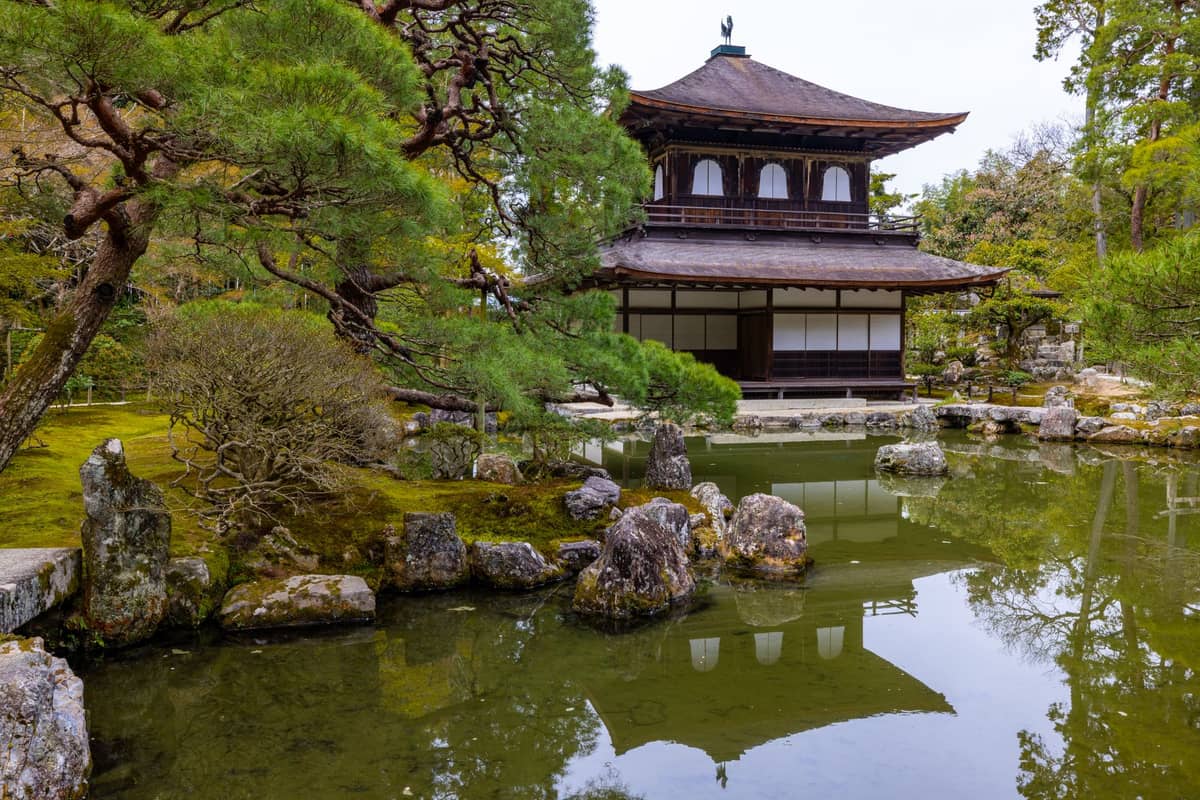
Ginkaku-ji, formally named Tozan Jishō-ji (東山慈照寺), is a Rinzai Zen Buddhist temple in Kyoto's Sakyo-ku ward. It was constructed in 1482 as a retirement villa for shogun Ashikaga Yoshimasa, who modeled it loosely on the gold-clad Kinkaku-ji built by his grandfather. The plan was apparently to coat the pavilion in silver foil, but the project was never completed, possibly because of the ongoing Onin War that had ravaged Kyoto. Today the two-story wooden structure stands unpainted and unclad, and that plainness has become its defining quality.
First-time visitors who arrive expecting something visually spectacular sometimes leave underwhelmed. If you come looking for glittering surfaces, you will be disappointed. What you get instead is one of the finest examples of Higashiyama-style aesthetics in Japan: restrained, deliberate, and deeply connected to the surrounding landscape. The real draw is not the pavilion itself but the garden that surrounds it, and the quiet hillside forest trail that climbs behind it.
ℹ️ Good to know
Opening hours: 8:30 a.m.–5:00 p.m. (March 1–November 30) and 9:00 a.m.–4:30 p.m. (December 1–February 28). Verify current hours at shokoku-ji.jp before visiting, as seasonal schedules occasionally change.
The Garden: Sand, Moss, and Careful Silence
You enter through a corridor of clipped camellia hedges so dense they form a green tunnel. The effect is deliberate: it compresses your vision and builds anticipation before opening onto the main garden. The first thing most visitors notice is the Kogetsudai, a conical mound of white sand roughly 1.8 meters high that stands in the flat expanse of the Sea of Silver Sand (Ginshadan). The mound is sculpted and raked by temple staff daily. Its purpose is interpretive rather than decorative: according to Zen tradition, the cone is said to evoke Mount Fuji and to reflect moonlight across the garden at night.
The raked sand garden is at its most photogenic in the early morning when the light is low and the shadows inside the furrows are sharp. By midday, the flat, high sun washes out the texture. If photography is important to you, arriving at opening time is worth the effort. The contrast between the white sand and the dark pavilion wood is far more striking at 8:30 a.m. than at noon.
Beyond the sand, the garden transitions into a moss and stone landscape fed by a small pond, Kyokochi, which reflects the pavilion when conditions are still. The pond area is older than the shogun's villa, drawing on springs that have fed this hillside for centuries. In autumn, the maples around the pond turn deep red and orange, and their color reflecting in the water makes this one of the better autumn foliage spots in the city. For context on timing that visit well, the guide to
Beyond the sand, the garden transitions into a moss and stone landscape fed by a small pond, Kyokochi, which reflects the pavilion when conditions are still. The pond area draws on springs that have fed this hillside for centuries. In autumn, the maples around the pond turn deep red and orange, making this one of the better foliage corners in northeastern Kyoto. For timing that visit well, see the guide toKyoto in autumn.
Tickets & tours
Hand-picked options from our booking partner. Prices are indicative; availability and final rates are confirmed when you complete your booking.
Kyoto Coast, Amanohashidate and Ine Bay 1-Day Trip from Osaka or Kyoto
From 46 €Instant confirmationFree cancellationKyoto Sanzen-in, Arashiyama and Bamboo Grove Full Day Tour
From 47 €Instant confirmationFree cancellationKyoto Arashiyama insider walking tour
From 66 €Instant confirmationFree cancellationMatcha green tea tour in Kyoto's Uji Market
From 130 €Instant confirmationFree cancellation
The Hillside Trail: The Part Most Visitors Rush Past
A path leads uphill from behind the main garden into the forested slope of Higashiyama. Many visitors stick to the lower garden circuit and miss this entirely. That is a mistake. The trail takes about 10–15 minutes to climb to its highest viewpoint, and from there you get a panorama across the rooftops of Kyoto toward the western mountains. In clear weather, the layered ridgelines and city spread below make it one of the more satisfying free views in the city.
The path itself is packed earth and stone, shaded by cedar and bamboo, with occasional stone lanterns along the edge. It is uneven in places, and after rain the surface becomes slippery. Wear shoes with grip. The slope is moderate, not strenuous, but it is not wheelchair accessible. The official temple FAQ notes that some scenic viewing spots are not reachable for visitors using wheelchairs.
The descent brings you back down through a different section of the garden, past additional stone arrangements and a small tea house structure. The whole loop, upper trail included, takes about 45 minutes at a relaxed pace.
How the Experience Changes by Time of Day and Season
Early morning, especially on weekdays, is the most peaceful time to visit. The tour groups that arrive from mid-morning onward can make the narrow garden paths genuinely congested, with the sand garden roped off and viewable only from fixed positions. By 10 a.m. on a spring or autumn weekend, the approach road outside the gate can feel like a slow-moving queue. The garden is not large, and 500 people moving through a prescribed route changes the experience considerably.
Winter is underrated. Between December and February, visitor numbers drop significantly. The sand garden takes on a different character under gray skies, and if light snow falls, the contrast between white sand and white snow creates an almost monochrome composition that professional photographers seek specifically. The shorter winter hours (closing at 4:30 p.m.) mean you need to plan accordingly, but the atmosphere is far more contemplative than in peak season.
Spring cherry blossom season brings the biggest crowds and the highest energy. The approach street from the Philosophers' Path fills up from about 9 a.m. onward. If you are visiting during cherry blossom season, read the broader context in the
Spring cherry blossom season brings the biggest crowds. The approach street from the Philosophers' Path fills from about 9 a.m. onward. If visiting during that period, the broaderKyoto cherry blossom guide is worth reading before you plan your timing.
Getting There and the Philosophers' Path Connection
The most useful bus stop is Ginkakuji-michi on several Kyoto City Bus routes including the 5 and 17 from central Kyoto. From Kyoto Station, the journey takes roughly 30 minutes by bus. From the bus stop, the temple gate is about a 10-minute walk along the vendor street that leads northeast from the canal.
The far better approach, if time allows, is to walk the Philosophers' Path (Tetsugaku no Michi) from the south. This 2-kilometer stone path follows the Biwako Canal north toward Ginkaku-ji, passing Nanzen-ji and Eikan-do on the way. It is one of the more pleasant walks in the city regardless of season, and arriving at Ginkaku-ji as the natural endpoint of that walk gives the visit a satisfying sense of direction.
The Philosophers' Path itself is worth treating as a destination rather than just a route. More detail on walking this stretch of northeastern Kyoto appears in thePhilosophers' Path guide and in the broader overview of the Philosophers' Path neighborhood.
💡 Local tip
If you plan to visit both Ginkaku-ji and Eikan-do Zenrin-ji on the same day, start at Ginkaku-ji at opening time, walk south along the Philosophers' Path, and arrive at Eikan-do mid-morning when the light in its garden is best.
Architecture and Historical Context
The Silver Pavilion itself is a two-story wooden structure in a style that blends residential shoin-zukuri architecture with elements of Zen temple design. The lower floor is built in the shinden style common to aristocratic residences; the upper floor, with its bell-shaped windows and curved roof, reflects Zen Buddhist aesthetic conventions. The whole structure sits just above the pond surface on a low platform, giving it the appearance of floating when the water is still.
Ashikaga Yoshimasa completed construction of his retirement complex at this site in 1482, during one of the most turbulent periods in Japanese medieval history. The Onin War (1467–1477) had left much of Kyoto in ruins, and the shogun's retreat here was as much an act of withdrawal from political life as it was an architectural project. Despite, or perhaps because of, this context, the Higashiyama culture that Yoshimasa cultivated at this site had a profound influence on Japanese aesthetics: the tea ceremony, ink painting, flower arranging, and Noh theater all received formative patronage here.
After Yoshimasa's death in 1490 the villa was converted into a Zen temple, as he had stipulated. It became part of the Shokoku-ji temple network, which still administers the site today. The pavilion and garden are designated as a National Special Historic Site and National Special Place of Scenic Beauty, and the temple is part of the UNESCO World Heritage property Historic Monuments of Ancient Kyoto.
Practical Notes for Visitors
Admission is ¥1,000 for adults and ¥500 for primary and middle school students from April 2026, paid at the gate. There is no advance booking system; you simply join the queue at the entrance. Payment is typically cash at the gate, so carry yen. The ticket includes full access to the garden circuit, the upper hillside trail, and the viewpoint.
The main garden circuit is on flat, paved or compacted-earth paths and is largely accessible for visitors using wheelchairs, strollers, or who have mobility limitations. The upper hillside trail is not wheelchair accessible due to uneven terrain and gradient. The official FAQ notes that it is possible to visit in a wheelchair except for some scenic viewing spots; confirm current conditions with the temple if this is critical to your visit.
⚠️ What to skip
The vendor street leading to Ginkaku-ji from the Philosophers' Path is lined with matcha ice cream stalls and souvenir shops. Food and drink are not permitted inside the temple grounds, so finish anything before you reach the gate.
Ginkaku-ji pairs naturally with other major temples in northeastern Kyoto.Nanzen-ji is a 25-minute walk south along the canal, and Eikan-do Zenrin-jisits between the two. Together, these three sites make a full and satisfying day in the northeastern quarter of the city.
Insider Tips
- Arrive at 8:30 a.m. (the March–November opening time) on a weekday. The garden before the first tour buses arrive is a completely different experience from the mid-morning rush. The raked furrows in the sand are freshest, the air smells of cedar and damp moss, and the paths are empty enough to stop and look without being moved along.
- Don't neglect the upper hillside trail. Most first-timers stay in the main garden, see the pavilion and sand mound, and leave. The 10-minute climb behind the main garden gives you a rooftop panorama of Kyoto that rewards the effort and costs nothing extra.
- The silver-coating story is a good conversation opener with a myth attached. The pavilion was never actually silver, and the name Ginkaku-ji (Silver Pavilion) likely came into use as a retrospective contrast to the golden Kinkaku-ji. Don't repeat the common tourist-map claim that it was 'planned to be covered in silver but funds ran out' as if it were settled fact — historians debate the original intent.
- Combining Ginkaku-ji with the Philosophers' Path walk and Nanzen-ji in one morning is entirely feasible if you start early. Take the bus to Ginkakuji-michi, visit the temple first, then walk south along the canal. You arrive at Nanzen-ji without retracing any steps.
- In winter, particularly after a light snowfall, the sand garden takes on a compressed, monochrome quality that serious photographers specifically seek out. Visitor numbers in January and February are a fraction of spring or autumn, and the shorter opening hours still give you plenty of time.
Who Is Ginkaku-ji (Silver Pavilion) For?
- Travelers who prefer contemplative, slow-paced cultural visits over crowded landmark moments
- Photographers seeking the interplay of raked sand, still water reflections, and wooden architecture in low morning light
- Autumn foliage seekers: the maple-draped hillside and pond reflection make this one of Kyoto's better autumn spots
- Walkers who want to combine a temple visit with a longer route along the Philosophers' Path
- Architecture and garden design enthusiasts interested in Muromachi-period Zen aesthetics
Nearby Attractions
Other things to see while in Philosopher's Path Area:
- Daimonji-yama
Daimonji-yama is a forested mountain in eastern Kyoto offering one of the city's most rewarding free hikes. Rising above the Philosopher's Path area, the trail leads to an open summit with sweeping views across the Kyoto basin, and once a year the hillside becomes the stage for the city's most spectacular Buddhist fire ritual.
- Eikan-do (Zenrin-ji Temple)
Eikan-do Zenrin-ji is a sprawling hillside temple in eastern Kyoto, celebrated for some of the city's most spectacular autumn foliage and home to a uniquely expressive Amida Buddha who turns to look back over his shoulder. Tucked just north of Nanzen-ji along the Philosopher's Path corridor, it rewards visitors year-round but reaches its full power in November.
- Heian Shrine
Built in 1895 to mark Kyoto's 1,100th anniversary as Japan's imperial capital, Heian Jingu Shrine combines monumental Heian-period architecture with one of the city's finest strolling gardens. Entry to the shrine precincts is free, while the Shin'en Garden rewards visitors willing to pay the small admission fee.
- Kyoto City KYOCERA Museum of Art
Originally opened in 1933, the Kyoto City KYOCERA Museum of Art is one of Japan's oldest public art museums. Renovated and reopened in 2020, it now combines a landmark Imperial-era building with contemporary gallery spaces, making it one of the most architecturally interesting cultural venues in the city.