Nanzen-ji Temple: Kyoto's Grand Zen Complex with a Surprise Aqueduct
Nanzen-ji stands as one of Kyoto's most architecturally striking temple complexes, where a soaring wooden gate and a 19th-century brick aqueduct share the same garden. Located at the base of the Higashiyama mountains in Sakyo-ku, it anchors the southern end of the Philosophers' Path and rewards visitors who arrive early or linger past the midday rush.
Quick Facts
- Location
- 86 Nanzenji Fukuchicho, Sakyo-ku, Kyoto (northern Higashiyama / Philosophers' Path area)
- Getting There
- Keage Station (Kyoto Municipal Subway Tozai Line), about a 10-minute walk
- Time Needed
- 1.5 to 2.5 hours for the main complex; longer if walking the Philosophers' Path afterward
- Cost
- 600 yen (Hojo Garden or Sanmon gate adults); 500 yen high school students; 400 yen elementary/junior high. Some sub-temples charge separately. Grounds entry is free.
- Best for
- Zen garden lovers, architecture enthusiasts, autumn foliage, photography, meditative walks
- Official website
- nanzenji.or.jp
What Nanzen-ji Actually Is
Nanzen-ji is not a single building but a sprawling Zen Buddhist temple complex that occupies a wide expanse at the foot of the Higashiyama mountains in Sakyo-ku. The complex includes a monumental sanmon gate, a classical Hojo garden, several sub-temples, and one of Kyoto's most unexpected sights: a red-brick aqueduct built in the Meiji era that carries water right through the heart of the grounds. The combination of ancient Zen aesthetics and 19th-century industrial infrastructure is genuinely unusual, and it's the main reason Nanzen-ji has a different quality from Kyoto's other major temple districts.
The official name in Japanese is 南禅寺, pronounced Nanzen-ji or sometimes written Nanzenji without the hyphen. It sits at the northern end of what locals call the northern Higashiyama sightseeing corridor, making it a natural starting or ending point for anyone walking the Philosophers' Path toward Ginkaku-ji.
ℹ️ Good to know
The temple grounds (sanmon exterior, aqueduct walkway, and general garden paths) are freely accessible. Entrance fees apply specifically to the Hojo building and its garden (600 yen for adults) and to climbing the Sanmon gate (600 yen for adults). You can spend a worthwhile hour here without paying anything.
The Sanmon Gate: Scale That Stops You
The first thing that recalibrates your expectations is the Sanmon. This two-story wooden gate is one of the largest of its type in Japan, standing roughly 22 meters high. Walking toward it along the stone path, with pine trees on either side and the Higashiyama ridge in the background, is one of those moments in Kyoto where the scale of history becomes physically felt rather than abstractly understood. The gate in its present form dates to 1628, rebuilt after an earlier structure was lost, and its upper story houses Buddhist figures and bodhisattvas.
Climbing the interior staircase to the upper level costs 600 yen separately and gives an elevated view across the treetops toward the city. The views are good rather than exceptional, and the staircase is steep and narrow. For most visitors, admiring the gate from the ground level and then moving into the complex is the more satisfying sequence. Photography of the gate is straightforward from the front approach path in morning light; by midday the gate faces into direct sun and the contrast becomes difficult to work with.
Tickets & tours
Hand-picked options from our booking partner. Prices are indicative; availability and final rates are confirmed when you complete your booking.
Kyoto Coast, Amanohashidate and Ine Bay 1-Day Trip from Osaka or Kyoto
From 46 €Instant confirmationFree cancellationKyoto Sanzen-in, Arashiyama and Bamboo Grove Full Day Tour
From 47 €Instant confirmationFree cancellationKyoto Arashiyama insider walking tour
From 66 €Instant confirmationFree cancellationMatcha green tea tour in Kyoto's Uji Market
From 130 €Instant confirmationFree cancellation
The Hojo Garden and the Zen Interior
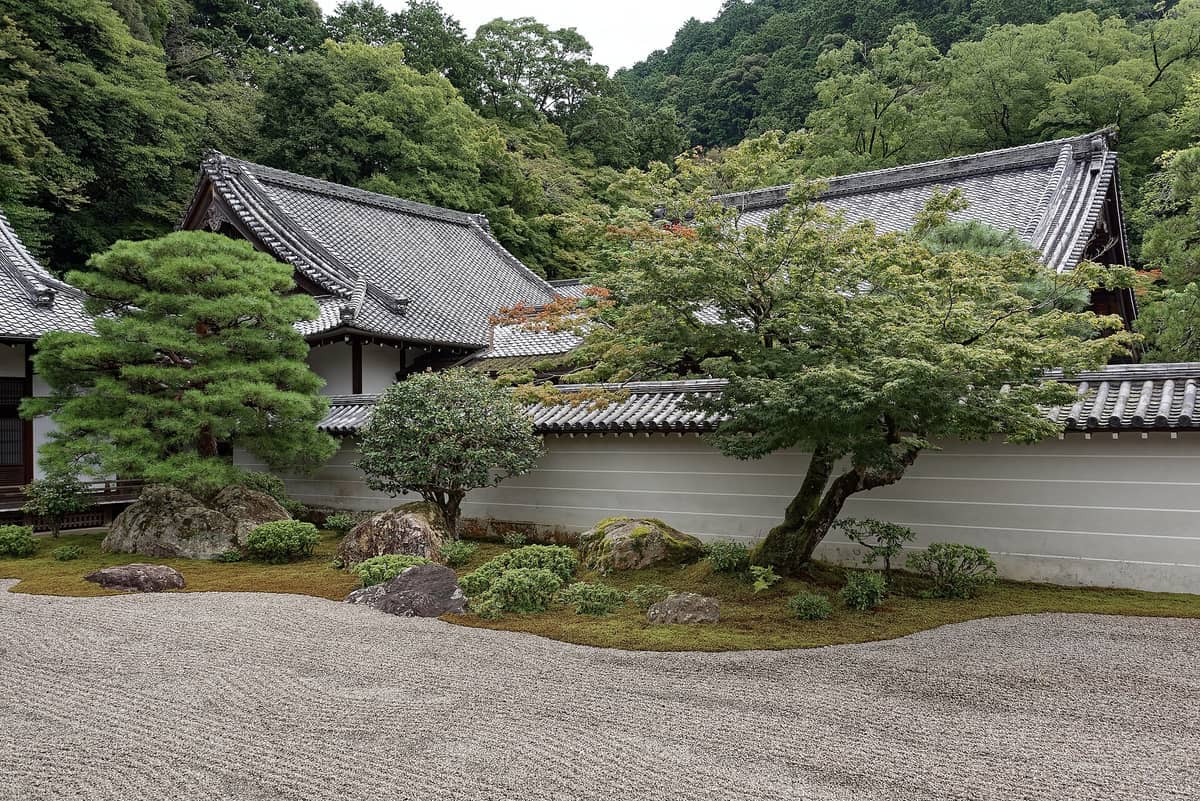
The Hojo is the main residential hall of the head abbot, and the garden attached to it is what most visitors come to see. It is a dry landscape garden in the karesansui tradition, using raked gravel, moss, trimmed shrubs, and carefully placed stones to suggest landscape and movement without using water. The design is attributed to the famous garden designer Kobori Enshu, though academic opinion on this attribution varies. What's not in dispute is the calibration of the space: from the veranda of the Hojo, the garden feels contained and precise, with the forested hillside of Higashiyama acting as borrowed scenery behind it.
The 600 yen admission for the Hojo buys you entry to the building's interior tatami rooms and the surrounding veranda. Shoes come off at the entrance. The rooms are cool and dim, with painted sliding screens that depict tigers in a bamboo forest, a common Zen artistic motif. In the quieter hours of early morning, the combination of the raked garden, the painted screens, and the faint smell of old cedar creates an atmosphere worth sitting with for several minutes rather than photographing and moving on.
💡 Local tip
Arrive before 9:30 am if you want the Hojo veranda to yourself. Tour groups from central Kyoto typically arrive between 10:00 and 11:30. The garden looks noticeably different in autumn when the maple trees near the outer walls turn — this is one of Kyoto's top foliage spots, and weekend crowds in November are dense.
The Meiji Aqueduct: Kyoto's Most Surprising Structure
Most visitors have seen photos of the aqueduct before arriving and still feel a jolt of incongruity when they first see it in person. The Suirokaku aqueduct is a series of red-brick arches carrying water from Lake Biwa, built as part of the Lake Biwa Canal project that was completed in 1890. The canal was an engineering initiative of the Meiji government intended to supply Kyoto with water and facilitate transport during a period when the city was losing population and economic standing to the newly designated capital of Tokyo.
The aqueduct passes directly through the Nanzen-ji grounds, which makes the historical collision of eras visually explicit. You can walk along the top of the structure on a narrow path with the water channel running beside you, and the view down into the wooded temple grounds from that elevated walkway has an unusual intimacy. The brick is weathered but solid, and in spring, wisteria and cherry branches drape over the arches from the surrounding trees. Photographers should note that the best angle for the arches is from ground level looking along the row of spans, ideally in early morning when the light comes from the east and rakes across the brickwork.
The aqueduct walkway is freely accessible. For deeper context on how this waterway fits into Kyoto's urban history, the area aroundthe Philosophers' Pathfollows the canal route northward, and the mood of the walk shifts noticeably with the seasons.
Sub-Temples and the Wider Complex
Nanzen-ji is the head temple of the Nanzen-ji branch of Rinzai Zen Buddhism, and the complex includes numerous sub-temples, some of which are independently open to visitors. Tenjuan, Nanzen-in, and Konchi-in are among those that admit visitors with separate admission fees, and each has its own garden character. Konchi-in has a garden also attributed to Kobori Enshu and is considerably less visited than the main Hojo, making it worth the short detour. Tenjuan features a combination pond garden and dry garden, with maple trees that become spectacular in mid-November.
Not all sub-temples are open every day, and hours and fees can vary. If the sub-temples are a priority, check the individual sub-temple pages or ask at the main complex entrance on arrival. Attempting all of them in a single visit creates a repetitive experience; picking one or two based on your interests in gardens, historical art, or quiet spaces is the more useful approach.
Getting There and Practical Logistics
The most direct route is the Kyoto Municipal Subway Tozai Line to Keage Station, then about a 10-minute walk along a quiet residential street that curves down through a small section of the old incline railway canal district. The walk itself is pleasant and passes the Keage Incline, a preserved section of the Meiji-era boat lift used to carry canal boats up the grade. City buses also serve the area, though Keage Station is typically faster from central Kyoto.
Opening hours are 8:40 to 17:00 from March 1 through November 30, and 8:40 to 16:30 from December 1 through February 28. Admission to paid sections closes 20 minutes before the complex closes. The free outer grounds, including the Suirokaku aqueduct area, can often be accessed slightly earlier if approaching from the outer gates.
Nanzen-ji anchors the southern end of a walking route that runs north along the canal toGinkaku-ji (Silver Pavilion). The stretch between them takes roughly 30 minutes at a relaxed pace and passes cafes, small galleries, and the seasonal scenery of thePhilosophers' Path area. This is one of the more rewarding half-day sequences in northern Kyoto.
⚠️ What to skip
In mid-November, the area around Nanzen-ji becomes one of the most congested parts of Kyoto for autumn foliage. Weekend afternoons see bus queues, packed paths, and very long waits at food stalls. If visiting during peak autumn color, aim for weekday mornings and arrive at opening time.
Accessibility, Photography, and What to Wear
The complex is partially wheelchair accessible. The main grounds, aqueduct base, and outer pathways are navigable on flat stone surfaces. The Hojo garden veranda involves a step up from the garden level, and some of the stone paths within the outer grounds are uneven. An accessible toilet is located near the complex entrance. The Sanmon interior staircase is steep and narrow and is not accessible to wheelchairs.
Dress comfortably for walking, and note that shoes are removed multiple times if you enter the Hojo and any sub-temples. Slip-on footwear makes this significantly easier. In winter, the stone paths can be cold underfoot in socks. Modest dress is appropriate but not strictly enforced; Nanzen-ji is an active religious complex and not just a tourist site.
For seasonal planning, the complex looks its best during cherry blossom season in late March to early April and during autumn color in mid-to-late November. TheKyoto cherry blossom guide and the Kyoto in autumn guideboth give timing guidance specific to the northern Higashiyama corridor.
Who Might Not Enjoy Nanzen-ji
Visitors expecting the kind of intimate, enclosed silence of a smaller Zen temple may find Nanzen-ji's scale and visitor volume counterproductive. On peak autumn or spring weekends, the main approach can feel more like a public park than a contemplative space. The complex also rewards a slower pace and some prior familiarity with Zen garden aesthetics; travelers who find dry rock gardens repetitive or who are focused primarily on shrine architecture rather than temple gardens may find other parts of the city more rewarding. The aqueduct is genuinely distinctive, but it is a relatively brief highlight in an otherwise garden-and-architecture-focused site.
If you have limited time in Kyoto and are choosing between major temple complexes, theKyoto first-timer guideprovides honest comparisons of which sites reward which types of traveler. Nanzen-ji pairs particularly well with a visit toEikan-do Zenrin-ji, which sits just a few minutes' walk to the south and is one of Kyoto's premier autumn foliage temples.
Insider Tips
- The Keage Incline, a short walk from Nanzen-ji near the subway exit, is lined with cherry trees and is far less visited than the main temple during blossom season. Build in 15 minutes to walk it before entering the complex.
- The tofu restaurants immediately outside the main gate are part of a longstanding local tradition of temple tofu (yudofu) in this area. Lunch at one of them is an authentic addition to the visit, but prices are higher than average — budget 2,000 to 3,500 yen per person.
- The walk along the top of the aqueduct is freely accessible and feels noticeably more quiet than the main complex below. If you want a few undisturbed minutes, spend them up there rather than on the Hojo veranda at midday.
- Konchi-in sub-temple consistently has fewer visitors than the main Hojo despite having a Kobori Enshu-attributed garden of comparable quality. It is the place to go if the Hojo feels too crowded to appreciate properly.
- City Bus routes connecting Nanzen-ji to central Kyoto can become very slow during peak tourist periods due to traffic. The Tozai Line subway is almost always the faster option for the return journey.
Who Is Nanzen-ji Temple For?
- Travelers with a genuine interest in Zen garden design and Rinzai Buddhist temple architecture
- Photography enthusiasts, especially during cherry blossom season and autumn foliage
- Visitors combining northern Higashiyama with a Philosophers' Path walk toward Ginkaku-ji
- Anyone curious about Meiji-era infrastructure and the intersection of industrial and traditional Japan
- Couples or solo travelers seeking a slower, more reflective counterpoint to Kyoto's more performative attractions
Nearby Attractions
Other things to see while in Philosopher's Path Area:
- Daimonji-yama
Daimonji-yama is a forested mountain in eastern Kyoto offering one of the city's most rewarding free hikes. Rising above the Philosopher's Path area, the trail leads to an open summit with sweeping views across the Kyoto basin, and once a year the hillside becomes the stage for the city's most spectacular Buddhist fire ritual.
- Eikan-do (Zenrin-ji Temple)
Eikan-do Zenrin-ji is a sprawling hillside temple in eastern Kyoto, celebrated for some of the city's most spectacular autumn foliage and home to a uniquely expressive Amida Buddha who turns to look back over his shoulder. Tucked just north of Nanzen-ji along the Philosopher's Path corridor, it rewards visitors year-round but reaches its full power in November.
- Ginkaku-ji (Silver Pavilion)
Officially known as Tozan Jishō-ji, Ginkaku-ji is a Zen temple in northeastern Kyoto whose sculpted sand garden, moss-covered hillside path, and understated wooden pavilion offer a counterpoint to the city's flashier showpieces. Admission is ¥1,000 for adults from April 2026, and the walk there along the Canal of Philosophy makes it one of Kyoto's most satisfying half-day outings.
- Heian Shrine
Built in 1895 to mark Kyoto's 1,100th anniversary as Japan's imperial capital, Heian Jingu Shrine combines monumental Heian-period architecture with one of the city's finest strolling gardens. Entry to the shrine precincts is free, while the Shin'en Garden rewards visitors willing to pay the small admission fee.