Daimonji-yama: The Free Hike Above Kyoto With Views Worth Every Step
Daimonji-yama is a forested mountain in eastern Kyoto offering one of the city's most rewarding free hikes. Rising above the Philosopher's Path area, the trail leads to an open summit with sweeping views across the Kyoto basin, and once a year the hillside becomes the stage for the city's most spectacular Buddhist fire ritual.
Quick Facts
- Location
- Sakyo-ku, Kyoto (Philosopher's Path area, eastern Kyoto)
- Getting There
- Ginkaku-ji-michi bus stop (City Bus routes 5, 17, 203) or Keage Station (Kyoto City Subway Tozai Line)
- Time Needed
- 2 to 3 hours for the out-and-back trail from Ginkaku-ji
- Cost
- Free (no trail admission); nearby Ginkaku-ji has its own separate entrance fee
- Best for
- City panoramas, light hiking, Gozan no Okuribi festival viewing
- Official website
- kyoto.travel/en/nature/nt8q3200000006wg.html
What Daimonji-yama Actually Is
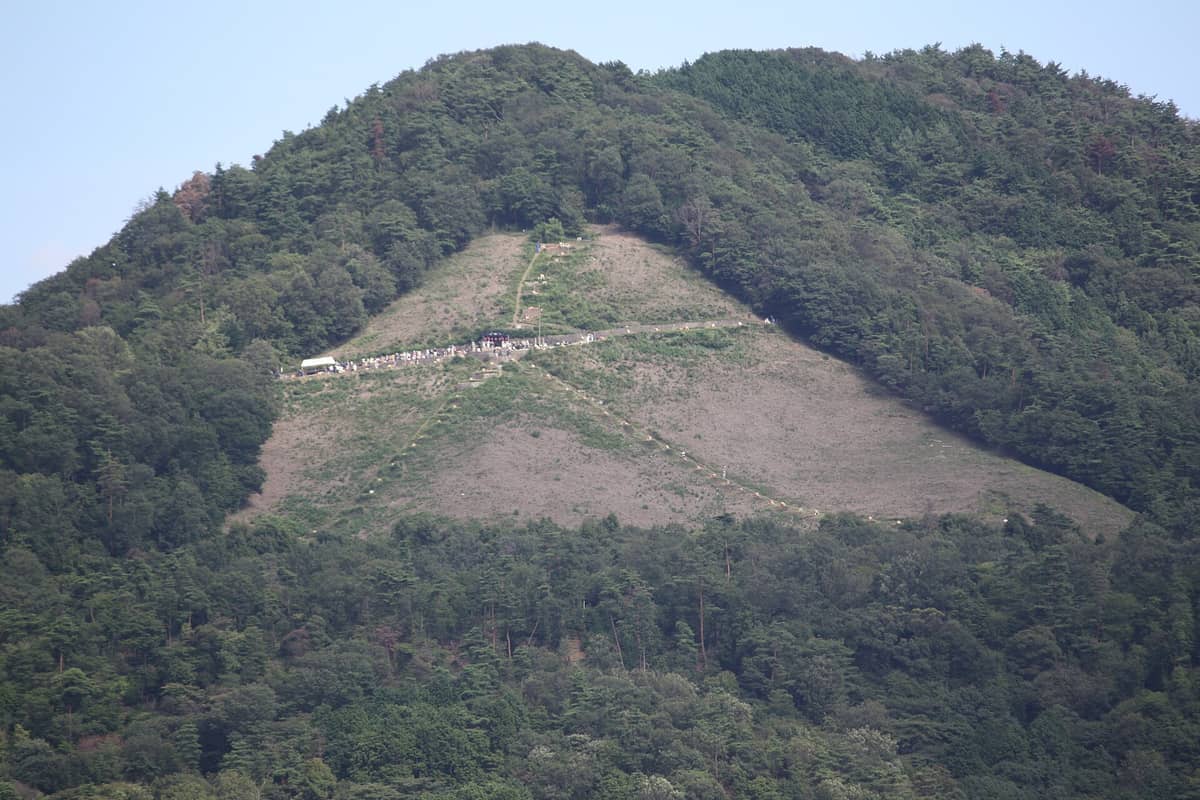
Daimonji-yama (大文字山, also known formally as Nyoigatake) is a 466-meter mountain in the Higashiyama range that forms the eastern backdrop of Kyoto. It is free to climb year-round during daylight hours, and its southern and western faces look directly down over the city's flat basin, with no tall buildings interrupting the sightline. On a clear day, the Kyoto Tower spike is plainly visible, and the grid of the former imperial capital stretches west until it fades into haze.
The mountain is best known outside hiking circles as the site of the most prominent of Kyoto's five Gozan no Okuribi bonfires, lit every August 16 as part of the Obon festival. The large Chinese character 大 (dai, meaning 'large' or 'great') is cut into the upper slope and outlined in fire, visible from much of the city below. But on the other 364 days of the year, the mountain belongs to locals walking their dogs, trail runners, and visitors who want a genuine physical experience rather than another ticketed temple courtyard.
ℹ️ Good to know
The trail itself has no entrance gate and no fee. However, the most popular starting point near Ginkaku-ji (Silver Pavilion) sits just outside that temple's paid grounds. You can walk past Ginkaku-ji's outer wall without entering and still reach the trailhead.
Getting There: Two Main Trailheads
Ginkaku-ji Route (Most Popular)
From Kyoto Station, take City Bus routes 5, 17, or 203 to the Ginkaku-ji-michi stop, then walk about 10 minutes north along the canal-side Path of Philosophy toward the temple. The trailhead proper is a short walk north of Ginkaku-ji's entrance gate, where a stone torii marks the beginning of a forested path. Follow the signs for 大文字山 upward through cedar and pine. The route climbs steadily on packed earth and stone steps, gaining roughly 226 meters in elevation over approximately 3.9 kilometers for the out-and-back to the summit fire site.
This is the route most visitors take and it connects naturally with a morning spent on thePhilosopher's Pathbefore heading uphill. The path through the Philosopher's Path area is one of Kyoto's most pleasant canal-side walks, especially in spring.
Keage Station Route (Less Crowded)
An official hiking course departs from Keage Station on the Tozai Subway Line, passing through Himukai Daijingu Shrine before ascending toward the summit. This approach is quieter, takes slightly longer, and offers a different perspective on the eastern hills. It is a practical option for those combining the hike with a visit to Nanzen-ji, which sits within easy walking distance of Keage.
💡 Local tip
Wear proper walking shoes with grip. The trail surface is unpaved throughout, and sections near the summit involve loose gravel and root-covered ground that become slippery after rain. Sandals and dress shoes are genuinely unsuitable.
Tickets & tours
Hand-picked options from our booking partner. Prices are indicative; availability and final rates are confirmed when you complete your booking.
Kyoto Sanzen-in, Arashiyama and Bamboo Grove Full Day Tour
From 47 €Instant confirmationFree cancellationKyoto Arashiyama insider walking tour
From 66 €Instant confirmationFree cancellationMichelin-Starred Restaurant Experience in Arashiyama Kyoto
From 142 €Instant confirmationFree cancellationGuided day tour from Osaka to Nara Park, Arashiyama and Fushimi Inari
From 59 €Instant confirmationFree cancellation
The Ascent: What You'll Experience
The lower section of the Ginkaku-ji route passes through dense bamboo and mixed forest, shaded enough that even on a hot summer morning the air feels a few degrees cooler than the streets below. The path narrows quickly; within five minutes of the trailhead the noise of the city drops away and is replaced by the dry rustle of leaves and the occasional crow call. In autumn the maples along the lower slope turn orange and deep red, and the contrast against dark cedar trunks is striking.
The middle section involves stone steps that have been worn smooth and uneven over decades. This is where the effort becomes noticeable, particularly in summer. Bring water: there are no vending machines or water points on the trail itself. In August the humidity in this basin city is intense, and the climb will be significantly more taxing than the modest elevation gain might suggest on paper.
The upper section opens onto the flat terrace of the Daimonji bonfire site. The stone fire platforms used for the August ritual are arranged in the shape of the character 大, and in the months following the festival the charred remnants are still faintly visible. The site itself is unremarkable outside of festival season, but the view from here is the real reward: the Kyoto basin fills your entire field of vision, framed by low mountains on three sides.
⚠️ What to skip
On August 16, most of Kyoto's Gozan no Okuribi mountains are closed to visitors for the day. Check current restrictions before planning any hike on that date, as access rules may vary by year.
The View and When to Be There
The summit view is best in the morning, before the city's ambient haze thickens. Early risers who arrive at the fire terrace by 8am on a clear October morning will see the Kyoto grid in almost geometric clarity: the straight avenues running north to south, the faint outline of distant mountain ranges to the west, and Kyoto Tower's white pillar rising over the station district. By midday in summer, heat shimmer and atmospheric moisture reduce visibility noticeably.
Late afternoon visits in autumn are also rewarding. The low-angle light turns the basin copper-orange and the mountain slopes behind you start to cool rapidly. However, descend before dark: the path has no lighting and the steps become difficult to navigate once the forest shadows deepen.
Autumn is arguably the finest season for this hike. Kyoto's autumnal colour season typically peaks in mid to late November, and the foliage on the lower slopes of Daimonji-yama is among the most accessible of any viewing spot in the city. For context on the wider autumn experience across Kyoto, see theguide to Kyoto in autumn.
The Gozan no Okuribi Festival
Every year on the evening of August 16, the Gozan no Okuribi (京都五山送り火) ceremony marks the close of Obon, the Buddhist period of honoring ancestral spirits. Five mountain bonfires are lit sequentially across the hills ringing Kyoto's basin. The Daimonji character is the first and largest to be lit, at 20:00, and its fire remains burning for approximately 30 minutes.
Watching from ground level is the standard approach for most visitors. Streets along the Kamo River, elevated points in the city, and rooftops of certain hotels all provide views. The character 大 appears as a bright orange lattice against the dark hillside and is visible from a wide stretch of northern and central Kyoto. The Ginkaku-ji area and Philosopher's Path can get extremely congested on this night; plan your transport and viewing position in advance.
It is worth understanding that the bonfire site itself is not open to the public during the festival, and the mountain path is typically closed on August 16. The hike and the festival are two separate experiences. For more on what draws visitors to this part of eastern Kyoto, the area aroundGinkaku-ji is worth reading about separately.
Historical and Cultural Context
The Gozan no Okuribi tradition has roots in Buddhist funerary practice and is understood as a way of guiding ancestral spirits back to the spirit world after their Obon visit. The five mountains and their characters or symbols have been associated with this ceremony for centuries, though the precise origins remain debated among historians. What is documented is that the practice has been maintained continuously as a civic religious observance and is registered as one of Kyoto's most significant intangible cultural assets.
Daimonji-yama itself sits within the broader Higashiyama range that has defined Kyoto's eastern horizon since the city was established as the imperial capital in 794. The mountains were not merely scenic backdrop: they formed a geomantic boundary in traditional capital planning, and temples and shrines were positioned along their lower slopes with deliberate intent. Several of those temples remain active today.
The wider Higashiyama districtat the base of these mountains contains some of Kyoto's most historically layered streets, including the preserved stone-paved lanes leading up toward Kiyomizu-dera.
Practical Notes: What to Know Before You Go
The hike is rated as moderately easy by most sources. AllTrails lists the out-and-back distance as approximately 3.9 km (2.4 miles) with an average completion time around 2 hours. A separate Japanese hiking resource rates it as difficulty 1 out of 5. Both assessments hold for fit adults in reasonable footwear; the climb will feel harder in Kyoto's humid summer, and easier on a cool November morning.
The trail is entirely unpaved and involves stone stairs and uneven surfaces throughout. It is not accessible by wheelchair or stroller. There are no facilities on the mountain: no toilets, no water, no shelter. Use facilities in the Ginkaku-ji area before starting. A small daypack with 1 to 1.5 liters of water per person, sunscreen, and a light jacket for the cooler summit is sufficient for most conditions.
Photography from the summit fire terrace is unrestricted outside of festival season. The view is wide-angle by nature: a standard lens or phone camera captures the panorama well. In clear conditions, a zoom lens allows you to pick out specific landmarks in the city below. Early morning light falls from the east and illuminates the basin from behind the viewer, making this a favorable direction for photography.
If you are planning a full day in this part of Kyoto, consider combining the hike with theNanzen-ji complexor the canal walk along the Philosopher's Path before or after the ascent. Allow at least half a day for the combination.
Insider Tips
- Start before 8am on weekdays in October or November: the trail is nearly empty for the first hour and the morning light over the basin is exceptional. By 10am on weekends, you will share the path with a steady stream of other hikers.
- The stone fire platforms at the summit give a much clearer sense of the Daimonji character's scale than any view from below. Each platform is roughly the size of a large campfire base, and the full character spans an area that takes several minutes to walk across.
- There is a secondary viewpoint about two-thirds of the way up the Ginkaku-ji route that offers a more intimate view of the Silver Pavilion's garden rooftop and the surrounding maple canopy: easy to miss if you push straight for the summit.
- In winter, after rare snowfall, the upper section of the trail ices over quickly. The stone steps become genuinely dangerous without microspikes or traction aids. Check weather conditions before heading up between December and February.
- The descent takes nearly as long as the ascent on this trail: the worn stone steps require careful footing on the way down. Budget your time accordingly, especially if you have a bus or train to catch.
Who Is Daimonji-yama For?
- Budget travelers seeking a free, high-quality viewpoint over Kyoto without a ticket queue
- Early-morning visitors who want physical activity before the city's temple crowds arrive
- Autumn foliage seekers combining a hillside hike with the classic eastern Kyoto circuit
- Anyone in Kyoto on August 16 wanting to understand the geography of the Gozan no Okuribi festival
- Repeat Kyoto visitors who have covered the main temple circuit and want something different
Nearby Attractions
Other things to see while in Philosopher's Path Area:
- Eikan-do (Zenrin-ji Temple)
Eikan-do Zenrin-ji is a sprawling hillside temple in eastern Kyoto, celebrated for some of the city's most spectacular autumn foliage and home to a uniquely expressive Amida Buddha who turns to look back over his shoulder. Tucked just north of Nanzen-ji along the Philosopher's Path corridor, it rewards visitors year-round but reaches its full power in November.
- Ginkaku-ji (Silver Pavilion)
Officially known as Tozan Jishō-ji, Ginkaku-ji is a Zen temple in northeastern Kyoto whose sculpted sand garden, moss-covered hillside path, and understated wooden pavilion offer a counterpoint to the city's flashier showpieces. Admission is ¥1,000 for adults from April 2026, and the walk there along the Canal of Philosophy makes it one of Kyoto's most satisfying half-day outings.
- Heian Shrine
Built in 1895 to mark Kyoto's 1,100th anniversary as Japan's imperial capital, Heian Jingu Shrine combines monumental Heian-period architecture with one of the city's finest strolling gardens. Entry to the shrine precincts is free, while the Shin'en Garden rewards visitors willing to pay the small admission fee.
- Kyoto City KYOCERA Museum of Art
Originally opened in 1933, the Kyoto City KYOCERA Museum of Art is one of Japan's oldest public art museums. Renovated and reopened in 2020, it now combines a landmark Imperial-era building with contemporary gallery spaces, making it one of the most architecturally interesting cultural venues in the city.