Kamigamo Shrine: Kyoto's Oldest Sacred Ground
Kamigamo Shrine, formally known as Kamo Wakeikazuchi Jinja, is one of Kyoto's oldest Shinto shrines and part of the UNESCO World Heritage Site 'Historic Monuments of Ancient Kyoto.' Set in the quiet northern reaches of the city, its wide gravel forecourt, twin sand cones, and cedar-forested riverbank create an atmosphere that feels genuinely removed from the tourist circuit.
Quick Facts
- Location
- 339 Kamigamo Motoyama, Kita-ku, Kyoto 603-8047
- Getting There
- Kyoto City Bus to 'Kamigamo Jinja-mae' stop; also walkable (around 10–15 minutes) from Kitayama subway station with bus connections
- Time Needed
- 45–90 minutes for grounds; add 30 min for special sanctuary visit
- Cost
- Grounds free; special visit to inner National Treasure sanctuaries ¥500 (adults), free for children under middle school age
- Best for
- History seekers, photography, peaceful morning walks, shrine culture
- Official website
- www.kamigamojinja.jp/en
What Kamigamo Shrine Is — and Why It Matters
Kamigamo Shrine, formally Kamo Wakeikazuchi Jinja, sits in Kyoto's Kita-ku ward, far enough north that the tour buses rarely make it here in numbers. It is one of the two great Kamo shrines — the other being Shimogamo Shrine to the south — and its origins are traditionally dated to the 7th century, making it among the oldest religious sites in a city that is itself a living archive of Japanese history.
The shrine was designated part of the UNESCO World Heritage Site 'Historic Monuments of Ancient Kyoto' in 1994, recognizing not just the main buildings but the integrity of the entire precinct, including the surrounding landscape and the Kamo River tributary that runs through it. The main sanctuary (honden) and temporary sanctuary (gonden) are both classified as National Treasures of Japan, the highest tier of cultural property protection.
This is not a compact shrine you pass through in ten minutes. The precinct is large, the approach long, and the atmosphere genuinely contemplative in a way that crowded southern Kyoto sites rarely manage. If you are planning a broader visit to Kyoto's sacred spaces, Kamigamo pairs logically with a visit toShimogamo Shrine— they share the same ancient Kamo clan lineage and can be combined in a half-day walk.
The Approach: First Impressions and the Sand Cones
Arriving at the first torii gate, you step onto a wide, raked gravel expanse — the sando, or approach — bordered by a modest stream called theならの小川(Nara no Ogawa). The sound of running water is constant here, and in warmer months it is accompanied by the rustling of willows and the occasional heron standing motionless at the bank. This is not a scene staged for visitors; the stream has been running alongside the approach for centuries.
Before the second torii gate (Ninotorii), you will notice two perfectly symmetrical conical mounds of white sand, known as tatesuna. These sand cones are among the shrine's most photographed features, and they carry genuine ritual significance — they serve as sacred seats for the deity during ceremonies. The geometry is precise and the sand is meticulously maintained; on weekday mornings a shrine worker is often seen re-raking the base. The light hits them differently through the day: flat and bright at midday, warmly lit and slightly shadowed in the late afternoon.
💡 Local tip
Photography tip: The tatesuna (sand cones) are best photographed in late afternoon when the low sun creates soft shadows that reveal their form clearly. Morning light works well for the gate reflections in the stream.
Tickets & tours
Hand-picked options from our booking partner. Prices are indicative; availability and final rates are confirmed when you complete your booking.
Kyoto temples, shrines, and Kimonos guided day tour
From 8.800 €Instant confirmationFree cancellationShiga Day Trip with Miho Museum, Lake Biwa and Waterbird Shrine
From 70 €Instant confirmationFree cancellationKyoto Coast, Amanohashidate and Ine Bay 1-Day Trip from Osaka or Kyoto
From 46 €Instant confirmationFree cancellationKyoto Sanzen-in, Arashiyama and Bamboo Grove Full Day Tour
From 47 €Instant confirmationFree cancellation
Inside the Precincts: Layers of the Sacred
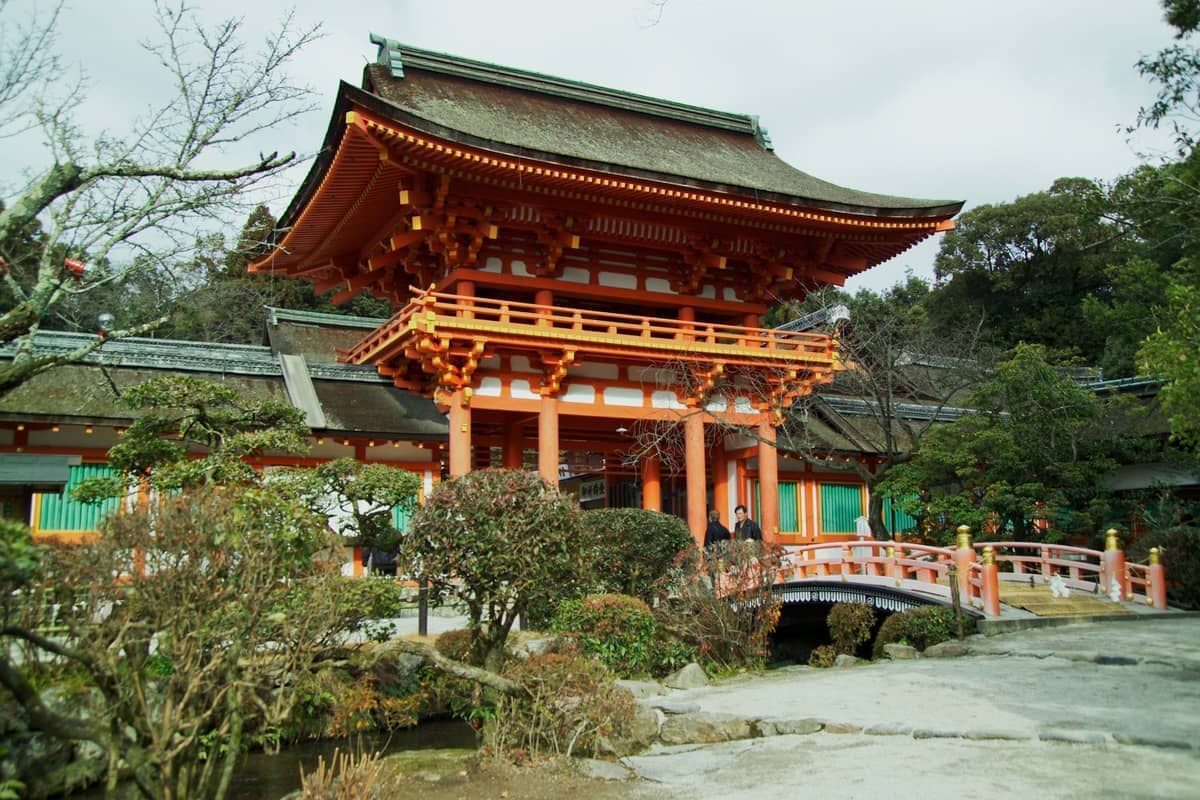
Passing through the Ninotorii, the atmosphere shifts. The gravel underfoot is finer, the trees older, and the sounds of the city disappear almost entirely. The inner precincts are organized around a series of gates and courtyards that progressively increase in sanctity. The Roumon gate, painted in the characteristic vermilion of Shinto shrine architecture, marks the boundary of the most protected area. Its opening hours are more restricted than the outer grounds: generally 8:30 to 16:00 on weekdays, with closing around 16:30 on weekends and holidays.
The main sanctuary and gonden sit behind this gate and are normally not open to casual viewing. To approach them closely, you can pay the special visit fee of ¥500, which grants access to the inner courtyard and a guided explanation of the sanctuary layout. The honden, dating to the early 17th century with the current structure, is a striking example of Nagare-zukuri architectural style, with characteristic sweeping curved rooflines extending over the front approach. The wood is aged and unpainted in sections, contrasting with the bright vermilion of the outer gates.
The inner Sakura-mon gate area (open April to October 8:00–17:00, November to March 8:30–17:00) provides additional context. Walking slowly through these graduated spaces, the sense of architectural depth becomes clear — each gate frames the next, drawing the eye inward in a compositional logic that is very deliberately constructed.
How the Experience Changes Through the Day
The shrine grounds open at 5:30 in the morning, and this is genuinely worth considering if you are an early riser. In the hour after dawn, the outer precincts are quiet enough that you can hear individual birds in the cedar trees. Local worshippers — often older residents — come to pray, clap twice, and leave without ceremony. The gravel crunches. There is no recorded music. The contrast with midday, when tour groups arrive and the approach fills with voices in several languages, is significant.
Midmorning, particularly on weekends, brings the largest crowds, though Kamigamo never reaches the compression levels of Kinkaku-ji or Fushimi Inari. Families come on Sundays; photography groups set up near the tatesuna. By 14:00 on weekdays, the precinct thins again noticeably.
The grounds are particularly atmospheric during the city's famous autumn color season, when the maple trees along the Nara stream turn orange and red. For full guidance on timing a Kyoto autumn visit, theKyoto in autumn guidehas month-by-month detail on foliage peaks across the city.
ℹ️ Good to know
Seasonal note: During the annual Aoi Matsuri festival in May, Kamigamo Shrine is one of the two endpoints of a procession that begins at Kyoto Imperial Palace. This is one of Kyoto's three major festivals, and the shrine takes on a very different, ceremonially charged atmosphere during this period. Verify exact dates before visiting.
The River, the Forest, and the Surrounding Area
One of Kamigamo's less-discussed qualities is what surrounds it. The narrow lanes east of the shrine, known as the Shake-machi district, were historically home to the shrine's hereditary attendant families. Some of these traditional earthen-walled machiya townhouses survive, giving the immediate neighbourhood a texture unlike anywhere else in Kyoto. A slow walk through these lanes before or after visiting the shrine adds genuine historical context.
The Kamo River, whose upper tributary runs through the precinct, continues south through the city. The area around Kamigamo is noticeably greener and calmer than the stretches of the river downtown. Bring something to sit on, and the riverside bank near the shrine is a pleasant place to decompress after the main visit, particularly in the warmer months when the water level is lower and the stones accessible.
The northern Kyoto area around Kamigamo is also within reach of Kyoto Botanical Gardens, which lies roughly 15–20 minutes south by bus. It makes a logical pairing for a full northern Kyoto day.Kyoto Botanical Gardens is particularly rewarding in spring and autumn.
Practical Walkthrough: Getting There and Around
Kamigamo Shrine sits in Kita-ku, Kyoto's northern ward — not on the main tourist circuit, which is both a feature and a logistical consideration. From Kyoto Station, the most straightforward approach is a Kyoto City Bus direct to the 'Kamigamo Jinja-mae' stop, which deposits you directly in front of the outer torii gate. Journey time from Kyoto Station varies with traffic but is typically around 30–50 minutes. Bus services also connect from Kitayama and Kitaoji subway stations, which reduces travel time from the city center.
For visitors arriving by car, the shrine has a parking lot open from 6:00 to 22:00 daily (paid parking, typically ¥100 per 30 minutes, with a flat ¥500 per visit during busy seasons). The path from the parking area to the main approach is level and paved, which is helpful for anyone with limited mobility. However, the inner precincts involve gravel surfaces and steps at the main gates, and full wheelchair access to the inner sanctuary area is not guaranteed. The outer grounds — including the tatesuna area and the approach alongside the stream — are accessible and worth visiting even without entering the inner precincts.
💡 Local tip
Wear flat, comfortable shoes. The main approach is raked gravel, which is uneven underfoot. In wet weather, gravel becomes slippery — the water drains slowly after rain. Traditional footwear like geta sandals, sometimes worn with rental kimono, is particularly challenging here.
If you are visiting Kamigamo as part of a wider temple and shrine itinerary across the city, thebest shrines in Kyoto guideprovides a prioritized overview of the city's top sacred sites with practical comparison notes. For understanding the customs and etiquette specific to Shinto shrine visits, theKyoto temple etiquette guide covers the essentials clearly.
Who Should Visit — and Who Might Not
Kamigamo Shrine rewards visitors who move slowly and notice small things: the sound of water in the inner garden, the particular way the aged wood of the sanctuary walls has weathered, the geometric precision of the tatesuna. It is not a place built around a single dramatic feature you can photograph and leave. If your priority is the most visually spectacular shrines in Kyoto, Fushimi Inari's thousands of torii gates will likely rank higher on your list.
Travelers who specifically enjoy Shinto architectural history, UNESCO heritage sites, or who want genuine quiet in the middle of a Kyoto itinerary will find Kamigamo one of the more satisfying stops in the city. It is also well-suited to those followinga budget-conscious Kyoto itinerary, since the outer grounds are entirely free to enter.
Visitors with very young children may find the long gravel approach and the lack of interactive elements frustrating. The shrine is peaceful precisely because it is understated — which is a disadvantage if you are traveling with anyone who needs more stimulation. The journey from central Kyoto is also real: 40 minutes by bus is not trivial if time is limited.
Insider Tips
- Arrive before 8:00 on a weekday morning to have the outer precincts almost entirely to yourself. The shrine opens its main area at 5:30, and the Roumon gate area comes alive with birdsong before the city noise intrudes.
- The special visit fee of ¥500 for the inner sanctuary is genuinely worth it if you have any interest in Shinto architecture. The honden's Nagare-zukuri roofline is a textbook example of the style, and you cannot see it properly without paying for entry to the inner courtyard.
- The Shake-machi lanes immediately east of the shrine — the former residential district of hereditary shrine attendants — contain some of the best-preserved traditional earthen-walled townhouse architecture in northern Kyoto. Very few visitors walk them. Allow 15–20 minutes to explore on foot.
- The Nara no Ogawa stream alongside the main approach is one of the most serene spots in the entire precinct. Stand on the small bridge and watch the water for a minute before continuing inside — the transition from gravel forecourt to the intimate scale of the stream is a genuine change of register.
- If you plan to visit during the Aoi Matsuri festival in May, arrive early and position yourself near the second torii gate for the procession arrival — this is where the ceremonial participants are most concentrated and the ritual atmosphere is strongest. Verify the exact date each year with the official shrine website.
Who Is Kamigamo Shrine For?
- History and heritage travelers who want depth over spectacle
- Photographers seeking early morning light and minimal crowds
- Budget travelers: the outer grounds are completely free
- Visitors looking for authentic Shinto atmosphere away from the tourist circuit
- Anyone combining a northern Kyoto day with Kyoto Botanical Gardens or the Kamo River
Nearby Attractions
Combine your visit with:
- Byodo-in Temple
Byodo-in Temple in Uji City is one of Japan's most photographed and historically significant Buddhist sites. Built in 1053, its Phoenix Hall appears on the 10-yen coin and draws visitors for its garden, gilded interior, and hilltop museum. A day trip from Kyoto that genuinely rewards the effort.
- Jingo-ji Temple (Takao)
Jingo-ji Temple rises from the forested slopes of Mount Takao in Kyoto's northwest corner, a 20-minute uphill walk from the nearest bus stop and a world away from the city's busiest temple districts. The site rewards the effort with ancient Buddhist halls, one of the finest autumn foliage settings in the Kansai region, and the curious ritual of hurling clay discs off a cliff into the Kiyotaki River gorge below.
- Katsura Imperial Villa
Katsura Imperial Villa is a 17th-century detached imperial palace in western Kyoto, considered the pinnacle of Japanese garden design and shoin-style architecture. Access is by guided tour only, with strict booking requirements — but for those who plan ahead, it is one of the most quietly extraordinary places in Japan.
- Kyoto Botanical Gardens
The Kyoto Botanical Gardens (京都府立植物園) in Sakyo Ward is Japan's oldest public botanical garden, covering formal garden beds, wide open lawns, and a large tropical conservatory. It draws both serious plant lovers and locals out for a quiet afternoon walk, and rewards visitors who time it right.