Katsura Imperial Villa (Katsura Rikyu): Japan's Most Refined Garden Estate
Katsura Imperial Villa is a 17th-century detached imperial palace in western Kyoto, considered the pinnacle of Japanese garden design and shoin-style architecture. Access is by guided tour only, with strict booking requirements — but for those who plan ahead, it is one of the most quietly extraordinary places in Japan.
Quick Facts
- Location
- Katsura Misono, Nishikyo-ku, Kyoto 615-8014
- Getting There
- Hankyu Katsura Station (East Exit), 20-min walk; or Kyoto City Bus to Katsura Rikyu-mae stop, 15-min walk
- Time Needed
- Approximately 1 hour (fixed guided tour route of about 1.2 km)
- Cost
- ¥1,000 adults (18+); free for ages 12–17; children under 12 not admitted
- Best for
- Architecture enthusiasts, garden lovers, Japanese cultural history
- Official website
- kyoto-gosho.kunaicho.go.jp/en/katsura-rikyu
What Is Katsura Imperial Villa?
Katsura Imperial Villa, known in Japanese as Katsura Rikyu (桂離宮), is a detached imperial palace and stroll garden located in the Nishikyo-ku ward of western Kyoto. Originally developed in the early 17th century as a retreat for the Hachijo-no-miya imperial family, it has been under the care of the Imperial Household Agency ever since and remains one of the most carefully preserved examples of classical Japanese design anywhere in the country.
Unlike the grand ceremonial spaces of Nijo Castle or the spiritual weight of Kyoto's temple circuit, Katsura exists in an entirely different register. It was designed for refined leisure: moon-viewing, tea ceremony, poetry, and the slow pleasures of walking a landscape that reveals itself gradually. Every path, stone, and planted tree serves a compositional purpose. Modernist architects including Walter Gropius and Bruno Taut famously studied Katsura in the 20th century, recognizing in it an aesthetic that felt almost contemporary in its restraint and precision.
⚠️ What to skip
Visits are by guided tour only. You must register in advance through the Imperial Household Agency's online portal. Same-day spots occasionally open up, but booking ahead is strongly recommended, especially for English-language tours.
The Garden: A Landscape Designed to Be Walked
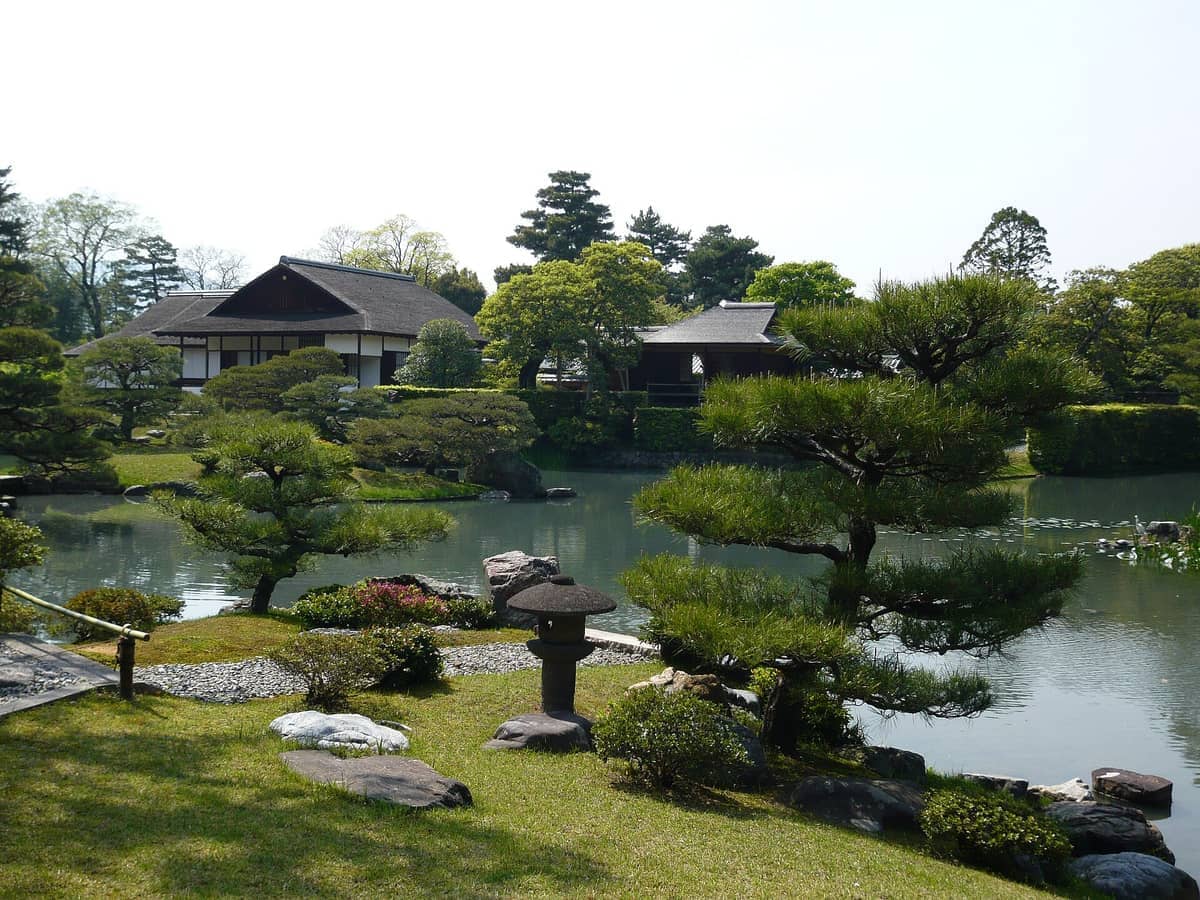
The heart of Katsura is its stroll garden, built around a central irregular pond edged with pine trees, stone lanterns, and carefully placed stepping stones. The design follows the kaiyushiki (回遊式) or 'stroll garden' principle: as you move along the prescribed circuit, the scenery shifts at each turn. A view of the Shoin pavilions reflected in still water gives way to a stone bridge over a narrow inlet, then a rustic tea house perched on a slope, then an opening to the pond's far shore framed by sculpted pines.
The garden covers roughly 70,000 square meters. Despite that scale, it never feels expansive in a grand European sense. The genius is compression: hills, islands, bridges, and planted areas create an illusion of depth and variety within a relatively contained space. The roji (dewy path) leading to each tea house is intentionally narrow and slightly uneven, slowing your pace and heightening attention to texture — the roughness of granite stepping stones, the cushion of moss between them, the faint sound of water.
Photography is permitted throughout the garden. The best light falls in the morning, when the pond surface is often calm and the low angle of sun creates long shadows across the stepping stones. By midday in summer, the contrast becomes harsh. Autumn visits between late October and mid-November bring the most visual drama, when the maples and Japanese zelkovas turn amber and red against the grey-green of the pines.
Tickets & tours
Hand-picked options from our booking partner. Prices are indicative; availability and final rates are confirmed when you complete your booking.
Kyoto Coast, Amanohashidate and Ine Bay 1-Day Trip from Osaka or Kyoto
From 46 €Instant confirmationFree cancellationKyoto Sanzen-in, Arashiyama and Bamboo Grove Full Day Tour
From 47 €Instant confirmationFree cancellationKyoto Arashiyama insider walking tour
From 66 €Instant confirmationFree cancellationMatcha green tea tour in Kyoto's Uji Market
From 130 €Instant confirmationFree cancellation
The Shoin Buildings: Architecture as Precision
The three main residential pavilions — Ko-shoin (Old Shoin), Chu-shoin (Middle Shoin), and Shin-goten (New Palace) — are arranged in a staggered formation along the western edge of the pond. This arrangement, sometimes described as resembling geese flying in formation, was deliberate: it allows each building to face the garden at a slightly different angle, maximizing views from within while breaking the visual mass from outside.
The construction is shoin-style, characterized by tatami floors, ranma transoms with geometric latticework, and fusuma sliding panels decorated with ink paintings. What strikes most visitors is the material honesty: there is no gold leaf, no lacquer excess, no statement grandeur. Cedar, bamboo, and washi paper do the work quietly. The proportions are calibrated so precisely that rooms feel simultaneously intimate and unconfined. Windows and shoji screens are positioned to frame garden views like paintings.
You will view the buildings from outside during the guided tour rather than entering their interiors. The guide points out specific architectural details — the irregular cut of a stone threshold, the way a post aligns with a distant pine — that would otherwise be easy to walk past. This is one reason the guided format, despite its constraints, genuinely adds value at Katsura.
How the Visit Works: Guided Tours Only
All visits to Katsura Imperial Villa are conducted as guided tours along a fixed route, managed by the Imperial Household Agency. There is no free-entry or self-guided option. The tour covers approximately 1.2 kilometers of the garden circuit and takes around one hour.
Japanese-language tours depart multiple times between 09:00 and 16:00, and English-language tours for foreign visitors are scheduled at set times such as 09:20, 11:20, 13:20, 15:20, and 16:20. Note that from October through February, some late-afternoon tours may not operate. The villa is closed on Mondays (with Tuesday closure if Monday falls on a public holiday) and from December 28 through January 4.
Admission is ¥1,000 per adult (age 18 and over). Visitors aged 12 to 17 enter free. Children under 12 are not admitted. Visitors with a disability certificate are exempt from the admission fee. Payment is typically made in cash (Japanese yen) on-site. Registration must be completed in advance through the Imperial Household Agency's portal — walk-ins are not guaranteed, and slots for English tours fill up faster than Japanese tours, particularly in cherry blossom and autumn foliage seasons.
💡 Local tip
Book English tours at least 2–3 weeks ahead during April, November, and Golden Week (late April to early May). The portal opens reservations three months in advance. If your preferred slot is full, check back closer to the date for cancellations.
Getting There and Practical Logistics
The most straightforward route from central Kyoto is the Hankyu Kyoto Line to Katsura Station, exiting from the East Exit. From there, it is approximately a 20-minute walk through a quiet residential area. The route is largely flat and well-signposted in both Japanese and English. Alternatively, from JR Kyoto Station you can take Kyoto City Bus or Keihan Kyoto Kotsu Bus to the Katsura Rikyu-mae stop, from which the villa is roughly a 15-minute walk.
Katsura sits in Nishikyo-ku, well west of the main tourist corridor. It is not conveniently combined in a single day with Higashiyama or central Kyoto without significant transit time. The most logical pairings are with Arashiyama to the north — both are accessible from Hankyu's western lines — or with Nishijin and the northern temple district if you are working through the western half of the city.
If you are planning a day in this part of Kyoto, the Tenryu-ji temple garden and the Arashiyama bamboo groveare both within 20–30 minutes by rail. Together they make a coherent western Kyoto itinerary.
Wear comfortable, closed-toe shoes. The tour route includes gravel paths, stone steps, and uneven terrain. High heels or sandals without grip are not suitable. The garden is exposed to the elements: bring an umbrella in rainy season (June and July), and dress in layers for morning tours in autumn and winter, when temperatures can drop sharply once you are standing still.
ℹ️ Good to know
Accessibility note: The fixed tour route includes gravel paths, steps, and uneven ground. The estate is not well-suited to wheelchair users or visitors with significant mobility limitations. Confirm current conditions with the Imperial Household Agency Kyoto Office before visiting.
When to Visit and What to Expect
The garden changes character with each season, and each has a legitimate claim on the best visit. Spring brings camellias and wisteria before the crowds fully arrive; late March and early April see the moss at its most vivid green after winter rains. Cherry blossoms are not the dominant feature here as they are at Maruyama Park or the Philosopher's Path, but a few trees near the Shoin buildings bloom quietly and without competition.
Autumn is the most popular season, and with reason. The combination of red maples reflecting in the central pond, the stone lanterns amid fallen leaves, and the subdued light of October and November afternoons makes this one of Kyoto's most atmosphericautumn foliage experiences. Book well ahead for this period.
Winter is underrated. Tour groups thin out considerably after the New Year closure, and the garden takes on a severe, stripped-back quality that suits its architectural ethos. On a clear February morning, the bare branches and grey-white gravel read as a near-monochrome composition. The 09:20 English tour in winter starts in cool, often mist-tinged air — bring a coat.
Summer visits are not recommended unless you have no other option. Kyoto's basin geography amplifies heat, and July and August afternoons in the garden are genuinely uncomfortable, with temperatures regularly exceeding 32°C and humidity adding to the difficulty. If you do visit in summer, take the 09:20 slot and finish before midday.
Is It Worth the Effort?
Katsura Imperial Villa requires advance planning in a way that most Kyoto attractions do not: you need to book online, arrive at a specific time, and surrender to a structured tour. For some visitors, that friction tips the calculation against it. If you are in Kyoto for two days and racing through a standard itinerary, this probably is not your priority.
But for visitors who care seriously about Japanese aesthetics, architecture, or garden design, Katsura is not comparable to anything else in the city. It operates at a different level of intentionality than most sites on the standardthree-day Kyoto itinerary. The tour format, though rigid, means you are never jostled by crowds and the guide genuinely improves comprehension. An hour here rewards careful attention in a way that a self-guided walk past a famous pagoda does not.
That said, visitors expecting visual spectacle may leave feeling underwhelmed. There is no golden pavilion moment, no sweeping panorama, no single photograph that communicates the whole. Katsura's quality is cumulative and quiet. It is a place for people who find subtlety satisfying rather than frustrating.
For context on how it fits within Kyoto's broader garden tradition, the contrast withRyoan-ji's dry rock garden or the lush moss landscape of Kokedera (the Moss Temple)is instructive — all three require advance planning, and together they represent the full range of classical Japanese garden philosophy.
Insider Tips
- The 09:20 English tour on a weekday in November gives you the autumn color at its peak with minimal competing groups. This is the single best slot of the year if you can arrange it.
- The Imperial Household Agency portal opens reservations three months ahead of the visit date. Set a reminder: popular English tour slots on autumn weekends fill within hours of opening.
- Bring cash. The on-site admission payment is typically cash-only in Japanese yen. There are no ATMs on the grounds, and the nearest convenience store is a walk away.
- The stepping stones across the garden's smaller channels are intentionally irregularly sized and spaced — this is a deliberate design technique to slow your pace and direct your gaze. Knowing this in advance helps you appreciate rather than just navigate them.
- During the tour, your guide will point out the 'borrowed scenery' (shakkei) technique used at certain points, where distant hills or trees outside the estate walls are visually incorporated into the garden composition. Look for this especially from the bridge over the main inlet.
Who Is Katsura Imperial Villa For?
- Architecture and design enthusiasts, particularly those with interest in modernist or minimalist aesthetics
- Travelers on a longer Kyoto itinerary (4 days or more) who have covered the main temple circuit
- Photographers seeking a less-crowded, more contemplative garden setting in autumn or spring
- Visitors interested in Japanese cultural history and the aesthetic principles of wabi and shibui
- Couples or small groups comfortable with a slower, more observational pace of sightseeing
Nearby Attractions
Combine your visit with:
- Byodo-in Temple
Byodo-in Temple in Uji City is one of Japan's most photographed and historically significant Buddhist sites. Built in 1053, its Phoenix Hall appears on the 10-yen coin and draws visitors for its garden, gilded interior, and hilltop museum. A day trip from Kyoto that genuinely rewards the effort.
- Jingo-ji Temple (Takao)
Jingo-ji Temple rises from the forested slopes of Mount Takao in Kyoto's northwest corner, a 20-minute uphill walk from the nearest bus stop and a world away from the city's busiest temple districts. The site rewards the effort with ancient Buddhist halls, one of the finest autumn foliage settings in the Kansai region, and the curious ritual of hurling clay discs off a cliff into the Kiyotaki River gorge below.
- Kamigamo Shrine
Kamigamo Shrine, formally known as Kamo Wakeikazuchi Jinja, is one of Kyoto's oldest Shinto shrines and part of the UNESCO World Heritage Site 'Historic Monuments of Ancient Kyoto.' Set in the quiet northern reaches of the city, its wide gravel forecourt, twin sand cones, and cedar-forested riverbank create an atmosphere that feels genuinely removed from the tourist circuit.
- Kyoto Botanical Gardens
The Kyoto Botanical Gardens (京都府立植物園) in Sakyo Ward is Japan's oldest public botanical garden, covering formal garden beds, wide open lawns, and a large tropical conservatory. It draws both serious plant lovers and locals out for a quiet afternoon walk, and rewards visitors who time it right.