Tenryu-ji Temple: Arashiyama's Landmark Zen Garden and UNESCO Heritage Site
Tenryu-ji is Arashiyama's most significant temple, a UNESCO World Heritage site anchored by a 14th-century Zen garden attributed to master Musō Soseki. The Sogenchi garden, its celebrated dragon ceiling painting, and its mountain backdrop make it one of Kyoto's most photogenic and historically grounded stops.
Quick Facts
- Location
- 68 Susukinobaba-cho, Saga Tenryu-ji, Ukyo-ku, Kyoto 616-8385 (Arashiyama district)
- Getting There
- JR Saga-Arashiyama Station (13-min walk) or Hankyu Arashiyama Station (15-min walk)
- Time Needed
- 1.5 to 2.5 hours for garden, halls, and Hatto; longer if combining with surrounding Arashiyama area
- Cost
- Garden ¥500 (adults); +¥300 for temple buildings; +¥500 for Unryu-zu dragon painting (weekends/holidays/select periods only)
- Best for
- Garden photography, Zen history, autumn foliage, spring cherry blossoms, architecture enthusiasts
- Official website
- www.tenryuji.com/en
What Tenryu-ji Actually Is
Tenryu-ji Temple is the head temple of the Tenryu branch of Rinzai Zen Buddhism and the highest-ranked of Kyoto's famous Five Mountain (Gozan) temple system. Founded in the Muromachi period, it was established by shogun Ashikaga Takauji in 1339 to honor the spirit of Emperor Go-Daigo. The garden was designed by Zen monk and landscape artist Musō Soseki, who is widely regarded as one of Japan's most influential garden designers. That garden, known as Sogenchi, has survived in essentially its original layout for nearly seven centuries, which is remarkable given the temple buildings themselves have burned down and been rebuilt multiple times over the years.
In 1994, Tenryu-ji was inscribed as part of the Historic Monuments of Ancient Kyoto UNESCO World Heritage Site. That designation is not decorative. The Sogenchi garden is considered a primary reason for the inscription, recognized internationally as a masterwork of spatial design that uses borrowed scenery from the surrounding Arashiyama hills to extend the composition far beyond the garden's physical boundaries.
ℹ️ Good to know
Admission is split into three separate fees: the garden alone (¥500 adults), the main temple halls including Daihojo and Shoin (additional ¥300), and the Hatto dragon ceiling painting (additional ¥500, available on weekends, national holidays, and certain spring/autumn periods). Budget around ¥1,300 if you plan to see everything.
The Sogenchi Garden: What You Are Looking At
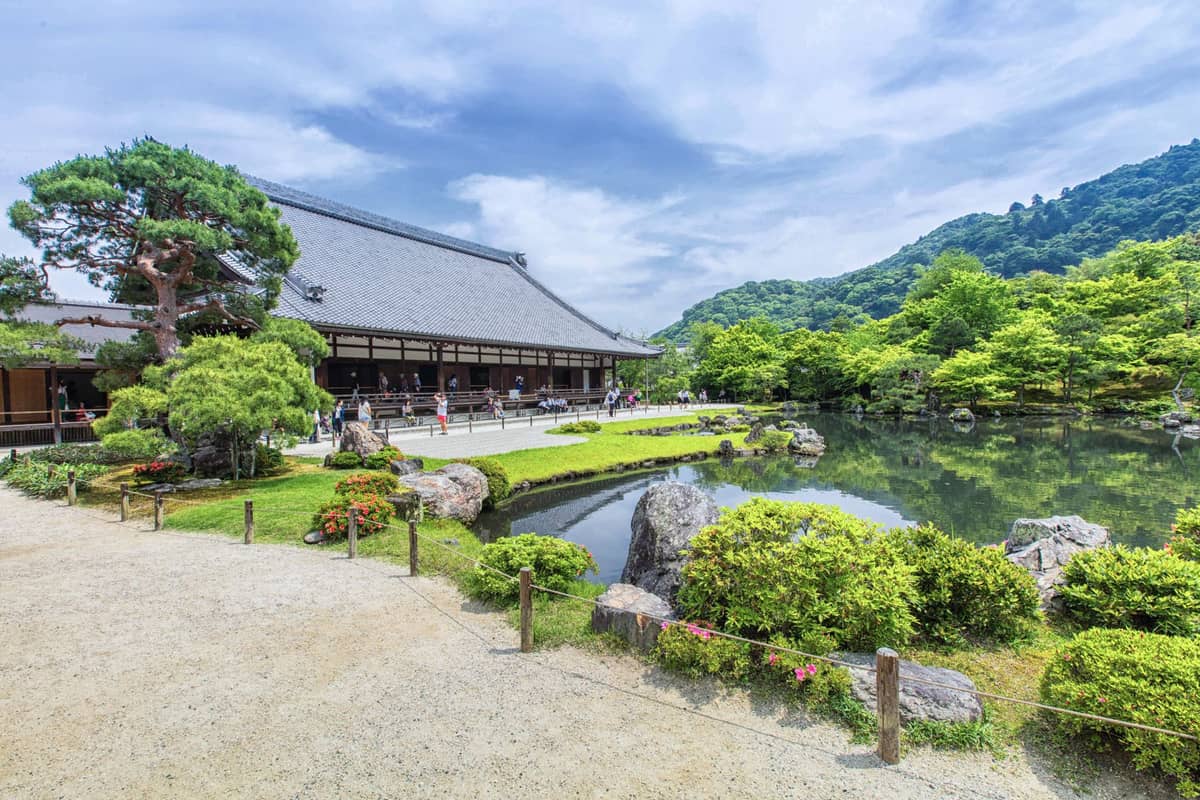
The Sogenchi garden centers on a large pond fed by springs, with carefully placed stones, clipped shrubs, and a forested hillside rising behind it. What distinguishes it from most Japanese gardens is the shakkei technique: the designer intentionally framed Arashiyama mountain and the ridgeline of Mount Kameyama as the background, so the garden's visual depth extends into the hills without enclosing them. The result is a composition that feels expansive even in a relatively compact space.
Walking the gravel path counterclockwise around the pond, you pass through zones that shift in character. Near the south side, large flat stones jut into the water, and the reflections of cherry trees or maples dominate depending on season. Moving north, the planting becomes denser, with mossy ground cover and bamboo beginning to encroach. From the northeast corner, the full panorama of pond, pavilion, and mountain opens up, and this is where most photographers stop.
The Hyakkaen, a secondary garden section featuring seasonal flowers, sits adjacent and is included in the same admission. It is quieter and less photographed, worth the few extra minutes even if it lacks the drama of the main pond.
Tickets & tours
Hand-picked options from our booking partner. Prices are indicative; availability and final rates are confirmed when you complete your booking.
Kyoto Coast, Amanohashidate and Ine Bay 1-Day Trip from Osaka or Kyoto
From 46 €Instant confirmationFree cancellationKyoto Sanzen-in, Arashiyama and Bamboo Grove Full Day Tour
From 47 €Instant confirmationFree cancellationKyoto Arashiyama insider walking tour
From 66 €Instant confirmationFree cancellationMatcha green tea tour in Kyoto's Uji Market
From 130 €Instant confirmationFree cancellation
How the Experience Changes by Time of Day and Season
Arriving at opening (8:30) makes a genuine difference. The garden light is soft from the east, the gravel paths are freshly raked, and the tour groups that arrive by 9:30 from Kyoto Station have not yet appeared. In that first hour, the garden is almost silent except for the sound of water from the spring-fed streams and the occasional carp breaking the surface of the pond.
By mid-morning the garden fills noticeably, and by 11:00 it can feel congested at the main photography spots on the northeast side of the pond. Crowds thin again after 15:00 as day-trippers move on toward the bamboo grove or head back to central Kyoto. Late afternoon in spring or autumn, when the angle of light warms the garden's colors and the mountain backdrop deepens, is arguably the most rewarding time visually.
Seasonally, spring cherry blossoms (typically late March to early April) draw very large crowds. The same is true for autumn foliage, which peaks roughly in mid to late November. If you are planning around either of these periods, theKyoto cherry blossom guide and the autumn in Kyoto guideprovide current timing information. The garden is genuinely at its most photogenic in both seasons, but expect the experience to be a shared one.
Summer visits are not widely recommended but are not without merit. The garden is deeply green, the moss is lush, and the crowds are somewhat thinner than in peak seasons. The downside is Kyoto's basin humidity, which in July and August makes the walk uncomfortable by late morning. Bring water, go early, and wear light clothing.
The Hatto and the Unryu-zu Ceiling Dragon
The Hatto, or Law Hall, contains the famous Unryu-zu, a large-format ink painting of a dragon on the ceiling, created by artist Kayama Matsuō. It is visually striking: the dragon fills the circular ceiling panel, and when you stand directly beneath it, the eyes appear to follow you regardless of where you position yourself in the room. This is a deliberate compositional effect rather than supernatural mechanics, but it works convincingly.
The Hatto is only open to visitors on weekends, national holidays, and certain extended periods during spring and autumn. Admission is ¥500 collected separately at the hall entrance. Photography of the ceiling dragon is not permitted inside. The experience itself takes around 10 to 15 minutes but tends to linger in memory longer than many more photographed attractions.
💡 Local tip
Check the temple's official website before your visit to confirm whether the Hatto is open on your date. The hours are 9:00–16:30, and access is not guaranteed on weekdays outside special seasonal periods.
Getting There and Practical Logistics
The most convenient access from central Kyoto is the JR Sagano Line to JR Saga-Arashiyama Station, which puts you roughly a 13-minute walk from the temple's main gate on the north side. The Hankyu Arashiyama Station is also an option and requires about a 15-minute walk, passing through the main commercial stretch of the Arashiyama area.
Arashiyama is a self-contained district with enough to fill a full day: thebamboo grove is immediately north of the temple grounds, and the Togetsukyo Bridgeis a short walk south along the river. Many visitors combine Tenryu-ji with aHozu River boat ride or the Sagano Scenic Railwayto make a full half-day or full-day loop of the western Kyoto hills.
The temple gates have multiple entrances. The north gate (Kitamon) leads directly toward the bamboo grove and is the preferred exit if you plan to walk through it afterward. The main entrance (Chokushimon) on the south side faces the main road and the Arashiyama area. Using different gates for entry and exit is permitted and makes logical sense if you are combining the bamboo grove with your visit.
Accessibility within the garden is partially manageable: the main pond loop uses gravel paths with gentle grades, but some sections have steps and uneven stone surfaces that present challenges for wheelchairs or strollers. The Daihojo temple hall interiors require removing footwear, which is standard at Kyoto temples.
Opening Hours and Admission Summary
- Garden hours: generally 8:30–17:00 (last admission 16:50); extended to 17:30 (last admission 17:20) from approximately March 21 to October 20
- Garden admission: ¥500 adults, ¥300 elementary/junior high school students, free for preschool children
- Temple buildings (Daihojo, Shoin, Tahoto): additional ¥300 on top of garden admission
- Hatto (Unryu-zu dragon ceiling): ¥500 additional, open 9:00–16:30 (last admission 16:20) on weekends, national holidays, and selected spring/autumn periods
- Verify current hours and fees at the official website before visiting, as seasonal adjustments apply
⚠️ What to skip
The Arashiyama area becomes extremely crowded during cherry blossom season (late March to early April) and autumn foliage season (mid to late November). Arriving on a weekday and reaching the temple before 9:00 is the single most effective way to avoid the worst congestion.
Is Tenryu-ji Worth It? An Honest Assessment
For visitors with genuine interest in Japanese garden design, Zen architecture, or Muromachi period history, Tenryu-ji is one of the most rewarding temple experiences in Kyoto. The Sogenchi garden has a quality of calm and compositional intelligence that holds up even under examination from someone who has seen many gardens. It rewards slow walking and pausing rather than moving quickly through.
That said, some visitors find it less immediately striking than Ryoan-ji's famous rock garden or Kinkaku-ji's golden pavilion because it requires a certain patience and visual literacy to fully appreciate. If you are short on time or find gardens broadly similar to one another, the garden portion alone (at ¥500) is a fair trade, but the full experience including the Hatto dragon and the temple halls offers considerably more depth.
Visitors who are temple-fatigued after multiple days in Kyoto may find Tenryu-ji more rewarding when paired with the outdoor walk through the bamboo grove and down toward the Katsura River rather than as a standalone stop. For broader planning, the3-day Kyoto itinerary includes logical sequencing for the Arashiyama area.
Insider Tips
- Exit through the Kitamon (north gate) after visiting the garden to walk directly into the bamboo grove without backtracking. The grove is at its quietest in the first 30 minutes after 8:30 opening, before tour buses unload.
- The northeast corner of the Sogenchi pond, beside the small stone bridge, is where the mountain backdrop lines up most cleanly with the pond reflection. Position yourself low to the water level for the strongest composition.
- If you visit on a weekday and the Hatto is closed, the Daihojo halls often have seasonal flower arrangements and painted sliding screens (fusuma) that receive far less attention than the dragon painting but are genuinely fine examples of Edo-period decorative art.
- The Hyakkaen garden section adjacent to the main Sogenchi pond is included in admission but skipped by most visitors. In late May it has wisteria, and in early November the maple color here reaches its peak a few days before the main garden's trees.
- Luggage storage is not available at the temple. Leave bags at coin lockers at JR Saga-Arashiyama Station before entering, especially if you plan to continue walking toward the monkey park or river afterward.
Who Is Tenryu-ji Temple For?
- Garden and landscape design enthusiasts who want to study shakkei (borrowed scenery) technique in one of its finest examples
- Photographers working in the early morning, particularly during spring and autumn when the light and foliage color are at their best
- History-focused travelers interested in Muromachi period Zen culture and the political circumstances that shaped the temple's founding
- Visitors combining a full Arashiyama day: the temple works logically as a starting anchor before walking north through the bamboo grove
- Travelers seeking a relatively complete cultural experience at a single site, where garden, architectural interiors, and a major artwork (the Unryu-zu) are accessible in one visit
Nearby Attractions
Other things to see while in Arashiyama:
- Arashiyama Bamboo Grove
The Arashiyama Bamboo Grove is one of Kyoto's most photographed spots, a 400-meter corridor of towering Moso bamboo in the Sagano district. Free to enter at any hour, it rewards early risers with near-solitude and punishes late arrivals with wall-to-wall crowds. Here is what to know before you go.
- Arashiyama Monkey Park Iwatayama
Arashiyama Monkey Park Iwatayama puts you face-to-face with free-roaming Japanese macaques on a forested hillside above the Katsura River. Reach the summit after a 20-minute uphill hike and you get two things at once: snow monkeys living on their own terms, and one of the broadest open views over Kyoto's western basin.
- Hozu River Boat Ride
The Hozu River Boat Ride carries passengers 16 kilometres downstream from Kameoka through a narrow forested gorge, ending in Arashiyama. It's one of the few ways to see this stretch of Kyoto's western mountains from water level, on traditional wooden craft steered by experienced boatmen.
- Kokedera (Saihoji Moss Temple)
Saihoji Temple, known as Kokedera or the Moss Temple, is one of Kyoto's most quietly extraordinary places. Entry requires advance reservation and participation in a brief sutra-copying ceremony, which means the garden is never overwhelmed with visitors. What you find inside is a carpet of over 120 moss species covering the ground beneath ancient maples and cedars, all part of a UNESCO World Heritage Zen garden dating to the 14th century.