Togetsukyo Bridge: Arashiyama's Most Iconic Crossing
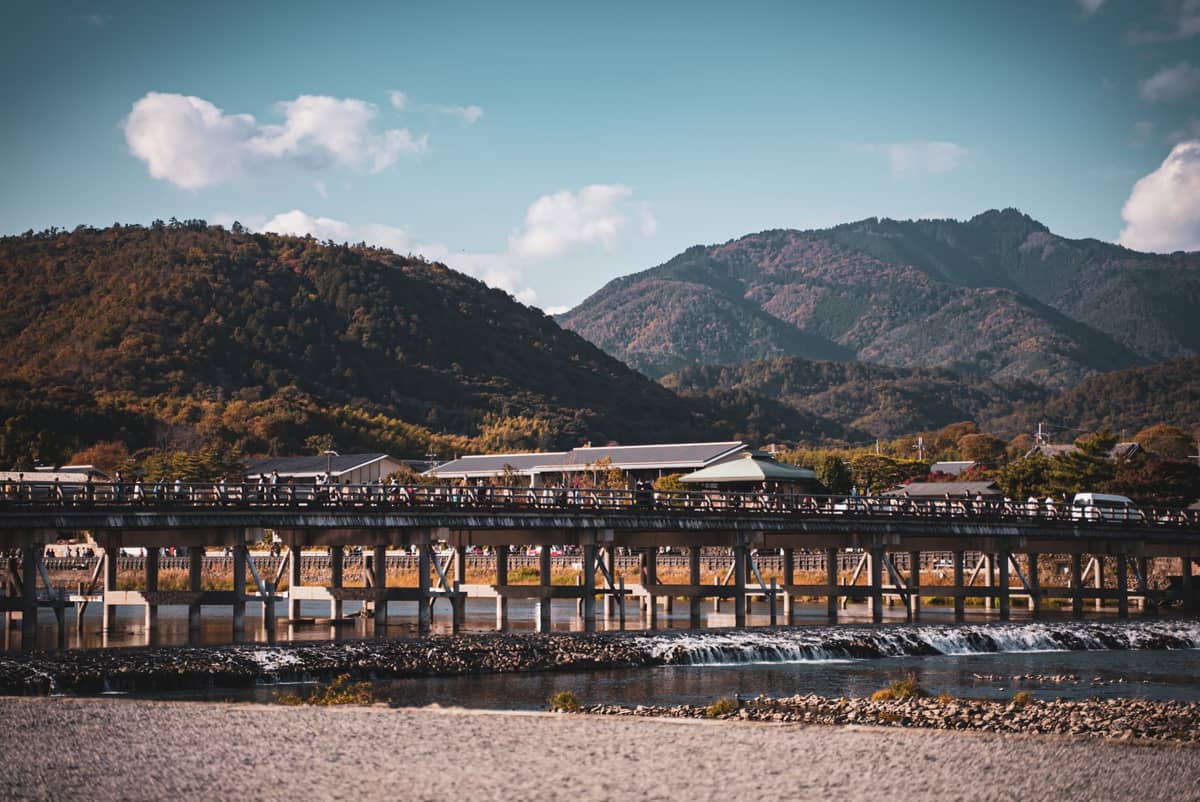
Stretching 155 metres across the Oi River in western Kyoto, Togetsukyo Bridge is the visual anchor of the Arashiyama district. Free to cross at any hour, it offers some of the city's most recognisable scenery, framed by forested mountains that turn copper and gold each November.
Quick Facts
- Location
- Saga Nakanoshima-cho, Ukyo-ku, Kyoto City (Nakanoshima area in Arashiyama)
- Getting There
- Keifuku Arashiyama Station (2–4 min walk); Hankyu Arashiyama Station (5–8 min); JR Saga-Arashiyama Station (10–15 min)
- Time Needed
- 15–30 minutes to cross and take in the views; allow 2–3 hours for the wider Arashiyama area
- Cost
- Free — open 24 hours, no admission gate or ticketing
- Best for
- Autumn foliage views, riverside photography, early-morning walks, and orienting yourself in Arashiyama
What Is Togetsukyo Bridge?
Togetsukyo Bridge, written in Japanese as 渡月橋 and formally romanised as Togetsukyō Bridge, is a 155-metre-long, 11-metre-wide wooden-railed bridge spanning the Oi River in Arashiyama, on the western edge of Kyoto. The name translates roughly as 'Moon Crossing Bridge', a poetic reference attributed to the Heian-era Emperor Kameyama, who reportedly watched the moon appear to glide across the bridge from the northern bank. That detail alone tells you something about the aesthetic weight this crossing carries in Japanese cultural memory.
The current structure dates to 1934, though bridges have existed at or near this location since at least the Heian period. It is not an ancient artefact so much as a carefully maintained symbol, rebuilt as a reinforced-concrete bridge for flood resilience while preserving the traditional wooden-railed silhouette that makes it so photogenic. Cross it on foot in under five minutes, but understanding what surrounds it takes a little longer.
ℹ️ Good to know
The bridge is a public road and is open 24 hours a day, free of charge. There are no ticket booths, no queues to enter, and no closing time.
The Experience: What It Actually Feels Like
Standing on the bridge on a clear morning, before the tour groups arrive, the scene is quietly spectacular. The Oi River runs wide and shallow below, its greenish current audible if the wind is low. On the northern bank, the forested slopes of Arashiyama and Ogura-yama rise steeply, their tree line meeting the sky without a single building to interrupt it. The air carries the faint smell of river water and damp stone. Cormorants often perch on the rocks midstream. It is the kind of view that feels composed, as though someone designed it for exactly the angle you are standing at.
By mid-morning on a weekend, the mood shifts. Rickshaw pullers in happi coats jog across the bridge with passengers in tow, tour group leaders hold up numbered flags, and the footpath along the southern bank fills with visitors moving between snack stalls selling matcha soft-serve and grilled skewers. The bridge itself is wide enough to accommodate all of this without feeling dangerous, but the contemplative quality of early morning is entirely gone. This is worth knowing before you plan your visit.
Late afternoon brings a different light. In autumn especially, the low western sun catches the hillside foliage at a warm, raking angle, turning the reds and oranges almost luminous. The water reflects it. This is peak photographic time, and it shows in the crowds on the bridge railing, phones pointed upstream. If you want a clean shot without strangers in frame, you will need to work for it.
Tickets & tours
Hand-picked options from our booking partner. Prices are indicative; availability and final rates are confirmed when you complete your booking.
Kyoto Coast, Amanohashidate and Ine Bay 1-Day Trip from Osaka or Kyoto
From 46 €Instant confirmationFree cancellationKyoto Sanzen-in, Arashiyama and Bamboo Grove Full Day Tour
From 47 €Instant confirmationFree cancellationKyoto Arashiyama insider walking tour
From 66 €Instant confirmationFree cancellationMatcha green tea tour in Kyoto's Uji Market
From 130 €Instant confirmationFree cancellation
Historical and Cultural Context
Arashiyama has been a retreat for Kyoto's aristocracy since the Heian period (794–1185 CE), when the ruling court would travel west to admire the mountain scenery and the seasonal changes of the Oi River valley. The area's cultural prestige is reflected in the density of significant sites along its banks: Tenryu-ji, a UNESCO World Heritage Site, sits within a few minutes' walk north of the bridge, and the bamboo grove that draws enormous crowds begins immediately behind the temple.
The bridge sits at the effective centre of this heritage landscape. It connects the main commercial strip on the southern bank to the quieter northern bank, where the foothills begin and the walking paths thin out. Understanding this geography is useful: most day-trippers stay south of the bridge, near the souvenir shops and restaurants. Cross to the north and you immediately enter a different, calmer register. This contrast is what makes Togetsukyo Bridge more than a photo stop — it is a functional threshold between the commercial and the contemplative sides ofArashiyama.
Seasonal Highlights: When the Bridge Transforms
Autumn (Mid-November)
Togetsukyo Bridge in autumn is the image most people have seen before they ever visit Kyoto — the bridge arcing across the river, red maples blazing on the hillside behind it. That view is real, and it does not disappoint, but the crowds are intense. Mid-November through early December brings some of the highest visitor numbers in Arashiyama all year. On peak autumn weekends, the bridge walkway itself can become slow-moving. Arrive before 8 a.m. for the view without the compression.
If autumn colour is your primary goal, Arashiyama is worth pairing with other foliage sites across the city.Kyoto's autumn seasontypically peaks at different times in different neighbourhoods, so a well-planned itinerary can string together multiple moments of colour across several days.
Cherry Blossom Season (Late March to Early April)
Spring brings a different palette. The hillsides turn pink with cherry blossoms, and the bridge is frequently photographed with flowering branches visible above the rooflines of the riverside restaurants. Crowds rival autumn in intensity.Cherry blossom timing in Kyotovaries year to year, so check bloom forecasts before building an itinerary around it.
Summer and Winter
Summer (July through late September) brings cormorant fishing displays on the river at night, a traditional practice called ukai that has roots going back centuries. The surrounding hills are deep green, and the evening light on the water can be beautiful, but humidity at this time of year is aggressive — temperatures regularly exceed 32°C with high moisture. Bring water, dress lightly, and treat midday visits as brief.
Winter is genuinely underrated here. On cold clear mornings, mist rises off the Oi River and drifts around the forested slopes in ways that feel almost staged. Visitor numbers drop sharply after December's foliage season ends, meaning you can stand at the railing for minutes at a time without anyone standing next to you. If occasional snowfall dusts the hills, the view becomes extraordinary. Pack warm layers — wind funnels along the river.
How to Get There and Where to Start
The most convenient approach is via the Keifuku Randen tram line, which terminates at Arashiyama Station, about a two- to four-minute walk from the bridge's southern end. This is the most atmospheric arrival: the tram is small, single-car, and passes through residential streets before depositing you directly into the heart of the Arashiyama strip. Hankyu Arashiyama Station is slightly further, around 5 to 8 minutes on foot, and connects to central Kyoto via Katsura. JR Saga-Arashiyama Station on the San-in Line is around 10 to 15 minutes away on foot but gives direct rail access from Kyoto Station in about 15 minutes.
If you are planning to see multiple sites in the area in a single day, read through theKyoto transport guidebefore you go. The combination of train lines serving Arashiyama is not immediately intuitive, and choosing the right one can save significant time.
💡 Local tip
Arrive via Keifuku Arashiyama Station for the most convenient and characterful approach. The station is approximately two minutes from the bridge on foot, and the surrounding street fills with food stalls and small shops as you walk toward the river.
Photography: Getting the Shot
The classic view of Togetsukyo Bridge is taken from the southern riverbank, looking upstream (east-northeast) toward the bridge with the forested hills behind it. This is accessible from the gravel riverside path that runs along the south bank, west of the bridge. In autumn, the hill behind serves as a natural backdrop of colour. In spring, cherry trees along the bank frame the left side of the shot.
A less common but worthwhile angle is from the northern bank, looking back across the bridge toward the southern commercial area. At dusk, this gives you the bridge silhouetted against a warm western sky. For elevated views of the whole scene, the hillside walking trails on the northern bank gain height quickly and offer the bridge in context with the full river bend.
⚠️ What to skip
During peak autumn and cherry blossom seasons, the bridge walkway itself becomes crowded enough that wide-angle shots often include many other visitors. Early morning (before 8 a.m.) dramatically improves your chances of cleaner shots. Tripods on the bridge surface are not practical during busy periods.
Practical Details and Accessibility
The bridge surface is paved and flat, making it generally walkable with pushchairs and manageable for most mobility levels. There are no steps to navigate on the bridge itself. The approach streets on both banks are mostly level, though the riverside gravel path on the south side can be uneven in places. No wheelchair-specific facilities were confirmed at the bridge, so those with specific accessibility needs should consider conditions before planning.
There are public toilets in the Arashiyama area, including near the Keifuku station end of the shopping street and in the parking area near the south bank. Dining options are plentiful along the south bank: the street running parallel to the river has everything from quick street food to more formal kaiseki lunch spots. If you are planning to combine the bridge with a meal in Arashiyama, booking ahead is advisable during autumn and spring peak weeks.
The bridge works best as part of a longer Arashiyama visit rather than a standalone destination. Within easy walking distance, you can reach theArashiyama Bamboo Grove, Tenryu-ji's garden, and the Hozu River boat ride departure point. The Sagano Scenic Railwaystation is also nearby for those who want to extend the day further into the valley.
Who Should Skip It
If you are visiting Kyoto primarily for interior cultural experiences, traditional architecture, or temple garden design, Togetsukyo Bridge on its own will likely feel underwhelming. It is a bridge, outdoors, free, and requires nothing of you. It carries enormous symbolic weight in Japanese culture and seasonal beauty in the right conditions, but if you arrive at midday in summer with no awareness of the surrounding landscape, it can feel like a short walk across unremarkable water.
Visitors with limited time who have to choose between standing on the bridge for ten minutes or spending that time inside Tenryu-ji's garden or the bamboo grove should probably choose one of those. The bridge is most rewarding when you slow down beside the river rather than simply crossing it and moving on.
Insider Tips
- Weekday mornings before 8 a.m. are categorically different from weekend midday visits. The bridge, the riverside path, and the surrounding lanes are quiet enough that you can hear the river. If your schedule allows any flexibility, protect that morning window.
- The northern bank of the Oi River, once you cross the bridge, offers a rapid escape from the crowds. The hillside walking paths gain elevation quickly and within about 10 to 15 minutes of uphill walking you are above the commercial noise entirely, looking down on the river bend.
- For autumn foliage, the hillside directly behind the bridge (Arashiyama-yama) typically peaks slightly earlier than some of the city's eastern temple districts. Check locally posted or app-based foliage forecasts specific to Arashiyama rather than general Kyoto reports.
- The riverside south of the bridge, toward the Nakanoshima area, is less photographed and less crowded than the main commercial strip. Small wooden boats are sometimes moored there, and the relative quiet makes it a better spot to actually sit and absorb the landscape.
- Cormorant fishing (ukai) on the Oi River traditionally takes place during summer evenings. The season and scheduling of these events should be confirmed locally before planning a visit around them, as operational dates vary.
Who Is Togetsukyo Bridge For?
- Photographers targeting Kyoto's most iconic seasonal views in autumn or spring
- First-time visitors to Arashiyama wanting to orient themselves before exploring the wider district
- Travellers who enjoy slow, riverside walks and want to escape central Kyoto's denser streets
- Winter visitors looking for atmospheric, crowd-free scenery with the possibility of mist or light snow
- Anyone combining Arashiyama's main sights into a half-day or full-day itinerary
Nearby Attractions
Other things to see while in Arashiyama:
- Arashiyama Bamboo Grove
The Arashiyama Bamboo Grove is one of Kyoto's most photographed spots, a 400-meter corridor of towering Moso bamboo in the Sagano district. Free to enter at any hour, it rewards early risers with near-solitude and punishes late arrivals with wall-to-wall crowds. Here is what to know before you go.
- Arashiyama Monkey Park Iwatayama
Arashiyama Monkey Park Iwatayama puts you face-to-face with free-roaming Japanese macaques on a forested hillside above the Katsura River. Reach the summit after a 20-minute uphill hike and you get two things at once: snow monkeys living on their own terms, and one of the broadest open views over Kyoto's western basin.
- Hozu River Boat Ride
The Hozu River Boat Ride carries passengers 16 kilometres downstream from Kameoka through a narrow forested gorge, ending in Arashiyama. It's one of the few ways to see this stretch of Kyoto's western mountains from water level, on traditional wooden craft steered by experienced boatmen.
- Kokedera (Saihoji Moss Temple)
Saihoji Temple, known as Kokedera or the Moss Temple, is one of Kyoto's most quietly extraordinary places. Entry requires advance reservation and participation in a brief sutra-copying ceremony, which means the garden is never overwhelmed with visitors. What you find inside is a carpet of over 120 moss species covering the ground beneath ancient maples and cedars, all part of a UNESCO World Heritage Zen garden dating to the 14th century.