Sagano Scenic Railway: What to Expect on Kyoto's Romantic Train Ride
The Sagano Scenic Railway, known informally as the Sagano Romantic Train, carries passengers through 7.3 km of forested gorge along the Hozu River between Arashiyama and Kameoka. It is one of the few ways to see this stretch of river valley at a slow enough pace to actually take it in.
Quick Facts
- Location
- Saga Torokko Station, Saga Tenryuji Kuruma-michi-cho, Ukyo-ku, Kyoto — adjacent to JR Saga-Arashiyama Station
- Getting There
- Take the JR Sagano Line to Saga-Arashiyama Station; Saga Torokko Station is immediately adjacent. From Kyoto Station, about 15 minutes by JR.
- Time Needed
- About 25 minutes one way; allow 2–3 hours total if combining with Arashiyama sightseeing
- Cost
- Adult: ¥880 / Child: ¥440 (one way, on-the-day tickets — verify current fares before visiting)
- Best for
- Autumn foliage, spring greenery, scenic photography, couples, families, slow-travel enthusiasts
- Official website
- www.sagano-kanko.co.jp/en
What the Sagano Scenic Railway Actually Is
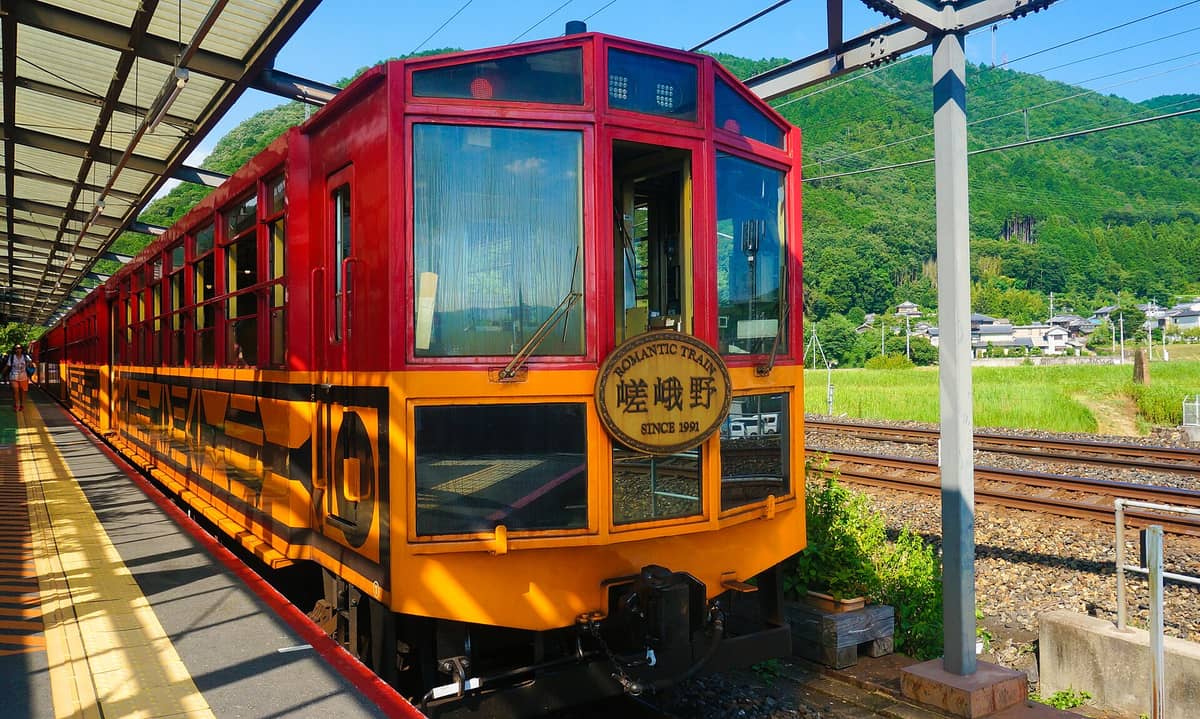
The Sagano Scenic Railway is a 7.3 km sightseeing line that runs open-sided torokko (trolley) cars through the Hozu River gorge, connecting Torokko Saga Station in Arashiyama with Torokko Kameoka Station on the far side of the mountains. The company, Sagano Scenic Railway Co., Ltd., was established in 1989 and operates over a section of the former JR San'in Main Line alignment — track that was bypassed when the modern Sagano Line tunnel opened and repurposed specifically for scenic tourism.
The train itself consists of small, partially open carriages. Some cars have mesh screens in place of full windows; in autumn and spring, the operator sometimes runs a fully open car at the rear called the "Happy Ride" car, with bench seating and completely open sides. It smells like river air and pine, and the sound of the Hozu River — which runs directly below the tracks for much of the route — is audible throughout the journey.
The line sits within the broader Arashiyama district, one of western Kyoto's most visited areas, and pairs naturally with a walk through the bamboo grove or a visit to Tenryu-ji. But the gorge itself — steep forested walls dropping to white water below — is a landscape that the surrounding tourist district cannot prepare you for. It is noticeably wilder than anything you see from the main Arashiyama streets.
⚠️ What to skip
The line is generally closed on Wednesdays, except during peak spring and autumn periods and public holidays. It also closes seasonally from late December through the end of February. Always check the official schedule before building your day around this ride.
The Route: Four Stations, One Gorge
There are four stations along the route: Torokko Saga, Torokko Arashiyama, Torokko Hozukyo, and Torokko Kameoka. Most visitors board at Torokko Saga, which sits right next to JR Saga-Arashiyama Station and is the easiest to reach by public transport. From here, trains depart roughly every hour, typically starting at 09:07 and running through to around 16:07.
Torokko Arashiyama is the second stop and sits near the base of the main Arashiyama tourist area, close to the monkey park trailhead. Some visitors choose to board here rather than at the main terminus, which saves a short walk but tends to offer fewer seating options. Torokko Hozukyo is the most dramatic intermediate stop, positioned right above the gorge with views directly down to the river below. The station is unmanned and accessible only via about 60 steps, so it is not suitable for visitors with mobility constraints.
Torokko Kameoka is the western terminus. It is not a particularly interesting destination in itself — so most visitors either return by the same train or arrange onward transport back to Kyoto via the Sagano Line from nearby Kameoka Station. Some combine the train with a Hozu River boat ride back downstream to Arashiyama, which makes for a full half-day loop along the gorge from two different vantage points.
The Hozu River boat ridedeparts from Kameoka and takes roughly two hours to reach Arashiyama, navigating the same gorge the train passes over. The combination of train one way and boat the other is arguably the best way to experience the gorge fully, though it requires advance planning and budget for both tickets.
Tickets & tours
Hand-picked options from our booking partner. Prices are indicative; availability and final rates are confirmed when you complete your booking.
Kyoto Coast, Amanohashidate and Ine Bay 1-Day Trip from Osaka or Kyoto
From 46 €Instant confirmationFree cancellationKyoto Sanzen-in, Arashiyama and Bamboo Grove Full Day Tour
From 47 €Instant confirmationFree cancellationKyoto Arashiyama insider walking tour
From 66 €Instant confirmationFree cancellationMatcha green tea tour in Kyoto's Uji Market
From 130 €Instant confirmationFree cancellation
How the Experience Changes by Season
Spring and autumn are when the Sagano Scenic Railway earns its reputation. In late March and April, the gorge walls are covered in fresh maple and cedar growth, and cherry trees along the river corridor produce short but striking bursts of color at certain bends. The light in the gorge is soft in the morning and more golden by mid-afternoon, when low sun angles catch the water through the trees.
Autumn is the railway's most photogenic season by a significant margin. From mid-November through early December, the maple canopy along the gorge turns through yellow, orange, and deep red. Because the gorge runs roughly east-west, afternoon trains heading toward Kameoka get the sun at their backs, which improves photographs of the tree-covered slopes across the river. Morning trains heading in the same direction face into the light, which can be hazy. For photography, the afternoon run toward Kameoka in mid-November tends to produce the most consistent results.
Summer operation has its own character. The canopy is dense and very green, the humidity is high, and the open car creates a genuine breeze that is noticeably cooler than standing on the Arashiyama streets below. However, summer crowds in Arashiyama are significant, and tickets sell quickly. Kyoto's summers are hot — regularly reaching 32–33°C in August — so the riverside air in the gorge provides real relief. See thebest time to visit Kyoto guidefor a full seasonal breakdown of what to expect across the city.
💡 Local tip
For autumn foliage, aim for the second or third week of November. Tickets sell out well in advance during peak koyo (autumn leaves) season — book online through the official site or at a ticket machine as soon as your travel dates are confirmed.
Tickets, Booking, and Practical Access
The current standard one-way fare is ¥880 for adults and ¥440 for children of elementary school age and younger, based on the operator's own FAQ as of August 2026. Some third-party travel sites still list an older price of ¥620; these figures should be verified directly with the official site before you visit, as fares are subject to change.
Tickets can be purchased at the station on the day, but during cherry blossom season (late March to mid-April) and autumn foliage season (mid-November), same-day tickets frequently sell out by mid-morning. Advance booking through the official website is strongly recommended for these periods. Tickets are sold for specific departure times, so you are committed to a particular train once you book.
Saga Torokko Station sits directly adjacent to JR Saga-Arashiyama Station on the JR Sagano Line. From Kyoto Station, the JR journey takes roughly 15 minutes. The station entrance for the torokko line is signposted from the JR station exit; the two are very close. Note that this is not the same as the Hankyu Arashiyama Station or the Keifuku (Randen) Arashiyama Station, both of which are further from the torokko terminus.
Accessibility
The operator provides two wheelchair-accessible spaces on each train, located in cars No. 3 and No. 5. A portable ramp is available from staff to bridge the gap between platform and carriage. However, Torokko Arashiyama Station involves approximately 60 steps to reach the platform, and Torokko Hozukyo is unmanned and similarly step-dependent. If you have significant mobility needs, the most accessible boarding option is Torokko Saga, where staff are present throughout the day. Service animals travel free of charge.
Photography Tips and Seat Selection
The most photographed view from this train is the Hozu River as seen from the left side of the carriage when traveling from Saga toward Kameoka. The river runs close to and below the track for a significant portion of the journey, and the steepest, most dramatic gorge sections come between Torokko Arashiyama and Torokko Hozukyo. Sitting on the left (river side) for the Saga-to-Kameoka direction gives the best direct water views.
The Happy Ride open car, when available, is the most atmospheric option — standing at the open side as the train curves through the gorge feels genuinely different from sitting behind a mesh screen. Availability is not guaranteed and it is first-come, first-seated, with no reserved places. Arriving at the station at least 20 minutes before departure gives a reasonable chance of accessing it during non-peak periods.
Smartphone cameras handle the gorge well in most lighting conditions, but compact camera lenses benefit from a polarizing filter to reduce glare off the water. The train does not move particularly fast — the journey takes about 25 minutes for 7.3 km — so blurring from movement is rarely a problem, even through the screen windows.
Who Will Love This, and Who Might Not
The Sagano Scenic Railway is well-suited to travelers who enjoy landscape over activity: the experience is fundamentally passive. You sit or stand, the gorge passes by, the train arrives. There is no hiking, no interpretation, no museum component. It connects naturally with the rest ofArashiyama's attractions, especially the bamboo groveand Tenryu-ji, and works well as a half-day itinerary component rather than a standalone day trip.
Travelers who are short on time and visiting only for a day should be realistic about the scheduling math. Including transit to and from the station, the round-trip ride, and waiting time, the railway easily consumes three hours of a tight itinerary. The scenery is genuinely striking — but it is gorge scenery, and if that does not appeal to you, the ride will feel long.
Young children generally respond well to the open carriages and river noise. The ride is smooth, relatively short, and the visual stimulation is continuous. Families with strollers should note the step-dependent intermediate stations and plan to board and alight mainly at Torokko Saga and Torokko Kameoka.
ℹ️ Good to know
The Sagano Scenic Railway does not accept IC cards (Suica, ICOCA) for payment. Fares must be paid in cash or by advance booking through the official site. Keep coins and small notes available.
Insider Tips
- The 10:00 or 11:00 departures from Torokko Saga tend to have lighter crowds than the first train of the day, which fills up with people who arrive early specifically to beat queues. By mid-morning, the light in the gorge has improved for photography too.
- If you plan to combine the train with the Hozu River boat ride back to Arashiyama, book both in advance rather than assuming you can sort out the boat ticket on arrival at Kameoka. The boat ride is operated by a separate company and sells out independently during peak season.
- Torokko Hozukyo Station is the most visually dramatic stop on the line, positioned directly above the gorge. Even if you are not getting off, this is the moment to have your camera ready — the train slows almost to a stop and the river views below are at their deepest and widest here.
- The return journey (Kameoka to Saga) runs along the opposite side of the carriage, which means your river-side seat on the way out becomes the hillside seat on the way back. If you do a round trip, consider walking along the platform at Kameoka to cross to the opposite side of the train for the return.
- During the last two weeks of November, the official site sometimes adds extra services on weekends. These sell out extremely fast but are worth monitoring if you are visiting specifically for autumn foliage.
Who Is Sagano Scenic Railway (Romantic Train) For?
- Couples and photographers visiting during autumn foliage season in November
- Families with children who want a tangible, sensory experience beyond temple-hopping
- Visitors combining a half-day Arashiyama itinerary with a river and gorge component
- Slow-travel enthusiasts who prefer landscape immersion over crowded landmark ticking
- Anyone pairing the train with the Hozu River boat ride for a full gorge circuit
Nearby Attractions
Other things to see while in Arashiyama:
- Arashiyama Bamboo Grove
The Arashiyama Bamboo Grove is one of Kyoto's most photographed spots, a 400-meter corridor of towering Moso bamboo in the Sagano district. Free to enter at any hour, it rewards early risers with near-solitude and punishes late arrivals with wall-to-wall crowds. Here is what to know before you go.
- Arashiyama Monkey Park Iwatayama
Arashiyama Monkey Park Iwatayama puts you face-to-face with free-roaming Japanese macaques on a forested hillside above the Katsura River. Reach the summit after a 20-minute uphill hike and you get two things at once: snow monkeys living on their own terms, and one of the broadest open views over Kyoto's western basin.
- Hozu River Boat Ride
The Hozu River Boat Ride carries passengers 16 kilometres downstream from Kameoka through a narrow forested gorge, ending in Arashiyama. It's one of the few ways to see this stretch of Kyoto's western mountains from water level, on traditional wooden craft steered by experienced boatmen.
- Kokedera (Saihoji Moss Temple)
Saihoji Temple, known as Kokedera or the Moss Temple, is one of Kyoto's most quietly extraordinary places. Entry requires advance reservation and participation in a brief sutra-copying ceremony, which means the garden is never overwhelmed with visitors. What you find inside is a carpet of over 120 moss species covering the ground beneath ancient maples and cedars, all part of a UNESCO World Heritage Zen garden dating to the 14th century.