Arashiyama Bamboo Grove: What It's Actually Like to Visit
The Arashiyama Bamboo Grove is one of Kyoto's most photographed spots, a 400-meter corridor of towering Moso bamboo in the Sagano district. Free to enter at any hour, it rewards early risers with near-solitude and punishes late arrivals with wall-to-wall crowds. Here is what to know before you go.
Quick Facts
- Location
- Sagano, Ukyo Ward, Kyoto (Arashiyama district)
- Getting There
- JR Saga-Arashiyama Station (10–15-min walk) or Randen Arashiyama Station (5–10-min walk)
- Time Needed
- 20-40 minutes for the path alone; 2-3 hours if combining with nearby temples
- Cost
- Free. No tickets or advance booking required.
- Best for
- Early-morning walkers, photography, nature, combining with Tenryu-ji or Okochi Sanso
What the Bamboo Grove Actually Is
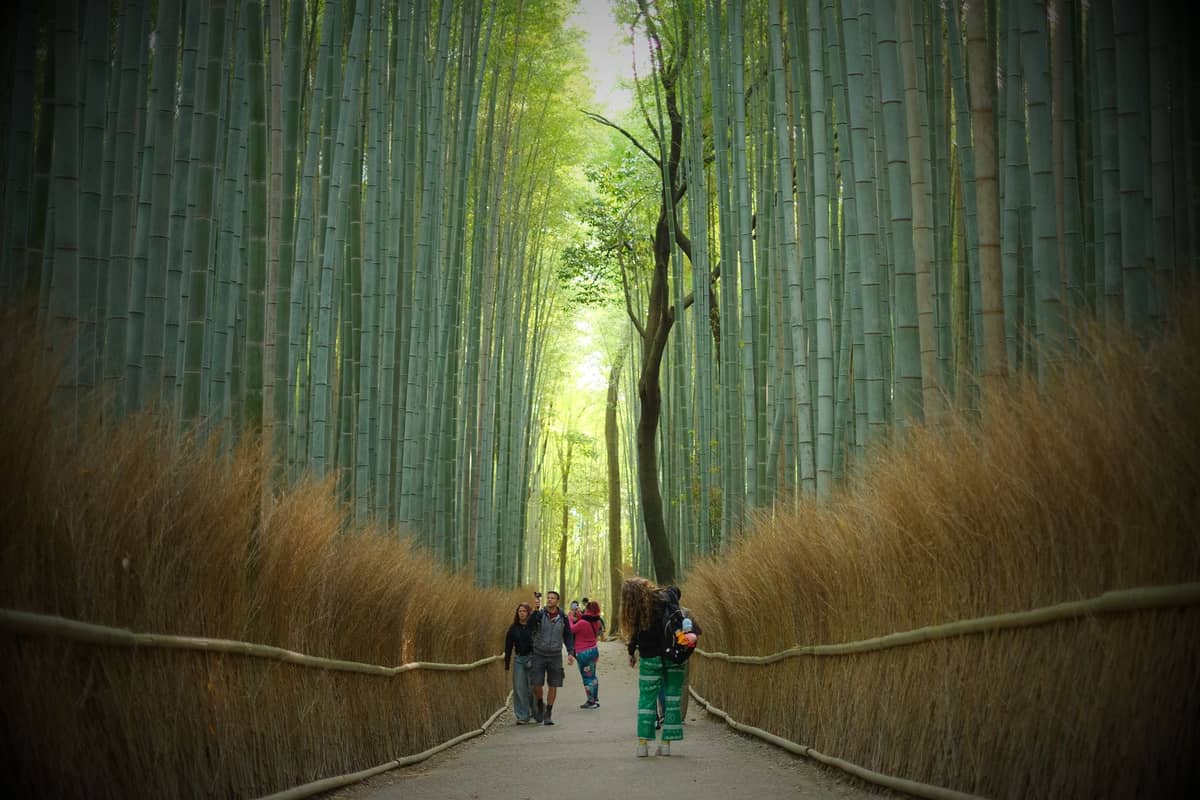
The Arashiyama Bamboo Grove, often referred to simply as the Sagano bamboo path, is a public pedestrian path cutting through a dense plantation of Moso bamboo on the western edge of Kyoto. The corridor runs roughly 400 meters and functions as an ordinary public walkway, open 24 hours a day with no gates, no tickets, and no last-entry cutoff. It is not a park or a managed reserve in the formal sense. You simply walk in from one end and walk out the other.
What makes it visually striking is the scale of the bamboo. Moso bamboo (Phyllostachys edulis) is among the largest bamboo species in the world, and here the culms reach heights that block out most of the sky, leaving only a narrow seam of light overhead. The trunks are packed densely enough that you cannot see more than a few meters into the grove on either side of the path. On a still morning, the stalks creak and sway in a way that produces a low, woody rustling, a sound distinctly different from forest trees. When wind picks up, the entire canopy shifts in waves.
ℹ️ Good to know
The bamboo grove itself is free and requires no booking. However, nearby Tenryu-ji Temple and Okochi Sanso Villa both charge separate admission. Plan your visit around which combination makes sense for your time and budget.
How the Experience Changes by Time of Day
Arriving before 7:30 a.m. is the single most effective decision you can make here. In the first hour after dawn, the path sees almost no foot traffic. The light is diffuse and directional, filtering horizontally through the bamboo in a way that makes photography effortless. The air is noticeably cooler than in the city center, held in by the canopy, and the only sounds are the bamboo itself and occasional birdsong. This is the version of the grove that justifies its reputation.
By 9 a.m., tour groups begin arriving in earnest. By 10 a.m. on a clear day in spring or autumn, the path can feel more like a crowded subway corridor than a quiet forest walk. Rickshas (jinrikisha) also operate around the grove during daytime hours, and their passage on the approach roads can add to the sense of crowding near the entrances. The experience is fundamentally different from the early morning, not ruined, but significantly compressed.
Late evening, after 6 p.m. in summer and after dark in winter, brings another crowd-free window. The grove is sometimes illuminated during special seasonal events, most notably the Arashiyama Hanatouro light-up festival held in December, when paper lanterns line the path and the bamboo is lit from below. On ordinary evenings with no event, the grove is dim and atmospheric but unlit, so a phone torch is useful if you arrive after sunset.
💡 Local tip
Aim to arrive by 7 a.m. in spring and autumn, or by 7:30 a.m. in winter when crowds build slightly later. Weekdays are meaningfully quieter than weekends regardless of season.
Tickets & tours
Hand-picked options from our booking partner. Prices are indicative; availability and final rates are confirmed when you complete your booking.
Kyoto Sanzen-in, Arashiyama and Bamboo Grove Full Day Tour
From 47 €Instant confirmationFree cancellationKyoto Arashiyama insider walking tour
From 66 €Instant confirmationFree cancellationMichelin-Starred Restaurant Experience in Arashiyama Kyoto
From 142 €Instant confirmationFree cancellationGuided day tour from Osaka to Nara Park, Arashiyama and Fushimi Inari
From 59 €Instant confirmationFree cancellation
The Path: A Practical Walkthrough
The main bamboo corridor begins just north of Tenryu-ji Temple's northern gate and runs toward the approach near Okochi Sanso Villa at the northern end. Most visitors walk it north to south or south to north as part of a larger Arashiyama circuit. The paved surface is smooth asphalt for most of its length, which makes it manageable for strollers and many wheelchairs, though the western section has a noticeable incline that may require assistance for manual wheelchair users.
The path is short enough that walking one way takes under ten minutes at a relaxed pace. What takes more time is stopping, backing up to avoid oncoming foot traffic, waiting for a gap in the crowd for a photograph, or pausing near the wooden fencing to look into the bamboo at ground level, where the rhizome network pushes through the soil in overlapping arcs. The lower third of the bamboo stalks is often bare of leaves and shows the joint rings clearly, worth examining up close even if you spend no more than a minute doing so.
At the northern end of the main path, a smaller side lane continues toward Jojakko-ji and other quieter temple grounds in upper Sagano. Most day-trippers turn back at the north end, so this continuation sees considerably less traffic. If you have an extra 30 minutes and want to keep the atmosphere, follow the path beyond the main grove into the residential back lanes of Sagano, where the bamboo continues in less formal clusters alongside garden walls.
Historical and Cultural Context
Arashiyama has been associated with aristocratic and imperial culture since the Heian period (794 to 1185 CE). The area around the Oi River, now called the Katsura River, was a favored retreat for the Kyoto court, and several imperial villas and temple complexes were established here across successive centuries. Tenryu-ji, the Zen temple whose northern garden wall adjoins the bamboo path, was founded in 1339 by the shogun Ashikaga Takauji and is now a UNESCO World Heritage Site.
The bamboo grove itself developed over centuries as Moso bamboo, originally introduced to Japan from China, spread through the Sagano landscape. It is not a planted decorative garden in the conventional sense but rather a preserved and managed section of bamboo that has been integrated into the public walking infrastructure of the area. The path is part of the broaderArashiyama district, which also encompasses the Togetsukyo Bridge, the Oi River embankment, and several major temples along a compact circuit most visitors complete in a half day.
Photography: What Works and What Doesn't
The grove is a genuinely photogenic subject, but it is also one of the most difficult spots in Kyoto to photograph well under typical tourist conditions. The central challenge is people. The path is narrow, and even a modest crowd makes it nearly impossible to capture the corridor without figures in frame. Early morning solves this problem entirely. If you must shoot later in the day, the only reliable option is a very long exposure to blur moving figures, which requires a tripod.
Compositionally, the strongest shots tend to come from a low angle looking straight down the path, emphasizing the vanishing point and the height of the bamboo. The overhead canopy also responds well to a wide-angle lens, which exaggerates the convergence of the stalks toward the sky. Overcast days produce softer, more even light inside the grove than full sunshine, which creates harsh contrast between lit and shaded bamboo. Avoid midday in summer, when light comes from directly above and flattens the texture of the stalks.
Getting There and Practical Logistics
From Kyoto Station, the most direct route is the JR Sagano Line (also called the San-in Line) to Saga-Arashiyama Station, a journey of roughly 15 to 20 minutes. From the station, the bamboo grove is about a 10-minute walk northwest, passing through the approach area near Tenryu-ji. Alternatively, the Randen (Keifuku) tram terminates at Arashiyama Station near the southern end of the bamboo path, which is a slightly longer walk to the grove if you approach via the riverside but passes through the more commercial part of the district.
If you are combining the bamboo grove with a visit to Tenryu-ji Templeand want to see the famous Sogenchi Garden there, enter Tenryu-ji from its main Bamboo Grove Gate on the northern side first, then exit directly onto the bamboo path. This sequence avoids backtracking and allows you to combine both sites in a single loop.
For visitors interested in extending the day, the Hozu River boat ridedeparts from nearby Kameoka and arrives in Arashiyama, making for a scenic approach to the district if you are coming from outside the city. TheSagano Scenic Railway offers a similar route by train through the Hozu Gorge.
⚠️ What to skip
Arashiyama as a whole gets extremely crowded during cherry blossom season (late March to early April) and autumn foliage season (mid-November). During peak periods, even a 7 a.m. arrival may not guarantee solitude. Consider visiting in early December or late January for the most manageable crowds year-round.
Seasonal Conditions and Weather
The bamboo grove looks good in every season, which is one of its genuine advantages over flowering attractions that depend on a narrow window. In winter, the grove retains its green color even when surrounding deciduous trees are bare, and occasional light snowfall settles on the top of the canopy and dusts the path in a way that is visually distinctive. Temperatures in Kyoto in December through February can drop near 0°C at night and hover around 5 to 8°C during the day, so dress in proper layers.
Spring brings warmer temperatures (13 to 24°C) and the highest visitor numbers of the year during cherry blossom season. Autumn, particularly October and November, offers stable weather with daytime temperatures around 17 to 24°C and lower humidity than summer. Summer visits (July and August) are possible but the combination of 30°C-plus heat, high humidity, and peak crowds makes the experience considerably more demanding. For a full breakdown of seasonal timing across Kyoto's attractions, thebest time to visit Kyoto guide covers each season in detail.
Who Should Think Twice
Visitors who arrive at 10 a.m. on a Saturday in October expecting the serene corridor from Instagram photographs will be disappointed. At peak times, the bamboo grove is a crowded public path with tour groups, rickshaws, and smartphone cameras pointing in every direction. The grove itself has not changed, but the experience of it is heavily shaped by timing. If you are unable or unwilling to arrive early, set your expectations accordingly and consider whether the 400-meter walk justifies the travel time to Arashiyama on its own.
Visitors with limited mobility should be aware that while the main path is paved, the surrounding Arashiyama area involves uneven stone paths, stepped approaches to temples, and inclines that can be tiring. The grove path itself is manageable, but the broader area requires comfortable footwear and reasonable mobility.
Insider Tips
- The northern exit of the main bamboo path leads into the quieter Sagano back lanes. Follow the smaller path past Jojakko-ji Temple for bamboo views without the main-path crowd, even at mid-morning.
- If you are staying in central Kyoto, the JR Sagano Line is the fastest option, but consider returning via the Randen tram for a different route through the Arashiyama riverside area.
- Nonomiya Shrine sits at the southern entrance to the bamboo path and is often overlooked in favor of the grove itself. The small moss garden inside the shrine precincts takes five minutes to walk through and is almost always quiet.
- During the Arashiyama Hanatouro light-up event in December, the evening crowds are substantial but move slowly and the atmosphere is genuinely different from daytime visits. Arrive after 7 p.m. when the initial rush thins.
- The bamboo grove is part of the historic Sagano landscape, which is also designated as one of the '100 Soundscapes of Japan' by the Japanese Ministry of the Environment. The sound of the bamboo in wind is the designated soundscape, so on a breezy day, pause and listen rather than just photograph.
Who Is Arashiyama Bamboo Grove For?
- Early-morning walkers who can arrive before 8 a.m. and want the path essentially to themselves
- Photography enthusiasts with a wide-angle lens and willingness to shoot in pre-dawn or low light
- Travelers combining a half-day Arashiyama circuit with Tenryu-ji, the Togetsukyo Bridge, and the Oi River embankment
- Visitors in winter or early spring looking for a green, photogenic landscape when the rest of Kyoto is bare
- Anyone on a tight budget, since the grove itself costs nothing and connects directly to other free or low-cost sights
Nearby Attractions
Other things to see while in Arashiyama:
- Arashiyama Monkey Park Iwatayama
Arashiyama Monkey Park Iwatayama puts you face-to-face with free-roaming Japanese macaques on a forested hillside above the Katsura River. Reach the summit after a 20-minute uphill hike and you get two things at once: snow monkeys living on their own terms, and one of the broadest open views over Kyoto's western basin.
- Hozu River Boat Ride
The Hozu River Boat Ride carries passengers 16 kilometres downstream from Kameoka through a narrow forested gorge, ending in Arashiyama. It's one of the few ways to see this stretch of Kyoto's western mountains from water level, on traditional wooden craft steered by experienced boatmen.
- Kokedera (Saihoji Moss Temple)
Saihoji Temple, known as Kokedera or the Moss Temple, is one of Kyoto's most quietly extraordinary places. Entry requires advance reservation and participation in a brief sutra-copying ceremony, which means the garden is never overwhelmed with visitors. What you find inside is a carpet of over 120 moss species covering the ground beneath ancient maples and cedars, all part of a UNESCO World Heritage Zen garden dating to the 14th century.
- Sagano Scenic Railway (Romantic Train)
The Sagano Scenic Railway, known informally as the Sagano Romantic Train, carries passengers through 7.3 km of forested gorge along the Hozu River between Arashiyama and Kameoka. It is one of the few ways to see this stretch of river valley at a slow enough pace to actually take it in.