Hozu River Boat Ride: Kyoto's Most Scenic River Descent
The Hozu River Boat Ride carries passengers 16 kilometres downstream from Kameoka through a narrow forested gorge, ending in Arashiyama. It's one of the few ways to see this stretch of Kyoto's western mountains from water level, on traditional wooden craft steered by experienced boatmen.
Quick Facts
- Location
- Departs Kameoka; arrives Arashiyama, Kyoto Prefecture
- Getting There
- JR Sagano Line from Kyoto Station to JR Kameoka Station (approx. 20–30 min depending on train), then 8–10 min walk to boarding point
- Time Needed
- 1.5–2 hours on the water; allow half a day including travel
- Cost
- Adults approx. ¥6,000; Children approx. ¥4,500 (verify on official site before visiting)
- Best for
- Seasonal scenery, photography, unhurried sightseeing away from temple crowds
- Official website
- www.hozugawakudari.jp/en
What the Hozu River Boat Ride Actually Is
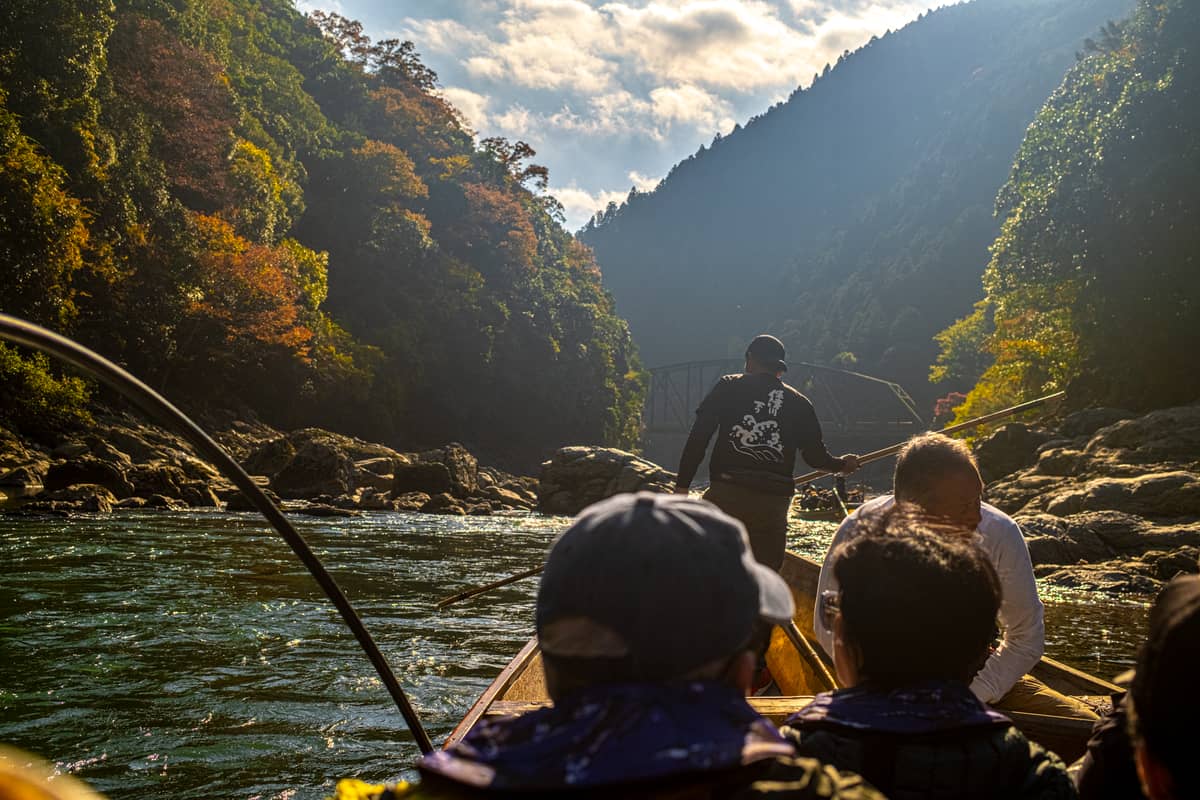
The Hozu River Boat Ride, officially the Hozugawa River Boat Ride (保津川遊船, Hozugawa Yusen), is a guided descent of roughly 16 kilometres along the Hozu River from Kameoka City down to the Arashiyama district of Kyoto. Passengers board traditional wooden flat-bottomed boats at a riverside staging area near JR Kameoka Station and are carried downstream by the current, guided by a crew of experienced oarsmen who use long poles and oars to navigate rapids, boulders, and tight river bends.
The ride lasts between 1.5 and 2 hours depending on water levels, which change with the seasons. This is not a theme park attraction. The gorge is genuinely wild in sections, the river is cold and fast in spring, and the boats are open-sided. What it delivers is an unobstructed view of one of Japan's most dramatic forested river valleys, accessible in no other way from ground level.
ℹ️ Good to know
You board in Kameoka and disembark in Arashiyama — these are two separate locations. Plan your return trip in advance. From Togetsukyo Bridge in Arashiyama, you can walk, rent a bicycle, or catch a local bus or train back into central Kyoto.
The River, the Gorge, and What You'll See
The upper section of the journey, shortly after Kameoka, is relatively calm. The river here is wide and shallow, framed by steep wooded hillsides. Egrets stand motionless in the shallows. The boats move at walking pace. Passengers begin to understand the scale of the gorge as the valley walls close in.
The middle section is where the river becomes something else entirely. The current quickens through a sequence of rapids, the water surface turns white, and the boatmen shift from casual conversation to focused teamwork. Poles go into the riverbed, oars brace against outcrops. Water can spray over the bow during high-flow periods. Bring a light rain jacket or a bag to protect your camera, especially in spring when snowmelt keeps the river running fast.
As the gorge gradually opens, the Sagano Scenic Railway tracks appear above on the left bank. The Sagano Romantic Train follows the same valley on a narrow-gauge line cut into the clifftop, and on clear days you'll hear the whistle before you see the red carriages crossing a viaduct overhead. The two experiences complement each other: one looks down at the river from above, the other looks up at the cliff face from water level.
The final stretch delivers you into the fringes of Arashiyama, where the valley widens into the famous Katsura River basin. TheTogetsukyo Bridgecomes into view on the right, and the boat pulls into a landing dock on the south bank. Disembarkation takes a few minutes, and from there the full sweep of Arashiyama's restaurants, temples, and riverside walks is within easy reach.
Tickets & tours
Hand-picked options from our booking partner. Prices are indicative; availability and final rates are confirmed when you complete your booking.
Kyoto Chion-ji Temple and Ine Boat Houses One-Day Tour
From 43 €Instant confirmationFree cancellationKyoto Coast, Amanohashidate and Ine Bay 1-Day Trip from Osaka or Kyoto
From 46 €Instant confirmationFree cancellationKyoto Sanzen-in, Arashiyama and Bamboo Grove Full Day Tour
From 47 €Instant confirmationFree cancellationKyoto Arashiyama insider walking tour
From 66 €Instant confirmationFree cancellation
Seasonal Changes: When You Go Shapes What You See
No two seasons produce the same trip. In late March and early April, cherry blossoms overhang sections of the riverbank and catch in the current below the boat. The water is cold and high from snowmelt, which makes the rapids more dramatic but also means spray is more likely. If cherry blossom timing is your priority, book early: this is the most popular period.
Autumn, particularly late October through mid-November, turns the gorge walls red and orange. The maples that cover the valley slopes shift colour gradually over about three weeks, and the low afternoon sun throws the colours sharply against the grey cliff face. River levels are lower in autumn, which produces a calmer ride but still enough current to keep the boat moving. This season rivals spring for visual impact and is generally considered the most photogenic.
Summer (July to August) means a lush green gorge and high humidity. Temperatures in the enclosed valley can feel intense, particularly midday. The shade of the overhanging forest provides some relief, but this is not an ideal season unless you are specifically comfortable with Kyoto's warm, damp summers. Winter operation runs with reduced hours, shorter departures, and the stark beauty of bare trees and possible frost on the rocks. Some visitors find the quieter winter boat the most atmospheric of all.
⚠️ What to skip
The ride can be cancelled or modified without notice due to high water levels, particularly after heavy rainfall in the rainy season (June to early July). Check the official site or call ahead before travelling to Kameoka on a rainy day.
History: From Log Rafts to Sightseeing Boats
The Hozu River served as a freight artery for centuries. Log rafts and cargo boats used the river's current to deliver timber, rice, and goods from the inland basin around Kameoka down to markets in Kyoto. The same rapids that now make the ride exciting were serious hazards for commercial boatmen, who developed specialised techniques for reading the water and controlling loaded craft through fast water.
As road and rail replaced river transport through the Meiji and Taisho eras, the commercial traffic disappeared. The Hozugawa Yusen Sightseeing Boat Association transformed the route into a tourist experience, preserving the traditional wooden boat design and the manual navigation techniques. The boatmen today — a crew of typically three per vessel — are trained in the same river-reading skills their predecessors used for freight, adapted for passenger safety.
The gorge itself sits within the broader Arashiyama landscape, which has been considered a place of scenic value since the Heian period. The area's cultural weight runs deep:Tenryu-ji, a UNESCO World Heritage Site garden, sits just upstream from where the boat docks, its outer garden designed to borrow the mountains of this same valley as a backdrop.
Getting There and Practical Logistics
The boarding point is in Kameoka City, not in Arashiyama. This is the detail most visitors overlook. From JR Kyoto Station, take the JR Sagano Line (also called the San-in Main Line on some maps) to JR Kameoka Station. Journey time is approximately 20 minutes. From the station, walk roughly 8 to 10 minutes to the riverside boarding area at 2 Shimo-Nakajima, Hozu-cho, Kameoka City. The route is signposted but involves an uneven riverside path.
Boats depart roughly hourly during operating hours. The seasonal schedule runs approximately 09:00 to 15:00 from March 10 to December 8, and 10:00 to 14:30 from December 9 to March 9, with no service from around December 29 to January 4. These hours are subject to change; confirm the current schedule on the official website before planning your day.
Ticket prices at the time of writing are approximately ¥4,100 for adults and ¥2,700 for children aged 4 to 12 through the operator, though some sources and third-party booking platforms list higher rates. Purchase tickets on arrival at the boarding office or via authorised booking platforms. TheSagano Scenic Railwayruns adjacent to the river through the same gorge and is sold by the same operator group as a complementary experience; a combination approach — ride the train one direction, take the boat the other — is a popular and efficient way to see the gorge from both perspectives.
💡 Local tip
Take the train from Arashiyama's Torokko station to Kameoka first, then ride the boat back downstream to Arashiyama. This way you end the day in Arashiyama with the rest of the area's sights still ahead of you, rather than arriving in Kameoka with nothing nearby to see.
Photography, Accessibility, and What to Bring
The boat rides low on the water, which gives an unusually intimate perspective on the gorge walls. A wide-angle lens is useful for capturing the full height of the valley cliffs in the tightest sections. The light is best in the morning, when it skims the water surface and catches the moisture in the air over the river. By midday in summer, the glare off the water is harsh. Autumn afternoon light on the red maples, however, is genuinely exceptional in the right conditions.
Protect your camera during the rapid sections. The bow of the boat can take spray when water levels are high, and there is no cover overhead. A waterproof bag or a simple zip-lock sleeve for your phone is enough in most conditions, but bring a rain jacket regardless of the forecast, particularly from March through June.
Accessibility is limited. Boarding involves stepping down from a dock into the wooden hull, which sits noticeably below quayside level. The seats are low wooden benches without backrests in the traditional style. Visitors with significant mobility impairments or difficulty with low seating will find this challenging. The boarding path from Kameoka Station also includes uneven ground. The operator does not currently indicate formal barrier-free facilities.
Once you disembark in Arashiyama, the full neighbourhood opens up immediately. TheArashiyama Bamboo Groveis a 10-minute walk from the boat landing, and the riverside area around Togetsukyo is good for a coffee or a meal before catching transport back into central Kyoto. For a deeper look at what the area offers beyond the boat ride, thecomplete Kyoto activity guide covers the wider options across the city.
Who Should Think Twice
The Hozu River Boat Ride is genuinely worthwhile, but it's not for everyone. If your time in Kyoto is limited to one or two days and you haven't yet seen the major temple districts, this half-day commitment — including transit to Kameoka and back from Arashiyama — takes a significant chunk out of a short itinerary. Those prioritising temples, shrines, and urban Kyoto's cultural density would be better served spending that time in Higashiyama or Fushimi.
Travellers who are uncomfortable on boats or prone to motion sickness may find the rapid sections disorienting. The wooden boats have no railings at seat level, and while accidents are rare, the openness of the craft is noticeable in fast water. Children tend to love it precisely for this reason; anxious adults may find the same sections less enjoyable. If you are visiting in summer with young children, the heat inside the gorge midday is worth factoring into the decision.
Insider Tips
- Book departure time as early as possible, especially in cherry blossom season (late March to early April). Later boats can sell out and queues at the Kameoka boarding office on peak days are long. The first departure of the day also tends to have fewer passengers.
- Wear layers even in summer. The gorge is shaded and the river generates its own cool air over the water. Visitors who arrive in light clothing can find the boat noticeably cooler than the Arashiyama streets they left behind.
- The boatmen occasionally sell small snacks and drinks from a floating vendor boat that pulls alongside mid-river. It's a brief stop, more for the novelty than the food, but worth having some yen coins ready if you want to participate.
- Combining the Sagano Scenic Railway and the boat ride in the same day is the most efficient way to see the gorge. Take the train from Torokko Arashiyama Station to Torokko Kameoka Station first, then walk down to the boat boarding point. You'll spend most of the morning in the gorge and arrive back in Arashiyama in time for lunch.
- The boat disembarkation point and Togetsukyo Bridge are not the same location. From where you step off the boat, Togetsukyo is about a 5-minute walk downstream along the south bank. Don't expect to be delivered directly to the postcard view.
Who Is Hozu River Boat Ride For?
- Travellers visiting Kyoto in autumn (October to mid-November) who want to see the foliage from a different angle than temple gardens
- Photographers looking for river-level perspectives on the Arashiyama gorge, particularly in morning light
- Families with children aged 5 and up who want an active, outdoor experience outside the temple circuit
- Anyone pairing the trip with the Sagano Scenic Railway for a full gorge day without repeating the same scenery
- Return visitors to Kyoto who have already covered the main temple and shrine highlights and want something distinctly different
Nearby Attractions
Other things to see while in Arashiyama:
- Arashiyama Bamboo Grove
The Arashiyama Bamboo Grove is one of Kyoto's most photographed spots, a 400-meter corridor of towering Moso bamboo in the Sagano district. Free to enter at any hour, it rewards early risers with near-solitude and punishes late arrivals with wall-to-wall crowds. Here is what to know before you go.
- Arashiyama Monkey Park Iwatayama
Arashiyama Monkey Park Iwatayama puts you face-to-face with free-roaming Japanese macaques on a forested hillside above the Katsura River. Reach the summit after a 20-minute uphill hike and you get two things at once: snow monkeys living on their own terms, and one of the broadest open views over Kyoto's western basin.
- Kokedera (Saihoji Moss Temple)
Saihoji Temple, known as Kokedera or the Moss Temple, is one of Kyoto's most quietly extraordinary places. Entry requires advance reservation and participation in a brief sutra-copying ceremony, which means the garden is never overwhelmed with visitors. What you find inside is a carpet of over 120 moss species covering the ground beneath ancient maples and cedars, all part of a UNESCO World Heritage Zen garden dating to the 14th century.
- Sagano Scenic Railway (Romantic Train)
The Sagano Scenic Railway, known informally as the Sagano Romantic Train, carries passengers through 7.3 km of forested gorge along the Hozu River between Arashiyama and Kameoka. It is one of the few ways to see this stretch of river valley at a slow enough pace to actually take it in.