Ryoan-ji Temple: Kyoto's Iconic Zen Rock Garden
Ryoan-ji Temple in Kyoto's Ukyo-ku ward is home to Japan's most celebrated dry rock garden, a UNESCO World Heritage site of the Rinzai Zen school. Fifteen stones arranged in raked white gravel, with no single viewpoint revealing all fifteen at once — the garden has puzzled and moved visitors for centuries.
Quick Facts
- Location
- Ukyo-ku, Kyoto (northwest Kyoto)
- Getting There
- Ryoanji-mae bus stop (Bus 59, directly in front) or Ryoan-ji Station on Keifuku Kitano Line (10-min walk)
- Time Needed
- 45–90 minutes
- Cost
- Adults ¥600 / High school ¥500 / Elementary & junior high ¥300 / Under 6 free
- Best for
- Zen philosophy, architectural history, quiet contemplation, photography
- Official website
- http://www.ryoanji.jp/smph/eng
What Is Ryoan-ji and Why Does It Matter?
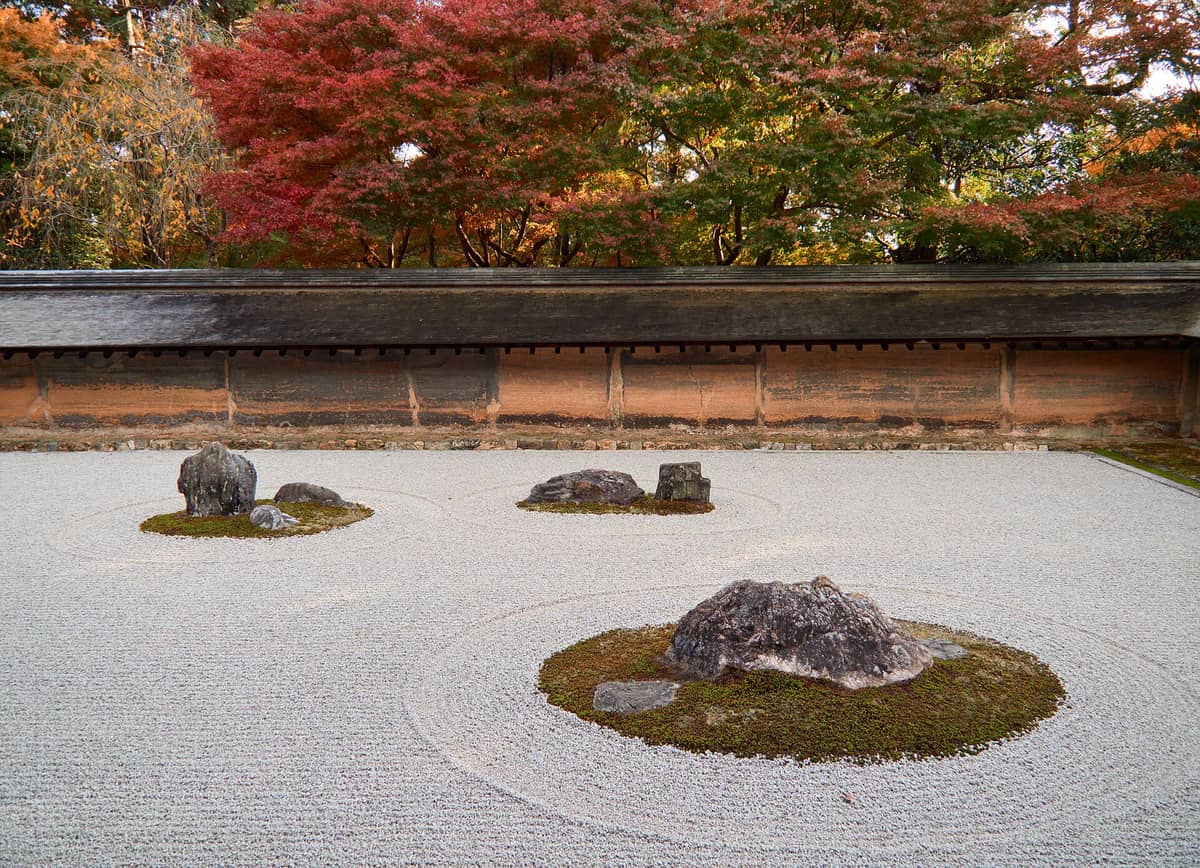
Ryoan-ji Temple — formally Daiun-zan Ryoan-ji — is a Rinzai Zen Buddhist temple in Kyoto's Ukyo-ku ward, designated as part of the UNESCO World Heritage Site "Historic Monuments of Ancient Kyoto." It was founded in 1450 during the Muromachi period, and its dry landscape garden, known as a karesansui, is generally dated to the same broad era, though the exact construction date remains uncertain. The garden is composed of fifteen carefully placed stones arranged across a bed of raked white gravel, enclosed by an earthen oil wall that has aged to a warm, mottled ochre. No plants grow within the gravel boundary. Nothing moves except the person looking.
What makes this garden extraordinary is not its size — the rectangle of raked gravel measures approximately 25 meters wide by 10 meters deep, smaller than many hotel lobbies — but its deliberate ambiguity. The stones are arranged in five clusters, traditionally described as groups of five, two, three, two, and three. No matter where you sit along the viewing veranda, at least one stone is hidden behind another. The garden rewards patience and resists quick conclusions, which is entirely in keeping with the Rinzai tradition of contemplative inquiry.
Interpreting the garden's meaning is a matter of active debate among scholars, monks, and visitors. Some read the stone clusters as mountain islands rising from an ocean of gravel. Others see a tiger carrying cubs across water. The temple itself makes no official claim about symbolism. If you are looking for an explanation on a sign, you will not find one. For context on how Zen temples in Kyoto approach space and silence, thebest temples in Kyoto guideoffers useful comparison points across the city's major Zen and Buddhist sites.
Opening Hours and Getting There
Ryoan-ji is open daily throughout the year. From March 1 through November 30, gates open at 08:00 and close at 17:00. From December 1 through the end of February, hours shift slightly to 08:30–16:30. There are no regular closing days, though it is worth checking the official site before a visit on major Japanese public holidays.
The most convenient public transport option is Kyoto City Bus No. 59, which stops at Ryoanji-mae directly in front of the temple entrance, eliminating any guesswork about the final approach. Alternatively, Ryoan-ji Station on the Keifuku Electric Railroad Kitano Line is roughly a seven- to eight-minute walk north of the temple grounds. The Keifuku Kitano Line runs between Kitano-Hakubaicho and Katabiranotsuji and is useful if you are combining Ryoan-ji with Ninna-ji or Kinkaku-ji in a single northwest Kyoto loop.
💡 Local tip
Bus No. 59 runs from Kyoto Station via the city center to Ryoanji-mae. If you are staying near Shijo or Kawaramachi, you can also reach the area via Kyoto City Bus lines that serve the northwest corridor. Confirm your route on the Kyoto City Bus route map before you go, as schedules vary by day.
Ryoan-ji sits in the northwestern part of the city, a short distance from bothKinkaku-ji (the Golden Pavilion) and Ninna-ji. The three are often combined into a half-day temple circuit, with Kinkaku-ji drawing the largest crowds of the three and Ryoan-ji offering comparatively more space, especially later in the morning.
Tickets & tours
Hand-picked options from our booking partner. Prices are indicative; availability and final rates are confirmed when you complete your booking.
Kyoto Coast, Amanohashidate and Ine Bay 1-Day Trip from Osaka or Kyoto
From 46 €Instant confirmationFree cancellationKyoto Sanzen-in, Arashiyama and Bamboo Grove Full Day Tour
From 47 €Instant confirmationFree cancellationKyoto Arashiyama insider walking tour
From 66 €Instant confirmationFree cancellationMatcha green tea tour in Kyoto's Uji Market
From 130 €Instant confirmationFree cancellation
The Experience: What You Actually See and Feel
You approach through the Kyoyochi Pond, a boating pond dating back to the Heian period that predates the rock garden by several centuries. In autumn the maples around the pond turn deep red and orange, their reflections sitting in still water. In spring, cherry trees along the path drop petals onto the surface. The pond itself sets a tone of unhurried observation before you ever reach the main attraction.
The rock garden is viewed from a long wooden veranda attached to the abbot's quarters, known as the Hojo. You sit or stand on the veranda — shoes off, left at the steps — and look out across the raked gravel. The surface is groomed in horizontal lines that shift to concentric rings around each stone cluster. The texture of the gravel reads differently depending on the angle and quality of light: flat and chalky under overcast skies, almost luminous in direct morning sun.
The enclosing wall is one of the garden's quiet masterpieces. Made from a mixture of clay and rapeseed oil, it has absorbed centuries of weathering into a surface of amber, gray, and pale rust that changes across its length. The wall is low enough to frame the distant treeline above it, giving the garden a sense of depth that the flat gravel alone could not produce.
ℹ️ Good to know
Footwear note: you will be asked to remove shoes before stepping onto the veranda. Slip-on shoes or sandals make this faster, especially during peak hours when foot traffic through the Hojo building can create a brief bottleneck at the entrance steps.
How the Experience Changes by Time of Day
Early morning, from opening until roughly 09:30, is when the garden is closest to its intended atmosphere. The light is low and angled, casting long shadows across the gravel furrows and making the texture of the stones stand out clearly. Tour groups have not yet arrived in volume. The veranda is quiet enough that you can hear the sound of water trickling somewhere beyond the garden wall.
By mid-morning, particularly on weekends and throughout spring cherry blossom season (late March to mid-April) and autumn foliage season (mid-November), the veranda fills with visitors two and three rows deep. The space becomes difficult to photograph without other people in the frame, and the quality of stillness that the garden is designed to produce is harder to access. This is not a reason to avoid the garden during peak periods, but it is worth understanding. The garden is simultaneously a world-famous tourist site and a functioning Zen space, and those two realities coexist imperfectly during busy hours.
Late afternoon, particularly in the hour before closing, sees a notable drop in visitors. The light shifts to a warmer angle, and the garden takes on a different character — less pristine, more worn, as if the day has settled into it. This is arguably the best time for photography if you can accept some compromise on harsh shadows.
⚠️ What to skip
Spring (late March to late April) and autumn foliage season (mid to late November) bring very heavy crowds throughout northwest Kyoto. Arriving at opening time is strongly advisable during these periods. Midweek visits are significantly quieter than weekend ones.
The Rest of the Temple Grounds
The rock garden gets the most attention, but the full grounds of Ryoan-ji extend considerably further. The Kyoyochi Pond circuit takes about fifteen minutes at an easy pace and is genuinely worth the time, especially in spring and autumn. Stone lanterns, small shrines, and moss-covered surfaces appear at intervals along the path. The atmosphere is more informal than the austere garden interior suggests.
Inside the Hojo building, before and after viewing the garden, there are additional rooms with painted screen doors and a secondary small garden that most visitors walk past quickly. It rewards a second look. There is also the Tsukubai, a small stone water basin famously inscribed with four kanji characters that share a central square, forming the phrase "I learn only to be contented" — a piece of calligraphic wordplay that circulates widely in Japanese design and philosophy.
If you plan to spend a full morning or afternoon in the northwest Kyoto temple corridor, consider combining Ryoan-ji with the formal garden atNinna-ji, which is a fifteen-minute walk southwest and offers a very different but complementary experience of Heian-era Buddhist space.
Photography Tips and Practical Considerations
The rock garden is best photographed from the ends of the veranda rather than the center. From the far left end, you get a strong perspective line along the wall that compresses the depth of the garden. From the far right, the relationship between the stone clusters and the wall becomes more legible. A wide lens in the 24–35mm range on a full-frame equivalent works well for full-garden compositions; a longer lens in the 85–135mm range lets you isolate individual stone clusters with the raked gravel as context.
Tripods are generally not permitted on the veranda. In low light conditions, pushing ISO sensitivity is the more practical solution. Overcast days, which are common in Kyoto outside of autumn's high-pressure windows, actually produce very even light across the gravel surface and are underrated for photography here.
On accessibility: the temple bus stop at Ryoanji-mae deposits visitors immediately at the entrance, which reduces the walking distance from transport. Detailed information on wheelchair access to the Hojo veranda is limited in available English-language sources, and visitors with specific mobility requirements should contact the temple directly before visiting.
Who Should Reconsider Visiting
Ryoan-ji is not the right choice for visitors who need constant stimulation or clear narrative payoff. The garden is a space that rewards stillness and extended looking. If you are working through a tight itinerary and allocating twenty minutes to each major site, the rock garden may not deliver what you are hoping for. In that case, the more visually dynamic options in the northwest corridor — particularly the gilded surfaces ofKinkaku-ji— may be better uses of limited time. Similarly, young children who find sitting and looking difficult may be better served at attractions with more interactive elements.
For those planning a broader exploration of Kyoto's historic temple and garden landscape, thebest gardens in Kyoto guidesets Ryoan-ji in useful context alongside other notable moss gardens, stroll gardens, and tea gardens across the city.
Insider Tips
- Arrive within the first thirty minutes of opening on weekdays. The veranda can be nearly empty at 08:15, with a quality of quiet that is completely different from the mid-morning experience.
- The Kyoyochi Pond path is often rushed or skipped entirely. Walk the full perimeter before entering the Hojo — the pond's northern bank in autumn offers one of the better understated autumn foliage scenes in northwest Kyoto, without any of the crowds that form at Kinkaku-ji simultaneously.
- The Tsukubai stone basin near the Hojo entrance is easy to miss. Look for the small circular stone with the central square character — it is a well-known example of Japanese visual wordplay and worth a few minutes of attention.
- Bus No. 59 back toward the city center can be very crowded mid-afternoon, especially on weekends. If you are flexible, waiting an extra twenty minutes for a less full bus, or walking fifteen minutes south to catch a different line, can spare you a very compressed standing ride.
- The garden looks fundamentally different under snow, which falls occasionally in Kyoto's January and February. If you are visiting in winter, an early snowfall transforms the raked gravel into a completely unmarked white surface — a rare and striking inversion of the usual composition.
Who Is Ryoan-ji Temple For?
- Travelers with an interest in Zen philosophy, Japanese garden design, or architectural minimalism
- Photographers looking for strong geometric compositions and variable light conditions
- Visitors building a half-day northwest Kyoto temple circuit combining Ryoan-ji, Kinkaku-ji, and Ninna-ji
- Anyone seeking a genuinely quiet contemplative experience outside of the city's most congested central tourist corridors
- Winter travelers who want to experience a major Kyoto landmark without peak-season crowd levels
Nearby Attractions
Other things to see while in Nishijin:
- Daitoku-ji Temple Complex
Daitoku-ji is a sprawling Rinzai Zen monastic complex in Kyoto's Nishijin district, containing roughly two dozen sub-temples set among raked gravel lanes, weathered mud walls, and ancient pines. The grounds are free to enter at any hour, while individual sub-temples charge modest admission to access some of Japan's most refined dry-landscape gardens.
- Funaoka Onsen
Built in 1923 and registered as a Tangible Cultural Property of Japan, Funaoka Onsen is a rare survivor of Taishō-era sento architecture in Kyoto's traditional Nishijin weaving district. Admission costs around ¥550, the carved wooden interiors are extraordinary, and almost everyone soaking alongside you is a local.
- Kinkaku-ji (Golden Pavilion)
Kinkaku-ji is Kyoto's most photographed temple, a three-story gold-leaf pavilion reflected in a tranquil pond within a classical strolling garden. Here is everything you need to visit intelligently: the best times, crowd patterns, transit routes, and a clear assessment of the experience.
- Kitano Tenmangu Shrine
Founded in 947 and dedicated to the deity of scholarship, Kitano Tenmangu is one of Kyoto's most culturally layered shrines. Entrance to the main grounds is free, the plum grove is among the finest in the city, and on the 25th of every month the whole complex transforms into one of Kyoto's largest antique markets.