Kitano Tenmangu Shrine: Kyoto's Shrine of Learning, Plum Blossoms, and Flea Markets
Founded in 947 and dedicated to the deity of scholarship, Kitano Tenmangu is one of Kyoto's most culturally layered shrines. Entrance to the main grounds is free, the plum grove is among the finest in the city, and on the 25th of every month the whole complex transforms into one of Kyoto's largest antique markets.
Quick Facts
- Location
- Bakurocho, Kamigyo Ward, Kyoto — Nishijin neighborhood
- Getting There
- Kyoto City Bus No. 50 from Kyoto Station (~30–35 min) to Kitano Tenmangū-mae stop; or Keifuku Line to Kitano-Hakubaicho Station
- Time Needed
- 45–90 minutes for the grounds; allow 2–3 hours on flea market days (25th of each month)
- Cost
- Shrine grounds: free. Seasonal gardens (plum/maple): approx. ¥1,200 adults, includes tea and sweets. Treasure House: ¥800 adults.
- Best for
- History lovers, students sitting exams, plum blossom season, antique hunters, photographers
- Official website
- kitanotenmangu.or.jp/en
What Is Kitano Tenmangu, and Why Does It Matter?
Kitano Tenmangu Shrine sits in the northwestern reaches of Kyoto's traditional weaver's quarter, a few minutes' walk from the wooden machiya townhouses of Nishijin. It is one of approximately 12,000 Tenmangu shrines across Japan, and it is considered the head shrine of the entire network. That distinction is not ceremonial: this is the site where the cult of Sugawara no Michizane was born, and it remains its spiritual center more than a thousand years later.
Sugawara no Michizane (845–903) was a Heian-period court scholar and poet of exceptional talent who rose to become one of the Emperor's most trusted advisors. Court rivals engineered his downfall and he was exiled to Kyushu, where he died in 903. Soon after, Kyoto was struck by floods, fires, and epidemic disease. When lightning struck the Imperial Palace, killing several of his political enemies, the court concluded that Michizane's angry spirit was responsible. In 947, the shrine was founded to appease him and honor his memory. Over time, the fearful spirit became a benevolent deity: Tenjin, the god of learning, scholarship, and calligraphy.
Today, the shrine draws students before university entrance exams, parents clutching ema wooden prayer tablets, and travelers who stumble upon it while navigating betweenKinkaku-jiand the Nishijin textile district. It also fills with antique dealers and market-goers on the 25th of every month, Michizane's memorial day. Each of these visits produces a very different experience at the same address.
Arriving at the Shrine: The Approach and Main Gate
The bus drops you at the Kitano Tenmangū-mae stop, and the entrance torii is immediately visible. The approach is notably different from the long forested paths of larger Kyoto shrines: Kitano Tenmangu sits in an urban setting, and the transition from ordinary street to sacred space happens quickly. You pass through the large stone torii and move along a broad paved path toward the rōmon, the two-story wooden gate that dates to 1607.
Pause at the gate and look at the details: the unpainted timber, the bracket sets stacked in the Momoyama-period style, the way the proportions are heavy and grounded rather than refined and ethereal. This is not the delicate aesthetic of the later Edo shrines. The main shrine complex was reconstructed under Toyotomi Hideyoshi's son Hideyori in 1607, and its architectural character reflects the confident, slightly muscular sensibility of that era.
💡 Local tip
The shrine grounds are open from 5:00–18:00 (April–September) and 5:30–17:30 (October–March), making Kitano Tenmangu one of the few major Kyoto shrines accessible at first light. Early morning visits on non-market days are genuinely quiet: stone lanterns still hold traces of incense smoke, and the only sounds are pigeons and the distant hum of Kyoto waking up.
Tickets & tours
Hand-picked options from our booking partner. Prices are indicative; availability and final rates are confirmed when you complete your booking.
Kyoto temples, shrines, and Kimonos guided day tour
From 8.800 €Instant confirmationFree cancellationKobe: Mt. Rokko Night View, Kitano Ijinkan, Arima Onsen Full Day Tour
From 47 €Instant confirmationFree cancellationShiga Day Trip with Miho Museum, Lake Biwa and Waterbird Shrine
From 70 €Instant confirmationFree cancellationKyoto Coast, Amanohashidate and Ine Bay 1-Day Trip from Osaka or Kyoto
From 46 €Instant confirmationFree cancellation
The Main Hall and the Cow Statues
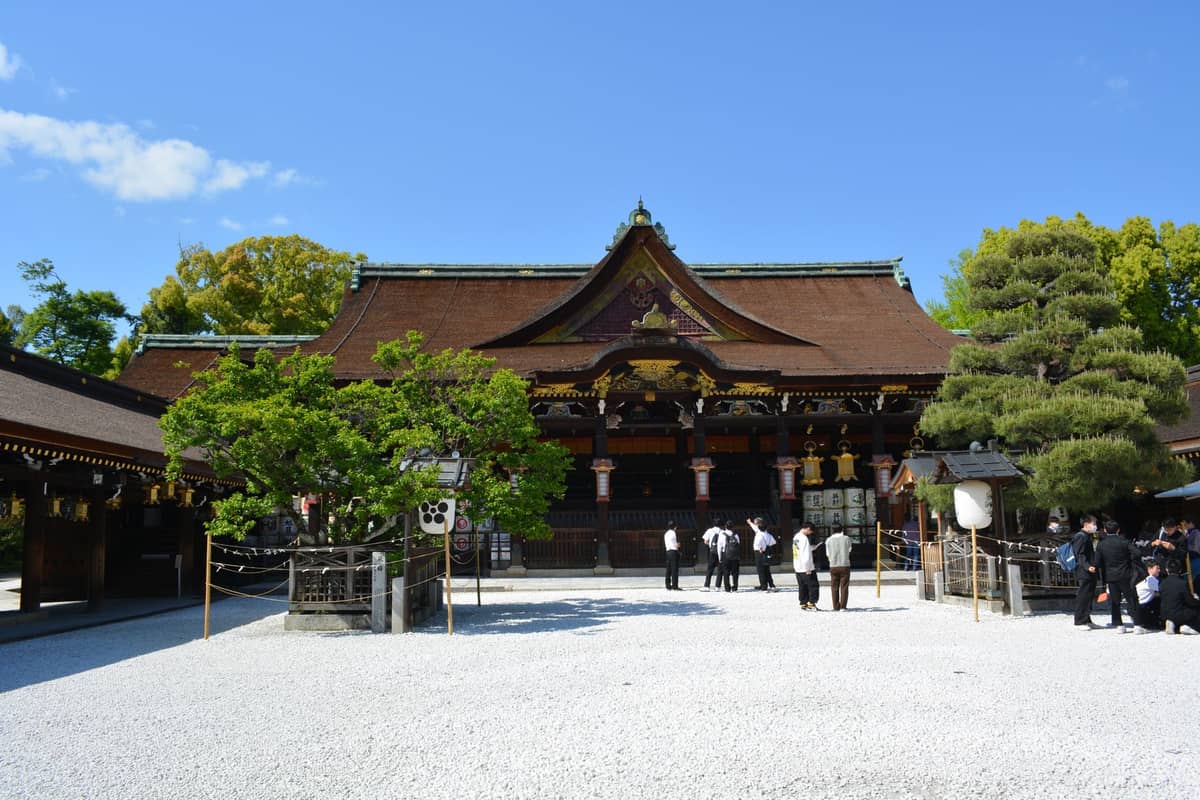
The main shrine hall is designated a National Treasure of Japan, a classification that applies to the entire Honden-Haiden-Ishi-no-Ma complex. The three connected halls follow the Gongen-zukuri style, with the main hall, worship hall, and stone corridor joined under a continuous roofline. The overall impression is of a building that has aged into its surroundings: the dark timber, the moss-edged stone base, and the weathered copper fittings read as a single organic whole.
Throughout the grounds you will find bronze and stone ox statues, often with polished heads and noses where countless visitors have touched them. The ox is Michizane's sacred animal: according to tradition, he was born in the Year of the Ox, and oxen carried his remains for burial. Rubbing the head of an ox is thought to transfer wisdom and good health. Near the main hall, students leave ema plaques in enormous quantities before exam season; in January and February, the wooden racks are practically buried in them.
The Plum Grove: Kitano Tenmangu's Most Distinctive Feature
Michizane was famously devoted to plum trees, and the shrine's garden holds roughly 1,500 plum trees representing around 50 varieties. They bloom in a sequence that begins in late January with the earliest white varieties and continues through mid-March, when the final deep-pink cultivars fade. The peak period shifts by a week or two depending on winter temperatures, but late February is typically the most concentrated display.
The garden is a ticketed enclosure during the blooming period, with adults paying approximately ¥1,200 for admission that includes a seat at one of the garden's tea houses where matcha and wagashi sweets are served. The combination of cold air, plum fragrance (a scent closer to honey than cherry blossom), and bitter matcha in a ceramic bowl is one of those very specific Kyoto experiences that is difficult to replicate elsewhere. The garden can get crowded on weekends at peak bloom: arriving when the gates open at 9:00 gives you the best light and the thinnest crowds.
A maple garden opens in the same enclosure from late October through early December, also at approximately ¥1,200 with tea included. If you are planning a Kyoto autumn trip, this is worth combining with other foliage sites in the area. For broader context on autumn timing across the city, theKyoto in autumn guide covers the timing and what to expect at different sites.
ℹ️ Good to know
Plum blossom season at Kitano Tenmangu typically runs early February through late March. The shrine holds the Kanko-sai plum festival, usually on February 25th, with formal ceremonies and occasionally maiko performances. Check the official website for the exact program as dates are set annually.
The 25th-of-the-Month Flea Market (Tenjin-san)
On the 25th of every month, the Tenjin-san market fills the entire approach and surrounding streets with up to 1,000 stalls. The 25th is Michizane's memorial day (he died on January 25th, and was enshrined on the same date in a different month), and the market tradition stretches back centuries. In practice today, Tenjin-san is a full-scale antique and flea market where you can find Edo-period ceramics next to 1980s LP records, handmade indigo textiles next to secondhand kimono, and grilled skewers of sweet potato being sold from a cart squeezed between two furniture dealers.
Arrive before 9:00 if you are genuinely looking for antiques: the serious dealers set up from early morning, and the pieces worth finding disappear quickly. By midday the market shifts character and becomes more of a street fair, which is enjoyable in a different way but less productive for shopping. The crowds on market day are substantial, particularly in November (autumn foliage season) and February (plum blossom season). Navigation through the stalls is slow and requires patience.
For those wanting to combine a market visit with nearby textile history, theNishijin Textile Centeris a short walk south and offers kimono weaving demonstrations that make a coherent pairing with Kitano Tenmangu on any day of the month.
The Treasure House and Peripheral Areas
The Treasure House opens on the 25th of each month and during specific seasonal windows: New Year, the plum season, spring, and the autumn maple period. Hours are generally 9:00–16:00 with last entry at 15:30. Adult admission is ¥800. The collection includes Heian-period documents, artwork, and objects connected to Michizane's life and the shrine's history. It is a specialist interest rather than a casual attraction: the interpretive materials in English are limited, and the experience rewards visitors who come with some background knowledge.
Beyond the main compound, the surrounding streets of Nishijin deserve at least a short wander. The neighborhood was Kyoto's traditional weaving district for centuries, and while the number of active looms has declined sharply, you can still hear the mechanical rhythms of Nishiki looms from open workshop doors in the quieter streets east of the shrine. The area also has several small wagashi sweet shops, an appropriate stop given Michizane's association with refined culture.
Practical Walkthrough: Getting There, Getting Around, What to Wear
From Kyoto Station, Kyoto City Bus No. 50 runs directly to the Kitano Tenmangū-mae stop in roughly 30–35 minutes. The Keifuku (Randen) Line to Kitano-Hakubaicho Station is another option if you are coming from Arashiyama: the single-car tram is a charming experience in itself and deposits you two minutes' walk from the shrine's rear entrance.
The shrine grounds are mostly flat paved stone, manageable for most visitors. However, specific wheelchair-accessible routes are not prominently documented on external sources. Visitors with mobility requirements should contact the shrine office directly (+81 75-461-0005) or check the official site before their visit.
Kitano Tenmangu is in the Nishijin area of Kyoto, which makes it a natural pairing withKinkaku-ji (about 20 minutes on foot heading northwest) and Ryoan-ji(about 30 minutes on foot or a short bus ride). Combining all three in a single half-day is feasible if you are not visiting on a market day.
For photography: the main hall photographs best in the hour after opening, when the angle of low morning light catches the carved details in the bracket sets. The plum garden is most photogenic on overcast days, when soft diffused light eliminates the harsh shadows between branches. On market days, the stall area near the stone torii is the most photogenic section between 8:00 and 10:00, before the crowds thicken.
⚠️ What to skip
Bus No. 50 from Kyoto Station is one of the most heavily used tourist routes in the city. On weekends and during cherry blossom or autumn foliage peak periods, waits at the stop can be long and buses arrive full. Leave extra time, or take a taxi from Kyoto Station for a predictable journey.
An Honest Assessment: Who Will Love This, and Who Might Not
Kitano Tenmangu rewards visitors who find meaning in layered history and are willing to slow down. The architecture is genuinely exceptional, the plum grove is one of the finest of its kind in Kansai, and the flea market is the best of its type in Kyoto. For travelers who want dramatic scale or manicured perfection, this shrine offers neither: it is an old, slightly scruffy, deeply interesting place.
Travelers primarily focused on Kyoto's famous temple circuits in Higashiyama or Arashiyama may find the trip to Nishijin a stretch if time is limited. If that is your situation, the3-day Kyoto itinerarycan help you decide whether Kitano Tenmangu fits your schedule or is better saved for a longer trip.
Visitors who tend to be uninterested in shrine architecture, who do not have a connection to the academic or scholarly aspect of the site, and who are visiting outside the plum season and market days may find the grounds underwhelming compared with the dramatic impact of Fushimi Inari or Kinkaku-ji. That is not a criticism of the shrine: it is honest calibration of what kind of traveler will get the most from it.
Insider Tips
- The plum season is the most popular time to visit, but early March weekday mornings are often less crowded than the official festival weekend in late February. The blossoms are still strong, the tea house queues are shorter, and the light is better.
- On Tenjin-san market days (the 25th), the stalls spill well beyond the shrine grounds into the surrounding streets. The blocks southeast of the main gate often have smaller, less-visited dealers with more interesting stock and more willingness to negotiate.
- The Keifuku (Randen) Line from Kitano-Hakubaicho is a single-car heritage tram that runs through residential Kyoto at street level. The ride from Arashiyama to Kitano-Hakubaicho takes about 30–35 minutes and is itself a quietly charming experience that most tourists miss entirely.
- Touch one of the bronze ox statues near the main hall and you will immediately understand what years of hands have done: the nose and forehead are polished to a smooth golden sheen while the rest of the statue remains dark. It is a surprisingly moving detail about what people ask for when they visit.
- The shrine's atmosphere changes completely after dark during the evening illumination events that accompany plum and maple seasons. These are separately ticketed, but the combination of lit blossoms or red maple leaves reflecting in the garden's water elements is a very different experience from the daytime visit.
Who Is Kitano Tenmangu Shrine For?
- Students and families praying for academic success, especially before university entrance exam season in January and February
- Antique and vintage hunters visiting on the 25th of the month for the Tenjin-san flea market
- Plum blossom seekers in late January through mid-March, particularly those who want a garden experience that includes matcha and sweets
- Architecture enthusiasts interested in Momoyama-period shrine construction and National Treasure buildings
- Travelers combining Nishijin textile history with a broader northwest Kyoto day that also includes Kinkaku-ji or Ryoan-ji
Nearby Attractions
Other things to see while in Nishijin:
- Daitoku-ji Temple Complex
Daitoku-ji is a sprawling Rinzai Zen monastic complex in Kyoto's Nishijin district, containing roughly two dozen sub-temples set among raked gravel lanes, weathered mud walls, and ancient pines. The grounds are free to enter at any hour, while individual sub-temples charge modest admission to access some of Japan's most refined dry-landscape gardens.
- Funaoka Onsen
Built in 1923 and registered as a Tangible Cultural Property of Japan, Funaoka Onsen is a rare survivor of Taishō-era sento architecture in Kyoto's traditional Nishijin weaving district. Admission costs around ¥550, the carved wooden interiors are extraordinary, and almost everyone soaking alongside you is a local.
- Kinkaku-ji (Golden Pavilion)
Kinkaku-ji is Kyoto's most photographed temple, a three-story gold-leaf pavilion reflected in a tranquil pond within a classical strolling garden. Here is everything you need to visit intelligently: the best times, crowd patterns, transit routes, and a clear assessment of the experience.
- Ninna-ji Temple
Founded in 888 AD and designated a UNESCO World Heritage Site, Ninna-ji Temple blends imperial history with striking architecture across freely walkable grounds. It is best known for the Omuro Sakura, a late-blooming dwarf cherry variety that draws visitors weeks after the city's other blossoms have fallen.