Nishijin Textile Center: Kyoto's Living Encyclopedia of Silk Weaving
The Nishijin Textile Center brings one of Japan's most refined craft traditions to life through working loom demonstrations, kimono fashion shows, and hands-on weaving workshops. Entry to the main exhibits is free, making it one of the most rewarding cultural stops in Kyoto's historic weaving district.
Quick Facts
- Location
- Imadegawa Minamihairu, Imadegawa-dori, Kamigyo-ku, Kyoto 602-8216
- Getting There
- Imadegawa Station (Karasuma Subway Line), approx. 12 min walk; city buses stop at Horikawa Imadegawa nearby
- Time Needed
- 45 minutes to 2 hours depending on shows and workshops
- Cost
- Free general admission; paid kimono wearing and weaving workshops available (fees vary)
- Best for
- Craft and textile enthusiasts, cultural learners, budget travelers, kimono fans
- Official website
- nishijin.or.jp/eng/nishijin_textile_center1
What Is the Nishijin Textile Center?
The Nishijin Textile Center is the public face of an industry that has shaped Kyoto's identity for centuries. Operated by the Nishijin Textile Industry Association, it occupies a modern multi-story building in the Nishijin district of Kamigyo-ku.
What sets this place apart from a standard craft museum is that the looms here actually run. You can stand a few feet from a weaver operating a jacquard loom, watch individual silk threads being interlaced at close range, and hear the rhythmic clack and hiss of machinery that produces fabric worth tens of thousands of yen per meter. That immediacy, paired with free general admission, makes the center genuinely useful for travelers who want substance rather than a surface-level cultural touch.
ℹ️ Good to know
General admission to the center and permanent exhibits is free. Paid experiences such as kimono wearing and weaving workshops are available separately. Check the official site for current schedules, hours, and fees before visiting, as these change seasonally.
The Weight of 1,000 Years: Historical Context
Nishijin-ori, meaning 'Nishijin weaving,' refers to a category of high-end silk textiles produced using techniques developed over centuries in this part of Kyoto. The craft's organized form took shape after the Onin War (1467-1477), when displaced weavers returning to the city congregated in the area west of the Kamogawa river.
At its historic peak, the Nishijin district was home to thousands of weaving households producing kimono fabric, obi sashes, and ceremonial textiles for the imperial court and aristocracy. Today that industry has contracted significantly under pressure from synthetic alternatives and changing fashion, but the techniques survive through workshops like those at the center and through the broader cultural context ofthe Nishijin neighborhooditself, where you can still hear looms operating from behind wooden machiya walls on a quiet weekday morning.
The center's permanent collection includes historical textiles, archival photographs, and explanatory panels that trace this evolution honestly, including the challenges the industry faces now. It does not romanticize decline, which gives the exhibits a credibility that many craft tourism experiences lack.
Tickets & tours
Hand-picked options from our booking partner. Prices are indicative; availability and final rates are confirmed when you complete your booking.
Kyoto Coast, Amanohashidate and Ine Bay 1-Day Trip from Osaka or Kyoto
From 46 €Instant confirmationFree cancellationKyoto Sanzen-in, Arashiyama and Bamboo Grove Full Day Tour
From 47 €Instant confirmationFree cancellationKyoto Arashiyama insider walking tour
From 66 €Instant confirmationFree cancellationMatcha green tea tour in Kyoto's Uji Market
From 130 €Instant confirmationFree cancellation
What You Actually See and Do Inside
The ground floor greets you with a shop selling Nishijin textiles, accessories, and souvenirs, ranging from affordable small items to serious investment pieces. Resist the urge to linger too long here on the way in; the more instructive parts of the building are upstairs.
The loom demonstration area is the center's most compelling feature. Weavers sit at working jacquard looms and continue their craft while visitors watch from close proximity. The sound is unexpectedly industrial for such delicate output: a mechanical rhythm that underlines the physical labor behind every centimeter of finished fabric. Informational panels in English explain the weaving process in detail, and staff are generally available to answer questions, though English fluency varies.
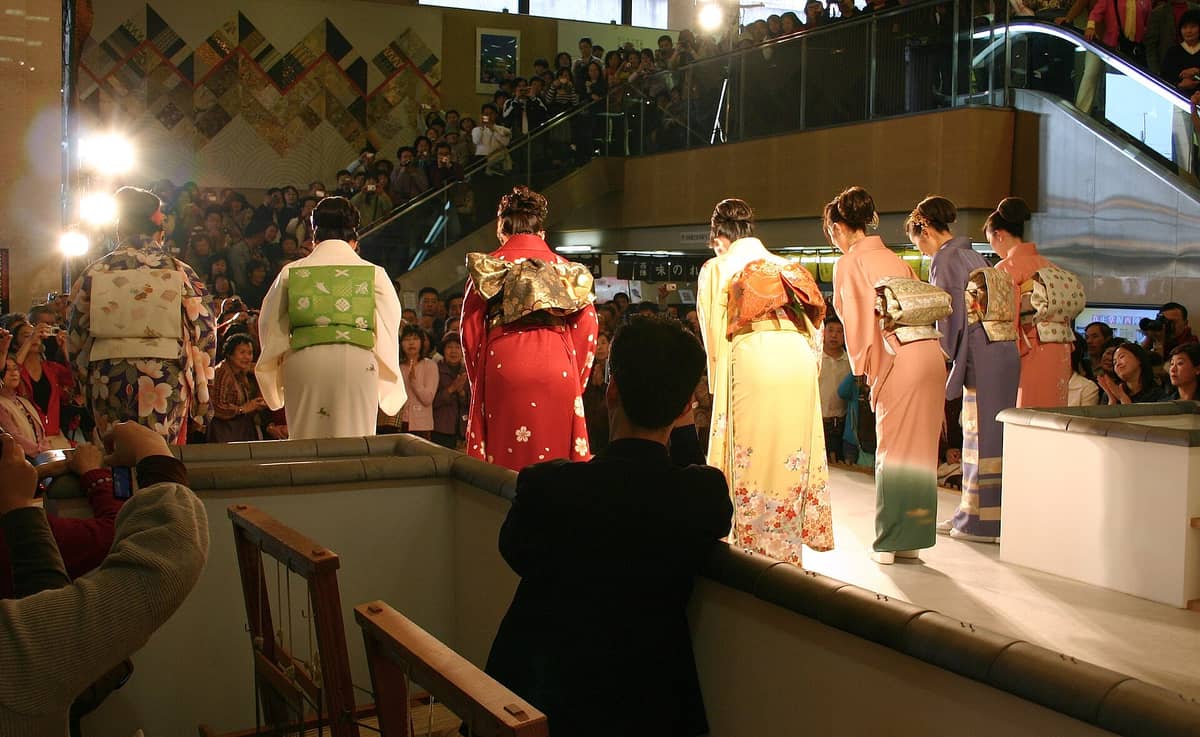
Kimono fashion shows are scheduled throughout the day and run for roughly 20 minutes. Models walk through the exhibition space wearing finished Nishijin garments, demonstrating the drape, weight, and visual complexity that distinguishes hand-woven silk from machine-produced alternatives. The shows feel more educational than theatrical, which is appropriate. Seating is limited, so arriving 10 minutes early is advisable, particularly on weekends.
Paid activities include kimono wearing sessions and introductory weaving workshops. These require booking and vary in availability by season. If wearing a kimono is on your itinerary, note that the center's version emphasizes the Nishijin textile itself rather than a full styling experience; for a more comprehensive kimono rental outing, theKyoto kimono rental guide covers dedicated rental shops across the city.
How the Visit Changes by Time of Day
Morning visits, particularly on weekdays, offer the quietest experience. The loom demonstration area is often occupied by just a handful of visitors, and the sound of the looms carries clearly without the background noise of a crowded room. The weavers are at work from opening, and natural light comes through the upper windows at a useful angle for observing textile detail.
Midday and early afternoon bring school groups and tour buses, especially on weekends and during cherry blossom and autumn foliage seasons. The kimono shows fill up quickly during these windows. If your schedule is flexible, a late morning arrival around 10:30 lets you catch an early show and complete the exhibits before the midday wave.
💡 Local tip
Hours vary by season: October to March the center closes at 16:00, while April to September it stays open until 17:00. The center is closed on Mondays, or the following Tuesday if Monday is a national holiday, and during the New Year period from December 29 to January 3.
Getting There and Getting Around Nishijin
The center is located on Horikawa-dori near the Imadegawa intersection in Kamigyo-ku. From Kyoto Station, the most straightforward approach is by city bus along Horikawa-dori, alighting near Horikawa-Imadegawa. The Karasuma Subway Line's Imadegawa Station is approximately 12 minutes on foot heading west.
The center sits within easy reach of several significant sites. Kamigamo Shrine is further north, and the large grounds ofKyoto Gyoen National Gardenlie to the southeast. The neighborhood itself rewards slow walking: many of the old wooden townhouses that characterize Nishijin survive along smaller side streets, and a few small shrines and neighborhood temples are woven into the residential fabric between the main roads.
Photography, Accessibility, and Practical Notes
Photography of the exhibits and loom demonstrations is generally permitted, though flash use near delicate textiles and working equipment is inadvisable. The kimono fashion shows can be photographed; ask staff if uncertain about specific areas.
The building is modern with elevator access to upper floors, making it significantly more accessible than many of Kyoto's historic sites. Accessible restrooms are available. Visitors with specific mobility requirements should confirm details directly with the center before arriving.
Weather has almost no bearing on the quality of this visit, which is a genuine advantage in Kyoto's unpredictable climate. If you are caught in rain while exploring nearby attractions likeKitano Tenmangu Shrine, the center makes an excellent retreat. See the Kyoto weather guide for seasonal planning advice.
⚠️ What to skip
The center is closed on Mondays (or the following Tuesday if Monday falls on a national holiday) and during the New Year period from December 29 to January 3. Arriving on a closure day is an easy mistake given that most Kyoto attractions stay open on Mondays.
Honest Assessment: Who This Is For and Who It Isn't
The Nishijin Textile Center delivers genuine value for travelers with any interest in craft, material culture, fashion history, or Japanese design. The combination of free admission, working demonstrations, and English-language information is unusually good for a specialized museum of this scale. It is not a polished, high-budget attraction: the building's interior is functional rather than architecturally compelling, the shop is uneven in quality, and the fashion shows, while informative, are modestly staged.
Travelers who want only the most iconic Kyoto experiences and have a packed three-day itinerary may find the center a lower priority than the major temple circuits. But for anyone spending more than three days in the city, or for those specifically interested in traditional crafts, this is one of the most substantive free stops available. It fits naturally into abudget-conscious Kyoto itineraryand pairs well with exploring the wider Nishijin neighborhood on foot.
Those with no interest in textiles, weaving, or kimono culture will likely find 30 minutes sufficient before moving on. The center does not try to be more than it is, which is both its limitation and its integrity.
Insider Tips
- Kimono fashion show seating fills up quickly on weekends. Check the daily show schedule posted at the entrance upon arrival and plan your visit around the next available time rather than wandering the exhibits first.
- The loom demonstration area is most rewarding on weekday mornings when crowds are thin and you can spend time speaking with staff without competing for attention. Some demonstrators will slow down a section of weaving to explain a specific technique if asked.
- The center's shop on the ground floor carries Nishijin textile products at prices that reflect actual production costs. Small items like pouches and bookmarks make more meaningful souvenirs than generic Kyoto trinkets, and the quality difference from tourist-market alternatives is immediately apparent.
- If you plan to do a paid weaving workshop, booking through the official website in advance is strongly advised. Walk-in availability is limited and sessions can fill days ahead during peak tourist seasons in April and November.
- The center's location at Horikawa and Imadegawa puts you at the edge of the old weaving district. After your visit, walk one or two blocks west or north on smaller residential streets to see surviving machiya townhouses; some still have workshop spaces where you can hear looms operating from the street.
Who Is Nishijin Textile Center For?
- Textile, fashion, and craft enthusiasts who want to see traditional Japanese weaving in practice rather than just on display
- Budget travelers: the combination of free admission and substantive content is rare in central Kyoto
- Travelers curious about kimono culture beyond the rental experience, including how the fabric itself is made
- Visitors on multi-day itineraries who have covered the major temple circuits and want to explore Kyoto's artisan heritage
- Families with older children or teenagers interested in design, material culture, or Japanese history
Nearby Attractions
Other things to see while in Nishijin:
- Daitoku-ji Temple Complex
Daitoku-ji is a sprawling Rinzai Zen monastic complex in Kyoto's Nishijin district, containing roughly two dozen sub-temples set among raked gravel lanes, weathered mud walls, and ancient pines. The grounds are free to enter at any hour, while individual sub-temples charge modest admission to access some of Japan's most refined dry-landscape gardens.
- Funaoka Onsen
Built in 1923 and registered as a Tangible Cultural Property of Japan, Funaoka Onsen is a rare survivor of Taishō-era sento architecture in Kyoto's traditional Nishijin weaving district. Admission costs around ¥550, the carved wooden interiors are extraordinary, and almost everyone soaking alongside you is a local.
- Kinkaku-ji (Golden Pavilion)
Kinkaku-ji is Kyoto's most photographed temple, a three-story gold-leaf pavilion reflected in a tranquil pond within a classical strolling garden. Here is everything you need to visit intelligently: the best times, crowd patterns, transit routes, and a clear assessment of the experience.
- Kitano Tenmangu Shrine
Founded in 947 and dedicated to the deity of scholarship, Kitano Tenmangu is one of Kyoto's most culturally layered shrines. Entrance to the main grounds is free, the plum grove is among the finest in the city, and on the 25th of every month the whole complex transforms into one of Kyoto's largest antique markets.