Funaoka Onsen: Step Inside Kyoto's Most Beautiful Public Bathhouse
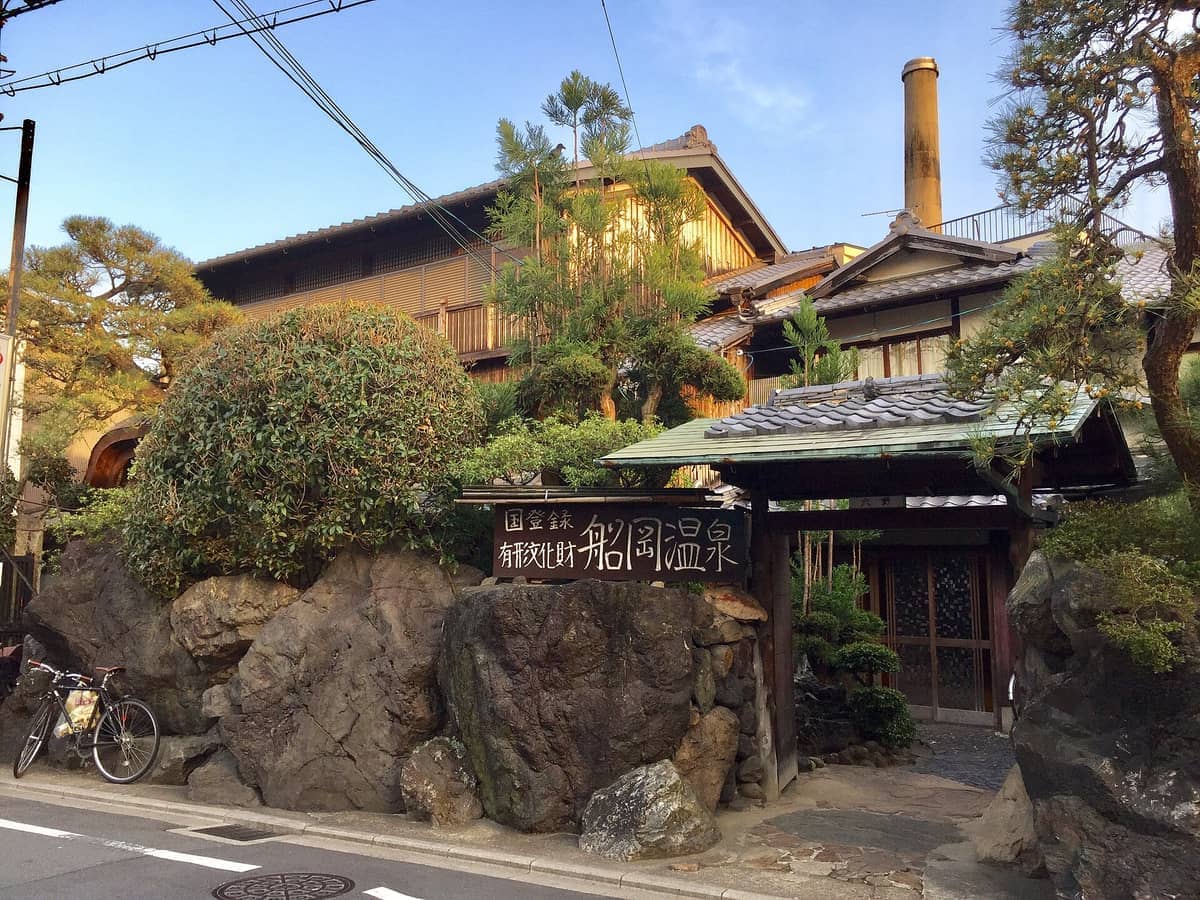
Built in 1923 and registered as a Tangible Cultural Property of Japan, Funaoka Onsen is a rare survivor of Taishō-era sento architecture in Kyoto's traditional Nishijin weaving district. Admission costs around ¥550, the carved wooden interiors are extraordinary, and almost everyone soaking alongside you is a local.
Quick Facts
- Location
- 82-1 Murasakino Minamifunaokacho, Kita Ward, Kyoto (near the Nishijin district)
- Getting There
- City Bus 206 to Senbon-Kuramaguchi stop, then 5 min walk; or Karasuma Line subway to Kuramaguchi Station, then 20 min walk
- Time Needed
- 45–90 minutes
- Cost
- Around ¥550 per adult (cash only; verify on arrival)
- Best for
- Architecture lovers, solo travelers, anyone wanting an authentic local experience away from tourist circuits
- Official website
- http://funaokaonsen.net/index.html
What Funaoka Onsen Actually Is
Funaoka Onsen is a public bathhouse, or sento, that has operated continuously in Kyoto's Nishijin district since 1923. Unlike a resort onsen or a ryokan with private baths, a sento is a neighborhood institution where local residents pay a small fee to bathe communally. The ritual is straightforward: you pay at the front desk, strip down in a changing room, wash yourself thoroughly at a tiled station with a hand shower, and then ease into a shared bath. No swimsuits, no spa branding, no tourist theater.
What sets Funaoka Onsen apart from the thousands of other sento that once dotted Japanese cities is its architecture. The building, constructed in the Taishō period and registered as a Tangible Cultural Property of Japan, is a rare example of ornate public bathhouse design that survived the Second World War, postwar rebuilding, and the slow death of the sento industry in the twentieth century. It is not a reconstruction or a revival. The carved wooden friezes, painted tiles, and lacquered fittings you see are original, maintained in a working building that charges you the standard city rate to use them.
ℹ️ Good to know
Hours changed in November 2025. Current schedule: Mon, Wed, Thu, Fri, Sat 15:00–23:30; Sun 08:00–23:30. Closed Tuesdays. Always check the official site before visiting, as these details may evolve.
The Architecture: Why This Building Matters
The entrance to Funaoka Onsen announces itself before you step inside. The facade is built in a style that blends traditional Japanese carpentry with Meiji and Taishō-era decorative ambition: heavy timber framing, a sweeping roof line, and wooden carvings that frame the doorway with the density of a temple gate. The effect is almost surprising on a quiet residential street in Nishijin, where most surrounding buildings are low-rise machiya townhouses or plain postwar concrete.
Inside, the changing rooms preserve their original wooden lockers and wicker baskets for storing clothes, a detail that has not been swapped out for plastic. The bathing hall itself features tiled murals depicting scenes from Japanese history and mythology. The craftsmanship in the tile work is precise enough to reward close inspection, though the steam and the social rhythm of the bath mean most visitors absorb it gradually rather than standing and studying it.
The building dates from 1923, placing it in the heart of the Taishō era, a period when Japan was rapidly modernizing while simultaneously cultivating a romantic interest in traditional aesthetics. Public bathhouses of this era were often deliberately grand, functioning as neighborhood landmarks and social anchors in districts where most homes lacked private baths. Funaoka Onsen was built to impress, and the 1923 structure has largely survived intact.
Tickets & tours
Hand-picked options from our booking partner. Prices are indicative; availability and final rates are confirmed when you complete your booking.
Kobe: Mt. Rokko Night View, Kitano Ijinkan, Arima Onsen Full Day Tour
From 47 €Instant confirmationFree cancellationKobe Sanda Outlets, Arima Onsen & Mount Rokko Night View Day Tour
From 48 €Instant confirmationFree cancellationKyoto Coast, Amanohashidate and Ine Bay 1-Day Trip from Osaka or Kyoto
From 46 €Instant confirmationFree cancellationKyoto Sanzen-in, Arashiyama and Bamboo Grove Full Day Tour
From 47 €Instant confirmationFree cancellation
The Bathing Experience: What to Expect Inside
The front desk is staffed by attendants who can see into both the men's and women's changing areas from a central position above, in the traditional sento arrangement called a bandai. You pay your entry fee here, around ¥550 as of 2025–2026, which is the standard Kyoto city sento rate. Towels and small toiletries are available to purchase if you have not brought your own. Bring cash; card payment is not standard practice at a traditional sento like this.
The baths are separated by gender. On the men's side, there are typically several pools at different temperatures, plus a rotenburo, an outdoor bath positioned in a small garden area, which is one of the more atmospheric features of the property. The outdoor bath is open to the sky, and on cooler evenings you can sit in warm water and look up at a narrow rectangle of night above the wooden walls. The water quality varies: Funaoka Onsen supplements its heated tap water with some mineral water, though it is not a natural hot spring in the geological sense.
Shower stations line the walls of the main bathing room. The standard protocol is to wash and rinse yourself completely before entering any shared pool. This is not enforced by signs so much as by social expectation: everyone around you will be doing it, and not doing it is conspicuous. For first-time visitors to a Japanese public bath, watching how other bathers move through the space for a few minutes is the fastest way to understand the rhythm.
💡 Local tip
Bring a small towel (around 34x90 cm is standard). Larger bath towels stay in the changing room; the small towel is used for modest covering while moving around and can be set on the side of the pool while you soak. Soap and shampoo are available for purchase at the entrance if you forget.
Time of Day and Crowd Patterns
On weekdays, the bath opens at 15:00 and the first hour tends to be quiet, populated mostly by retired residents who have made the afternoon bath a fixed part of their daily routine. The pace is unhurried and the atmosphere is genuinely calm. If you want the best combination of atmosphere and space, the period between 15:00 and 17:30 on a weekday is the practical optimum.
By early evening, the after-work crowd arrives and the changing rooms and pools fill up considerably. This is not an unpleasant experience, but the contrast with the quiet afternoon session is significant. On Sundays, the extended morning opening from 08:00 means you can arrive early and have the baths largely to yourself, with morning light filtering into the changing room and the building at its most serene.
Weekend evenings are the busiest periods, and the queue at the front desk can back up briefly. The bathhouse is not large, so capacity is a practical reality. Avoid arriving in the last thirty minutes before closing if you want enough time to soak properly without feeling rushed by the clean-up process.
Nishijin: The Neighborhood Context
Funaoka Onsen sits in Nishijin, Kyoto's historic weaving district, which produced the silk textiles used in imperial and temple ceremonial dress for centuries. The neighborhood has a particular character: older than Gion, less photographed, with long residential streets interrupted by small shrines, machiya workshops, and fabric wholesalers. Walking to the bathhouse from the bus stop takes you through the kind of Kyoto that does not appear on most itineraries.
The closest major landmark is Kitano Tenmangu Shrine, about fifteen minutes on foot to the southwest. If you are combining the bathhouse with a broader afternoon in the northern city, consider pairing it with a visit toKitano Tenmangu Shrineearlier in the day and ending at Funaoka Onsen when it opens in the afternoon. The contrast between a busy shrine precinct and the quiet ritual of the bath makes for a coherent and satisfying half-day.
For context on how this kind of bathing culture fits into Kyoto's broader range of onsen and hot spring experiences, theKyoto onsen guidecovers the spectrum from resort facilities to neighborhood sento.
Practical Details and Getting There
The most convenient route from central Kyoto is Kyoto City Bus 206, which runs frequently from Kyoto Station and takes about 30 minutes to reach Senbon-Kuramaguchi. From there, Funaoka Onsen is about a five-minute walk. The bus can be slow during rush hour; allow extra time. Alternatively, the Karasuma Line subway to Kuramaguchi Station puts you about twenty minutes on foot from the bathhouse, which is a reasonable walk through residential streets if you are not in a hurry. A taxi from downtown Kyoto takes around fifteen minutes and costs roughly ¥1,500.
The address in Japanese is 船岡温泉, Murasakino Minamifunaokacho 82-1, Kita Ward. Showing the kanji to a taxi driver is the most efficient approach if your Japanese is limited.
⚠️ What to skip
Funaoka Onsen is a historic wooden building with traditional sento layout. There are steps and level changes inside; step-free access throughout the facility is not confirmed. Visitors with significant mobility limitations should contact the bathhouse in advance to discuss access.
Tattoos: Japan's public bath culture has traditionally excluded visible tattoos, and many sento continue this policy. Funaoka Onsen's approach to tattoo policy is not definitively documented in English-language sources; if this applies to you, contacting the bathhouse directly before your visit is advisable.
Who Will Enjoy This, and Who Might Not
Funaoka Onsen rewards travelers who are comfortable with communal nudity in a quiet, rule-governed environment and who have at least a passing interest in historical Japanese architecture and everyday urban culture. It is one of the more genuinely local experiences available in a city where much of the visitor infrastructure is organized around temples and traditional performance. If you are already curious about how ordinary Kyoto residents live, and especially if you have read about sento culture or explored topics likeKyoto's lesser-known experiences, this is a high-quality example of that kind of discovery.
Travelers who are uncomfortable with communal nudity, or who are looking for a spa experience with private facilities and English-language service, will find this experience a poor match. The staff are friendly but the interaction is minimal and in Japanese. There are no lockers with electronic keys, no branded amenity kits, and no menu of treatments. It is a bathhouse, not a wellness resort.
Families visiting Kyoto with young children should note that the experience requires children to follow standard sento protocol and remain in the correct gender section. For broader family planning across the city, theguide to Kyoto with kids offers more targeted suggestions.
Insider Tips
- The outdoor bath on the men's side is particularly atmospheric on cooler evenings in autumn and winter. If temperature comfort matters less to you, visiting in November or December gives you the most striking contrast between the cold air and the warm water.
- The Sunday morning session from 08:00 is typically one of the least crowded windows of the entire week. Arriving within the first hour gives you an almost meditative experience in a building that is usually quiet at that hour of the day.
- The wooden lockers in the changing room use a simple key system. Leave valuables at your accommodation rather than in the locker, which is adequate but not modern-secure.
- A small hand towel in a plain white or dark color is the practical choice. The traditional sento towel size (roughly 34x90 cm) is sold at the entrance for a modest fee if you arrive unprepared.
- The carved wooden friezes above the partition between the men's and women's bathing areas are among the finest details in the building. They are easy to miss when you are focused on the bathing ritual itself; take a moment to look up before you step into the pools.
Who Is Funaoka Onsen For?
- Architecture and design travelers with an interest in Taishō-era craftsmanship
- Solo travelers wanting to experience an authentic neighborhood ritual rather than a curated attraction
- Return visitors to Kyoto who have already covered the major temples and are looking for something with more local texture
- Travelers on a budget who want a culturally significant experience for under ¥600
- Anyone visiting in winter who wants an affordable and genuinely warming way to end an afternoon of sightseeing
Nearby Attractions
Other things to see while in Nishijin:
- Daitoku-ji Temple Complex
Daitoku-ji is a sprawling Rinzai Zen monastic complex in Kyoto's Nishijin district, containing roughly two dozen sub-temples set among raked gravel lanes, weathered mud walls, and ancient pines. The grounds are free to enter at any hour, while individual sub-temples charge modest admission to access some of Japan's most refined dry-landscape gardens.
- Kinkaku-ji (Golden Pavilion)
Kinkaku-ji is Kyoto's most photographed temple, a three-story gold-leaf pavilion reflected in a tranquil pond within a classical strolling garden. Here is everything you need to visit intelligently: the best times, crowd patterns, transit routes, and a clear assessment of the experience.
- Kitano Tenmangu Shrine
Founded in 947 and dedicated to the deity of scholarship, Kitano Tenmangu is one of Kyoto's most culturally layered shrines. Entrance to the main grounds is free, the plum grove is among the finest in the city, and on the 25th of every month the whole complex transforms into one of Kyoto's largest antique markets.
- Ninna-ji Temple
Founded in 888 AD and designated a UNESCO World Heritage Site, Ninna-ji Temple blends imperial history with striking architecture across freely walkable grounds. It is best known for the Omuro Sakura, a late-blooming dwarf cherry variety that draws visitors weeks after the city's other blossoms have fallen.