Jingo-ji Temple (Takao): Kyoto's Forgotten Mountain Sanctuary
Jingo-ji Temple rises from the forested slopes of Mount Takao in Kyoto's northwest corner, a 20-minute uphill walk from the nearest bus stop and a world away from the city's busiest temple districts. The site rewards the effort with ancient Buddhist halls, one of the finest autumn foliage settings in the Kansai region, and the curious ritual of hurling clay discs off a cliff into the Kiyotaki River gorge below.
Quick Facts
- Location
- 5 Umegahata Takaocho, Ukyo-ku, Kyoto City (Mount Takao area, northwest Kyoto)
- Getting There
- JR Bus Takao/Keihoku Line from Kyoto Station to Takao stop (about 50 minutes), then 20-min uphill walk. City Bus 8 from Shijo/Karasuma area to Takao is an alternative.
- Time Needed
- 2–3 hours on site; allow 1 hour each way for the bus journey from central Kyoto
- Cost
- Admission approximately ¥1,000 for junior high school students and adults (prices vary by source — verify at the gate). Elementary school students approx. ¥500.
- Best for
- Autumn foliage, Buddhist heritage, off-the-tourist-trail exploration, photography
- Official website
- http://www.jingoji.or.jp
What Jingo-ji Temple Actually Is
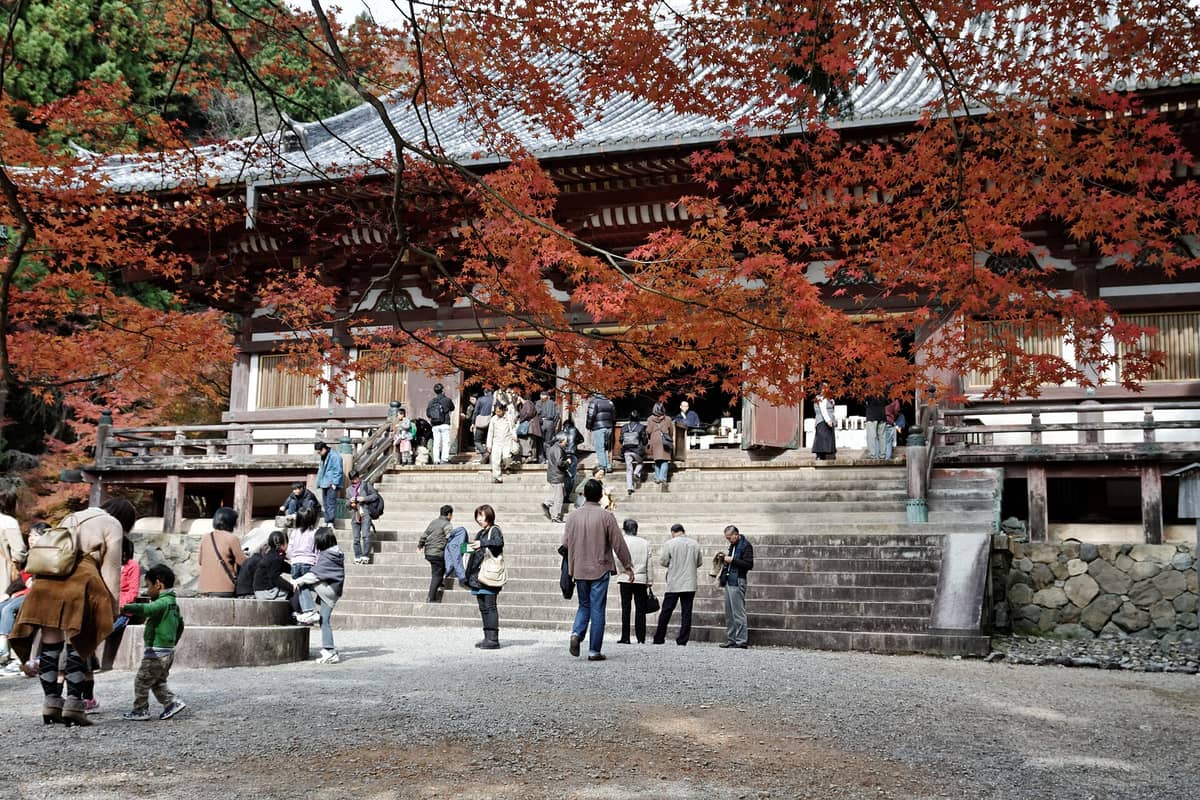
Jingo-ji (神護寺) is a mountain Buddhist temple on the forested slopes of Mount Takao, roughly 15 kilometres north of central Kyoto. It is one of the oldest temple sites in the region, affiliated with the Shingon school of esoteric Buddhism, and its grounds hold several Important Cultural Properties including Buddhist statues and sacred paintings that date back over a millennium. The temple is not a compact, strollable complex — it spreads across a steep hillside, connected by stone stairways and narrow paths through dense cedar and maple forest.
This is emphatically not a temple for visitors who want a quick photo stop between other sites. The approach from the bus stop alone takes around 20 minutes and involves a sustained climb. The reward is a place that genuinely feels removed from city life, where incense smoke drifts through tall trees and the sound of traffic is replaced by wind and river noise from the Kiyotaki gorge below.
⚠️ What to skip
The walk from the Takao bus stop to the main gate is uphill throughout and involves uneven stone steps. Visitors with limited mobility or knee problems should assess this carefully before making the trip. There is no accessible alternative route.
The Approach: What to Expect Before You Arrive
The JR Bus from Kyoto Station (Takao/Keihoku Line) is the most practical way to reach Takao. The journey winds northwest through increasingly forested terrain, and by the time you step off at the Takao or Yamashiro Takao stop, the atmosphere has already shifted. The bus timetable has gaps between departures, so checking schedules before you leave is worth doing — missing a bus here means a longer wait than missing one in central Kyoto.
From the bus stop, a path descends briefly toward the Kiyotaki River before climbing again up a long flight of stone steps. The steps are well-maintained but steep, and after rain they can be slippery in places. Comfortable walking shoes with grip are not optional. In summer the canopy provides shade, but the humidity of the climb still builds up quickly. In autumn, the same path is lined with maple trees turning red and orange, and it becomes one of the most photogenic approaches to any temple in Kyoto.
💡 Local tip
Pick up a bus timetable at Kyoto Station before departing. Return buses from Takao can be infrequent in the mid-afternoon, and the last bus back to the city runs earlier than you might expect.
Tickets & tours
Hand-picked options from our booking partner. Prices are indicative; availability and final rates are confirmed when you complete your booking.
Kyoto Coast, Amanohashidate and Ine Bay 1-Day Trip from Osaka or Kyoto
From 46 €Instant confirmationFree cancellationKyoto Sanzen-in, Arashiyama and Bamboo Grove Full Day Tour
From 47 €Instant confirmationFree cancellationKyoto Arashiyama insider walking tour
From 66 €Instant confirmationFree cancellationMatcha green tea tour in Kyoto's Uji Market
From 130 €Instant confirmationFree cancellation
Inside the Temple Grounds
The main gate, Romon, frames the final ascent to the principal buildings. The Kondo (main hall) and Daishi-do are the architectural anchors of the complex, their weathered timber and mossy stone bases conveying a sense of age that more heavily restored sites in central Kyoto do not always achieve. The buildings are not ornate in the way that Kinkaku-ji or Ninna-ji are — their appeal is in their austerity and their setting among the trees.
The temple treasures here, displayed in the Reihokan treasure house, include a National Treasure portrait of the monk Kukai (Kobo Daishi), who is closely associated with the site and with Shingon Buddhism in Japan. If you have an interest in early Japanese Buddhist iconography, this collection is unusually significant. Visitors with a broader interest in Kyoto's Buddhist heritage may also want to exploreDaitoku-jiin the city's north, which holds a very different but equally serious collection of Zen art and garden design.
One of the stranger and more enjoyable features of Jingo-ji is the kawarake throwing area near the Kizuna-an rest area on the bluff overlooking the Kiyotaki River gorge. Visitors purchase small unglazed clay discs and hurl them from the edge of the cliff. The ritual is tied to the idea of releasing bad luck, and the sight of the discs spinning out over the gorge and disappearing into the trees below has an oddly satisfying finality to it. It costs a small additional fee and is entirely optional, but it gives children and adults alike something physically engaging to do.
Time of Day and Seasonal Variation
Morning visits, particularly on weekdays, offer the quietest experience. The grounds are peaceful in a way that is difficult to find at Kyoto's more central temples, and the low light filtering through the trees in the first hours after opening gives the stone lanterns and mossy steps a particular quality. By midday on weekends, visitor numbers increase — not to the level of Fushimi Inari or Kiyomizu-dera, but enough to feel busier.
Autumn is Jingo-ji's defining season. The maple trees across the Takao area — including the forests around Jingo-ji, Saimyo-ji, and Kozan-ji, which together form what locals call the Three Takao Temples — turn red and gold from late October into November. The combination of the gorge, the temple architecture, and the foliage is genuinely exceptional, and this area is considered among the best autumn colour spots in Kyoto by those who know the city well. For context on when foliage peaks across the city, theguide to Kyoto in autumn has detailed timing information.
Winter strips back the foliage and makes the stone architecture and dark timber of the halls more prominent. The approach path can be cold and damp, and on very cold days the steps may be icy. Spring brings softer greenery but Jingo-ji is not known for cherry blossoms in the way some central Kyoto sites are — those looking for spring colour are better served by the city's more established sakura spots.
ℹ️ Good to know
The Takao area hosts three historic temples close together: Jingo-ji, Saimyo-ji, and Kozan-ji. If you are already making the journey northwest, a half-day covering all three is a reasonable ambition for a reasonably fit visitor.
Photography Notes
The most photographed views at Jingo-ji are the stone stairway approach lined with cedar and maple, the Romon gate framing the sky above it, and the kawarake throwing area looking out over the gorge. In autumn, any point along the approach path gives strong colour. A wide-angle lens handles the forest canopy well; a telephoto helps with the gorge view and with picking out architectural detail on the hall rooflines.
Overcast days are often better than bright sunshine here — the forest light diffuses nicely without harsh shadows on the steps or the timber halls. The treasure house interiors are dim and photography restrictions apply to the sacred objects on display, so check signage before raising a camera inside.
Honest Assessment: Is the Journey Worth It?
Jingo-ji takes real commitment. The bus journey from central Kyoto, the uphill walk, and the admission cost all add up, and the site does not offer the instant visual payoff of, say, theGolden Pavilion or the Arashiyama bamboo grove. What it offers instead is atmosphere, architectural integrity, and a real sense of remove from the city.
For visitors on a short itinerary who are ticking off central highlights, Jingo-ji is probably not the right call. For those who have already seen the major sites and want something with more texture — or who are visiting in autumn specifically — it earns its place in a Kyoto itinerary. The Takao district as a whole is under-visited relative to its quality, and that is its main advantage over almost everywhere else in the city.
If you are building a longer Kyoto trip and looking for similar off-the-beaten-path experiences, theguide to Kyoto's lesser-known attractionscovers several destinations that share Jingo-ji's character: significant history, natural settings, and noticeably smaller crowds than the city centre. TheKurama-dera templeto the northeast offers a broadly similar experience — a mountain approach, ancient Buddhist buildings, and forest scenery — for comparison.
Practical Information Summary
- Opening hours: 9:00–16:00 daily (no regular closing days, but verify around major holidays)
- Admission: approximately ¥1,000 for junior high school students and adults, ¥500 for elementary students — confirm at the gate as published figures vary
- Getting there: JR Bus Takao/Keihoku Line from Kyoto Station to Takao stop (about 50 minutes); City Bus 8 from the Shijo/Karasuma area to Takao is an alternative. Both require about a 20-minute uphill walk from the stop.
- Footwear: wear shoes with grip — the stone steps become slippery after rain
- What to bring: water, especially in summer; layers in winter; IC card or exact change for the bus
- Combining with other sites: Saimyo-ji and Kozan-ji temples are both within walking distance of Takao and can be visited the same day
Insider Tips
- The kawarake throwing area (near Kizuna-an) is on a promontory above the Kiyotaki River gorge. Go here first after entering, before the main hall climb, so you can take your time without rushing to catch a return bus.
- JR Bus timetables to Takao have significant gaps in the afternoon. Check the return schedule before you leave central Kyoto and set a mental deadline for heading back to the bus stop.
- The stretch of path between the bus stop and the temple entrance, running along and across the river, is itself one of the best autumn foliage walks in the Takao area — slow down here rather than rushing uphill to the temple.
- If visiting in autumn, aim for a weekday morning. Weekend afternoons in late October and early November see the highest visitor numbers by far, and the narrow approach path gets congested.
- The Reihokan treasure house may have specific viewing seasons for its most significant pieces. Check the temple's official website (http://www.jingoji.or.jp/) before visiting if the Buddhist art collection is a primary reason for your trip.
Who Is Jingo-ji Temple (Takao) For?
- Visitors returning to Kyoto who have already covered the central highlights and want depth over convenience
- Autumn foliage seekers looking for a forested mountain setting rather than a garden or riverside location
- Fans of early Japanese Buddhist art and Shingon heritage
- Hikers and walkers who enjoy an approach that is an experience in itself
- Photographers seeking atmospheric forest-and-temple compositions with fewer crowds in the frame
Nearby Attractions
Combine your visit with:
- Byodo-in Temple
Byodo-in Temple in Uji City is one of Japan's most photographed and historically significant Buddhist sites. Built in 1053, its Phoenix Hall appears on the 10-yen coin and draws visitors for its garden, gilded interior, and hilltop museum. A day trip from Kyoto that genuinely rewards the effort.
- Kamigamo Shrine
Kamigamo Shrine, formally known as Kamo Wakeikazuchi Jinja, is one of Kyoto's oldest Shinto shrines and part of the UNESCO World Heritage Site 'Historic Monuments of Ancient Kyoto.' Set in the quiet northern reaches of the city, its wide gravel forecourt, twin sand cones, and cedar-forested riverbank create an atmosphere that feels genuinely removed from the tourist circuit.
- Katsura Imperial Villa
Katsura Imperial Villa is a 17th-century detached imperial palace in western Kyoto, considered the pinnacle of Japanese garden design and shoin-style architecture. Access is by guided tour only, with strict booking requirements — but for those who plan ahead, it is one of the most quietly extraordinary places in Japan.
- Kyoto Botanical Gardens
The Kyoto Botanical Gardens (京都府立植物園) in Sakyo Ward is Japan's oldest public botanical garden, covering formal garden beds, wide open lawns, and a large tropical conservatory. It draws both serious plant lovers and locals out for a quiet afternoon walk, and rewards visitors who time it right.