Selfridges London: The Department Store That Reinvented Shopping
Opened in 1909 by Harry Gordon Selfridge, Selfridges on Oxford Street is far more than a place to buy things. It's an experience in scale, curation, and spectacle that has shaped how Londoners — and visitors — think about retail. Here's how to approach it like a seasoned shopper.
Quick Facts
- Location
- 400 Oxford Street, London W1A 1AB (West End)
- Getting There
- Bond Street (3-min walk); Marble Arch (6-min walk) — Central, Jubilee and Elizabeth lines at Bond Street; Central line at Marble Arch
- Time Needed
- 1.5 to 3 hours depending on floors visited
- Cost
- Free to enter; no admission charge
- Best for
- Fashion lovers, beauty buyers, food hall grazers, architecture admirers
- Official website
- www.selfridges.com
What Selfridges Actually Is (and Why It Still Matters)
Selfridges opened on 15 March 1909 at 400 Oxford Street, and it changed the nature of urban retail in Britain almost overnight. Before Harry Gordon Selfridge brought his American-inflected vision to Oxford Street, department stores were transactional places — staff approached customers, goods were kept behind counters, and browsing was not really encouraged. Selfridge flipped the model: open displays, perfume and cosmetics at the entrance (a layout still copied globally today), theatrical window dressing, and a philosophy that shopping should feel like an event.
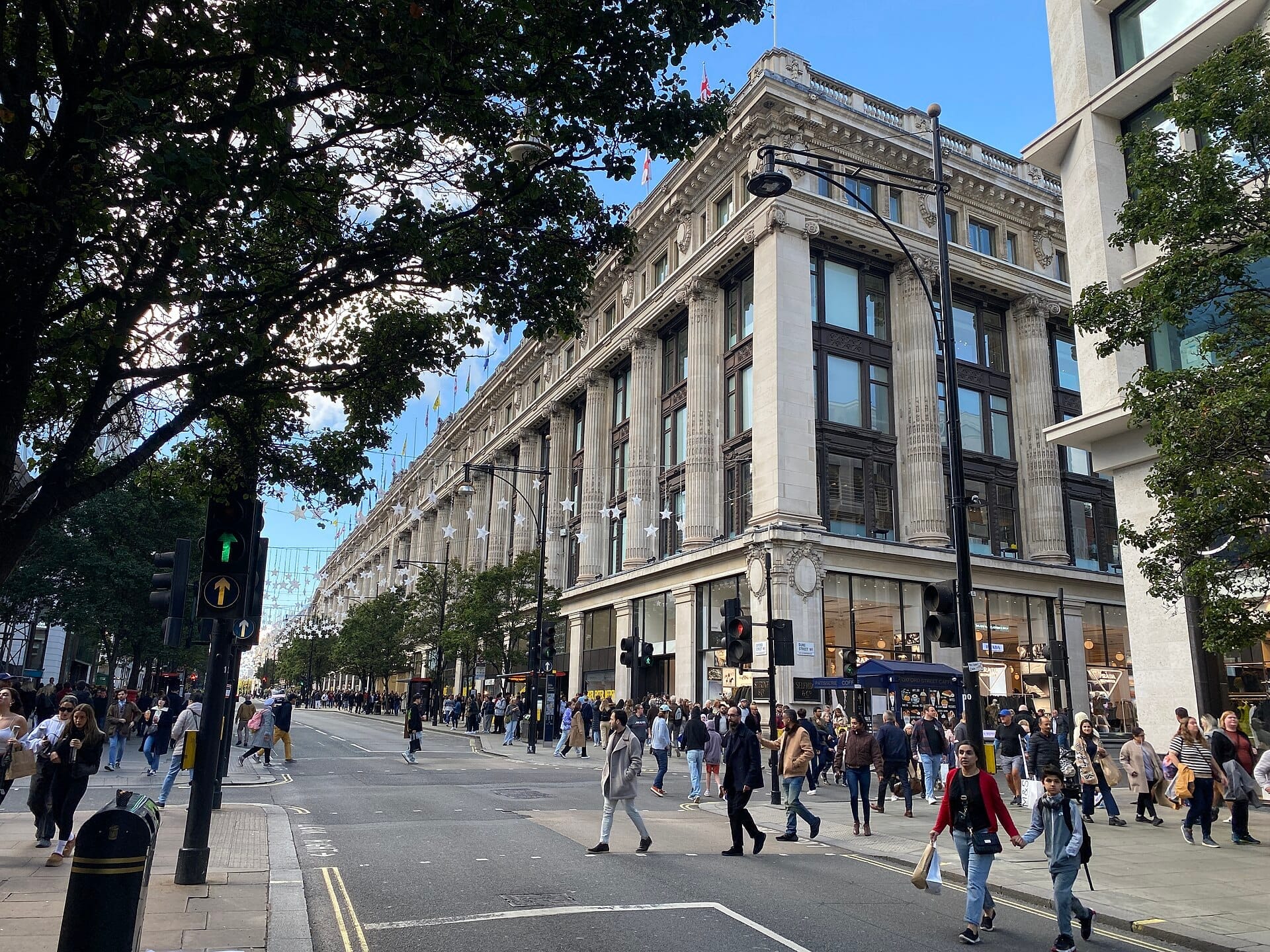
More than a century later, Selfridges still occupies that same position in London's retail landscape. It sits at 400 Oxford Street, occupying a commanding neoclassical block with its distinctive Ionic columns running the length of the facade. The building alone is worth a few minutes of attention from the pavement, particularly the central section where the columns reach their full height and the proportions feel almost Roman.
For anyone building a broader West End day, Selfridges sits at the quieter, slightly less chaotic western end of Oxford Street, making it a natural anchor for a morning or afternoon that also takes in Oxford Street or a loop through the West End more broadly.
The Building and the Ground Floor
Step inside and the first thing you notice is the smell: a dense, layered wave of fragrance from dozens of perfume counters arranged across the ground floor. This is not accidental. It was Selfridge's original idea to place cosmetics and perfume at street level, and the store has kept faith with that logic ever since. The ground floor is also where the lighting is most considered — warm, diffused, designed to make skin tones and product colours look their best. Compared with the harsher overheads upstairs, the ground floor has an almost theatrical quality.
The counters here represent some of the most complete beauty and fragrance retail in London. Niche perfume houses sit alongside global flagship brands, and the staff-to-customer ratio is noticeably higher than at comparable retailers. If you want to test obscure fragrances without the pressure of a boutique, this is one of the few places in London where that works comfortably.
💡 Local tip
Arrive before 11am on a weekday if you want the ground floor to yourself. By midday, the fragrance counters attract significant crowds, and the noise level rises considerably. Early mornings are quieter and staff have more time for questions.
Tickets & tours
Hand-picked options from our booking partner. Prices are indicative; availability and final rates are confirmed when you complete your booking.
Soho Instagram a self-guided walking tour to top photo spots
From 6 €Instant confirmationFree cancellationTootbus London by Night: Bus tour
From 32 €Instant confirmationFree cancellationIFS Cloud Cable Car Ride and Uber Boat Hop-on Hop-off 1 Day Ticket
From 38 €Instant confirmationFree cancellationThe Making of Harry Potter Guided Tour of London Warner Bros. Studio
From 201 €Instant confirmationFree cancellation
The Food Hall: Underrated and Worth Seeking Out
The lower ground floor food hall is one of Selfridges' most compelling sections for travellers who are not primarily here to shop for clothes. The range is serious: charcuterie, cheese, fresh bread, patisserie, Japanese convenience foods, caviar, and an unusually broad selection of UK-produced goods. It operates at a premium, but the quality justifies the prices in most categories.
There are sit-down and counter-dining options integrated within the food hall, making it a reasonable choice for a mid-shopping lunch that avoids the predictable chain restaurants lining Oxford Street. The crowd here tends to be a mix of tourists, local office workers, and food-focused shoppers rather than the broader retail mass — which makes the atmosphere noticeably calmer than the floors above.
Selfridges' food offering is substantial, but it is not the only serious food market experience in central London. Borough Market in Southwark remains the benchmark for scale and produce variety if food is your primary focus.
Fashion, Homeware, and the Upper Floors
Selfridges carries an unusually broad mix of price points across its fashion floors, from accessible contemporary brands to high-end designer labels occupying their own shop-in-shop spaces. The curation is generally more adventurous than at comparable UK department stores, with a visible appetite for emerging designers alongside established luxury names. The womenswear and menswear floors occupy multiple levels, and the layout can feel labyrinthine on a first visit — there are no strict grids, and departments bleed into each other in a way that encourages wandering.
The fourth-floor homeware and design sections reward browsers with an eye for contemporary design. Kitchenware, stationery, furniture, and lifestyle objects are curated with more editorial intent here than in most department stores, and the selection of design-led products makes it a reasonable source for considered gifts.
ℹ️ Good to know
Selfridges is typically open Monday to Saturday from 10:00am to around 9:00pm and Sunday from late morning to early evening; check the official website for current hours before visiting. Sunday hours are significantly shorter, so plan accordingly if visiting on a weekend.
When to Go and How Crowds Behave
Selfridges on a Saturday afternoon in the pre-Christmas period is an exercise in crowd management. The store fills from around noon, the escalators queue, and the ground floor fragrance area becomes difficult to navigate without purpose. If your goal is browsing or discovery, this is not the experience to seek out. Weekday mornings — particularly Tuesday through Thursday between 10am and 12pm — offer a fundamentally different atmosphere: quieter, more spacious, and with sales staff who have time to engage properly.
Summer weekends bring a sustained tourist presence throughout the day, and the windows, which Selfridges invests in heavily as seasonal installations, attract clusters of photographers on Oxford Street itself. If you want to photograph the exterior without crowds, early Sunday mornings (before the store opens at 11:30am) give you the best chance, when Oxford Street is at its quietest.
The January and summer sale periods draw very large queues before opening, sometimes stretching along the Oxford Street facade. These are not situations for casual visitors — they are high-intensity retail events for buyers with specific items in mind. Worth knowing about if you're in London during those periods, but not a reason to plan a trip around.
⚠️ What to skip
Oxford Street as a whole becomes extremely crowded on weekends and during school holidays. If you are travelling with young children, a pushchair, or have mobility limitations, midweek mornings are strongly preferable. The store itself has lifts throughout, but weekend crowds make them slower.
Getting There and Practical Notes
Bond Street station, served by the Central, Jubilee and Elizabeth lines, puts you within a three-minute walk of the main entrance. Exit towards Oxford Street and turn left (east) and Selfridges' columned facade is immediately obvious. Marble Arch station on the Central line is six minutes away and deposits you at the western end of Oxford Street, making it a slightly longer walk but a useful alternative if Bond Street is congested.
Multiple bus routes serve Oxford Street, though TfL's restrictions on through-traffic mean journeys along the full length can be slower than the Tube during peak hours. The Elizabeth line at Bond Street (accessed via its own entrance nearby) provides fast connections from Paddington, the City, and Canary Wharf — making Selfridges convenient from almost anywhere in central London.
There is no dedicated visitor parking. Driving to Oxford Street is strongly inadvisable given the traffic restrictions in place and the relative ease of public transport access. The Congestion Charge zone covers this area, and parking options within walking distance are limited and expensive.
If Selfridges is part of a broader shopping day, consider pairing it with Carnaby Street to the east (around 15 minutes on foot) for a very different retail character, or heading towards Liberty London on Great Marlborough Street, which offers a more intimate, Arts and Crafts interior and a tighter, more curated selection.
Who Will Love It, and Who Might Not
Selfridges rewards people who enjoy scale, variety, and the experience of a well-operated retail space. For fashion enthusiasts, beauty buyers, or anyone looking for serious homeware or food, it earns its reputation. The window displays and the building's exterior are also worth seeing, even if you have no intention of buying anything.
Visitors looking for something culturally specific to London, or those expecting the kind of compressed historical experience that the city's museums and monuments offer, may find Selfridges underwhelming as a destination in its own right. It is, ultimately, a department store — an exceptional one with real historical significance, but primarily a place for shopping rather than sightseeing. If your time in London is limited and retail is not a priority, there are stronger candidates for those hours.
For a fuller picture of how to allocate limited time in the West End and beyond, the 3-day London itinerary offers a practical framework that balances shopping, culture, and the city's major sights.
Insider Tips
- The Wonder Room on the ground floor carries fine jewellery, watches, and some of the more unusual luxury objects in the store. It is a distinct space with its own lighting and feel, and is significantly quieter than the main beauty floor even when the store is busy.
- Selfridges' own-brand food packaging makes for practical, reasonably priced gifts. The yellow carrier bag is recognisable worldwide, and the food hall's packaged goods — jams, biscuits, chocolates — are a solid alternative to the more touristy options available elsewhere on Oxford Street.
- The store's window displays change seasonally and are taken seriously as creative commissions. Walking the full length of the Oxford Street and Duke Street facades before entering is worth five minutes of your time, particularly around Christmas, when they attract genuine critical attention.
- If you need a quiet rest during a busy West End day, the upper-floor restaurant and cafe spaces are noticeably calmer than street-level cafes on Oxford Street and offer decent food at moderate prices. Midweek lunchtime is the sweet spot for finding a seat.
- Selfridges participates in tax-refund services for eligible non-UK visitors on qualifying purchases; the dedicated desk handles paperwork, but be aware that processing time at busy periods can run 20 to 30 minutes. Factor this in if you are buying high-value items and want to claim before departing the UK.
Who Is Selfridges For?
- Fashion and beauty enthusiasts wanting London's most comprehensive luxury-to-contemporary range under one roof
- Food lovers looking for a serious alternative to chain supermarkets for specialty and premium produce
- Architecture-minded visitors interested in the early 20th-century neoclassical Oxford Street facade
- Shoppers from outside the UK who want a single location covering multiple categories and tax-refund services
- Anyone building a full West End day who wants a central, well-serviced anchor point mid-route
Nearby Attractions
Other things to see while in West End:
- British Library
The British Library holds over 170 million items spanning thousands of years of human thought, from the Magna Carta to Beatles lyrics. Entry to the building and permanent collection galleries is free, making it one of the most rewarding stops in central London for curious travellers.
- British Museum
The British Museum holds one of the world's great collections of human history and culture, spanning two million years across more than 60 free galleries. Entry to the permanent collection is free, but knowing how to navigate the scale of it makes the difference between a rewarding visit and an overwhelming one.
- Carnaby Street
Carnaby Street is the pedestrianised shopping district in Soho that defined the look of 1960s London and continues to draw fashion lovers, food hunters, and curious walkers today. Free to explore and five minutes from Oxford Circus, it rewards those who slow down and wander its connecting lanes.
- Coal Drops Yard
Coal Drops Yard is a redeveloped Victorian industrial estate in King's Cross, now home to independent retailers, restaurants, and bars set beneath strikingly restored brick vaults. The public outdoor spaces are free to enter and a short walk from King's Cross St Pancras station.