Rotonda della Besana: Milan's Most Surprising Former Cemetery
Built between 1695 and 1732 as a burial ground for the Ospedale Maggiore, the Rotonda della Besana is a late-Baroque complex of striking architectural beauty. Today it functions as a free public garden and culture centre, with a children's museum inside the central church. Few places in Milan carry this much layered history so quietly.
Quick Facts
- Location
- Via Enrico Besana, near Piazza Cinque Giornate, Milan
- Getting There
- Tram and bus lines serving Piazza Cinque Giornate (ATM Milan); no direct metro stop
- Time Needed
- 30–60 minutes for the garden and exterior; longer if visiting MUBA inside
- Cost
- Free to enter the outdoor garden and portico; MUBA children's museum charges separately (verify current prices at muba.it)
- Best for
- Architecture lovers, families with children, locals seeking a quiet green pause, photographers
What the Rotonda della Besana Actually Is
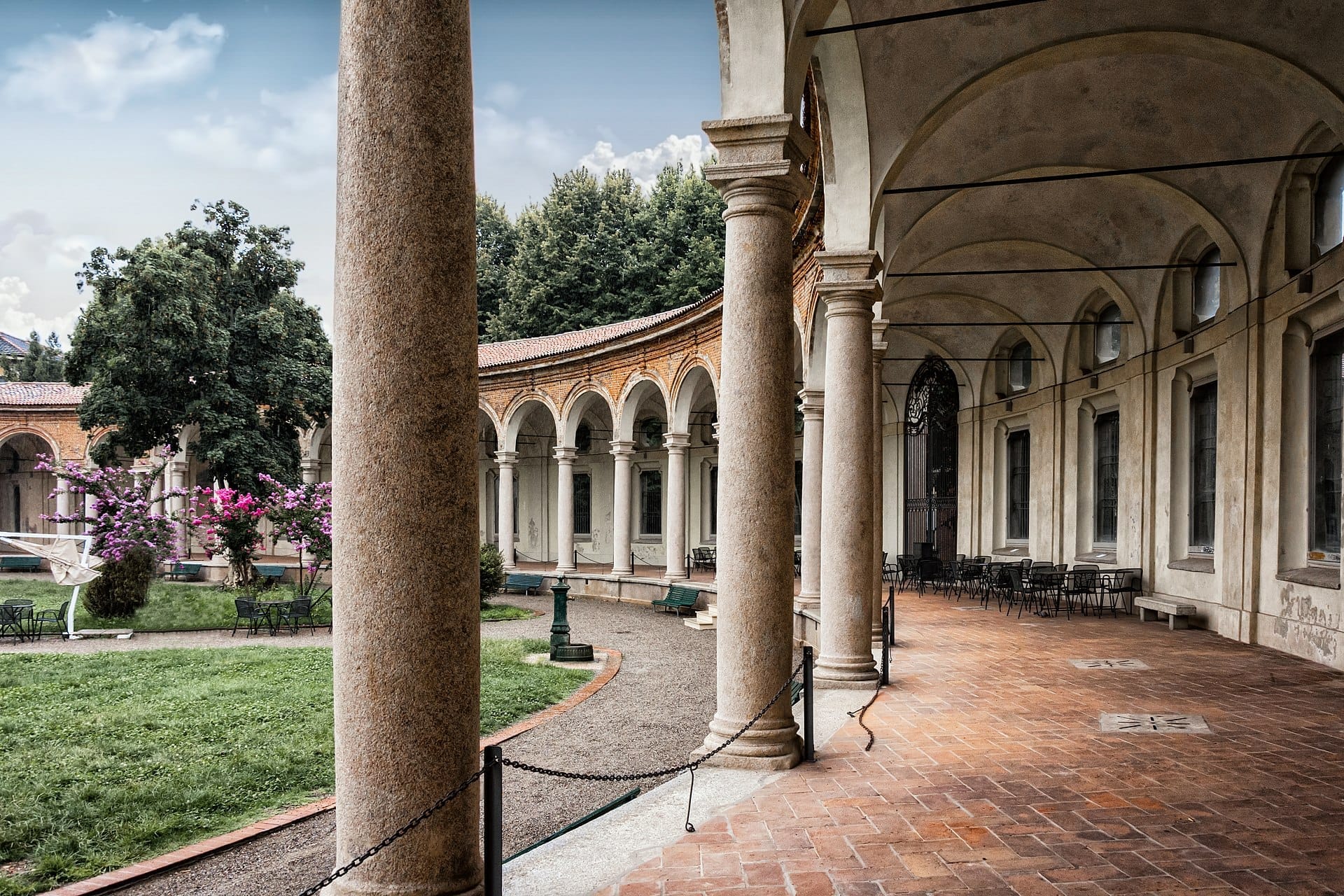
The Rotonda della Besana is one of those places that rewards the visitor who looks past the surface. From Via Enrico Besana, it announces itself with a long, curving brick portico of late-Baroque severity: no gilding, no grand entrance, just the muted terracotta of Lombard brickwork forming a continuous colonnade that wraps around the entire perimeter. Step through the gate and you find yourself in a circular green garden, with the former church of San Michele ai Nuovi Sepolcri sitting at the centre like a squat, self-contained chapel in an open field.
What looks like a peaceful city park was, for most of its early history, a cemetery. The complex was built between 1695 and 1732 to serve as the burial ground for patients of the Ospedale Maggiore, the large public hospital known as Ca' Granda. During restoration excavations, archaeologists uncovered the remains of approximately 150,000 people buried within the grounds. The scale of that figure, set against the serenity of the current garden, gives the place a particular weight that visitors often remark upon without quite knowing why.
ℹ️ Good to know
The garden is open daily, generally from 07:00 until between 20:00 and 22:00 depending on the season, and admission to the outdoor complex is free. The MUBA children's museum inside the central church operates on its own schedule and requires a separate ticket — check muba.it before visiting with children.
Architecture and Historical Context
The architectural form of the Rotonda is unusual enough to stop you mid-step. The surrounding colonnade is not a true circle but a polylobate shape, sometimes described as a lobate octagon, formed by a sequence of convex brick bays that ripple outward slightly at regular intervals. The effect from inside the garden is of a softly undulating wall of arches, the rhythm broken only by the entrance gate and a few secondary openings. The brickwork has the textured warmth typical of Lombard late-Baroque construction, closer in material spirit to the city's older churches than to the marble grandeur of the Duomo.
The central church, San Michele ai Nuovi Sepolcri (Saint Michael at the New Graves), was built as part of the original cemetery complex. Its circular plan echoes the broader geometry of the enclosure. The church's name tells you exactly what it was: a funerary chapel for a site still, in the early 18th century, considered to lie beyond the city's populated core. For context on how this relates to Milan's broader ecclesiastical heritage, the Milan churches guide covers the city's most significant religious buildings, many of which share this same Lombard brick character.
After cemeteries were moved outside the city walls under Austrian rule in the late 18th century, the Rotonda lost its original purpose. Over the following decades it was repurposed as barracks, then a hay loft, and at some point a laundry. These are the indignities that befall ecclesiastical buildings when their original function disappears. The Municipality of Milan acquired the property in 1958 and undertook restoration works, converting it into a public garden and cultural space. Since 2014, the church interior has housed MUBA, the Museo dei Bambini di Milano.
Tickets & tours
Hand-picked options from our booking partner. Prices are indicative; availability and final rates are confirmed when you complete your booking.
Audio guide for the Last Supper in Santa Maria delle Grazie
From 4 €Instant confirmationDuomo Cathedral private tour with a local guide
From 105 €Instant confirmationFree cancellationSforza Castle entry and self-guided tour
From 15 €Instant confirmationFree cancellationSkip-the-line Duomo tour in Milan
From 40 €Instant confirmationFree cancellation
How the Experience Changes Through the Day
Early mornings bring joggers doing loops around the garden path, the portico still in shadow, the grass carrying the particular damp smell of a lawn in a city that doesn't get much direct sun until later in the morning. At this hour, the space has the quality of a private courtyard rather than a public park. The surrounding brick absorbs the low light differently than stone would — it's matte, warm, slightly rough when you run a hand along the columns.
By mid-morning on weekdays, the garden fills with local parents and small children, especially if MUBA has a morning program running. The energy shifts accordingly: strollers, raised voices, a line forming at the entrance to the museum. On weekday afternoons, after the school-age crowd has cleared out, the complex settles back into relative quiet. Office workers from the surrounding Porta Romana and Porta Vittoria neighborhoods sometimes bring lunch here. The bistro inside the complex, Rotonda Bistrò, serves food and drinks Tuesday to Sunday from 10:00 to 21:00 and is closed on Mondays, though hours may vary for events.
In the evening, particularly in late spring and summer, the garden takes on a different atmosphere entirely. The lighting is low, the brick of the portico glows amber rather than terracotta, and the relative obscurity of the space means it retains a local crowd rather than a tourist one. This is one of the clearest markers that you are somewhere Milanese rather than somewhere merely in Milan.
💡 Local tip
For the best light for photography, visit in the hour after sunrise or the hour before sunset. The polylobate portico casts distinctive shadow patterns in low-angle light, and the garden is at its least crowded in early morning.
MUBA: The Children's Museum Inside the Church
The Museo dei Bambini di Milano, known as MUBA, has occupied the former church of San Michele ai Nuovi Sepolcri since 2014. It is a dedicated children's cultural institution that uses the interior for rotating hands-on exhibitions and educational programs. The programming is aimed broadly at children up to age 11 or 12, with activities designed around art, creativity, and interactive learning. The combination of a working children's museum inside a late-Baroque funerary church is, architecturally speaking, quite strange in the best possible way.
If you're visiting Milan with children, MUBA can be combined usefully with the Museo Nazionale della Scienza e della Tecnologia Leonardo da Vinci, which offers extensive family-oriented exhibits across a much larger site. Both work well for a family day that stays away from the crowds around the Duomo. The Milan with kids guide has further suggestions for family-focused itineraries.
Tickets for MUBA are purchased separately from any general admission and should be booked in advance when possible, particularly on weekends and during school holidays when the museum fills quickly. Pricing and program schedules change seasonally — verify on muba.it before your visit.
Getting There and Navigating the Area
The Rotonda della Besana sits in the southeastern inner city, roughly between the historic Spanish Walls (Bastioni Spagnoli) and Piazza Cinque Giornate. There is no metro stop immediately adjacent, which is part of why the space remains relatively uncrowded. Tram and bus lines operated by ATM Milan serve Piazza Cinque Giornate, which is a short walk from the complex. Check the ATM app or website for current routes and stops before traveling.
On foot from the city centre, the walk from the Duomo takes roughly 20–25 minutes through streets that pass through the transitional neighborhoods between the historic core and the inner ring. It is a pleasant walk that gives a clearer sense of how Milan's residential fabric looks beyond the tourist-facing streets. The broader guide to getting around Milan covers public transport options in more detail.
The surrounding area includes Piazza Cinque Giornate, named for the five days of the 1848 Milanese uprising against Austrian rule, and marked by a notable monument. The street grid in this part of the city follows the semicircular trace of the Spanish Walls, giving it a slightly different rhythm than the grid-based inner center. Flat, walkable surfaces throughout make the area accessible to most visitors.
⚠️ What to skip
Accessibility details for the Rotonda della Besana and MUBA, including step-free entry and adapted toilet facilities, are not clearly documented in publicly available sources. Visitors with specific mobility requirements should contact the venue or MUBA directly before traveling.
Is It Worth Your Time?
If you are visiting Milan for two or three days and working through the canonical list of sights, the Rotonda della Besana probably does not displace the Duomo, the Last Supper, or the Pinacoteca di Brera. It is not that kind of place. It carries no masterwork, no single transformative object, no event that changed the course of history.
What it offers instead is scale, quiet, and a legible piece of Milanese history that most tourists never encounter. For travelers who have already covered the main circuit, or who are visiting Milan specifically for its architecture and urban character, it provides something the more famous sites cannot: the experience of being largely alone with a genuinely significant building. Those interested in the city's architectural range should also consider Milan's architecture guide for a fuller picture of what the city offers beyond its Baroque period.
Travelers who want active programming, coffee-shop culture, or shopping within steps of their attraction will find the immediate surroundings fairly quiet. The neighborhood around Via Besana is primarily residential. There is a bistro within the complex, but it does not operate year-round. Plan to combine this stop with Piazza Cinque Giornate or continue south toward the Navigli canal area, which is about a 25–30-minute walk away.
The Naviglio Grande makes a natural continuation of a walk from the Rotonda, particularly in the late afternoon when the canal-side bars begin to fill. Together, the two form a route that traces Milan from its 18th-century institutional past into the present.
Insider Tips
- Visit on a Tuesday or Wednesday morning for the fewest people — weekends bring families to MUBA and the garden fills quickly by 10:00.
- The portico walkway that rings the interior garden is a full loop. Walk it completely before entering the central garden to appreciate the architectural geometry from the inside edge.
- The bistro inside the complex operates seasonally and is not always open; if you are planning to eat or drink here, check current operating hours before you arrive.
- The brickwork of the portico photographs particularly well in overcast light, which flattens harsh shadows and reveals the texture of the Lombard masonry without the glare that direct sunlight creates.
- The surrounding area around Piazza Cinque Giornate has several good neighborhood bars and bakeries on Via Muratori and adjacent streets — a better option than retracing your steps to the tourist-heavy center for coffee.
Who Is Rotonda della Besana For?
- Architecture travelers who want to see late-Baroque Lombard construction without crowds
- Families with children visiting MUBA for a hands-on cultural experience
- Repeat visitors to Milan looking beyond the main circuit of sights
- Photographers seeking distinctive shadow and texture in a non-commercial setting
- Locals and visitors wanting a quiet green space away from the Duomo district
Nearby Attractions
Combine your visit with:
- Abbazia di Chiaravalle
Founded in 1135 by Saint Bernard of Clairvaux, the Abbazia di Chiaravalle is one of the earliest examples of Gothic architecture in northern Italy. Tucked into the agricultural parkland south of Milan, it remains an active Cistercian monastery and offers a rare counterpoint to the city's more trafficked landmarks.
- Idroscalo di Milano
Built in the late 1920s as a seaplane runway, the Idroscalo di Milano is now a sprawling park wrapping a roughly 0.8 km² artificial lake on Milan's eastern fringe. Entry to the park is free, the perimeter path stretches over 6 km, and the facilities range from open-air swimming pools to kayaking and concert venues. It is the closest thing Milan has to a beach resort within city reach.
- Pirelli HangarBicocca
Housed in a converted locomotive factory in Milan's Bicocca district, Pirelli HangarBicocca is one of Europe's largest single-storey exhibition spaces. Entry is free, shows are ambitious, and the permanent installation by Anselm Kiefer alone justifies the trip across town.
- San Siro Stadium (Stadio Giuseppe Meazza)
Stadio Giuseppe Meazza, universally known as San Siro, is Italy's largest football stadium and one of the most recognizable sports arenas in the world. Home to both AC Milan and Inter Milan, it holds 75,817 spectators and opens its doors to visitors through a guided stadium tour and dedicated museum. Whether you attend a match or explore on a quiet weekday morning, the sheer scale of the place makes an impression that photographs cannot prepare you for.