Abbazia di Chiaravalle: An Early Gothic Abbey South of Milan
Founded in 1135 by Saint Bernard of Clairvaux, the Abbazia di Chiaravalle is one of the earliest examples of Gothic architecture in northern Italy. Tucked into the agricultural parkland south of Milan, it remains an active Cistercian monastery and offers a rare counterpoint to the city's more trafficked landmarks.
Quick Facts
- Location
- Via Sant'Arialdo 102, 20139 Milan — Parco Agricolo Sud Milano, between the Vigentino and Rogoredo districts
- Getting There
- Best reached by Metro line M3 to Corvetto or Rogoredo, then bus 77 from Corvetto or bus 140 (Monday to Saturday) from Rogoredo to Via Sant'Arialdo. Check ATM Milano for current connections.
- Time Needed
- 1 to 2 hours, including the cloister and surrounding grounds
- Cost
- No admission fee is charged for entering the church; guided tours (which include the cloister and other spaces, especially on weekends) carry a ticket fee to be verified directly with the abbey.
- Best for
- Architecture lovers, medieval history, peaceful escapes from the city centre
- Official website
- www.monasterochiaravalle.it/it-it/storia-e-arte.aspx
What Is the Abbazia di Chiaravalle?
The Abbazia di Chiaravalle, formally known as the Abbazia di Santa Maria di Rovegnano, is a Cistercian monastic complex founded in 1135 by Saint Bernard of Clairvaux. It sits inside the Parco Agricolo Sud Milano, between the Vigentino and Rogoredo districts, in what was once a marshy, uncultivated stretch of the Po Valley. Cistercian monks from France arrived here, drained the land, and gradually built one of the most architecturally significant religious complexes in northern Italy.
The abbey is widely recognized as one of the earliest examples of Gothic architecture in northern Italy, though its forms still carry strong Romanesque roots. That transition is exactly what makes the building so interesting to study: pointed arches begin to assert themselves against the thick stone walls and earthbound proportions that define the Romanesque tradition. Chiaravalle did not follow the Gothic revolution — it was part of its first hesitant steps on Italian soil.
Critically, this is not a museum or a restored ruin. Cistercian monks continue to live and pray here, which means the space operates on their schedule and their terms. That active religious life shapes every part of the visitor experience, from the hours of access to the atmosphere inside the church itself.
⚠️ What to skip
Hours change without notice due to religious services and ongoing restoration work. As of the latest official information, the church and cloister are generally open Tuesday to Friday 09:00–12:00 and 15:00–17:00, and Saturday 09:00–12:00, with weekend afternoon access usually via guided visits; Art Bonus and the abbey itself specifically advise confirming by phone before making the trip. Do not arrive without checking first.
The Architecture: What You're Actually Looking At
The first thing that registers from the approach road is the tower. The lantern tower above the crossing is a distinctive Lombard structure, octagonal and tiered, rising above the church with a vertical confidence that sets it apart from the flat landscape around it. By 12th-century standards, this kind of verticality was a statement. Up close, the brickwork is precise and warm in color, particularly in afternoon light when the sun hits it from the south.
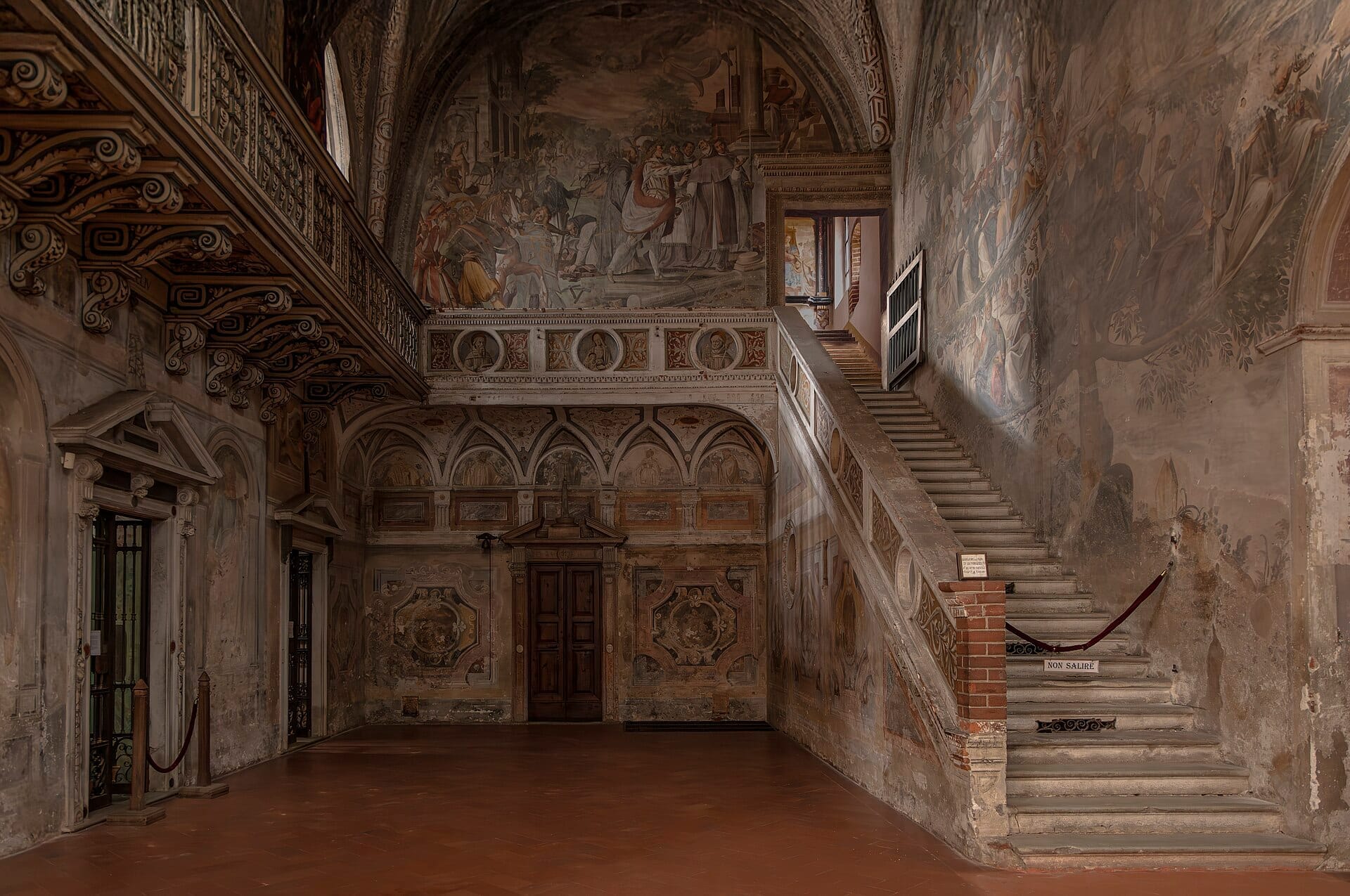
Inside, the church interior is austere in the way Cistercian houses were designed to be. Bernard of Clairvaux argued forcefully against decorative excess in religious buildings, and the early phases of Chiaravalle reflect that philosophy: stone, proportion, and light are the primary tools. Later centuries added frescoes and woodwork that soften the original severity somewhat, but the structural bones of the building remain unmistakably early medieval.
The cloister is the most rewarding part of the visit for those who appreciate spatial composition. Its arcaded galleries frame a central garden with quiet authority. The proportions feel calibrated rather than accidental, which is consistent with the Cistercian approach to architecture as a form of contemplative discipline. The stone smells faintly of damp even in dry weather, a consequence of the building's proximity to what was once wetland.
For a broader map of how this building fits into Milan's extraordinary church history, the Milan churches guide provides useful architectural context spanning multiple centuries and districts.
Tickets & tours
Hand-picked options from our booking partner. Prices are indicative; availability and final rates are confirmed when you complete your booking.
Duomo Cathedral private tour with a local guide
From 105 €Instant confirmationFree cancellationSforza Castle entry and self-guided tour
From 15 €Instant confirmationFree cancellationSkip-the-line Duomo tour in Milan
From 40 €Instant confirmationFree cancellationNavigli Canals of Milan private walking tour with a local guide
From 40 €Instant confirmationFree cancellation
The Setting: South Milan's Agricultural Park
Getting to Chiaravalle is part of the experience. The route from the city centre leads through neighborhoods that feel distinctly un-touristic, then opens into the Parco Agricolo Sud Milano, a protected agricultural belt that encircles the southern edges of the municipality. Working farms operate within sight of the abbey. On still mornings, the air carries the faint smell of cut grass and soil rather than the traffic exhaust that characterizes most Milan visits.
This setting is historically accurate. The Cistercians deliberately chose marginal, undeveloped land for their monasteries, and then transformed it through organized agricultural labor. Chiaravalle became an economic hub for the southern Milanese countryside, demonstrating how medieval monasteries functioned as engines of land management and rural productivity, not just places of prayer.
The parkland surrounding the abbey is pleasant for a short walk before or after the visit, particularly in spring and early autumn when the light is good and the fields are actively cultivated. In summer, midday heat on the open agricultural land can be tiring, and winter visits can be grey and damp given the Po Valley's tendency toward fog and overcast skies.
When to Visit and How It Feels at Different Times
Morning visits on a weekday, during the Tuesday to Saturday window, tend to offer the quietest experience. The church has a particular quality of light in the late morning hours when sunlight enters through the upper windows and falls across the stone floor at an angle. Sounds outside the complex — birdsong, distant farm machinery, the occasional passing vehicle — carry clearly in the surrounding silence, which creates an unusual sensory contrast with the dense acoustic environment of central Milan.
Sunday afternoon openings attract a slightly different crowd: local families, occasional groups organized through cultural associations, and visitors who specifically made the journey to see the abbey. The 15:00 to 17:00 window is narrow, so arrival by 15:00 is advisable to have adequate time in the cloister and church before the complex closes.
Avoid visiting on major religious feast days without confirming access in advance. The monastery community may prioritize liturgical use of the space, and public access could be restricted at short notice. The abbey's official site lists contact information for exactly this reason.
💡 Local tip
Spring (April to June) and early autumn (September to October) offer the most comfortable conditions both inside the abbey and in the surrounding park. Summer visits, especially in July and August, can be more demanding due to heat and occasional thunderstorms, while winter fog can be atmospheric but cold.
Getting There: A Practical Walkthrough
The abbey sits at Via Sant'Arialdo 102, in the southern area of Milan between the Vigentino and Rogoredo districts. It is not directly served by a Metro line, which means most visitors combine a Metro ride on line M3 to Corvetto or Rogoredo with a short onward journey by bus (77 from Corvetto or 140 from Rogoredo on weekdays) or on foot. Check ATM Milano's current route planner for up-to-date connections, as service configurations change.
By bicycle, the abbey is accessible via the Po Valley cycling paths that cut through the agricultural park. This is easily one of the more pleasant approaches, particularly on a clear morning in spring or autumn, and it allows visitors to arrive having already engaged with the landscape that defined the monastery's original context. Cycling hire is available at various points in the city.
Driving is straightforward in terms of navigation, but parking in the immediate vicinity is limited. Arriving by car during weekend afternoons, when local visitors also tend to use the parkland, requires some patience. Taxis and ride-hailing services can reach the address without difficulty.
If you are organizing a full day around southern Milan's historic sites, the Basilica di Sant'Eustorgio and the Basilica di San Lorenzo Maggiore are logical additions, both accessible from the Ticinese district before heading south.
Practical Considerations: What to Know Before You Go
Dress code applies. The Abbazia di Chiaravalle is an active religious community, not a heritage site open for general tourism. Shoulders and knees should be covered, and visitors are expected to behave in keeping with the monastic environment: speaking quietly, not photographing monks or ongoing religious activities, and respecting any areas marked as restricted.
Photography of the architecture and cloister is generally possible during public visiting hours, but it is worth asking at the entrance if any specific restrictions are in place during your visit. Interior lighting is low, and flash photography may be unwelcome regardless of formal policy. A camera capable of handling natural light well will serve better than one that relies on artificial illumination.
Accessibility across the complex varies. Medieval stone floors and uneven surfaces throughout the cloister and church present challenges for visitors with mobility limitations. Contact the abbey directly in advance to ask about the current state of the site, as restoration work occasionally affects which sections are accessible.
ℹ️ Good to know
No official admission fee is listed for visits to the church. However, guided tours that include the cloister and other areas may carry a fee. Verify this directly with the abbey before your visit, as the situation may have changed.
Is This Worth the Detour?
For travelers with a specific interest in medieval architecture, Cistercian history, or simply the experience of standing in a place that has been continuously inhabited by monks since the 12th century, the journey is justified. Reaching it usually takes around 30 to 40 minutes from the city centre depending on connections, and the visiting windows are narrow. Travelers with limited time in Milan who are primarily interested in art collections, fashion, or the city's more celebrated central monuments will likely find the detour frustrating relative to what they gain.
For travelers with a specific interest in medieval architecture, Cistercian history, or simply the experience of standing in a place that has been continuously inhabited by monks since the 12th century, the journey is justified. There is no crowd, no audio guide, no gift shop pressure. The experience is unusually straightforward about what it is.
Travelers who want to understand Milan's deeper architectural heritage should also consider the Milan architecture guide, which places Chiaravalle within a longer continuum of the city's built history.
Insider Tips
- Call ahead, every time. The abbey's visiting hours are narrower than most Milan attractions and can shift without warning. The official site lists a phone number specifically for confirming access before your visit.
- If you arrive by bicycle through the Parco Agricolo Sud Milano, approach from the north via the Vettabbia canal path and the cycle route from Porta Romana. The route passes through working farmland and gives the abbey's setting genuine meaning before you arrive at the gates.
- The cloister light is best in the late morning, roughly 10:30 to noon on weekdays. At that angle, sunlight hits the arcade columns and the central garden simultaneously, and the thermal mass of the stone keeps the air noticeably cooler than outside.
- The abbey's tower is visible from some distance before the building itself comes into view. If you lose your bearings in the parkland, orient yourself by the octagonal lantern tower rather than by street signs, which become sparse near the complex.
- Sunday afternoon visits (15:00 to 17:00) attract local Italian visitors rather than tourists. If you want a quieter experience with fewer other non-Italian speakers around, the Tuesday to Saturday morning slots tend to be the most solitary.
Who Is Abbazia di Chiaravalle For?
- Architecture and medieval history enthusiasts who want to see one of Italy's earliest Gothic structures in an active, unrestored context
- Travelers with at least three full days in Milan who have covered the central landmarks and want something genuinely different
- Cyclists looking for a half-day route that combines urban cycling with a meaningful cultural destination
- Visitors seeking quiet and contemplative spaces well outside the tourist circuit
- Anyone with a specific interest in Cistercian monastic history or the relationship between religious communities and agricultural land management
Nearby Attractions
Combine your visit with:
- Idroscalo di Milano
Built in the late 1920s as a seaplane runway, the Idroscalo di Milano is now a sprawling park wrapping a roughly 0.8 km² artificial lake on Milan's eastern fringe. Entry to the park is free, the perimeter path stretches over 6 km, and the facilities range from open-air swimming pools to kayaking and concert venues. It is the closest thing Milan has to a beach resort within city reach.
- Pirelli HangarBicocca
Housed in a converted locomotive factory in Milan's Bicocca district, Pirelli HangarBicocca is one of Europe's largest single-storey exhibition spaces. Entry is free, shows are ambitious, and the permanent installation by Anselm Kiefer alone justifies the trip across town.
- Rotonda della Besana
Built between 1695 and 1732 as a burial ground for the Ospedale Maggiore, the Rotonda della Besana is a late-Baroque complex of striking architectural beauty. Today it functions as a free public garden and culture centre, with a children's museum inside the central church. Few places in Milan carry this much layered history so quietly.
- San Siro Stadium (Stadio Giuseppe Meazza)
Stadio Giuseppe Meazza, universally known as San Siro, is Italy's largest football stadium and one of the most recognizable sports arenas in the world. Home to both AC Milan and Inter Milan, it holds 75,817 spectators and opens its doors to visitors through a guided stadium tour and dedicated museum. Whether you attend a match or explore on a quiet weekday morning, the sheer scale of the place makes an impression that photographs cannot prepare you for.