Basilica di Sant'Eustorgio: Milan's Oldest Church and Its Extraordinary Hidden Depths
The Basilica di Sant'Eustorgio is one of Milan's most historically layered sacred sites, combining a paleochristian necropolis, a Renaissance chapel of rare refinement, and a 12th-century Romanesque nave into a single compact complex. Located on Piazza Sant'Eustorgio in the Ticinese quarter, it rewards visitors who look past the plain brick facade to discover what lies beneath and behind it.
Quick Facts
- Location
- Piazza Sant'Eustorgio 1–3, 20122 Milan (Ticinese quarter)
- Getting There
- Tram 3 from Piazza Duomo; trams 9 (stop Piazza XXIV Maggio); bus 94 from Sant'Ambrogio MM2 (stop De Amicis–Corso Porta Ticinese)
- Time Needed
- 1–2 hours for church and museum; add 30 min if visiting the necropolis carefully
- Cost
- Church free; Museum €6 full (reductions available; check current categories on site)
- Best for
- History enthusiasts, architecture lovers, travelers seeking depth over spectacle
- Official website
- http://www.santeustorgio.it
Why Sant'Eustorgio Deserves More of Your Time Than It Gets
Most visitors walk past the Basilica di Sant'Eustorgio on their way to the Navigli canals without realizing they are passing one of the oldest sacred sites in all of northern Italy. The exterior gives little away: a broad Romanesque brick facade, a campanile rising above the surrounding streetscape, and a quiet piazza that feels removed from the tourist circuits to the north. That understatement is precisely what makes it worth stopping for.
The basilica traces its origins to the 4th century, placing its founding in the era following the Edict of Milan in 313 AD, which granted religious tolerance across the Roman Empire. The current structure dates in its main form to the second half of the 12th century, though the complex has absorbed additions and modifications across nearly two millennia. Beneath the nave, excavations conducted between 1959 and 1962 revealed a late Imperial necropolis that is now visitable as part of the museum ticket. It is one of the few places in Milan where you can stand, quite literally, on Roman-era burial ground. For context on how Sant'Eustorgio fits into Milan's longer architectural story, the Milan architecture guide traces the city's sacred and civic buildings across the centuries.
💡 Local tip
Museum hours: Tuesday–Sunday 10:00–18:00 (closed Monday). The museum entrance is through the door to the left of the basilica at Piazza Sant'Eustorgio 3, corresponding to the southern portico of the first cloister. Enter here to access the necropolis, chapter hall, and Portinari Chapel.
The Portinari Chapel: A Renaissance Interior Hidden Behind a Brick Wall
The single most compelling reason to visit Sant'Eustorgio is the Cappella Portinari, and it consistently surprises visitors who have not done their reading in advance. Commissioned in the 1460s by Pigello Portinari, a Florentine banker representing the Medici in Milan, the chapel is attached to the rear of the basilica and accessed through the museum. Stepping into it from the relatively sober nave feels like entering a completely different building.
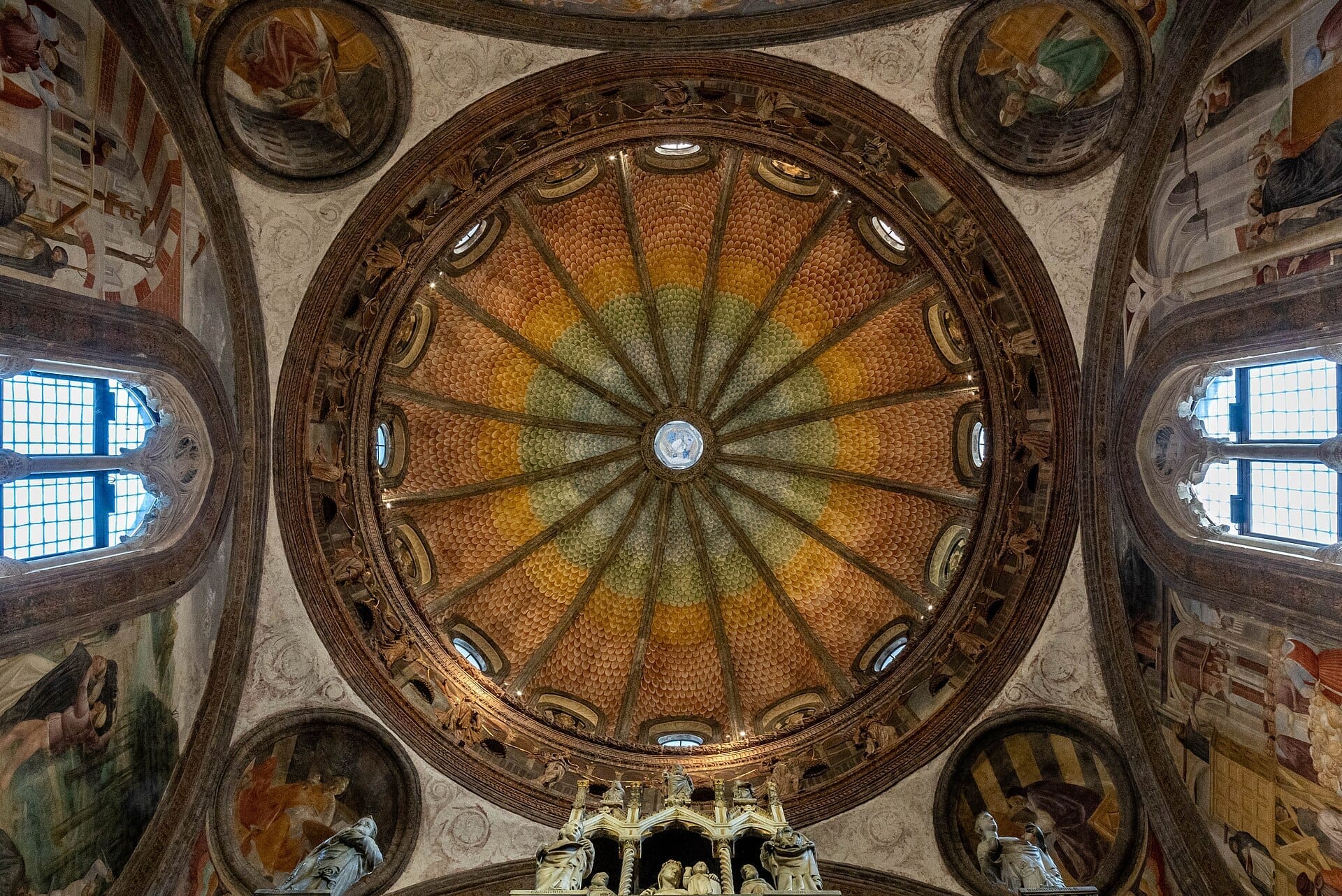
The interior is a near-perfect square capped by a dome, with every surface covered in frescoes attributed to Vincenzo Foppa, one of the most important Lombard painters of the 15th century. The colors remain vivid: deep terracotta reds, pale blues, and earthy ochres arranged in narrative scenes from the life of Saint Peter Martyr. The architectural composition, with its pendentives, drum, and central lantern, reflects the Florentine Renaissance vocabulary transplanted north of the Apennines with considerable sophistication. The marble arca, or sarcophagus, in the center of the chapel holds the remains of Saint Peter Martyr, a 13th-century Dominican friar canonized just one year after his death in 1252.
Lighting in the chapel is indirect and relatively low, which protects the frescoes but means photography without a tripod produces mixed results. Early morning visits, before group tours arrive around 11:00, allow you to stand in the chapel in near silence, which is the appropriate way to experience a space of this quality. The acoustic is intimate: voices carry, footsteps echo slightly on the stone floor, and the absence of background noise makes the painted figures feel present in an unusual way.
Tickets & tours
Hand-picked options from our booking partner. Prices are indicative; availability and final rates are confirmed when you complete your booking.
Duomo Cathedral private tour with a local guide
From 105 €Instant confirmationFree cancellationSforza Castle entry and self-guided tour
From 15 €Instant confirmationFree cancellationSkip-the-line Duomo tour in Milan
From 40 €Instant confirmationFree cancellationNavigli Canals of Milan private walking tour with a local guide
From 40 €Instant confirmationFree cancellation
The Basilica Itself: What to Look For in the Nave and Apses
The main body of the church is Romanesque in character, with a wide nave, side aisles, and a series of chapels opening off both flanks. The brick construction is typical of Lombard Romanesque building practice, and the proportions are generous without being monumental. Several funerary monuments and medieval sarcophagi are positioned along the nave walls and in the chapels, some dating to the 13th and 14th centuries. These are not reproductions but original works in marble, occasionally bearing legible inscriptions.
The bell tower, one of the tallest in Milan's older neighborhoods, was added to the complex over time and remains a useful orientation point when approaching the piazza on foot from Corso Porta Ticinese. The church sits within the broader Ticinese quarter, which is also home to the Colonne di San Lorenzo, a row of Roman columns that stand just a few minutes' walk north along the same road. Together, they form an informal archaeological corridor through one of the city's oldest inhabited zones.
ℹ️ Good to know
The church is open to the public in its stated opening hours, and entry to the basilica is free. If you arrive when the main doors are closed, access the museum separately via the door to the left of the facade. The museum ticket covers the Portinari Chapel and the necropolis, which are the primary reasons most non-worshippers visit.
The Paleochristian Necropolis: What Lies Beneath
Few visitors expect to find an excavated Roman-era burial site underneath a church in this part of Milan, and the necropolis beneath Sant'Eustorgio is genuinely significant. Identified during archaeological excavations between 1959 and 1962, it represents a late Imperial funerary area that predates the current Romanesque structure by centuries. The descent is modest, through a narrow stair accessed from within the museum circuit, and the space is cool and quiet year-round.
Tombs are visible in situ, with explanatory panels in Italian and English. The atmosphere is entirely different from the church above: lower ceilings, rough stone, and the particular stillness that underground spaces carry. It is not a dramatic spectacle but a straightforward archaeological site, presented with appropriate restraint. If you have any interest in Roman Milan, this is one of the few places in the city where that layer is physically accessible.
For broader context on Milan's ancient past, the Museo Civico Archeologico di Milano holds the city's main Roman and pre-Roman collections and pairs well with a visit to Sant'Eustorgio on the same afternoon.
How the Experience Changes by Time of Day
The piazza in front of Sant'Eustorgio is used throughout the day by locals crossing between Corso Porta Ticinese and the streets leading toward the Navigli. In the mornings, it is quiet: a few residents, the smell of coffee from the bar on the corner, and the sound of tram wheels on the nearby tracks. The light on the brick facade is warmest in the late afternoon, particularly in spring and autumn, when it turns the stone a deep amber.
The museum is least crowded at opening, around 10:00, and in the early afternoon between 13:00 and 14:30, when tour groups tend to be at lunch. Weekday mornings in the off-season produce the most favorable conditions inside the Portinari Chapel: no queue, no guided groups, and the frescoes effectively to yourself. Weekend afternoons in summer bring more visitors, and the chapel, which is small, can feel crowded with more than fifteen people inside simultaneously.
After visiting, the surrounding Ticinese quarter rewards further exploration on foot. The stretch of Corso Porta Ticinese between Sant'Eustorgio and the Porta Ticinese gate is lined with independent shops, bars, and the particular low-key energy of a neighborhood that has not been entirely smoothed out for tourism. In the evening, the same streets shift toward aperitivo territory, with tables spilling onto the pavement and the sound of the trams replaced by conversation.
Getting There, Practical Notes, and Who Should Skip It
Sant'Eustorgio is straightforward to reach without a car. Tram 3 from Piazza Duomo drops you close to the piazza. Alternatively, trams 9, 29, and 30 stop at Piazza XXIV Maggio, a five-minute walk south. If you are coming from the Sant'Ambrogio area (Metro Line 2), bus 94 stops at De Amicis–Corso Porta Ticinese, also within easy walking distance. The walk south from the Duomo along Corso Porta Ticinese takes roughly 15–20 minutes and passes the Colonne di San Lorenzo, making it a logical route for those covering this corridor on foot.
Dress requirements follow standard Italian church protocol: shoulders and knees should be covered when entering the basilica. Comfortable walking shoes are advisable given the uneven stone floors in the older sections. No specific wheelchair accessibility details are confirmed in available official sources, so visitors with mobility considerations should contact the basilica directly before visiting. The broader neighborhood context, including the Naviglio Grande and Darsena area, is largely flat and walkable.
Who should consider skipping Sant'Eustorgio? Visitors with very limited time in Milan who prioritize major civic landmarks over sacred architecture may find it difficult to justify the detour from the historic center. The church does not offer the monumental scale of the Duomo, the collection breadth of the Pinacoteca di Brera, or the fame of the Last Supper. What it offers is depth, specificity, and a quality of quiet that those other sites cannot always provide. If that is not what you are looking for on a given trip, it is a fair trade-off.
⚠️ What to skip
Ticket prices and opening hours listed here are drawn from available official sources but are subject to change. Verify current information at santeustorgio.it before your visit, particularly around religious holidays when the basilica schedule may differ.
Pairing Sant'Eustorgio with the Rest of the Ticinese Quarter
The Ticinese and Sant'Ambrogio quarter contains a concentration of early Christian and medieval religious architecture that few other neighborhoods in Milan can match. A half-day walking circuit might begin at the Basilica di San Lorenzo Maggiore and its adjacent Roman columns, continue south to Sant'Eustorgio, and conclude with a walk along the canal at the Darsena. This sequence covers roughly two kilometers on foot and spans nearly two thousand years of building history in a compact, walkable area.
For travelers building a broader church itinerary across Milan, the Milan churches guide provides a comparative overview of the city's major sacred buildings, including Sant'Eustorgio's place in that sequence. The basilica is easily one of the most rewarding stops for anyone interested in how Christian architecture in northern Italy evolved from late antiquity through the Renaissance, all within a single unassuming complex.
Insider Tips
- Arrive at museum opening (10:00) on a weekday to have the Portinari Chapel to yourself. The chapel holds only a handful of people comfortably, and the experience of seeing Foppa's frescoes without a crowd is qualitatively different.
- The paleochristian necropolis is included in the museum ticket but is easy to overlook. Ask at the entrance to confirm the current route, as access points within the museum circuit can vary.
- The bar on Piazza Sant'Eustorgio is a legitimate local spot, not a tourist-facing establishment. Coffee here before entering the basilica costs what coffee should cost in Milan.
- If you are visiting on a Sunday, check Mass times in advance. The church is often more accessible to visitors between services on weekday mornings than on weekend afternoons when the community gathers.
- The bell tower is one of the taller structures in this part of the city and is visible from several blocks away. Use it as a navigation aid when approaching through the narrow streets of the Ticinese quarter.
Who Is Basilica di Sant'Eustorgio For?
- History and archaeology enthusiasts who want to see Roman-era burial sites in situ, not just in glass cases
- Art historians and architecture lovers drawn to the Cappella Portinari and the Lombard Renaissance fresco tradition
- Travelers on a second or third visit to Milan who have already covered the major civic landmarks and want greater depth
- Those building a half-day walking itinerary through the Ticinese quarter combining ancient, medieval, and modern layers
- Anyone seeking a notably quiet church interior away from the crowds that gather at more famous sacred sites
Nearby Attractions
Other things to see while in Ticinese & Sant'Ambrogio:
- Basilica di San Lorenzo Maggiore
The Basilica di San Lorenzo Maggiore is one of the earliest Christian churches in Milan, dating to the late 4th–early 5th century CE. Fronted by 16 ancient Roman columns and housing 4th-century mosaics in the Cappella di Sant'Aquilino, it sits at the heart of the Ticinese neighborhood, a short walk from the Navigli canals.
- Basilica di Sant'Ambrogio
Founded by Saint Ambrose himself in 379 AD and rebuilt in the 11th century as a masterpiece of Lombard Romanesque architecture, the Basilica di Sant'Ambrogio is the spiritual and historical anchor of Milan. Entry to the church is free, and the complex rewards slow, attentive visitors far more than a quick stop.
- Cenacolo Vinciano (The Last Supper)
Leonardo da Vinci's Last Supper survives on the refectory wall of Santa Maria delle Grazie, a 460 x 880 cm tempera mural painted between 1495 and 1498. Visits are strictly limited to 15 minutes per group of 40, and tickets require advance reservation. This guide covers everything you need to know before you go.
- Chiesa di San Maurizio al Monastero Maggiore
Built in 1503 on Corso Magenta, the Chiesa di San Maurizio al Monastero Maggiore holds more than 4,000 square metres of Renaissance frescoes across its painted interior walls. Entry is free, crowds are modest, and the experience rewards slow attention.