Porta Ticinese: Milan's Neoclassical Gate and the Neighborhood It Defines
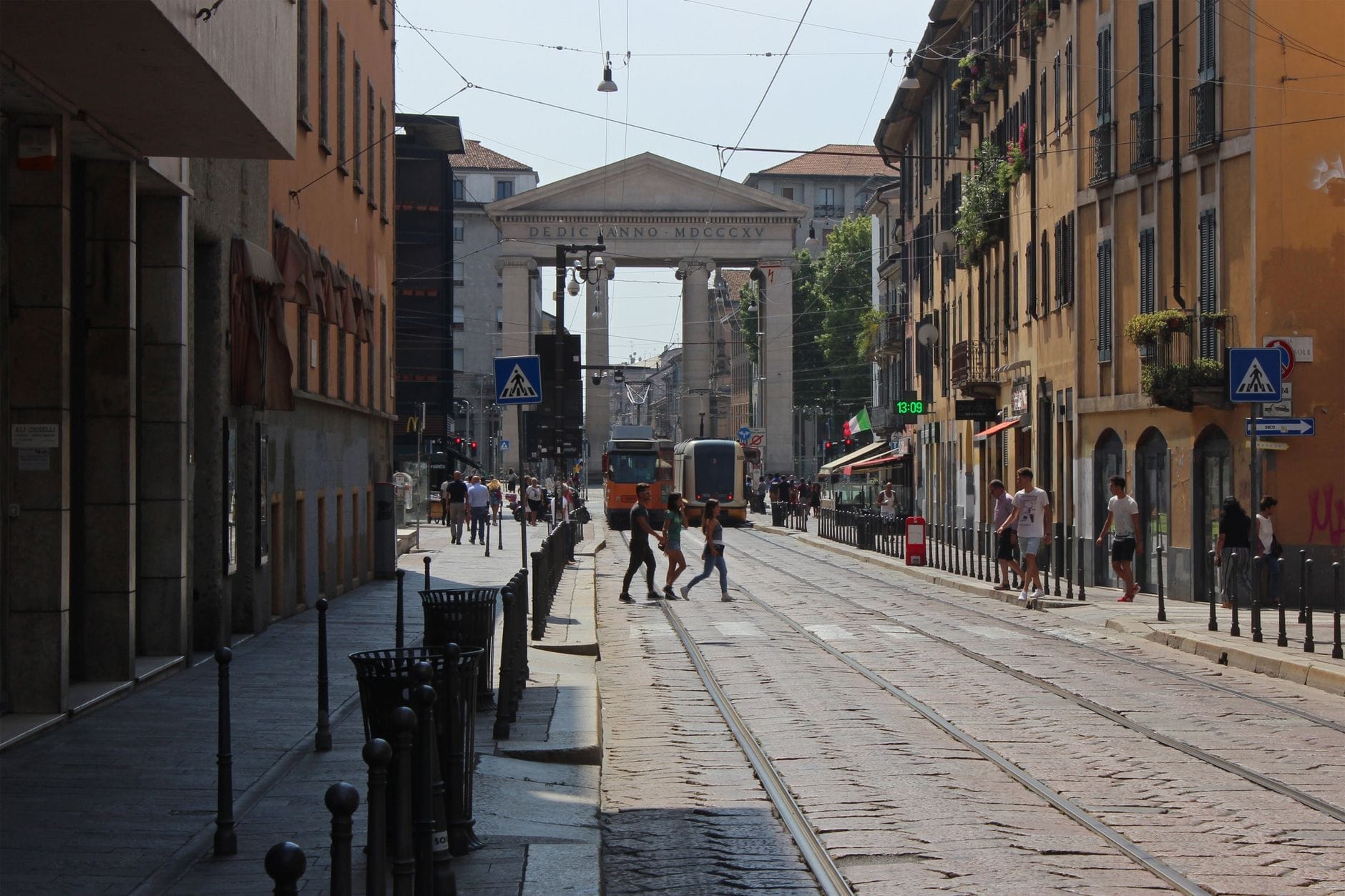
Porta Ticinese is a neoclassical triumphal gate completed around 1801–1814, designed by Luigi Cagnola and built in pink Baveno granite. Free to visit at any hour, it stands at Piazza 24 Maggio as the southern threshold between the city center and the Navigli canal district, making it one of Milan's most layered urban landmarks.
Quick Facts
- Location
- Piazza 24 Maggio, 20136 Milan (Ticinese–Sant'Ambrogio)
- Getting There
- Tram 3 or 9 (Corso di Porta Ticinese stop); Porta Genova M2 (10 min walk)
- Time Needed
- 15–30 min for the gate itself; 1–2 hours including the surrounding area
- Cost
- Free — open-air monument, no tickets required, accessible 24 hours
- Best for
- Architecture lovers, history walkers, photography, and canal-area exploration
What Porta Ticinese Actually Is (and Why It Matters)
Porta Ticinese is not one gate but two, separated by about 600 meters of one of Milan's most characterful streets. The more dramatic of the pair, and the one most visitors encounter first, is the neoclassical structure standing at Piazza 24 Maggio. Completed around 1801–1814, it was designed by architect Luigi Cagnola as part of a Napoleonic-era toll-gate project that reshaped the southern edge of the city. The second, older gate stands further north along Corso di Porta Ticinese, near the Colonne di San Lorenzo: a medieval relic dating to the 12th century, restored in the 19th century.
Together, the two gates frame a street that has been a major access route into Milan since antiquity. The road leading through them once connected the city to Pavia and, beyond that, to Ticino — hence the name. Understanding this context transforms what might otherwise look like decorative urban furniture into something genuinely significant: you are walking a corridor that Roman, medieval, Spanish-colonial, and Napoleonic Milan all considered essential.
ℹ️ Good to know
There are two distinct structures both called Porta Ticinese. The neoclassical gate is at Piazza 24 Maggio. The medieval gate is roughly 600 meters north at Corso di Porta Ticinese 51b, near the Colonne di San Lorenzo. Many visitors see only one and miss the other entirely.
The Neoclassical Gate at Piazza 24 Maggio
Luigi Cagnola's gate is a composed, horizontal structure built in pink granite quarried at Baveno, on the western shore of Lake Maggiore. Decades of urban pollution have greyed the stone considerably, but in certain morning light the original warm tone is still visible in the recessed surfaces. The design features Ionic columns supporting a triangular tympanum, the formal vocabulary of Roman triumphal architecture adapted to early 19th-century civic ambitions. It is measured and precise rather than showy, which suits the neighborhood it presides over.
The gate sits within Piazza 24 Maggio, a modest square that becomes a social gathering point in the evenings, particularly in warm months. Locals sit on the stone steps, cyclists cut through in both directions, and the aperitivo crowd from the Navigli gradually fills the surrounding streets from around 6 p.m. The gate itself stands slightly apart from all of this, not cordoned off, not lit theatrically — simply there, as it has been for over two centuries.
Photography works best in the early morning, before 9 a.m., when the light comes from the east and the piazza is quiet. The gate faces roughly south, so harsh midday sun flattens the columns. If you are exploring the wider Ticinese–Sant'Ambrogio neighborhood on foot, Piazza 24 Maggio makes a natural starting or ending point for a walk north toward the medieval gate and the Colonne di San Lorenzo.
Tickets & tours
Hand-picked options from our booking partner. Prices are indicative; availability and final rates are confirmed when you complete your booking.
Genova and Portofino day trip from Milan
From 119 €Instant confirmationFree cancellationBus transfer between Bergamo Orio al Serio airport and Milan city center
From 9 €Instant confirmationFree cancellationBus transfer between Malpensa airport and Milan city center
From 10 €Instant confirmationFree cancellationDuomo Cathedral private tour with a local guide
From 105 €Instant confirmationFree cancellation
The Medieval Gate: Older, Quieter, and Often Overlooked
The medieval Porta Ticinese is the less-photographed but arguably more historically resonant of the two structures. Originally constructed in the 12th century as part of the medieval city walls, it survived long after those walls were superseded by the Spanish fortifications built between 1546 and 1560. By the 19th century it had fallen into disrepair, and its current condition reflects the 1861 restoration carried out by Camillo Boito, one of the leading figures of Italian architectural conservation.
The medieval gate sits close to the Colonne di San Lorenzo, a row of 16 Roman columns that predate the gate by roughly a thousand years and form one of Milan's most atmospheric outdoor spaces. In the evenings, the colonnade fills with people sitting on the steps, and the combination of Roman columns, medieval masonry, and contemporary street life creates a layered scene unlike anything else in the city. Even if you are only visiting for Porta Ticinese, allow time to stop at the columns.
The Colonne di San Lorenzo and the medieval gate are within a few steps of each other. The nearby Basilica di San Lorenzo Maggiore is one of the oldest Christian buildings in Milan and rounds out what is a remarkably dense cluster of historical layers in this stretch of the street.
How the Experience Changes Through the Day
At 8 a.m., Corso di Porta Ticinese is relatively quiet. Shopkeepers are rolling up metal shutters, the smell of coffee drifts from a bar near the medieval gate, and you can walk the entire corridor between the two structures without navigating foot traffic. This is the best window for anyone interested in the architecture itself: the facades are unobstructed, the light is directional, and the street has the unhurried quality of a neighborhood before the day starts properly.
By midday the street is busy with a mix of tourists, students from nearby universities, and workers cutting through on lunch breaks. The medieval gate sees a reasonable volume of visitors who stop to photograph it against the colonnade backdrop. The neoclassical gate at Piazza 24 Maggio is noticeably less crowded, partly because it sits slightly off the main pedestrian flow once you reach the southern end of Corso di Porta Ticinese.
Evenings shift the character of the area entirely. The Navigli district begins just south of Piazza 24 Maggio, and from Thursday through Sunday the crowd density increases sharply after 7 p.m. The gate at Piazza 24 Maggio becomes more of a backdrop than a subject at this hour, but the atmosphere is lively and worth experiencing if you are already heading toward the canals.
💡 Local tip
If you want both gates and the Colonne di San Lorenzo in the same visit, walk the full length of Corso di Porta Ticinese from Piazza 24 Maggio northward. The walk takes under 15 minutes at a slow pace and passes several independent shops, a few notable bars, and the medieval gate before arriving at the columns. It is one of the more rewarding short walks in this part of Milan.
Historical Context: From Spanish Walls to Napoleonic Urbanism
The Spanish walls, constructed between the late 1540s and early 1560s during the period of Spanish dominion over the Duchy of Milan, defined the city's outer limit for nearly three centuries. Porta Ticinese was one of the formal gates in this defensive perimeter, controlling movement along the road to Pavia. The original gate at this location was demolished when the Napoleonic administration set about modernizing Milan's civic infrastructure in the early 19th century.
Cagnola's replacement was not conceived as a military structure but as a statement of urban improvement. The decision to use Baveno granite, the choice of Ionic rather than Doric or Corinthian order, and the restrained horizontal proportions all reflect the neoclassical aesthetic that the Napoleonic period promoted across northern Italy. Comparable projects from the same era survive elsewhere in Milan, most prominently the Arco della Pace, which Cagnola also designed.
Travelers interested in Milan's architectural history across different periods will find useful context in the Milan architecture guide, which places the neoclassical interventions of the early 19th century alongside the city's medieval, Renaissance, and modernist layers.
Practical Information for Visitors
Both gates are open-air structures in public spaces, accessible at all hours with no admission charge. There is nothing to book, no queues to manage, and no time limit on your visit. This makes Porta Ticinese one of the few completely pressure-free stops in Milan, appropriate for early mornings or late evenings when most other attractions are closed.
The neoclassical gate at Piazza 24 Maggio is reachable by tram lines 3 and 9, which run along Corso di Porta Ticinese. Porta Genova station on Metro Line 2 is roughly a 10-minute walk away. From the Duomo, Metro Lines 1 and 3 connect to stops from which the Ticinese area is a manageable walk or short tram ride. The terrain throughout the neighborhood is flat, with standard city pavements, though dedicated accessibility infrastructure at the gates themselves is not specifically documented in official sources.
Dress code is not a factor here, as neither gate is a religious or institutional building. Comfortable walking shoes are sufficient. If you are combining this visit with the Navigli area, the southern end of Piazza 24 Maggio leads directly onto the canals.
For a broader walk through this part of Milan that takes in the canals, the medieval churches, and the gate area, the Naviglio Grande is within easy reach to the south, and the Darsena di Milano is a short walk from Piazza 24 Maggio toward the canal basin.
⚠️ What to skip
The Navigli area directly south of Piazza 24 Maggio becomes very crowded on weekend evenings. If you are visiting Porta Ticinese primarily for the architecture, Friday and Saturday nights are the least suitable time — not because the gate is inaccessible, but because the surrounding streets are dense with aperitivo crowds and the atmosphere is more nightlife than heritage.
Who May Not Find This Worth the Trip
Visitors whose primary interest is interior spaces — decorated churches, museum collections, or rooftop panoramas — will find Porta Ticinese relatively unremarkable on its own. There is no interpretive center, no permanent exhibition, and no guided tour infrastructure at either gate. The experience is entirely about reading the architecture in context, and travelers who prefer a structured, annotated visit will find the gates underwhelming without prior preparation or a good map of the surrounding historical sites.
Similarly, visitors tight on time who need to prioritize Milan's headline attractions should treat Porta Ticinese as a bonus stop rather than a primary destination. It is an excellent complement to an afternoon in the Navigli or Ticinese area, not a stand-alone reason to cross the city.
Insider Tips
- The medieval gate and the Colonne di San Lorenzo are most atmospheric on weekday evenings between 6 and 8 p.m., when locals gather on the Roman column steps and the light is warm without the full weekend crowd density.
- Stand directly under the neoclassical gate's tympanum and look up: the granite details and the underside of the arch are far more precise close-up than they appear from the street. Most visitors photograph it from a distance and miss the stonework quality.
- Corso di Porta Ticinese between the two gates is lined with small independent shops and a few bars that reflect the neighborhood's younger, design-conscious demographic. The street is worth walking slowly rather than treating as a corridor between monuments.
- In spring and early autumn, Piazza 24 Maggio in the early morning has very little foot traffic and good directional light on the gate's facade — conditions that are rare at more visited Milan landmarks.
- The full historical sequence of this corridor, from the Roman columns to the medieval gate to the neoclassical gate, spans roughly 1,800 years of urban development compressed into a 15-minute walk. That density is the point of coming here.
Who Is Porta Ticinese For?
- Architecture and urban history enthusiasts who want to read layers of the city on foot
- Photographers looking for early-morning light on historic stonework without crowds
- Travelers combining a Navigli evening with a daytime heritage walk
- Visitors interested in Napoleonic-era neoclassicism and its Milan-specific expression
- Anyone building a self-guided walking tour of the Ticinese–Sant'Ambrogio area
Nearby Attractions
Other things to see while in Ticinese & Sant'Ambrogio:
- Basilica di San Lorenzo Maggiore
The Basilica di San Lorenzo Maggiore is one of the earliest Christian churches in Milan, dating to the late 4th–early 5th century CE. Fronted by 16 ancient Roman columns and housing 4th-century mosaics in the Cappella di Sant'Aquilino, it sits at the heart of the Ticinese neighborhood, a short walk from the Navigli canals.
- Basilica di Sant'Ambrogio
Founded by Saint Ambrose himself in 379 AD and rebuilt in the 11th century as a masterpiece of Lombard Romanesque architecture, the Basilica di Sant'Ambrogio is the spiritual and historical anchor of Milan. Entry to the church is free, and the complex rewards slow, attentive visitors far more than a quick stop.
- Basilica di Sant'Eustorgio
The Basilica di Sant'Eustorgio is one of Milan's most historically layered sacred sites, combining a paleochristian necropolis, a Renaissance chapel of rare refinement, and a 12th-century Romanesque nave into a single compact complex. Located on Piazza Sant'Eustorgio in the Ticinese quarter, it rewards visitors who look past the plain brick facade to discover what lies beneath and behind it.
- Cenacolo Vinciano (The Last Supper)
Leonardo da Vinci's Last Supper survives on the refectory wall of Santa Maria delle Grazie, a 460 x 880 cm tempera mural painted between 1495 and 1498. Visits are strictly limited to 15 minutes per group of 40, and tickets require advance reservation. This guide covers everything you need to know before you go.