Darsena di Milano: Milan's Ancient Port Reborn as a Waterfront Square
Once the commercial heart of Milan's canal network, the Darsena di Milano is a vast open basin in Piazza XXIV Maggio where the Naviglio Grande and Naviglio Pavese converge. Renovated for Expo 2015, it is now the social and geographic anchor of the Navigli district, free to visit at any hour.
Quick Facts
- Location
- Piazza XXIV Maggio, 20123 Milano — Navigli district, near Porta Ticinese
- Getting There
- Metro M2 (Green) to Porta Genova or Sant'Agostino; Tram 9 to Porta Genova; Bus 59 or 94
- Time Needed
- 30–90 minutes for the basin and quays; longer if you continue along the canals
- Cost
- Free — public space, open 24/7
- Best for
- Canal walks, aperitivo evenings, weekend markets, slow travel
What the Darsena Actually Is
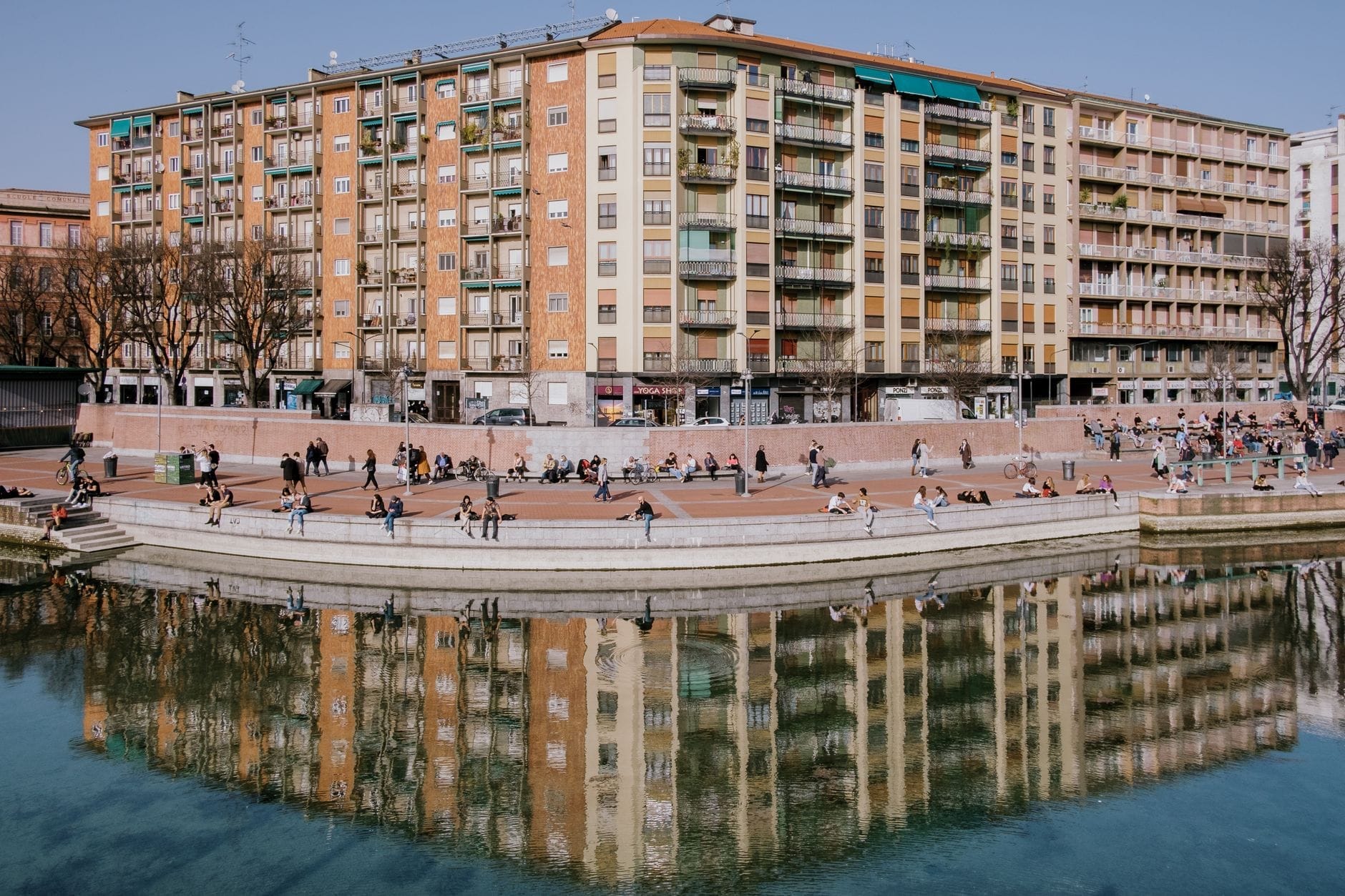
The Darsena di Milano is Milan's largest inner-city canal basin: with a surface area of approximately 17,500 square metres and a depth of just 1.5 metres. It sits at the confluence of the Naviglio Grande and the Naviglio Pavese in Piazza XXIV Maggio, a few hundred metres south of Porta Ticinese. For most of its history, it functioned as Milan's working river port, a place where barges unloaded marble, grain, and building stone. Today, after a major renovation completed in 2015 for Expo Milano, it operates as the social and geographic centre of the Navigli neighbourhood.
The water itself is an unremarkable grey-green on overcast days and catches a warm copper light on clear evenings. What makes the Darsena worth your time is not the water alone, but the specific rhythm of this part of the city: the way the promenade fills with cyclists and dog walkers in the morning, empties during the hot afternoon, and then gradually crowds again from around 6 pm as the aperitivo circuit activates along the surrounding canalside bars.
💡 Local tip
The most photogenic time at the Darsena is late afternoon on a clear day, when the low light catches the basin from the western end and the stone quays glow. Arrive around 5 pm in spring or autumn for the best combination of light and manageable crowds.
Eight Centuries of Working Water
The Darsena dates to 1603, when the basin was built under Spanish rule, commissioned by Pedro Enríquez de Acevedo, Count of Fuentes, as part of broader fortification and infrastructure works.
For centuries, the Darsena was a genuinely industrial place: banchine (loading quays) and calate (sloping ramps for rolling barrels) defined its edges, and the area smelled of sawdust, livestock, and river mud. Commercial canal traffic continued well into the 20th century before road and rail made it economically obsolete. The basin was partially covered in the 1930s and fell into a long period of neglect. The 2015 renovation uncovered the water again, rebuilt the promenades, and planted trees along the quays, transforming an abandoned port into a usable public waterfront without erasing the industrial geometry of the original structures.
If you want to understand how the canal network extends outward from this point, walking south along the Naviglio Grande or the Naviglio Pavese takes you into progressively quieter stretches that still carry the character of the pre-renovation canal city.
Tickets & tours
Hand-picked options from our booking partner. Prices are indicative; availability and final rates are confirmed when you complete your booking.
Milano highlights 2 hours private tour by vintage car
From 300 €Instant confirmationFree cancellationMilano highlights 3 hours private tour by vintage car
From 400 €Instant confirmationFree cancellationMilano highlights 30 minutes private tour by vintage car
From 80 €Instant confirmationFree cancellationMilano highlights 1 hour private tour by vintage car
From 200 €Instant confirmationFree cancellation
How the Space Changes Through the Day
Early mornings at the Darsena are quiet in a way that surprises first-time visitors expecting something more tourist-oriented. By 7 am, the quays belong to joggers, commuting cyclists, and the occasional fisherman watching a line drop into the shallow water. The bars around Piazza XXIV Maggio are still shuttered. The sound is mostly birdsong, bicycle chains, and the low hum of traffic from the adjacent roads.
Between roughly 11 am and 4 pm, foot traffic is moderate but not heavy. On weekends, a farmers market and artisan market operate near the basin (the Mercato della Darsena, typically on Saturdays), bringing local producers selling cheese, cured meats, vegetables, and craft goods. This is a distinctly local market rather than a tourist-facing one, and the quality tends to be high. Bring cash.
Evenings are when the Darsena earns its reputation. From around 6 pm, the atmosphere shifts completely. The canal bars along both navigli fill with the aperitivo crowd: spritz glasses, bowls of olive, conversation at high volume. The promenade around the basin becomes a slow circuit for groups walking between bars. On summer evenings this can feel overwhelming if you dislike dense crowds, but in spring and autumn the same dynamic feels comfortable and thoroughly pleasant. Weekday evenings are notably calmer than weekends.
⚠️ What to skip
On Friday and Saturday nights in summer, the Navigli area around the Darsena becomes extremely crowded, with queues outside bars and significant noise until well past midnight. If you are staying nearby, expect this. If you are sensitive to noise or crowds, visit on a weekday morning instead.
Walking the Darsena: A Practical Orientation
The Darsena basin is not a contained attraction with a clear entry point; it is a public urban space you move through rather than visit. The main approach from the city centre is via Corso di Porta Ticinese, which deposits you at the northern end of Piazza XXIV Maggio with the basin opening in front of you. From here, the quay runs along both sides of the water, with a tree-lined promenade on the western bank being the more photogenic and usually less crowded of the two.
The southern end of the basin is where the Naviglio Grande and Naviglio Pavese diverge. Standing at this point and looking north gives you a clear view of the basin's full length, the Porta Ticinese arch in the distance, and the mix of old stone buildings and newer bar terraces along the banks. This is the standard postcard angle. The ramps and low stone walls of the original quay structures are still visible, particularly on the eastern bank, giving a concrete sense of the port infrastructure that once operated here.
The surrounding Navigli neighbourhood extends along both canals and is worth exploring on foot. The streets immediately behind the quays hold independent restaurants, vintage shops, and small galleries. The area around Porta Ticinese a short walk north, adds further historical context to the walk.
Photography and Weather Considerations
The Darsena photographs well under diffuse cloud cover and in the hour before sunset. The basin is wide enough that a standard smartphone lens captures the water, the promenade, and the surrounding architecture without needing anything special. The reflections in the water are most pronounced in calm conditions; after rain, when the surface is still and the stones are wet, the light can be exceptional.
In winter, the Darsena is often enveloped in the dense fog that characterizes Milan from November through February. This transforms the atmosphere entirely: the opposite bank disappears into white, the sound is muffled, and the few people present move through the space like figures in a period photograph. If you visit Milan in winter, the foggy Darsena is one of the more distinctively Milanese experiences available to you. Dress warmly and expect damp stone underfoot.
For context on how the Navigli and Darsena fit into Milan's broader seasonal calendar, the best time to visit Milan guide covers the trade-offs between weather, crowds, and events across the year.
What the Darsena Is and Isn't
The Darsena is not a dramatic attraction in the conventional sense. There is no entry fee because there is no enclosed space; no guided tour because there is no single focal point; no exhibit because the thing itself is the exhibit. It is a large, flat, open basin in a working city neighbourhood. If you arrive expecting a manicured tourist waterfront on the scale of Amsterdam or Copenhagen, you will find something rougher and more urban than that.
What it offers instead is something harder to manufacture: an authentic neighbourhood pulse in a city that can otherwise feel opaque to visitors. The Navigli area has historically attracted students, artists, and the less formal end of Milanese social life, and that character is still present even after the post-2015 renovation and the resulting increase in bar prices. The Darsena is the geographical centre of this.
Travellers who want concentrated cultural programming, museum-quality experiences, or iconic landmark photography will find more at the Duomo district or Brera. The Darsena rewards those willing to slow down, sit at a canal-side table, and watch the city operate at its own pace.
If you are building a multi-day itinerary, the Milan 3-day itinerary places the Navigli and Darsena in context alongside the city's higher-intensity attractions.
Insider Tips
- The Saturday farmers market at the Darsena (Mercato della Darsena) draws local shoppers rather than tourists. Arrive before 11 am for the full selection and bring cash, as not all vendors accept cards.
- The western quay (Alzaia Naviglio Grande side) is narrower and less trafficked than the eastern promenade, making it the better choice for a quiet walk along the water's edge, especially on weekend evenings.
- Bar prices along the Darsena and Naviglio Grande have risen sharply since the 2015 renovation. If you want the same canal atmosphere at lower prices, walk five to ten minutes south along either canal and the bars become noticeably cheaper and less crowded.
- The best elevated view of the basin is from the steps and terraced seating at the southern end of Piazza XXIV Maggio. It is not a high vantage point, but it gives enough elevation to photograph the length of the water without other pedestrians in the foreground.
- In summer, the city runs occasional open-air cinema screenings and cultural events on and around the Darsena. Check the Municipality of Milan's event calendar (Comune di Milano website) in the weeks before your visit.
Who Is Darsena di Milano For?
- Slow travellers who want to experience a working neighbourhood rather than a tourist attraction
- Aperitivo seekers looking for Milan's most atmospheric early-evening canal setting
- Photographers interested in reflections, industrial waterfront geometry, and urban light
- Families with young children: the flat, open promenade is easy to navigate and the water is endlessly fascinating
- Winter visitors wanting to experience Milan's famous fog in a characteristically local setting
Nearby Attractions
Other things to see while in Navigli:
- Armani Silos
Housed in a converted 1950s granary in Milan's Tortona district, Armani/Silos presents four decades of Giorgio Armani's work across around 4,500 square metres and four floors. It is one of the few fashion museums in the world conceived and curated by a living designer as a permanent retrospective of their own career.
- Naviglio Grande
Stretching nearly 50 kilometres from the Ticino River to Milan's city edge, the Naviglio Grande is one of the oldest navigable canals in Europe. Free to visit at any hour, this historic waterway draws everyone from early-morning joggers to late-night aperitivo crowds, offering a side of Milan that feels genuinely distinct from its fashion-forward centre.
- Naviglio Pavese
Naviglio Pavese is a 33.1-kilometer canal stretching from Milan's Darsena dock to the River Ticino at Pavia. Free to access and open around the clock, it offers a slower, more local side of the Navigli district, away from the crowds that pack the more famous Naviglio Grande just across the water.