Naviglio Grande: Milan's Ancient Canal and the Heart of the Navigli District
Stretching nearly 50 kilometres from the Ticino River to Milan's city edge, the Naviglio Grande is one of the oldest navigable canals in Europe. Free to visit at any hour, this historic waterway draws everyone from early-morning joggers to late-night aperitivo crowds, offering a side of Milan that feels genuinely distinct from its fashion-forward centre.
Quick Facts
- Location
- Alzaia Naviglio Grande, 20144 Milan — south-west of the city centre, Navigli district
- Getting There
- Metro M2 Porta Genova (approx. 8-min walk); Romolo (approx. 10-min walk)
- Time Needed
- 1–3 hours for a canal walk; allow a full evening if you plan to eat and drink
- Cost
- Free to walk; individual bars, restaurants, and boat tours charge their own prices
- Best for
- Evening aperitivo culture, canal-side strolls, street photography, and local neighbourhood atmosphere
- Official website
- www.italia.it/en/lombardy/milan/naviglio-grande
What Is the Naviglio Grande?
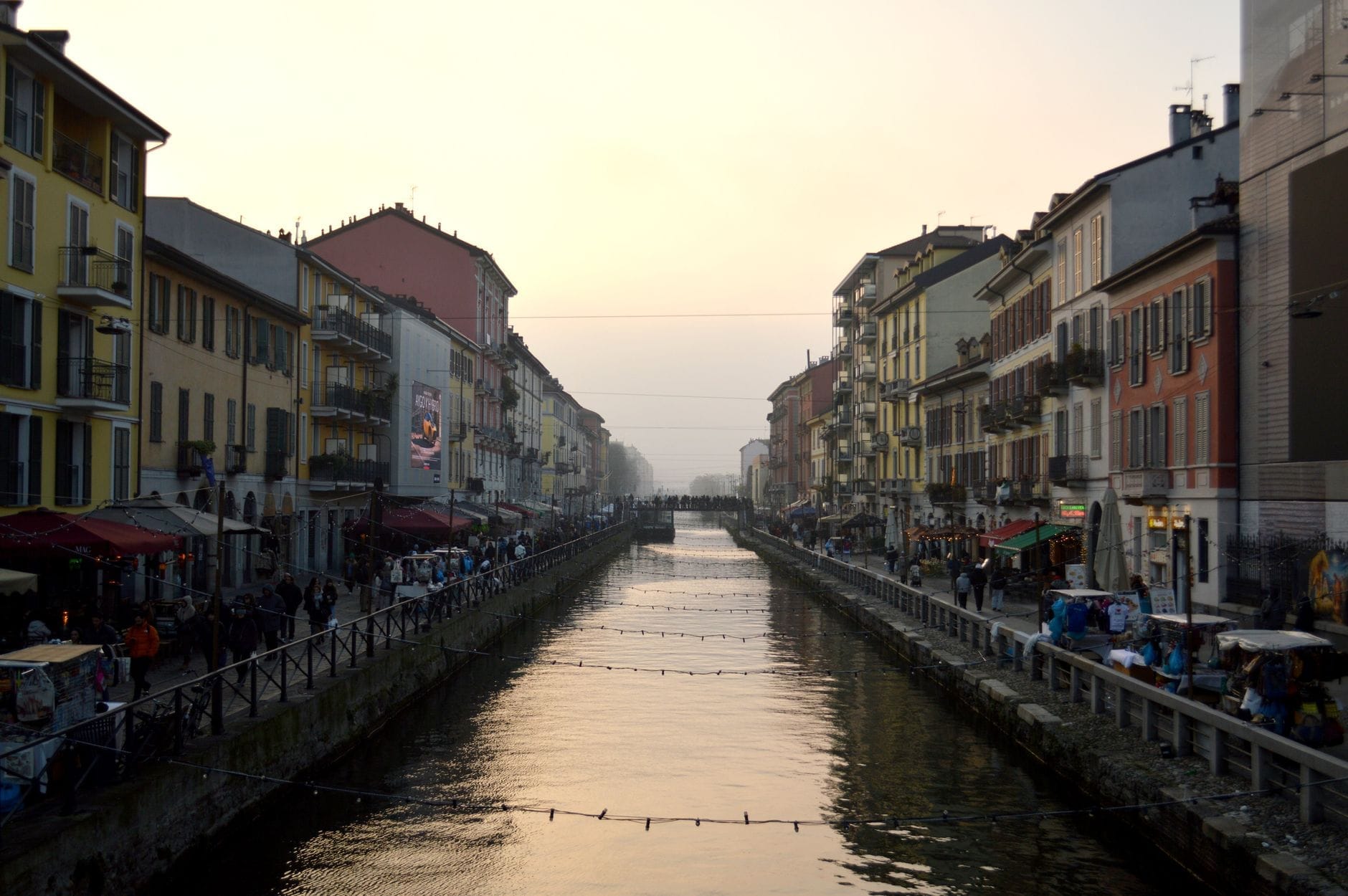
The Naviglio Grande is not a museum, a monument, or a ticketed attraction. It is a working canal, a pedestrian thoroughfare, and a neighbourhood all at once. Running approximately 49.9 kilometres from Tornavento on the Ticino River into the Darsena basin at the south-west edge of Milan, it is one of the oldest navigable canals in Europe, with construction dating to 1177 and navigability established by 1272. For centuries it was a major commercial waterway carrying marble, grain, and building materials into the city — including the white Candoglia marble used for the Duomo di Milano.
The section that most visitors explore is the urban stretch along the Alzaia Naviglio Grande, where the towpath widens into a continuous pedestrian corridor lined with low buildings, converted workshops, bars, galleries, and restaurants. It sits in the Navigli district, a neighbourhood that retains a rougher, more relaxed character than the polished centre of Milan — partly by design, partly because the canal itself anchors it to an older, more utilitarian identity.
ℹ️ Good to know
Access to the canal towpath is free and open 24 hours a day. There is no entrance gate, no ticket booth, and no formal closing time. The experience shifts dramatically depending on the hour you arrive.
The Canal Through History
Few urban waterways carry as much historical weight as the Naviglio Grande. Work on the canal began in 1177, and by 1239 the main channel was complete. It was made navigable in 1272, making it a central pillar of Lombardy's medieval economy. The broader network of Milanese canals — the navigli system — was partly engineered with input from Leonardo da Vinci, who designed several lock mechanisms to manage the canal system’s 34-metre total drop across its length in the 15th century. His contribution, while not exclusive, is documented and well-established.
The canal was so commercially vital that goods unloaded at the Milan terminus fed warehouses, workshops, and the construction of the city's greatest landmarks. When the navigli system was largely covered over in the early 20th century to make way for roads, the Naviglio Grande was one of the few stretches to survive above ground. If the story of Milan's lost waterways interests you, the lesser-known sides of Milan include traces of the buried canal network that still surface in unexpected places across the city.
The canal's width varies considerably: around 20 metres in the open countryside near its intake, narrowing to about 12–15 metres as it approaches Milan. That narrowing is visible in the urban section, where the water feels close and immediate rather than distant, and where the stone-edged banks give the canal a European character that often surprises visitors who associate Milan entirely with contemporary fashion and finance.
Tickets & tours
Hand-picked options from our booking partner. Prices are indicative; availability and final rates are confirmed when you complete your booking.
Navigli Canals of Milan private walking tour with a local guide
From 40 €Instant confirmationFree cancellationMilan Food and Drinks Guided Tour along the Navigli
From 76 €Instant confirmationFree cancellationMagic along the water, online exploration game in Milan Navigli
From 7 €Instant confirmationFree cancellationDuomo Cathedral private tour with a local guide
From 105 €Instant confirmationFree cancellation
What to Expect When You Arrive
The canal's towpath runs on both banks, though the southern side (Alzaia Naviglio Grande) sees the heaviest foot traffic and carries most of the bars and restaurants. The northern bank (Ripa di Porta Ticinese) is quieter and gives a better sense of the canal's scale from a slight distance. Walking between the two is possible at several bridge crossings.
The surface underfoot varies. Parts of the towpath are smooth paved stone, good for walking at any pace. Other sections are older cobblestone, which requires a little more attention, particularly after rain when surfaces become slick. Cyclists also use portions of the route, so stay aware of your surroundings on the narrower stretches. For visitors using wheelchairs or pushchairs, much of the main promenade is accessible, but the cobbled sections and some venue entrances present real obstacles.
The buildings lining the canal are low — mostly two to four storeys — giving the area an open, uncrowded feel that contrasts with the tighter streets of central Milan. Many of the ground-floor spaces were historically workshops and storage for goods coming off the barges. Today those same spaces house wine bars, artisan shops, antique dealers, and small restaurants, some with terraces extending almost to the water's edge.
Time of Day: How the Canal Changes
Morning
In the morning, before 9am, the Naviglio Grande belongs to locals. Joggers move along the towpath, occasionally competing for space with delivery workers restocking the bars. The water reflects grey or pale gold depending on the season, and the air carries a faint mineral smell from the canal itself, mixed with coffee from the handful of cafes already open for breakfast. Graffiti on the lower walls, visible at this hour without the crowd, shows how deeply the area identifies with street art as part of its identity. This is the quietest and most photogenic window.
Afternoon
By mid-afternoon, the canal fills with a mixed crowd: students, tourists arriving from the centre, and residents using it as a shortcut. In summer, heat builds in the south-facing stretch and shade is limited, so bring water if you plan to walk any distance. In spring and autumn, the afternoon light is excellent for photography, particularly looking west toward the outer canal where the buildings thin out and the water stretches further.
Evening: The Aperitivo Hour
The Naviglio Grande earns most of its reputation from what happens between 6pm and 9pm. The aperitivo tradition is embedded in Milanese culture, and the canal's bars practice it seriously: order a drink and a spread of food accompaniments arrives, often generous enough to substitute for dinner. Every bar has its own version, some involving simple olives and cured meats, others offering elaborate buffet-style setups. By 7pm the towpath can be shoulder-to-shoulder on weekends, particularly in warm months, when the atmosphere shifts from neighbourhood walk to something closer to an outdoor social event.
💡 Local tip
For aperitivo without the worst of the crowds, aim for weekdays between 6pm and 7pm, or walk slightly beyond the main cluster of bars toward the outer end of the urban canal stretch, where the same culture operates at lower density.
The Antique Market and Seasonal Events
On the last Sunday of each month, the Naviglio Grande hosts one of Milan's most established antique markets, the Mercatone dell'Antiquariato sul Naviglio Grande. Dozens of vendors set up along the towpath selling furniture, prints, ceramics, jewellery, vintage clothing, and objects that span several centuries of Italian domestic life. The market runs along the length of the urban canal and draws both serious collectors and casual browsers. Arriving early (before 9am) gives you the best selection and the cooler temperatures; by noon it can be extremely congested.
Beyond the monthly market, the canal area hosts seasonal events including the Navigli Grande Mercatone during the spring and summer months. If you are planning your visit around specific events, cross-reference with what Milan offers in spring when the canal-side programme tends to be most active. During Milan Design Week in April, the Navigli district becomes one of the key satellite venues, with installations and exhibitions in courtyards and former workshops throughout the neighbourhood.
Practical Walkthrough: Navigating the Canal
The most straightforward approach is to take the M2 metro to Porta Genova station and walk roughly eight minutes south-west to reach the main stretch of the Alzaia Naviglio Grande. From the Duomo, the journey by metro or tram takes around 15–20 minutes; walking from the centre takes about 30–35 minutes and passes through the Porta Ticinese area, which adds historical context to the approach.
The most rewarding walk follows the southern bank westward from the Porta Genova area, continuing as far as time and interest allow. The canal extends far beyond the urban core, and within a 20-minute walk the crowds thin considerably. At the Darsena, the large basin where the Naviglio Grande meets the Naviglio Pavese at the eastern end of the canal district, you get the broadest view of open water in the area and a sense of the original commercial scale of the navigli system.
The Darsena di Milano is worth a short detour before or after your canal walk — it was fully restored in 2015 and functions as a waterfront public square with its own market, cafes, and event space.
⚠️ What to skip
On weekend evenings, some sections of the towpath become very crowded and street noise from bars can be significant. Visitors looking for a quiet, reflective experience should come on weekday mornings or in the early afternoon.
Photography tip: the most consistently good light falls in the late afternoon on the northern bank, when the low sun hits the coloured facades of the buildings on the southern side. Reflections on the water are cleanest in the morning before wind picks up and before boat tours disturb the surface. A polarising filter helps cut glare on the water at midday.
For a broader understanding of how the Naviglio Grande fits into Milan's canal history and the city's architectural development, the Milan architecture guide covers the navigli system within the wider context of the city's urban planning across different eras.
Insider Tips
- The last Sunday of each month brings the Mercatone dell'Antiquariato to the towpath. Arrive before 9am for the best selection and to avoid the midday crush.
- The northern bank (Ripa di Porta Ticinese) is noticeably quieter than the southern side and gives better sightlines across the water for photographs. Most tourists stay on the Alzaia side without crossing.
- During Milan Design Week in April, the Navigli district hosts some of the most interesting satellite installations of the whole event, often in private courtyards that are only open to the public that week. Check the Fuorisalone programme in advance.
- If you want aperitivo without fighting for a table, walk further west along the canal past the main cluster of bars. The same neighbourhood culture continues at lower density, and prices at the outer bars tend to be marginally lower.
- The Darsena basin at the eastern end of the canal district was restored in 2015 and has its own regular market, particularly active on weekends. Combining a Darsena visit with a canal walk makes for a logical two-hour circuit without retracing steps.
Who Is Naviglio Grande For?
- Travellers who want to experience everyday Milan rather than landmark Milan
- Photographers looking for water reflections, coloured facades, and street life
- Evening visitors who want to understand the aperitivo tradition in its natural setting
- Antique and vintage market enthusiasts visiting on the last Sunday of the month
- Design Week visitors looking for the Fuorisalone satellite programme in the Navigli neighbourhood
Nearby Attractions
Other things to see while in Navigli:
- Armani Silos
Housed in a converted 1950s granary in Milan's Tortona district, Armani/Silos presents four decades of Giorgio Armani's work across around 4,500 square metres and four floors. It is one of the few fashion museums in the world conceived and curated by a living designer as a permanent retrospective of their own career.
- Darsena di Milano
Once the commercial heart of Milan's canal network, the Darsena di Milano is a vast open basin in Piazza XXIV Maggio where the Naviglio Grande and Naviglio Pavese converge. Renovated for Expo 2015, it is now the social and geographic anchor of the Navigli district, free to visit at any hour.
- Naviglio Pavese
Naviglio Pavese is a 33.1-kilometer canal stretching from Milan's Darsena dock to the River Ticino at Pavia. Free to access and open around the clock, it offers a slower, more local side of the Navigli district, away from the crowds that pack the more famous Naviglio Grande just across the water.