Basilica di Sant'Ambrogio: Milan's Most Historically Significant Church
Founded by Saint Ambrose himself in 379 AD and rebuilt in the 11th century as a masterpiece of Lombard Romanesque architecture, the Basilica di Sant'Ambrogio is the spiritual and historical anchor of Milan. Entry to the church is free, and the complex rewards slow, attentive visitors far more than a quick stop.
Quick Facts
- Location
- Piazza Sant'Ambrogio 15, 20123 Milan (Ticinese/Sant'Ambrogio neighborhood)
- Getting There
- Metro M2 and M4 Sant'Ambrogio station (2-min walk); Bus lines 50, 58, 94
- Time Needed
- 45–90 minutes for the church and atrium; add 30 min for the museum
- Cost
- Church entry free; Ambrosius treasury/museum route charges a separate ticket (verify current prices on the official site).
- Best for
- History lovers, architecture enthusiasts, travelers seeking quiet from Milan's busier sights
- Official website
- basilicasantambrogio.it
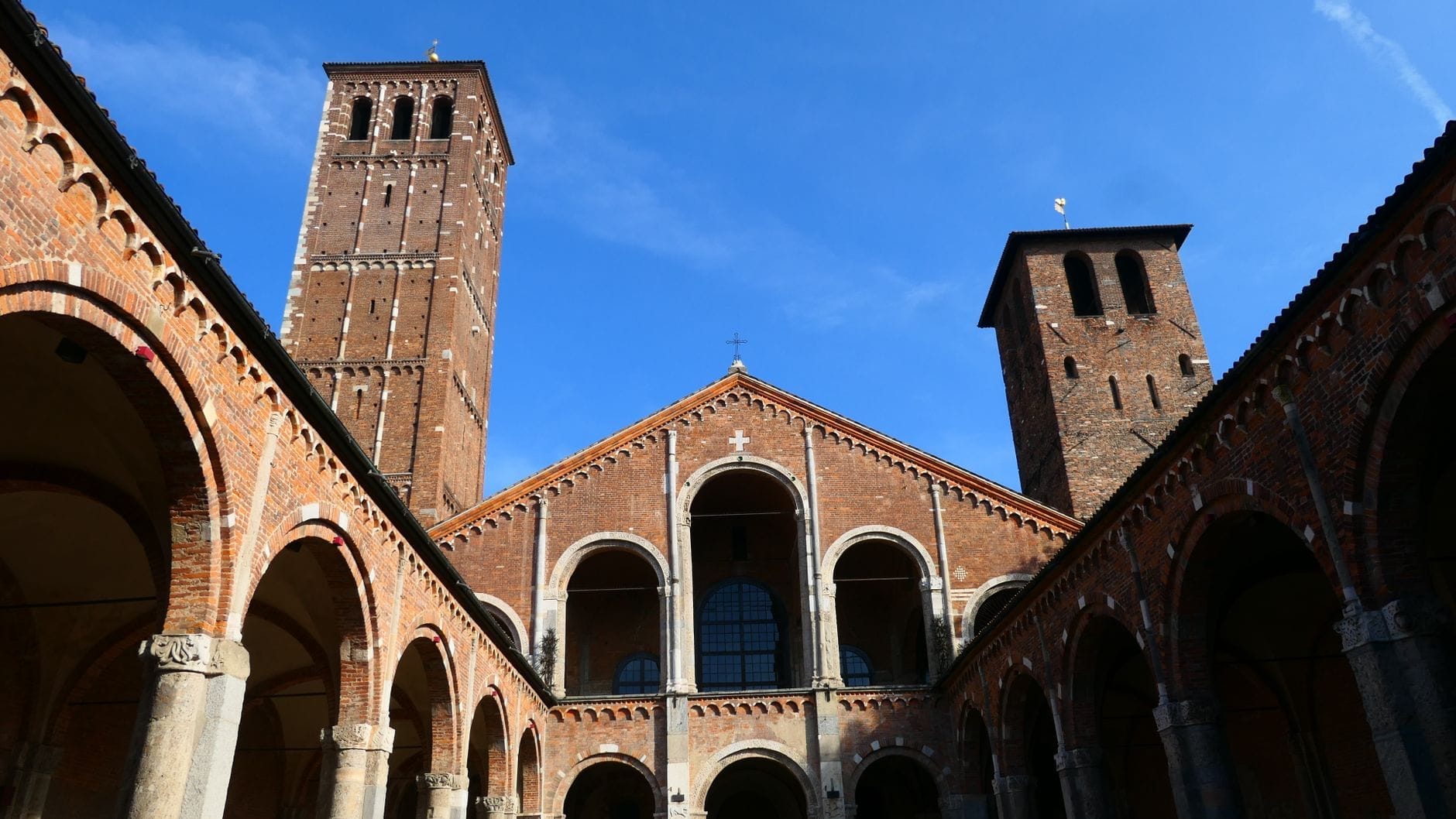
What the Basilica di Sant'Ambrogio Actually Is
The Basilica di Sant'Ambrogio is not just another old church in a city full of them. Its full official name, Basilica romana minore collegiata abbaziale prepositurale di Sant'Ambrogio, hints at its layered religious status, but what matters most for the visitor is this: it was founded by Saint Ambrose, the bishop who defined early Christian Milan, between 379 and 386 AD. That makes it roughly 1,600 years old, predating the Duomo by nearly a thousand years. Ambrose consecrated it in 387, and his remains still lie beneath the high altar alongside those of two early Christian martyrs, Gervasius and Protasius.
The structure standing today is largely the result of an 11th-century reconstruction that became a foundational example of Lombard Romanesque architecture, influencing church design across northern Italy. It was substantially restored after severe World War II bomb damage, with work completed in 1949 under architect Ferdinando Reggiori. Despite that restoration, the atmosphere inside is unmistakably ancient: low vaulted ceilings, worn stone floors, and a quality of silence that is remarkably hard to find elsewhere in central Milan.
ℹ️ Good to know
Sightseeing hours: Monday to Saturday 10:00–12:00 and 14:30–18:00; Sunday 15:00–17:00. Hours may be reduced during religious services. Always check the official site before visiting.
The Approach: Piazza and Quadriportico
Before you even enter the basilica, the approach across Piazza Sant'Ambrogio sets the tone. The square is relatively quiet compared to the area around the Duomo, with the slow pace of a neighborhood that has actual residents and a functioning university nearby. On weekday mornings, students from the adjacent Università Cattolica del Sacro Cuore cross the piazza in both directions, and there are usually a few pigeons doing very little of interest near the entrance.
What stops most visitors before they reach the doors is the quadriportico, a large colonnaded atrium that stretches across the front of the church. It is almost as large as the church itself, which is architecturally unusual and visually striking. The two brick towers flanking the facade are noticeably different heights: the one on the right, the Monks' Tower, is taller and more austere; the one on the left, the Canons' Tower, has a more ornate crown. Standing in the atrium and looking back toward the arcade, you get a sense of the scale of what 11th-century builders were attempting. The worn brick and irregular stonework are not signs of neglect but of genuine age.
💡 Local tip
The atrium is freely accessible and worth spending 10 minutes in before entering. Morning light hits the facade and colonnade from the east, making it the best time for photography of the exterior.
Tickets & tours
Hand-picked options from our booking partner. Prices are indicative; availability and final rates are confirmed when you complete your booking.
Duomo Cathedral private tour with a local guide
From 105 €Instant confirmationFree cancellationSforza Castle entry and self-guided tour
From 15 €Instant confirmationFree cancellationSkip-the-line Duomo tour in Milan
From 40 €Instant confirmationFree cancellationNavigli Canals of Milan private walking tour with a local guide
From 40 €Instant confirmationFree cancellation
Inside the Basilica: What to Look For
The interior is dim, deliberately so. The nave is divided by thick columns into three aisles, with a raised presbytery at the far end where the gold altar canopy, the Ciborium, stands on four columns of porphyry and marble. Beneath the altar lies the crypt with the remains of Ambrose and the two martyrs, which can be viewed through a grated window. The stone effigy of Ambrose gives the crypt an oddly specific gravity: this is not a symbolic tomb but an actual location of continuous veneration since the 4th century.
The golden altar frontal, the Paliotto d'Oro, is one of the most important pieces of early medieval goldsmithing in existence, created by Master Vuolvinus in the 9th century. It depicts scenes from the life of Christ on one side and the life of Ambrose on the other. You need to walk into the presbytery area and get fairly close to read the detail, and it is worth doing slowly.
Near the entrance of the nave, look up at the pulpit. It incorporates a sarcophagus from the 2nd or 3rd century as its base, an example of the kind of layered reuse of material that characterizes the entire building. Nothing here was built from scratch in a single campaign; it accumulated. That accumulation is part of what makes it interesting.
Visitors interested in how this basilica fits into the broader arc of Milanese church architecture should also consider the Chiesa di San Maurizio al Monastero Maggiore, sometimes called the Sistine Chapel of Milan, which offers a very different but equally rewarding experience just a short walk away.
How the Experience Changes by Time of Day
The basilica is at its most atmospherically compelling in the morning, when the light filters through the small windows at a low angle and the interior is noticeably quiet. The midday closure between 12:00 and 14:30 is strictly observed and should be factored into any itinerary. Attempting to visit at 12:05 means finding the doors shut.
The afternoon session, from 14:30, draws slightly more visitors, particularly on weekends when tour groups sometimes arrive together. Even then, the space absorbs crowds reasonably well because the nave is relatively long and the crypt, pulpit, and altar each draw visitors to different corners. Sunday opening is limited to 15:00–17:00 only, which catches many people off guard.
In winter, the church can feel very cold inside. Bring a layer regardless of what the outside temperature suggests. In summer, the thick stone walls keep it noticeably cooler than the street, which makes a midafternoon visit more pleasant than it might otherwise be.
⚠️ What to skip
Dress code is strictly enforced: shoulders and knees must be covered. There is no provision of coverings at the door, so arrive appropriately dressed or carry something to cover up.
Historical and Cultural Context
Saint Ambrose was bishop of Milan from 374 to 397 AD, during a period when Milan, then called Mediolanum, served as the de facto capital of the Western Roman Empire. His influence on Christian theology and church-state relations was profound enough that he is counted among the four original Doctors of the Church. The basilica he built was intended partly as a burial place for Christian martyrs and partly as a statement of the Church's growing institutional presence in the city.
The 11th-century reconstruction turned the structure into what became the defining template for Lombard Romanesque, a style characterized by brick construction, low horizontal proportions, arcaded galleries, and restrained decoration compared to contemporaneous French or German Romanesque work. Architects from across Lombardy studied Sant'Ambrogio as a model, which explains why you see echoes of it in churches throughout the region.
For context on Milan's broader religious architecture, the Milan churches guide covers the full range from Sant'Ambrogio through to the Gothic Duomo and beyond, helping place each building in its historical sequence.
The Museum and Adjoining Areas
Attached to the basilica complex is a small museum that houses items from the church's treasury including liturgical objects, manuscripts, and architectural fragments. It also contains Bramante's famous Portico della Canonica, a Renaissance cloister that the architect designed in the late 15th century, partially damaged in WWII and later reconstructed. Even if you skip the museum, walking through the external courtyard area gives a sense of how the complex extended well beyond the church itself over centuries.
A bookshop operates within the complex, small but well-stocked with books on the basilica's history and Ambrosian Christianity. It is one of the better places in Milan to find serious art history texts rather than tourist merchandise.
Getting There and Practical Notes
The Metro M2 and M4 Sant'Ambrogio stations deposit you almost directly in front of the piazza, making this one of the easiest major historical sites in Milan to reach without navigating on foot from the centre. Bus lines 50, 58, and 94 also serve the area. The basilica is at Piazza Sant'Ambrogio 15, 20123 Milan.
The surrounding Ticinese/Sant'Ambrogio neighborhood is worth exploring before or after your visit. The area between Sant'Ambrogio and the Colonne di San Lorenzo to the south has a lower density of tourists and a more local character than the Duomo district, with cafes, wine bars, and antique shops along Via Santa Maria delle Grazie and the surrounding streets.
Photography inside the basilica is generally permitted without flash for personal use, but respect ongoing services and the presence of other visitors in the crypt area. The low light levels inside mean a phone with a capable night mode will produce better results than a standard point-and-shoot.
Accessibility: the basilica welcomes disabled visitors and regularly receives school and organized groups, provided these are accompanied by a private guide. Some areas of the museum complex involve stairs or uneven surfaces. Visitors with specific mobility requirements should contact the parish directly before their visit to confirm current arrangements.
💡 Local tip
If you are combining Sant'Ambrogio with the Last Supper (Santa Maria delle Grazie), both are within 10 minutes of each other on foot. The Last Supper requires advance booking; Sant'Ambrogio does not.
To plan a logical route that includes both, see the Milan 3-day itinerary, which sequences these western sites efficiently without backtracking.
Insider Tips
- The midday closure (12:00–14:30) is absolute, not approximate. Build your itinerary around it rather than hoping the doors might still be open at 12:10.
- The crypt beneath the high altar is easy to overlook. Walk down to the lower level to see the actual remains of Ambrose and the two martyrs through the grated viewing window. Most visitors walk past the stairs without realizing where they lead.
- The Paliotto d'Oro golden altar frontal is one of the finest surviving pieces of Carolingian-period goldwork in Europe. Get as close as the barrier allows and use your camera to zoom in on the detail panels: the craftsmanship is easier to read magnified.
- If you visit on a weekday morning just after opening at 10:00, you may find the church nearly empty for the first 20–30 minutes. Weekend afternoons bring considerably more foot traffic.
- Bramante's Portico della Canonica in the museum courtyard is undervisited relative to its significance. The architect who would later design the original plan for St. Peter's Basilica in Rome worked here in Milan, and this cloister shows an early stage of his thinking.
Who Is Basilica di Sant'Ambrogio For?
- Architecture and history enthusiasts who want depth beyond the Duomo and La Scala
- Travelers following Milan's Leonardo da Vinci and Renaissance connections, given the proximity to Santa Maria delle Grazie
- Visitors seeking a genuinely quiet, contemplative space away from the city's commercial centre
- Anyone interested in early Christian history and medieval religious art in context
- Slow travelers who prefer fewer sights visited carefully over a rapid checklist approach
Nearby Attractions
Other things to see while in Ticinese & Sant'Ambrogio:
- Basilica di San Lorenzo Maggiore
The Basilica di San Lorenzo Maggiore is one of the earliest Christian churches in Milan, dating to the late 4th–early 5th century CE. Fronted by 16 ancient Roman columns and housing 4th-century mosaics in the Cappella di Sant'Aquilino, it sits at the heart of the Ticinese neighborhood, a short walk from the Navigli canals.
- Basilica di Sant'Eustorgio
The Basilica di Sant'Eustorgio is one of Milan's most historically layered sacred sites, combining a paleochristian necropolis, a Renaissance chapel of rare refinement, and a 12th-century Romanesque nave into a single compact complex. Located on Piazza Sant'Eustorgio in the Ticinese quarter, it rewards visitors who look past the plain brick facade to discover what lies beneath and behind it.
- Cenacolo Vinciano (The Last Supper)
Leonardo da Vinci's Last Supper survives on the refectory wall of Santa Maria delle Grazie, a 460 x 880 cm tempera mural painted between 1495 and 1498. Visits are strictly limited to 15 minutes per group of 40, and tickets require advance reservation. This guide covers everything you need to know before you go.
- Chiesa di San Maurizio al Monastero Maggiore
Built in 1503 on Corso Magenta, the Chiesa di San Maurizio al Monastero Maggiore holds more than 4,000 square metres of Renaissance frescoes across its painted interior walls. Entry is free, crowds are modest, and the experience rewards slow attention.