Chiesa di San Maurizio al Monastero Maggiore: Milan's Frescoed Masterpiece
Built in 1503 on Corso Magenta, the Chiesa di San Maurizio al Monastero Maggiore holds more than 4,000 square metres of Renaissance frescoes across its painted interior walls. Entry is free, crowds are modest, and the experience rewards slow attention.
Quick Facts
- Location
- Corso Magenta 15, Milan (Castello / Cadorna area)
- Getting There
- MM1 Cordusio or Cairoli; MM2 Cadorna; Tram 16
- Time Needed
- 60–90 minutes
- Cost
- Free. Group reservations (8–30 people) require advance booking.
- Best for
- Renaissance art lovers, architecture enthusiasts, anyone needing respite from the Duomo crowds
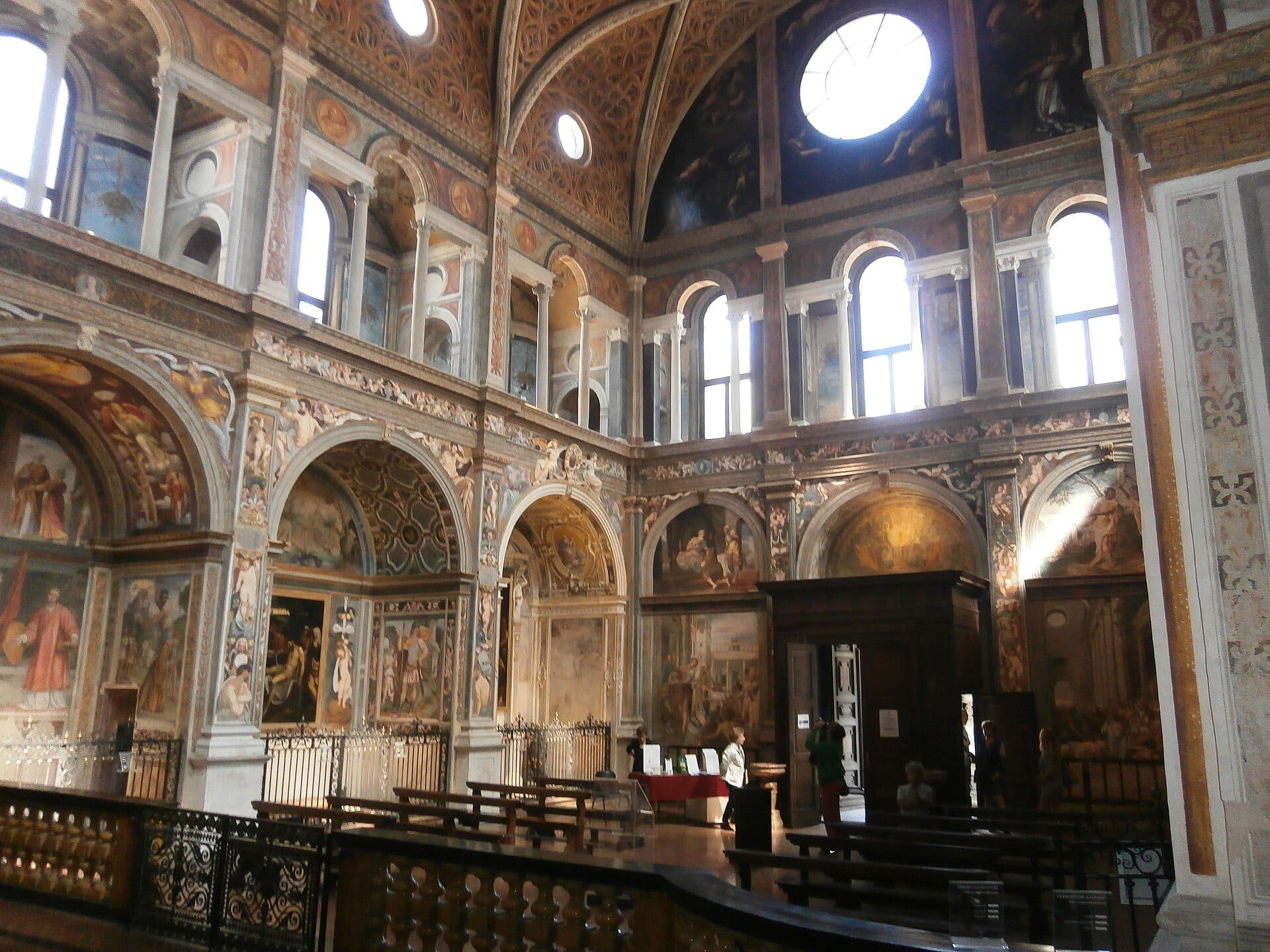
What the Chiesa di San Maurizio al Monastero Maggiore Actually Is
The Chiesa di San Maurizio al Monastero Maggiore is, by almost any fair measure, the most completely frescoed interior in Milan. That claim isn't hyperbole: roughly 4,000 square metres of 16th-century painting cover every surface of the two main halls, from floor level to the vault above. The names behind the work include Bernardino Luini, one of Leonardo da Vinci's most gifted Lombard contemporaries, as well as members of his workshop and his sons. You are standing inside a commission of extraordinary ambition, and it costs nothing to enter.
Despite this, the church remains far less visited than the Pinacoteca di Brera or the Duomo complex a short walk east. On an average weekday morning, you may find no more than a dozen people inside. That contrast with its artistic weight is worth understanding before you arrive: this is not a minor devotional chapel. It is a significant monument to Lombard Renaissance painting, and the relative quiet is an accident of geography and habit rather than a reflection of its merit.
ℹ️ Good to know
The church is closed on Mondays. Current opening hours are Tuesday to Sunday, 10:00 to 17:30. Admission is free for individual visitors. Groups of 8 to 30 people must book in advance, with at least 15 days' notice.
History: From Carolingian Monastery to Counter-Reformation Jewel
The monastery attached to this church traces its origins to the Carolingian era (8th century), making it one of the oldest religious foundations in Milan. For centuries, it operated as a Benedictine convent, and the nuns who lived here shaped the unusual layout of the church you walk into today. The current building was constructed between 1503 and 1518, replacing earlier structures on the same site.
The interior is divided by a painted wall into two sections: the public nave, which ordinary worshippers could enter, and the nuns' choir behind it, accessible only to the cloistered community. This division was not merely architectural. It reflected strict rules governing enclosure that governed Benedictine convents in the early 16th century. The wall between the two spaces is itself painted, containing a grated opening through which the nuns could participate in Mass without being seen. That detail, easy to overlook, tells you more about the social and religious world of Counter-Reformation Milan than any museum label could.
The location on Corso Magenta places the church in one of Milan's historically richest corridors. The Basilica di Sant'Ambrogio is a few hundred metres to the south-west, and the area contains layers of Roman, early Christian, and medieval remains that make the entire neighbourhood worth treating as a single walking itinerary rather than a series of isolated stops.
Tickets & tours
Hand-picked options from our booking partner. Prices are indicative; availability and final rates are confirmed when you complete your booking.
Last Supper, Duomo, San Maurizio and Sforza Castle Guided Walking Tour
From 134 €Instant confirmationFree cancellationDuomo Cathedral private tour with a local guide
From 105 €Instant confirmationFree cancellationSforza Castle entry and self-guided tour
From 15 €Instant confirmationFree cancellationSkip-the-line Duomo tour in Milan
From 40 €Instant confirmationFree cancellation
The Frescoes: Reading the Walls
Bernardino Luini worked at San Maurizio in the 1520s, and his contribution defines the public nave. His palette is warm and soft, his figures rounded and emotionally legible without being theatrical. The scenes drawn from the life of St Maurice and other saints occupy large registers across the walls. In the lower sections, portraits of the patrons who commissioned individual altars appear with the calm confidence of people who expected posterity to look.
Move through the opening in the dividing wall into the nuns' choir and the atmosphere shifts. The space is smaller and the decoration more intimate, painted by multiple hands over several decades. Natural light filters differently here, and the frescoes in the upper registers require your eyes to adjust. Bring the screen of your phone if the ambient light is low: the camera sensor often captures detail that the eye struggles to hold in dim conditions.
There are no interactive displays, no audio guide desks, no interpretive panels beyond modest Italian-language labels. The experience is essentially unmediated. If you know the iconography of 16th-century Italian religious painting, the programme rewards close reading. If you don't, the density of imagery can feel overwhelming. A brief review of Luini's life and the hagiography of St Maurice before your visit pays dividends once you're standing inside.
💡 Local tip
Photography is permitted. The interior light is generally low, so a phone with a capable night mode or a mirrorless camera will outperform a standard compact. Avoid using flash, both as a courtesy and because it flattens the modelling in the fresco surfaces.
How the Experience Changes Through the Day
The church faces roughly south onto Corso Magenta, and its small windows mean the interior never receives strong direct sunlight. Morning visits, between opening and around 11:00, tend to be quietest. By midday, school groups and tour parties moving along the Corso Magenta corridor between Cadorna and the Castello Sforzesco sometimes pass through, though numbers rarely reach the point of genuine crowding.
Afternoons in the final hour before closing, around 16:30 to 17:30, see a second wave of visitors. The light at that time is the same inside, but the temperature in summer months is noticeably lower than outdoors, making a late-afternoon visit appealing after a long morning walking the city. In winter, the stone interior is cold. A light layer is worth carrying even if the weather outside seems mild.
Getting There and Planning the Visit
Corso Magenta 15 sits at an easy intersection of Milan's public transport network. The MM1 red line stops at Cordusio and Cairoli, both within a ten-minute walk. The MM2 green line stops at Cadorna, slightly further but still manageable. Tram 16 runs along Corso Magenta itself, stopping close to the entrance. Buses 19, 50, 59, and the night line NM1 also serve the area.
The church pairs naturally with several nearby sites. The Cenacolo Vinciano (The Last Supper) is roughly five minutes on foot to the north-west, inside Santa Maria delle Grazie. If you are visiting both on the same day, book The Last Supper first: it requires timed-entry reservations that sell out weeks in advance. San Maurizio requires no booking for individual visitors and can anchor either end of the itinerary without complication.
The neighbourhood itself, covered in more detail in the Castello / Cadorna district guide, contains Roman-era columns, early Christian basilicas, and a density of civic museums that justify an entire day on foot without retracing your steps.
Practical Notes: What to Wear, Accessibility, and Who Should Reconsider
San Maurizio is an active place of worship as well as a heritage site. Visitors are expected to dress appropriately, with modest clothing that covers shoulders and knees recommended. Lightweight scarves or a spare layer carried in a bag resolve the issue for most warm-weather visitors.
The floor is flat and the entrance has no significant step, making the public nave accessible to wheelchair users. The transition into the nuns' choir involves a narrower opening, and visitors should assess the threshold width depending on their needs.
Visitors who find slow, contemplative looking unrewarding will likely feel the visit drags. There is no narrative to follow, no audio, and no spectacle beyond the paintings themselves. Young children who are not engaged by art will be finished in ten minutes and potentially restless. The space is quiet enough that a bored or vocal child becomes noticeable quickly, which may affect your own experience and that of others.
⚠️ What to skip
Opening hours have changed over the years and may differ during public holidays or civic events. Check current hours directly through the Comune di Milano's cultural venues portal before visiting, particularly during August and December.
Where San Maurizio Fits in Milan's Broader Art Picture
Anyone following Milan's Leonardo connection will want to read the Milan Leonardo da Vinci guide before or after this visit. Luini's work at San Maurizio exists in direct conversation with Leonardo's influence on Lombard painting, and understanding that relationship deepens what you see on the walls considerably.
For a more complete picture of Milan's religious architecture, the Milan churches guide maps the city's ecclesiastical heritage from early Christian foundations through to Baroque. San Maurizio occupies a distinct position in that lineage: neither as architecturally imposing as Sant'Ambrogio nor as ceremonially significant as the Duomo, but arguably more intact as a single coherent decorative programme than either.
Insider Tips
- Enter as soon as the church opens at 9:30 on a weekday. Before 10:00, you may have both halls almost entirely to yourself, which is the only way to appreciate the quieter details in the nuns' choir without competition for sightlines.
- The dividing wall between the public nave and the nuns' choir contains a grated confessional window at low height. Crouch down and look through it toward the altar: the framed view gives you a precise sense of how the cloistered nuns experienced Mass, and it photographs extraordinarily well with natural light from the nave behind you.
- Luini's work is concentrated in the public nave. If your time is short, spend the majority of it there rather than splitting equally between the two halves. The nuns' choir rewards repeat visits once you know the public section well.
- The Corso Magenta street outside the church has several good cafes for a post-visit coffee. Avoid the one directly opposite the entrance, which caters heavily to tourist traffic and charges accordingly. Walk one block toward Cadorna for better value and a less hurried atmosphere.
- If you are visiting with a smaller group and want context, the Civico Museo Archeologico di Milano sits directly adjacent to the church within the same former monastery complex. Combining both visits adds no more than an hour and provides useful historical grounding for the area's Roman and medieval layers.
Who Is Chiesa di San Maurizio al Monastero Maggiore For?
- Art historians and Renaissance painting enthusiasts looking for Lombard work outside the major museum circuit
- Photographers seeking complex, layered interiors with genuine depth and no admission barriers
- Travellers combining The Last Supper visit with a wider Corso Magenta itinerary
- Anyone wanting a serious cultural experience that is genuinely free and rarely crowded
- Visitors interested in the social history of Benedictine convent life in Counter-Reformation Italy
Nearby Attractions
Other things to see while in Ticinese & Sant'Ambrogio:
- Basilica di San Lorenzo Maggiore
The Basilica di San Lorenzo Maggiore is one of the earliest Christian churches in Milan, dating to the late 4th–early 5th century CE. Fronted by 16 ancient Roman columns and housing 4th-century mosaics in the Cappella di Sant'Aquilino, it sits at the heart of the Ticinese neighborhood, a short walk from the Navigli canals.
- Basilica di Sant'Ambrogio
Founded by Saint Ambrose himself in 379 AD and rebuilt in the 11th century as a masterpiece of Lombard Romanesque architecture, the Basilica di Sant'Ambrogio is the spiritual and historical anchor of Milan. Entry to the church is free, and the complex rewards slow, attentive visitors far more than a quick stop.
- Basilica di Sant'Eustorgio
The Basilica di Sant'Eustorgio is one of Milan's most historically layered sacred sites, combining a paleochristian necropolis, a Renaissance chapel of rare refinement, and a 12th-century Romanesque nave into a single compact complex. Located on Piazza Sant'Eustorgio in the Ticinese quarter, it rewards visitors who look past the plain brick facade to discover what lies beneath and behind it.
- Cenacolo Vinciano (The Last Supper)
Leonardo da Vinci's Last Supper survives on the refectory wall of Santa Maria delle Grazie, a 460 x 880 cm tempera mural painted between 1495 and 1498. Visits are strictly limited to 15 minutes per group of 40, and tickets require advance reservation. This guide covers everything you need to know before you go.